@Smeeg1234 It's called ax25_popt. It's a terminal program for packet radio.
You can find it on github, along with further information.
https://t.co/CrGkoL1niG
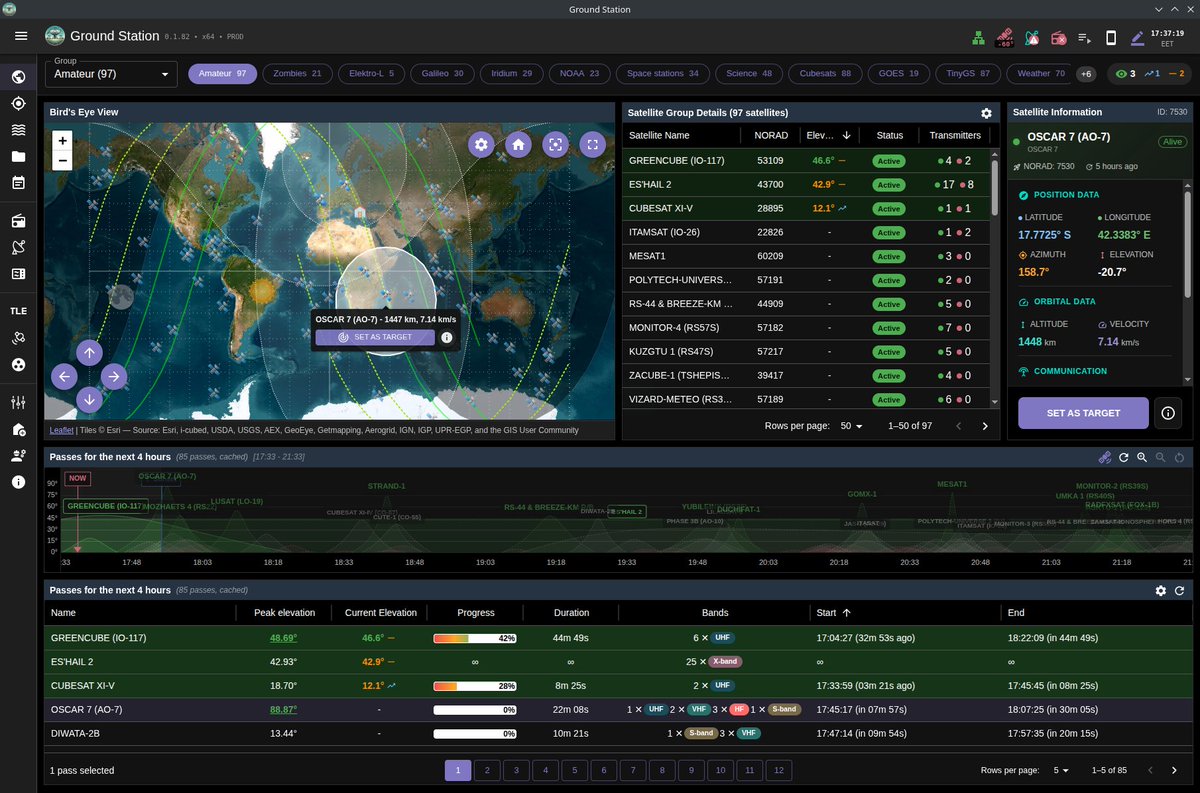
Someone open-sourced a tool that tracks satellites in real time and decodes their radio signals locally.
It tracks satellites in real-time, streams IQ from any SDR, and decodes their signals locally. It even has AI transcription for ISS audio passes.
100% Open Source.
REVOLUCIÓN EN LA ROBÓTICA
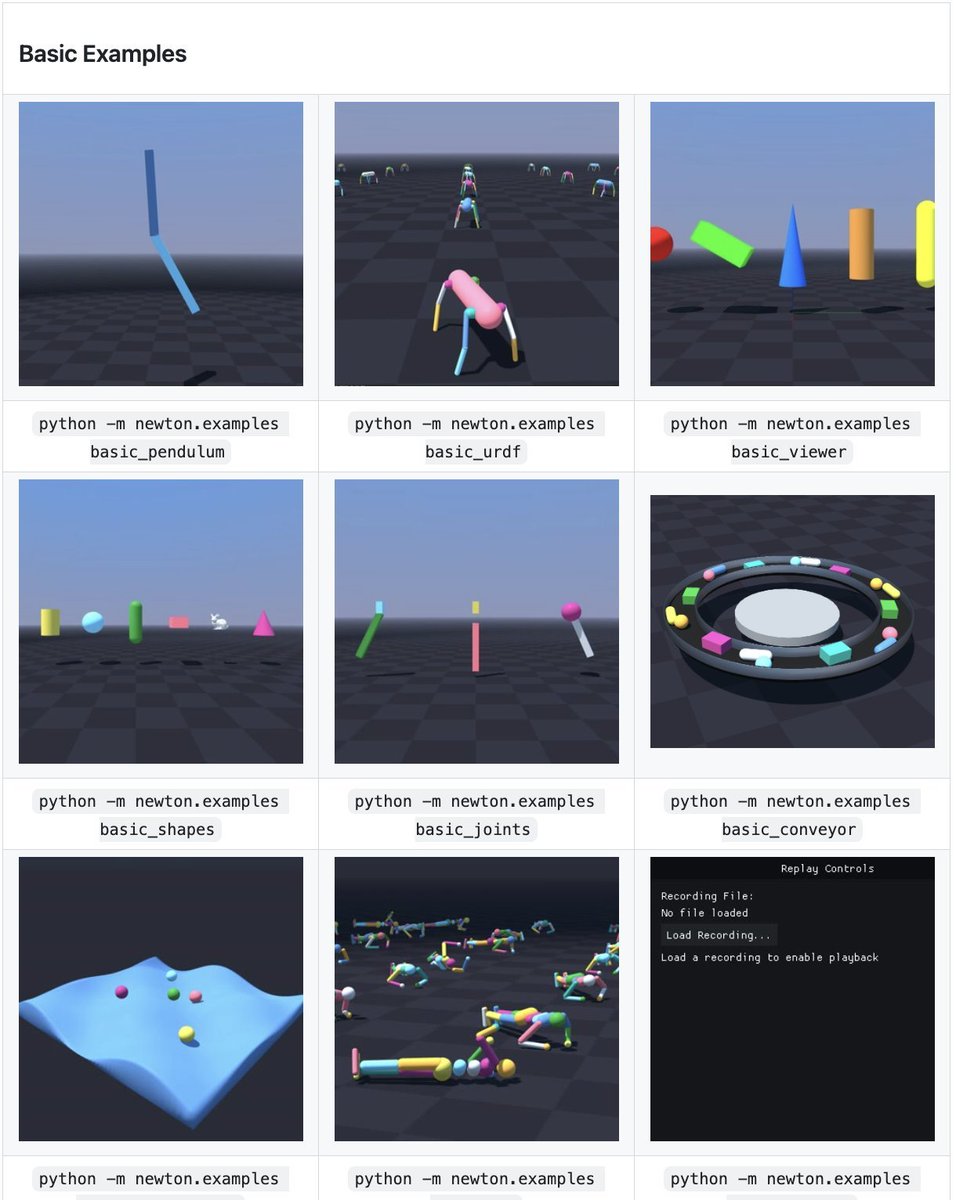
NVIDIA, Google DeepMind y Disney Research acaban de hacer público su simulador de física más avanzado hasta ahora.
Lo llaman Newton y es 100 % open source. Con él, entrenar robots ya no cuesta una fortuna ni semanas de espera: ahora es mucho más barato y rapidísimo.
Lo que hace especial a Newton:
- Corre miles de robots simultáneamente en una sola GPU
- Es 475 veces más rápido que el MJX de DeepMind en tareas de agarre y manipulación
- 252 veces más rápido en movimiento y caminatas
- Lo que antes tomaba días, ahora se hace en minutos usando GPUs normales de escritorio
- Es totalmente diferenciable: puedes calcular gradientes dentro de la simulación para mejorar redes neuronales
- Un solo motor que maneja todo: objetos rígidos, tejidos, arena, líquidos y cuerpos blandos
- Se conecta directo con Isaac Lab, Isaac Sim y Omniverse gracias a OpenUSD
- Incluye el famoso solver Camino de Disney, ideal para movimientos naturales y llenos de contacto
- Funciona perfecto con PyTorch (y JAX está por llegar)
Empresas ya lo están usando a pleno: Skild AI lo emplea para entrenar brazos que ensamblan piezas. Samsung lo usa en fábricas para manejar cables con precisión.
Disney entrenó los droides BDX de Star Wars que vimos en el escenario de GTC 2026.
La simulación siempre fue el problema número uno para cualquiera que construye robots.
Newton lo acaba de resolver de un golpe.
Administrado por la Linux Foundation y creado por tres gigantes de la investigación.
Licencia Apache 2.0.
Totalmente gratuito y abierto para todos.
El futuro de los robots ya está aquí.
Meet Gemma-4-26B-A4B-it-GGUF: a powerful vision-language model that can actually SEE and UNDERSTAND images. It's not just another text model. This one processes both images AND text to generate intelligent responses. The community is hyped because it's quantized for efficiency without losing its multimodal magic.
Meet Gemma-4-E2B-IT-Litert-LM, a powerful fine-tuned language model that's turning heads. It's built on Google's Gemma architecture, specifically optimized for Italian language tasks. This isn't just another model, it's a specialized tool for Italian NLP.
🚨 Reticulum : le réseau mesh chiffré off-grid qui n’a besoin d’ABSOLUMENT RIEN pour fonctionner
C’est LA stack réseau du futur pour tous ceux qui veulent communiquer sans dépendre d’Internet, des FAI, des opérateurs ou des géants du web.
🔥 Qu’est-ce que c’est ?
Reticulum est une couche réseau complète, open-source (licence MIT modifiée), chiffrée de bout en bout, qui transforme n’importe quel support physique en maillage autonome :
• LoRa (868 MHz)
• WiFi
• Ethernet
• Liaison série
• Radio amateur en packet (AX.25 avec TNC/KISS)
• Et tout ce que vous voulez y brancher Vous pouvez mixer tout ça dans un seul réseau. Un paquet parti en LoRa longue portée peut continuer en WiFi à haute vitesse sans que vous ayez à faire quoi que ce soit.
🛡️ Sécurité militaire, vie privée maximale
• Échange de clés X25519 + signatures Ed25519
• Chiffrement AES-256-CBC avec forward secrecy
• Zéro adresse source dans les paquets → traçabilité = 0
• Un lien chiffré s’établit en seulement 3 paquets (297 octets). Ultra léger.
🌐 Comment ça marche ?
Pas de serveur central, pas de DNS, pas d’IP publique obligatoire.
Les paquets se routent tout seuls, trouvent le chemin le plus efficace, et s’adaptent à la bande passante disponible :
150 bps en LoRa longue portée
500 Mbps en Ethernet local
Ça marche même sur des liens intermittents ou ultra-lents. C’est littéralement conçu pour survivre sans infrastructure.
📱Ce que vous pouvez faire aujourd’hui :
• Messagerie chiffrée
• Transfert de fichiers
• Appels vocaux (via Sideband)
• Héberger des pages web off-grid (NomadNet)
• Shell distant (rnsh)
• IoT massif
• Réseaux de radioamateurs autonomes
• Communications en zone blanche, catastrophe, bateau, montagne, manif, zone rurale…
Exemple concret : vous prenez un Raspberry Pi + un RNode LoRa sur USB → vous avez un nœud mesh qui couvre des kilomètres.
Vous en mettez plusieurs → vous avez un vrai réseau décentralisé qui tourne tout seul.
✅ Points forts
• Zéro dépendance aux infrastructures
• Chiffrement partout par défaut
• Extrêmement résilient
• Multi-supports = ultra flexible
• Développé par un seul gars (Mark Qvist) depuis des années, mais d’une qualité folle
Le projet est déjà mature, la doc est en anglais mais claire, et la communauté grandit vite
Si vous êtes, radioamateur, survivaliste, maker, défenseur de la vie privée ou simplement fatigué de dépendre de l’Internet des autres…
Reticulum est fait pour vous !
llama.cpp at 100k stars
now that 90% of the code worldwide is being written by AI agents, I predict that within 3-6 months, 90% of all AI agents will be running locally with llama.cpp 😄
Jokes aside, I am going to use this small milestone as an opportunity to reflect a bit on the project and the state of AI from the perspective of local applications. There is a lot to say and discuss and yet it feels less and less important to try to make a point. Opinions about viability of local LLMs are strongly polarized, details are overlooked, the scientific approach is lacking. Arguments are predominantly based on vibes and hype waves.
One thing is clear though - local LLMs are used more and more. I expect this trend to continue and likely 2026 will end up being one of the most important years for the local AI movement.
I admit that I didn't expect the agentic era to come so quickly to the local LLM space. One year ago, the available models were too computationally expensive for doing long-context tasks. There wasn't an obvious path towards meaningful agentic applications. The memory and compute requirements were huge. Last summer, with the release of gpt-oss, things started to change. It was the first time we saw a glimpse of tool calling that actually works well within the resource constraints of our daily devices. Later in the year, even better models were released and by now, useful local agentic workflows are a reality.
Comparing local vs hosted capabilities at a given moment of time is pointless. To try put things into perspective:
- We don't need frontier intelligence to automate searches and sending emails
- We don't need trillion parameter models to be able to summarize articles or technical documents
- We don't need massive GPU data centers to control our home appliances or turn the lights off in the garage
I believe that there is a certain level of intelligence we as humans can comprehend and meaningfully utilize to improve our working process. Beyond that level, access to more intelligence becomes unnecessary at best and counterproductive at worst. I also believe that that level of useful artificial intelligence is completely within reach locally and it has always been just a matter of implementing the right software stack to bring it to the end user.
With llama.cpp, I am confident that we continue to be on the right track of building that software stack!
The llama.cpp project is going stronger than ever. With more than 1500 contributors, the project keeps growing steadily.
From technical point of view, I think that llama.cpp + ggml is the only solution that actually makes sense. That is, the software stack must run efficiently on every possible device, hardware and operating system. The technology is too important to be vendor-locked. It has to be developed in the open, by the community, together with the independent hardware vendors. This is the only right way to build something that will truly make a difference in the long run.
I won't try to convince you about what is currently and will be possible with local AI. We will just continue to build as usual. I am confident that after the smoke clears and we look objectively at what we have built together, the benefits will be obvious to everyone.
Big shoutout to all llama.cpp maintainers. I feel extremely lucky to be able to work together with so many talented contributors. Every day I learn something new and I feel there is so much more cool stuff that we are going to build. Also, I am really thankful that the project continues to have reliable partners to support it!
Cheers!
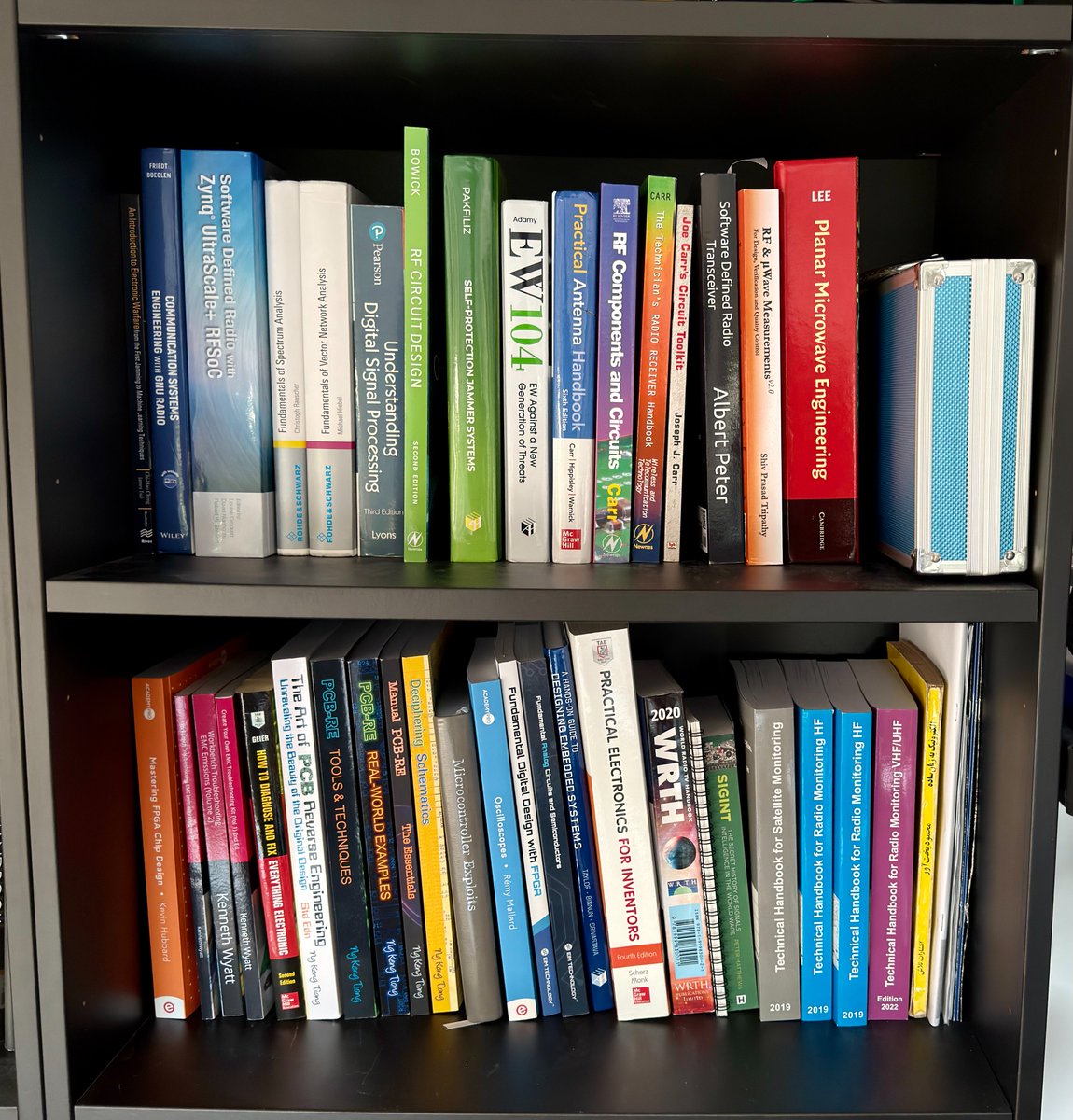
Book thread: to make it easier to find all the books I have introduced so far, I will link them under this thread.
They are about: RF, radios, satellites, SDR, electronic warfare, radars, wireless communications, and electronics. (And related topics)
0/n
🚨 BREAKING: Someone just open-sourced a full suite for tracking satellites and decoding their radio signals locally.
You don't even need the internet. It uses an SDR to pull weather images and raw data straight from space to your hard drive.
100% Open Source.
@chiefofautism Consumer phased array starts at ~$250 - specifically Starlink's antenna is a very sophisticated phased array, 10.7 to 12.7 GHz. https://t.co/0LFLKd1njW
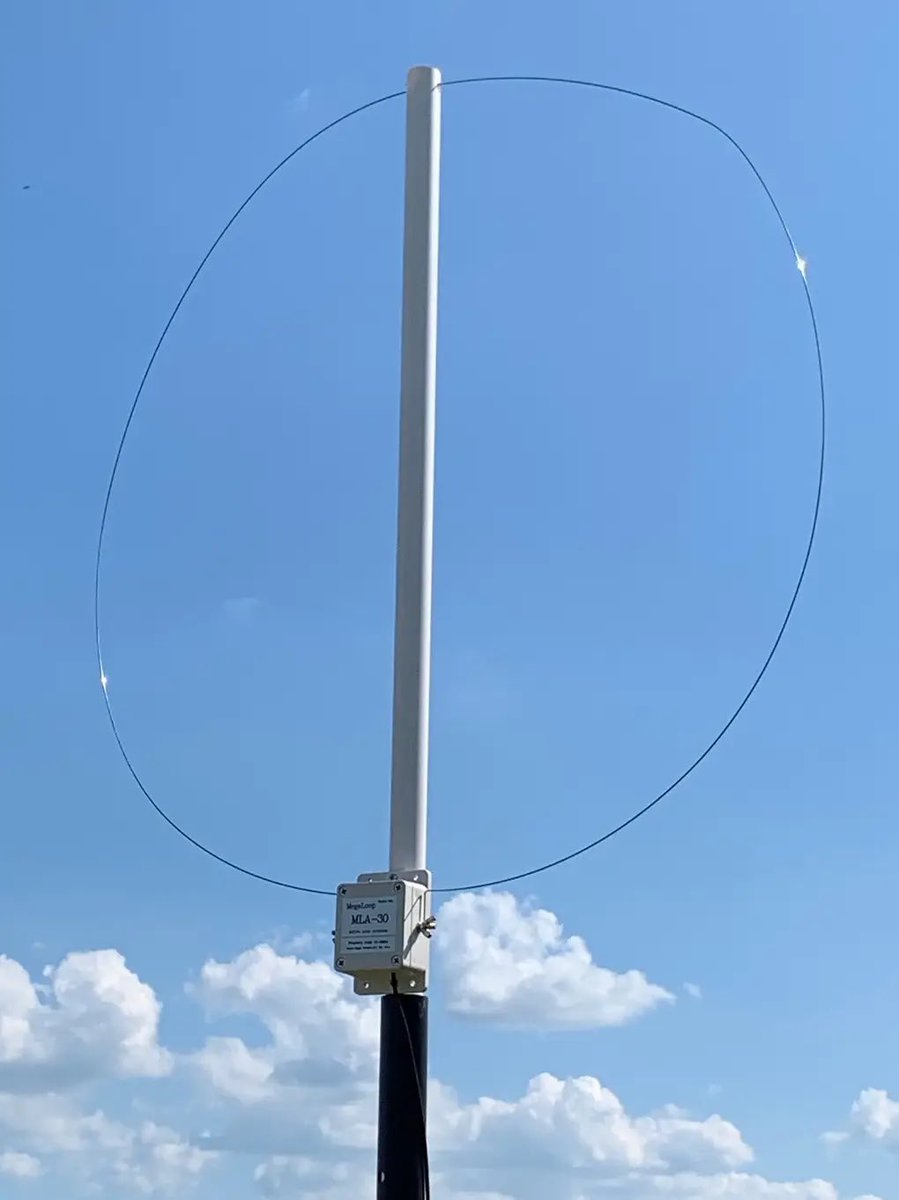
People who don't have space for big shortwave radio antennas: I am using MLA-30+ magnetic loop and I'm super happy with it!
It's small (60cm diameter), cheap, and has so far worked great for me.
Good for small balconies.
antenna gain -- measured in dBi -- defines how strongly an antenna concentrates RF energy in a given direction, relative to the ideal isotropic radiator (a perfect sphere)
they DONT amplify power! the radiated energy is constant. increasing the gain reshapes the radiation pattern to be flatter and more directional, therefore "increasing range" in the favored direction
Releasing Blue Dragon.. a wideband BLE 5 + Classic Bluetooth passive sniffer in Rust. Captures up to 40 BLE channels simultaneously from a single SDR using a polyphase channelizer. Decodes LE 1M, LE 2M, LE Coded, and Classic BT BR in real time. 🐉
https://t.co/T3xzMTPOsu
NVIDIA just dropped a full hands-on robotics course. Completely free!
If you're learning robotics, bookmark this ✨
It covers the entire pipeline:
- build your first robot (joints, physics, sensors, ROS 2)
- import URDFs + real robot assets
- generate synthetic data + domain randomization
- run software-in-the-loop (SIL)
- deploy hardware-in-the-loop (HIL) on Jetson
This is the modern robotics workflow:
simulate → generate data → validate in software → deploy to hardware.
If you want to stop watching robotics and start building, this is a strong entry point.