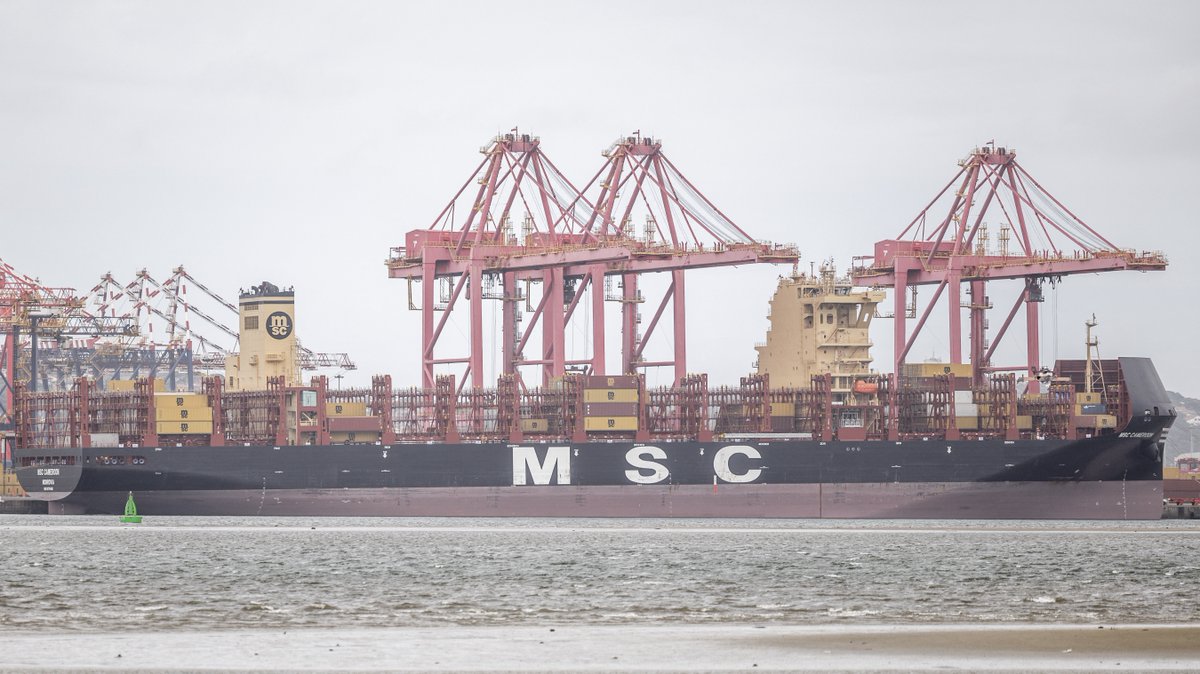
Rerouting shipping traffic around South Africa exposes maritime blind spotsRerouting shipping traffic around South Africa exposes maritime blind spotsRerouting shipping traffic around South Africa exposes maritime blind spots.
.@BernieSanders , it is a time to celebrate. @elonmusk has created enormous value for society by building @SpaceX, driving down the cost of rocket launches and creating a global satellite communication network that has brought high speed, low-cost internet and communication access to hundreds of millions and eventually billions of people along with critical advantages for our military and our nation’s defense.
SpaceX and its technologies will cause an acceleration in the growth of wages and wealth creation globally, including in some of the poorest communities in the U.S. and around the world.
Access to low-cost, high speed communications everywhere will allow children around the world to be educated, families to build businesses, and life-saving medical knowledge and care to be available everywhere.
SpaceX will materially bring down the cost of compute, advancing AI and humanity.
Meanwhile, 4,000 SpaceX employees yesterday became millionaires, including hourly wage employees who you claim you are trying to help.
The Elon Musks of the world drive growth, global GDP, and provide access to goods and services at lower cost that would otherwise not exist.
Elon’s nominal trillionaire status is due to his ownership of SpaceX, Tesla, Neuralink, the Boring Company and his other initiatives that have brought new technologies that improve our everyday lives.
Elon is not sitting on a trillion dollar pile of cash, jewelry and gold. He is using his controlling stakes in his companies to advance mankind. Elon’s companies don’t pay dividends. They reinvest all of their capital to accelerate innovation and value creation.
Elon is working 24/7 for all of us. He deserves respect and appreciation, not smears.
Bernie, your socialism would never allow a SpaceX to be built. Socialism has only proven to impoverish mankind and lead to death and destruction.
We need to create the conditions for more SpaceXs to be built, not attack the great entrepreneurs who are helping to advance our country.
All of this success while the Department of Higher Education presides over failure, shrinking credibility, and the politicisation of once-great universities. Not to mention NSFAS and zero new ideas. In the next decade, all South Africa’s innovators, entrepreneurs and global thinkers will come from private universities like this one.
You can’t complain about property prices being too high and also object to new housing developments.
You can’t want better public transport and also object to densification.
You can’t want a city that attracts investment and also object to urbanization.
You can’t, in short, have your cake and eat it.
South Africans would quickly realize the Starlink ban makes zero sense if they forced the government to reveal its own rural connectivity plans.
The truth is, Politicians have no alternative that even comes close. This blockade isn't about sovereignty or consumer protection, it's about extortion.
Millions of citizens and school children are having their futures held ransom by an artificial digital divide, all to enrich a few well connected cadres under the guise of "regulation."
A hard lesson from administering my late mother's estate: read the fine print on life rights before your parents sign one.
For those unfamiliar: a life right is a popular retirement-village model in South Africa. You don't buy the property. You pay a large lump sum (often R2m+) for the right to occupy a unit for the rest of your life. The operator retains ownership and the title.
When the holder dies, here is what nobody really explains up front.
1. The operator takes a fixed chunk regardless of how long you lived there. Typical contracts deduct around 40 percent of a notional "Listing Consideration" as the operator's effective fee, amortised over five years. If your loved one lives in the unit for two years, three years, or even just under five, that 40 percent disappears anyway. My mother paid R2 million in 2021. Five years later, the estate stands to receive less than half of it back.
2. The estate keeps paying levies after death. Indefinitely. The contract terminates automatically when the holder dies. But you, as the estate, remain liable for the full monthly levy, rates, and consumption charges until the operator finds a new buyer. There is no deadline. No reasonable-time obligation written in. We are six weeks past hand-over and the invoices keep arriving.
3. The estate cannot use, let, or even allow family to enter the unit. The right to occupy was "personal in nature." It died with the holder. The estate cannot put a tenant in, cannot let it on Airbnb, cannot even allow family to stay there without the operator's written consent. Every mitigation lever sits with the operator at their sole discretion.
4. The operator has zero incentive to re-sell quickly. They hold your capital interest-free until a buyer is found. They earn the levy every month you wait. They earn a remarketing fee on re-sale. The longer they take, the better for them. The worse for you.
5. The contract usually contains a CPA exemption-by-design. Most of these schemes acknowledge the Consumer Protection Act on paper, then carve themselves into clauses that allow exactly the kind of one-sided continuation of obligations the CPA was meant to police. Sections 48 and 52 of the CPA, and the Constitutional Court line on fairness in contract (Barkhuizen, Beadica), give real grounds to push back. But you have to know to push.
If you or a family member is considering a life right, please:
- Read the full agreement including every annexure, not just the marketing brochure.
- Model the worst case: holder dies within 3 to 5 years of taking occupation.
- Calculate the estate's expected net return, including post-death levy bleed if re-sale takes 6 to 12 months.
- Get independent legal advice before signing. Not advice from the village's referred attorneys.
- Ask explicitly: what is the operator's contractual obligation to re-sell within a reasonable time? If the answer is "none," walk away.
There are genuinely good retirement villages and well-structured life rights out there. But the structural risk to the estate is rarely disclosed up front.
If you've been through this and want to compare notes, please reach out.
Balwin Properties has received a R2.26 billion buyout offer💰
The offer comes from a consortium led by the PIC, acting on behalf of the GEPF, alongside CEO Stephen Brookes and MD Rodney Gray.
Two years ago, I wrote a piece for the Mail & Guardian asking whether Balwin was too bold for the South African market and why they should delist. Today, that question has a definitive answer.
The offer is R4.35 per share - a 41% premium to the six-month volume-weighted average price. If approved, Balwin delists from both the JSE and A2X, ending a public market run that began in 2015.
In my December 2024 M&G article, I raised concerns that now feel prescient. Profits had dropped 57%, and revenue was down 28% in the interim results to August 2024. The loan-to-value ratio was above the comfortable range. Dividends had been suspended. Munyaka had 3,705 of 5,020 apartments unsold. The share price had fallen from roughly R10 at listing to R2.30.
The full-year results to February 2026, released just before the announcement, show genuine recovery, but also why that recovery cannot solve the structural problem.
Revenue grew 21% to R2.7 billion. Apartment handovers increased 17% to 2 053 units. Recurring profit grew 36% to R273.6 million. The loan-to-value ratio improved to 38.1%, finally within the target range. These are not the numbers of a distressed business.
And yet the board declared no dividend for the 2nd consecutive year.
That single fact captures everything about why Balwin and the JSE were always a difficult fit. Property investors expect income. Balwin’s model: long cash-conversion cycles, multi-year inventory build-up, heavy infrastructure investment, makes consistent dividends structurally difficult regardless of how well the underlying business performs.
The geographic picture in the results is also telling. The Western Cape now accounts for 54% of apartment sales revenue, up 47% to R1.3 billion. Gauteng, despite 11 active developments, contributed just 39%, with revenue growing only 2%.
The results explicitly note a change toward rental preference over ownership in Gauteng. Meanwhile, across the full build-to-sell portfolio of 41,226 planned apartments, 25,056 remain unsold. In Tshwane alone, 11 751 apartments are unsold, a node where Balwin invested R120.6 million in infrastructure.
This is a business making long-dated bets that the public market has neither the patience nor the appetite to back.
The tangible net asset value per share as at February 2026 was R9.72, more than double the offer price of R4.35. That gap between what the business is worth on paper and what the market has been willing to pay is the clearest possible argument for going private. The PIC and GEPF can absorb a 15-year pipeline and a 7 700-apartment rental pipeline on land already owned by the group. Public market shareholders cannot.
My view is the same as it was 2 years ago, just more certain. This is the right move, and it should have happened sooner.
Three months ago today, my son and I arrived in America as refugees from South Africa, leaving everything behind in search of safety and opportunity.
In just 5 weeks of full-time work, we’ve both been promoted. I’ve been asked to lead an entire new branch of the company — and my son is coming with me.
Hard work, determination, and fresh ideas got noticed and rewarded. The training is intense and accelerating fast, but we’re ready to rise to the challenge.
This isn’t just a promotion, it’s living proof that America is still the greatest country on Earth — where you’re judged by what you can contribute, not who you know or where you came from.
We arrived determined to become self-sufficient as quickly as possible, and we are almost there. What we didn’t expect was the overwhelming generosity, kindness, and support from the American people. From the bottom of our hearts — thank you.
This country has given us a real chance, and we will make you proud - thank you, @realDonaldTrump
What if the smartest thing you consumed tomorrow only took 15 minutes?
I’ve spent the last 27 years in media watching intelligent people drown in noise, propaganda, clickbait, outrage, and “analysis” by people who learned what a microphone was on Tuesday.
So I built something different.
A concise daily briefing for people who value clarity over chaos.
Politics. Economics. Culture. Media. What matters. Why it matters. What to ignore.
No activism. No theatre. No fluff.
Launching next week.
The Gareth Cliff Daily Briefing.
"We have undertaken to visit the Strait of Hormuz to see what is magic about this strait, this small passage of oil, that destabilises the world."
This has to be a joke, right? Right?
https://t.co/VNpzdYF9df
🔴 Sakeliga welcomes Concourt judgment in Solidarity case against "central pillar" of the NHI Act
The Court recognised the professional freedom of medical practitioners, the operational realities and rights of private health establishments, and the importance of patient care. 🧵
Solidarity triumphs as central pillar of NHI collapses
Solidarity celebrates the Constitutional Court’s ruling today on the Certificate of Need and considers it a huge victory for healthcare practitioners and the broader public.
According to this ruling, parts of the National Health Act that provide for the so-called Certificate of Need have been declared unconstitutional. This Certificate of Need was one of the most important mechanisms by which the government wanted to exercise greater control over the health industry.
It would have increasingly given the state the power to determine which healthcare practitioners may practice where and which services may be provided.
This is in line with the appeal brought before the court by Solidarity and seven other applicants.
For healthcare practitioners, this ruling is a victory for freedom and professional independence, but also a win for every South African’s right to better healthcare.
Anton van der Bijl, Deputy Chief Executive of Solidarity, says this ruling is toppling one of the central pillars on which the government’s distorted and destructive healthcare plans are based.
“One of the NHI’s central pillars has collapsed today. The Certificate of Need was far more than merely an administrative instrument. It was an instrument of centralisation and state control.
“The government wanted to move health practitioners around like its own pawns on a chessboard to cover up its own failures. Today the court said that South Africans are not state property and professionals are not pawns of the government,” says Van der Bijl.
Solidarity consistently argued that quality healthcare cannot be expanded through coercion and bureaucratic control.
Van der Bijl says the ruling can therefore be regarded as a major breakthrough, particularly for sought-after professionals in the healthcare sector.
“No government can force doctors, dentists, nurses and other healthcare practitioners through regulations to create quality healthcare where the government itself has failed,” he says.
Solidarity further emphasises that the ruling has greater significance for the fight against the NHI and serves as strong opposition to the constitutionality of state centralisation, which is a core principle of the NHI.
I saw this on FB and it made me very sad. Is their absolutely NOTHING that this criminal government can do properly.
Written by James Deacon.
I am about to write what has to be one of the most difficult and painful posts for me to write on Facebook.
On Friday I was given news which unfortunately I cannot disclose yet that has forced me to turn my back on something I truly love with all my heart: Kirstenbosch Garden.
I have been involved there for 19 years due to my love and passion for the garden. However Kirstenbosch is no longer a place that brings me joy and happiness but rather pain and sadness.
When I walk through nursery now I see neglect, decay and death. The amazing plant collections that have taken decades and more to establish sit neglected slowly dying.
The Protea collection is less than a third of what it was and only a fraction of the Ericas remain. One plant has gone from extinct in the wild to completely extinct purely due to lack effort to keep it going. Places once full of plants sit empty and in some cases full of weeds because the production of plants is so diminished.
Great plantsmen and women like Ernst van Jaarsveld, Monique McQuillan , Louise Nurrish , Cherise Viljoen , Anthony Hitchcock who I admired and looked up to all left way before they should have because working there had become so unpleasant and because things like procurement made it impossible for them to do their jobs.
One told me when they tried to order pots the response they got from the management of SANBI the SOE that runs many of the country's botanical gardens was what were they cooking. Another ordered pots and three years later they yet to arrive.
Poor financial management has resulted in the organisation having to use funds donated for educational purpose to pay staff salaries.
Kirstenbosch no longer has a Protea or an Erica expert and hasn't had either for years.
Staff morale is at an all time low and respect for the leadership of the garden has broken down.
The garden cannot produce metal labels to tell visitor what the names of the plants are.
I say all these things not out of animosity to anyone or with the desire to see people in trouble. I say these things because I love the garden and what I am seeing is breaking my heart. I am also saying these things because after all the friends, experiences, knowledge and memories the garden has given me I feel I have a duty to speak out for the garden in difficult times such as these.
I don't know what will happen to me for saying all this. Maybe I will be banned from the garden or get into trouble. However I refuse to stay silent and standby while the things and people that I care about suffer. I also feel that we the current custodians of the garden have a duty to preserve and protect the work of those custodians of the past for the custodians of the future.
We have two choices to be remembered as those who fought for Kirstenbosch during its most difficult and challenging times or as those who sat idly by and allowed it break down and be ruined.
I don't know if anyone will read this or if it will achieve anything but I will not keep silent while the place I love suffers and will continue to speak out against what is happening.
Mozambique police thwart Cartel’s attempt to establish presence in the countryMozambique police thwart Cartel’s attempt to establish presence in the country.
The Hilton brand has pulled out of the Hilton hotel in Durban, marking the end of an era that began when Nelson Mandela first opened the Hilton in 1997.
From post-COVID struggles to evolving investment patterns and the rise of Umhlanga as a new hospitality hub, this story unpacks what’s really driving the change behind the scenes.
Thank you for having me, Kaya FM.