Valuation change on foreign portfolio holdings of LT USTs (Foreign Non-Official holdings), 1995-present.
Fascinating chart, esp. if we think of it as a global financial system seismograph of sorts (as we should, IMO.)
A Dutch computer scientist gave one lecture in 1988 arguing that programming is unlike anything humans have ever tried to do before, and the reason most software on earth is broken is that we are still teaching it as if it were a hobby.
His name was Edsger Dijkstra. He won the Turing Award in 1972. He invented the shortest path algorithm that every GPS on earth still runs on.
He wrote the paper that killed the goto statement in modern programming languages.
He spent 50 years quietly being one of the most consequential thinkers in the entire history of computer science, and he was in a very bad mood by the time he stood up at the ACM Computer Science Conference in 1988 to deliver the lecture that almost nobody at the conference wanted to hear.
The lecture was called On the Cruelty of Really Teaching Computer Science.
It is now one of the most cited papers in the entire history of computing education. It was filed in his archive as EWD1036, handwritten in his careful fountain-pen calligraphy because he refused to use a typewriter and famously refused to use email for the rest of his life.
The argument was simple and uncomfortable.
Programming, Dijkstra said, is a radical novelty. Not a new tool. Not a new skill. Not a faster version of something humans already knew how to do. A genuinely new category of intellectual activity that has no real precedent in the entire history of the human species, and our brains have not been built to handle it.
Here is what he meant by that.
When a programmer writes a line of high-level code and presses run, that single line might trigger a billion operations at the level of the silicon.
The ratio between the abstraction you are working in and the physical events you are actually causing is roughly one billion to one. No engineer in history before computing ever had to reason about a system spanning that kind of ratio inside their own head.
A bridge builder reasons about steel beams and the physics of weight. A surgeon reasons about organs and the physics of tissue. A chemist reasons about molecules and the physics of bonds.
All of them are working inside ratios of physical scale where the largest and smallest things they need to think about are within a few orders of magnitude of each other.
A programmer routinely writes one line that orchestrates a billion physical events on a chip, and is expected to predict the behavior of all of them in advance.
Dijkstra argued that the human brain was simply not built for this. Every intuition we have evolved over hundreds of thousands of years comes from a world of medium-sized objects behaving in continuous ways. Computing is the opposite. It is discrete, not continuous.
A program that runs perfectly a billion times can crash on the billion-and-first iteration because of a single bit. A single character missing from a line of code can take down a power grid. There is no margin. There is no graceful degradation. The system either works or does not, and the only way to know is to actually run it.
This was the part of the lecture where Dijkstra made everyone in the room uncomfortable.
He said the way computer science was being taught in universities was a quiet disaster. Professors were teaching programming the way carpenters teach woodworking. With examples. With metaphors. With analogies to things students already understood. Files are like folders. Memory is like a desk. A function is like a recipe.
Dijkstra said this was actively making it harder for students to think clearly. The whole point of a radical novelty is that there is nothing in your past experience to compare it to.
The moment you start reaching for metaphors, you are smuggling in old intuitions that do not apply, and those intuitions will betray you the first time you try to reason about a system the metaphor was not built to describe.
His exact line was this: the usual way in which we plan today for tomorrow is in yesterday's vocabulary. And yesterday's vocabulary, he argued, was killing the field.
The reason most software is broken is downstream of this single misunderstanding. Programmers are taught to think of code as a craft. Something you get a feel for.
Something you pick up through practice. Something where intuition gets sharper with experience.
Dijkstra said this is exactly backwards. Programming is not a craft. It is closer to mathematics than to carpentry, and the moment you treat it as a craft, you guarantee that the software you produce will be full of the kind of bugs that craftsmanship cannot catch.
The fix, in his view, was to teach programming the way mathematics is taught. You should be able to prove your program correct before you run it.
You should reason about your code formally, the way a mathematician reasons about a theorem, not the way a carpenter feels their way through a joint. The students who learned this way, he said, would walk out of their classes with a kind of confidence that no amount of typing practice could produce.
The lecture was published in Communications of the ACM in 1989. The field did not listen. Universities kept teaching programming the same way.
Software kept getting bigger. Bugs kept compounding. By 2026, almost every piece of software on earth has known security vulnerabilities, undefined behaviors, and edge cases that nobody has ever proven safe. The doom that Dijkstra warned about in 1988 is now the default condition of the digital world we have built.
The deeper lesson is the one most readers miss the first time through.
Dijkstra was not just talking about software. He was making a much bigger point about how humans learn anything that is genuinely new. The instinct to translate the unfamiliar into the familiar is the most natural thing in the world.
It is also the single biggest obstacle to actually understanding something that has no precedent. If you keep reaching for analogies, you will never see the new thing clearly. You will only see your old framework projected onto it.
This is happening right now with AI. The same instinct that made people learn programming through metaphors of files and folders is making people understand large language models through metaphors of brains and people.
Almost every framework being used to describe AI in 2026 is borrowed from a previous domain. None of them quite fit. The few people who are actually building useful intuitions about how these systems work are the ones who have done what Dijkstra recommended forty years ago.
They have set down the old vocabulary. They have looked at the new thing on its own terms. They have accepted that the radical novelty is radical for a reason.
You are not slow. You were taught a discipline as if it were a hobby. The cruelty is real.
The fix is still available.
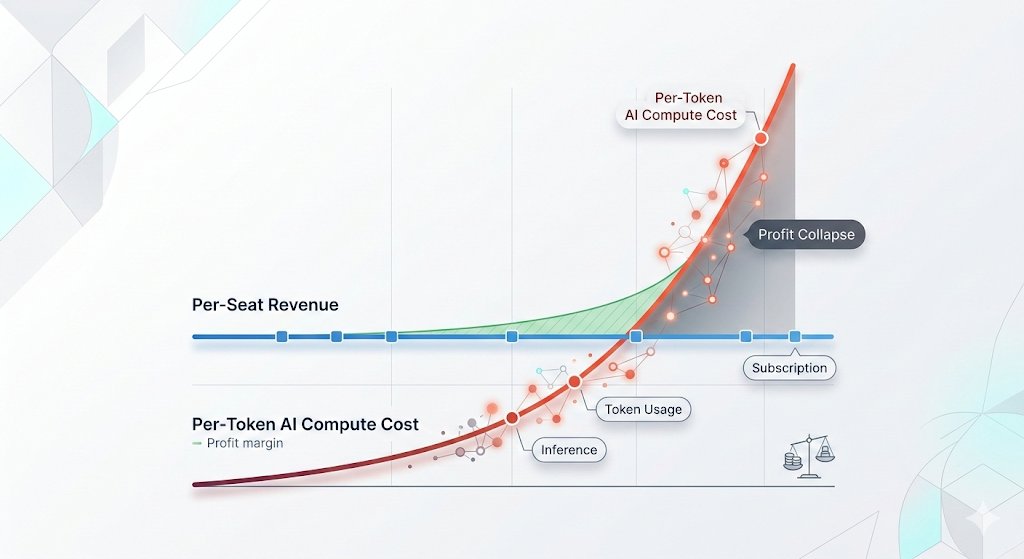
🦔Microsoft canceled its internal Claude Code licenses this week after token-based billing made the cost untenable, even for a company with effectively infinite cloud resources. Uber's CTO sent an internal memo warning the company burned through its entire 2026 AI budget in just four months. American AI software prices have jumped 20% to 37%, and GitHub (owned by Microsoft) is dropping flat-rate plans for usage-based billing across its products.
My Take
The AI subsidy era is ending in real time. The same company that put $13 billion into OpenAI and built the Azure infrastructure powering most of Anthropic's compute just looked at the bill from a competitor's coding tool and decided it was not worth paying. That is not a productivity failure on Anthropic's end. Token-based pricing is forcing every enterprise customer to confront the actual cost of running these models at scale, and the number turns out to be far higher than the flat-rate experiments suggested.
This ties directly to my Gemini Flash post yesterday. Anthropic, OpenAI, and Google all raised effective prices in the last six months. Enterprises that built workflows assuming AI costs would keep falling are now watching annual budgets evaporate in months. Two outcomes look likely from here. Either enterprises scale back AI usage to fit budgets, which slows the revenue ramp the labs need to justify their valuations ahead of IPOs, or the labs cut prices and absorb the losses, which makes the unit economics worse at exactly the wrong moment. Both paths land in the same place, the numbers stop working, and somebody has to take the writedown.
Hedgie🤗
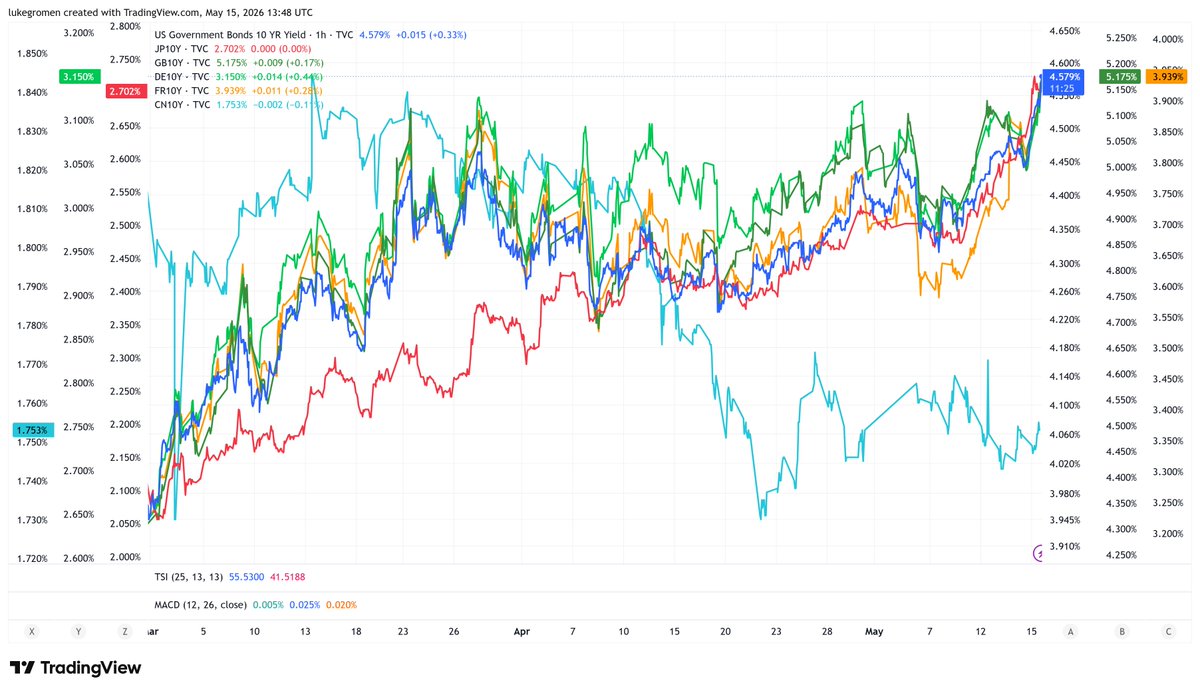
10y government bond yields of US, Japan, UK, Germany, France, and China since the beginning of the Iran war.
China = aquamarine line
If the Iran war strategy was "choking out China's oil supplies", it's time to reconsider the strategy.
One thing is clear: Neither the Trump Administration nor the Iranian regime cares about the livelihoods of billions of people worldwide. The fallout from closing the Strait of Hormuz will be far worse than most experts expect — some effects obvious, others not.
Let us look at some headlines:
🛞A Closed Strait of Hormuz Risks a Global Food Security Crisis
🛞The world's poorest countries are paying the price for a war they didn't start
🛞Global famine fears rise as Hormuz crisis threatens 'eight-year,' Suez-scale disruption
🛞UNCTAD reports: Disruptions worsen fertilizer access for the poorest countries, strain debt-burdened economies, weaken currencies, and raise household budget pressures
🛞IMF notes: Energy importers in Africa/Asia suffer most; food (43% of consumption in low-income countries) becomes unaffordable.
🛞Indonesia to maintain coal use amid energy security concerns
🛞Japan petrol prices surge to record high
🛞South Africa's diesel prices increase to record high
Chi oggi a Milano ha gridato "siete saponette mancate" a Emanuele Fiano, figlio di un testimone della Shoah, ha insozzato il 25 aprile. Né più né meno del criminale che a Roma ha sparato colpi di pistola contro due manifestanti dell'Anpi
@Anpinazionale
Buon 25 aprile.
Con i vecchi partigiani per estirpare la malapianta del fascismo contemporaneo propagatore di guerre, inimicizia e povertà.
#noipartigiani.it
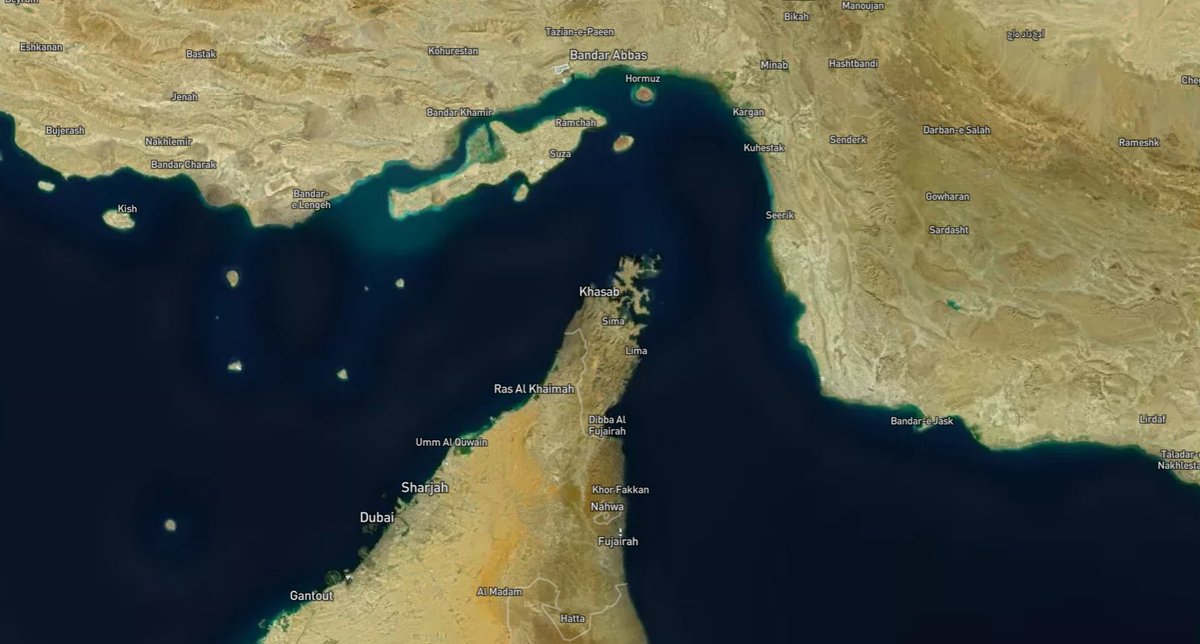
This is really significant. Hopefully this threat is just a negotiating tactic. But for the record, a simultaneous closure of the Straits of Hormuz and Bab el-Mandeb would mean lights out (literally) for the global economy within a few weeks. Within a few months, tens of millions would starve to death.
And to be clear, Iran DOES have the ability (thru its Houthi proxies) to effect a Bab el-Mandeb block. They've done it before.
In other news, the S&P 500 has rallied to fully retrace all Iran-related losses, as the market breathes a sigh of relief that the crisis has ended.
Three questions:
1) Would the US stop Chinese-flagged vessels going in-and-out the Persian Gulf? And if the tankers don’t stop?
2) What’s the plan if the Houthis of Yemen blockade the Bab al-Mandeb?
3) Would the U.S. stop Iranian tankers loading at Jask (outside the SoH)?
Già dopo il controllo di Saras passato a Vitol, buona parte della capacità di raffinazione italiana era finita sotto controllo estero: 58 Mt/a su 87,3 Mt/a totali secondo UNEM. Aggiungendo ora Socar su Falconara e Trecate, la quota non-italiana lambisce l’80%.