Niklas Luhmann wrote 70 books out of a wooden box of index cards and refused to fully explain how the system worked while he was alive, and 19 years after his death a German researcher named Sönke Ahrens finally cracked the manual.
The story of the wooden box has been told a thousand times.
Luhmann was a civil servant in a small German town in the 1950s. He started taking notes on index cards, one idea per card, linking each card to other cards in the box.
By the time he died in 1998, the box held over 90,000 handwritten notes. He had produced 70 books and over 400 academic papers from it. He had invented an entirely new theory of modern society that sociologists are still arguing about today.
He gave interviews about the system. He told people that the box was smarter than he was.
He said it was his communication partner. He said it remembered connections his conscious mind had long since forgotten making.
He answered the question of how he was so productive with a single sentence. He said he never worked against resistance. He followed what the box was pulling him toward.
What he never did was write the manual.
He never sat down and explained, in a step-by-step way, what kinds of notes went into the box, how they were structured, how they linked together, how a person sitting in front of an empty box was supposed to actually start using one.
He treated the system the way a craftsman treats a craft. It was something he did. Not something he taught.
For 20 years after his death, hundreds of academics, writers, and knowledge workers tried to reverse-engineer the box.
People photographed the actual cards. People wrote dissertations on the linking structure. People built software trying to replicate the network.
Most of them ended up with elaborate filing systems that looked like Luhmann's box from the outside and produced almost nothing.
The problem was that everyone was copying the surface of the system and missing the engine inside it.
The cards were not the point. The links were not the point. The point was a specific cognitive workflow that Luhmann had been running inside his own head for 30 years, and nobody had been able to articulate it clearly.
In 2017, a German education researcher named Sönke Ahrens published a 178-page book called How to Take Smart Notes.
He had spent years studying Luhmann's archive, comparing it to modern research on learning and writing, and trying to extract the actual method from the physical artifact.
The book did not get a big release. It came out through self-publishing. It spread by word of mouth through writers, students, and knowledge workers, and within a few years it had become the single most cited modern guide to thinking on the internet.
The reason is that Ahrens finally explained what Luhmann had refused to explain.
The system, Ahrens said, runs on three kinds of notes, and almost everyone trying to copy Luhmann was failing because they were confusing the three.
The first type is fleeting notes.
These are the quick captures. The scrap of an idea you have in the shower. The thought that hits you on a walk. The half-formed reaction to something you just read.
Fleeting notes are written fast, by hand if possible, with no concern for structure or grammar. Their only purpose is to make sure the thought is not lost before you can do something useful with it.
Most people stop here. Their notebooks are full of fleeting notes that never go anywhere because nothing was ever done with them.
The second type is literature notes.
These are written while you are reading something. The rule is brutal. You are not allowed to copy and paste. You are not allowed to highlight. You are not allowed to summarize in the author's words.
You must read a passage, close the book or look away from the screen, and write down what the author was claiming in your own words. The act of translating into your own language is the act of finding out whether you understood it.
Most people skip this step because it is uncomfortable. The discomfort is the entire point. The discomfort is where the learning happens.
The third type is the one that makes the whole system work.
Permanent notes. These are written from your fleeting notes and literature notes once a day, ideally, while the material is still fresh in your mind.
Each permanent note contains one idea, written in your own words, structured as if it would be read by a stranger years later. The note must stand on its own. It must be specific enough to be useful and short enough to fit on a single card.
Then you do the thing almost nobody does.
Before you file the new note, you go into the box and find every other note it connects to. You write the links explicitly.
This new note about a behavioral economics experiment connects to that older note about a Stoic principle. This new note about a coding pattern connects to that older note about a biological system.
You force yourself, every single time you add a note, to physically interrogate the box for what it already knows that this new idea touches.
Over time the box stops being a storage system and becomes a thinking partner.
When you sit down to write, you do not stare at a blank page. You go to the box. You find the cluster of notes that has been quietly accumulating around a topic you did not know you were obsessed with.
You pull those notes out. You arrange them. You discover that you have been writing the article, the essay, the book chapter for months without knowing it.
The writing becomes assembly, not invention.
This is the part Luhmann never explained out loud, and the part Ahrens spent the entire book hammering on.
The system does not store knowledge. The system generates it.
The act of forcing every new idea into conversation with everything you already know is what makes the new idea sharper, and the act of linking thousands of ideas to each other over decades is what produces the kind of dense network where original thinking actually lives.
Ahrens called the book a manual for how to write a PhD thesis or a nonfiction book. The book turned out to be much bigger than that.
The system inside it is the operating manual for any person who works with ideas for a living. Researchers use it. Writers use it. Engineers use it. Entrepreneurs use it.
AI researchers use it to keep up with papers that are being published faster than any human can read.
The reason Luhmann would not have predicted any of this is that he was working alone in a quiet German town with a wooden box on his desk.
He did not know that the system he had built by accident was the answer to a problem the entire world was about to have.
Ahrens did what Luhmann never quite did. He turned the private habit into a public method.
And the most original thinkers of the next 20 years will not be the ones reading more books than everyone else.
They will be the ones with a better box.
🛑#Justice ⚖️🤢 : Quand on entend ce général de gendarmerie t’expliquer qu’un magistrat pédo avec plus d’un million d’images et vidéos pédo a simplement reçu une amende de 1 000 € et aucune peine de prison ! C'est toute la magistrature qui est gangrenée avec la complicité des gouvernements qui ont laissés faire ! ....
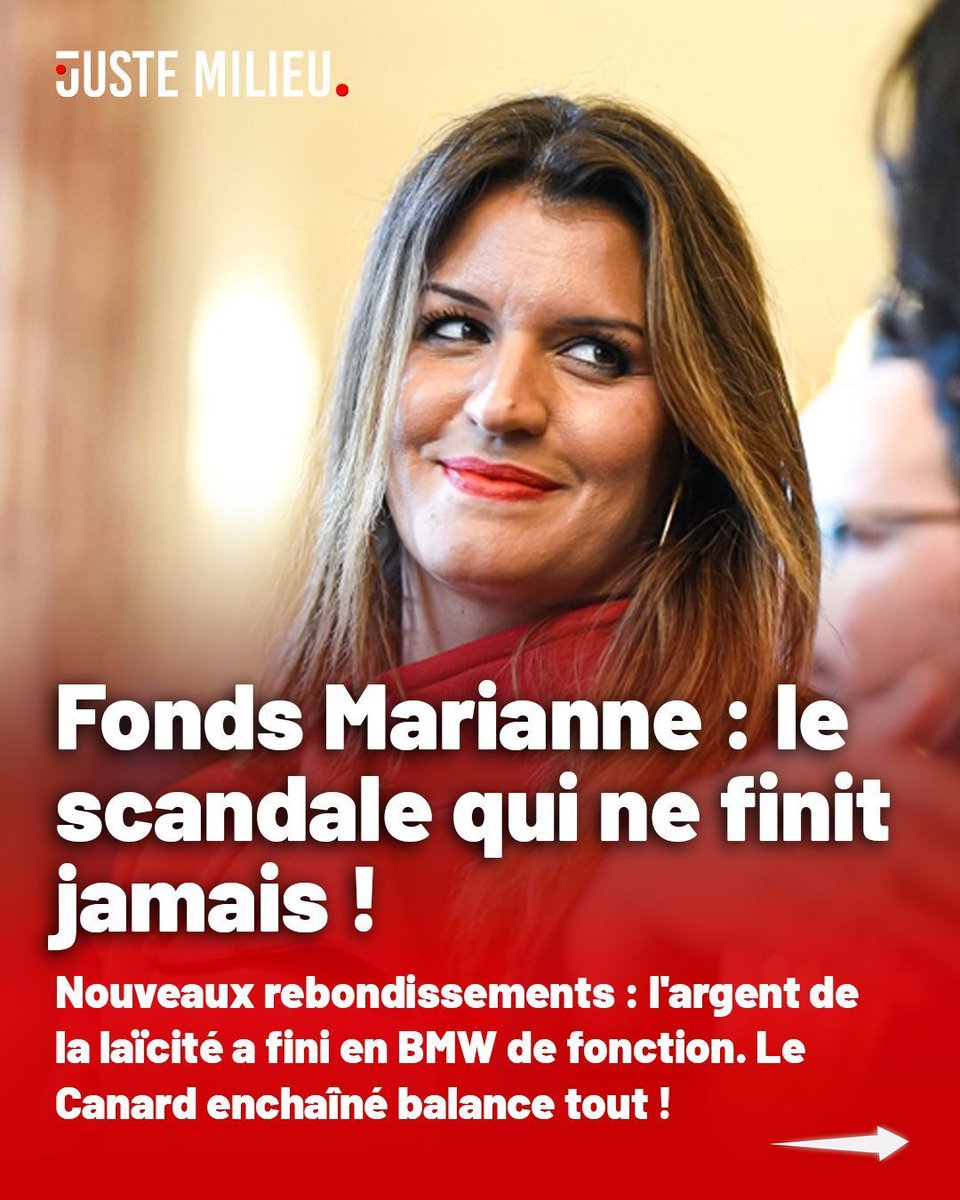
Fonds Marianne : le scandale qui ne finit jamais !
Nouveaux rebondissements : l'argent de la laïcité a fini en BMW de fonction. Le Canard enchaîné balance tout !
La République en version "M Sport" !
📍 + 500 % : L'augmentation de salaire que s'est versé le gérant de l'association.
📍 Faux et usage de faux : Des documents antidatés pour justifier les subventions de 266 000 €.
📍 Le crash : Quatre suspects devant le juge ce 18 mai pour escroquerie en bande organisée.
Suffisant pour relancer ce scandale trop vite enterré ?
"We Shouldn't Let This Get Out." Alleged Internal Communications From the Agencies That Shaped COVID Policy.
Documents obtained through FOIA requests and whistleblower testimony have revealed internal communications where officials discussed suppressing safety signals, softening language in published reports, and coordinating messaging to protect vaccine uptake. These aren't allegations from fringe sources. They are subpoenaed communications, Senate testimony, and published FOIA documents. The people who said "we shouldn't let this get out" were in charge of public health. That is the crisis.
Join the Fight: https://t.co/rvCeXmwbdp
Courtesy of Savage Minds @SavageMindsMag, Julian Vigo @_JVigo
Listen to the Full Episode: https://t.co/EzT8dN70By
#MedicalFreedom
Thiel décrit un choix entre deux abîmes. D'un côté l'Antéchrist: un pouvoir qui promet "la paix et la sécurité", qui supprime tout risque technologique au nom de la protection, et qui fige le monde dans la stagnation. De l'autre l'Armageddon, l'effondrement par la guerre. Et son intuition la plus puissante, c'est que ces deux pôles ne s'opposent pas, ils s'alimentent. La peur de l'apocalypse pousse à tout centraliser "pour notre bien", et cette centralisation, cette stagnation, devient elle-même la matrice de la catastrophe. Le katechon, la force censée retenir l'apocalypse, finit par se confondre avec la bureaucratie, la régulation, le principe de précaution.
Karim Zéribi sur une chaine d'Etat algérienne appelle la diaspora africaine qu'il évalue entre 10 et 12 millions de personnes à aller voter à la présidentielle contre "l'extrême droite".
Il insiste auprès de ses compatriotes algériens.
Qui parlera d'ingérence ?
@FrenchResponse
🚨 Je viens de découvrir par hasard un SCANDALE.
En 2017, Accor Hotels a réussi à revendre près de 60 hôtels en faillite à l’État alors que personne n’en voulait...
Le coût total de l’opération pour le contribuable approche les 500 000 000 € 🤡
NEW: Oncologist ANGUS DALGLEISH
"There are at least 12 mechanisms where mRNA can insert into DNA and activate oncogenes"
"there is no way you can control this technology"
"its use for future vaccines should be banned and the Covid ones stopped now"
@ChildrensHD
People don't grasp the sheer speed and scale of Europe's decline.
This 👇 is an extraordinary number shared by Luis Vassy, director of Sciences Po (one of France's most famous schools) in this article: https://t.co/BQbkXb2kPl
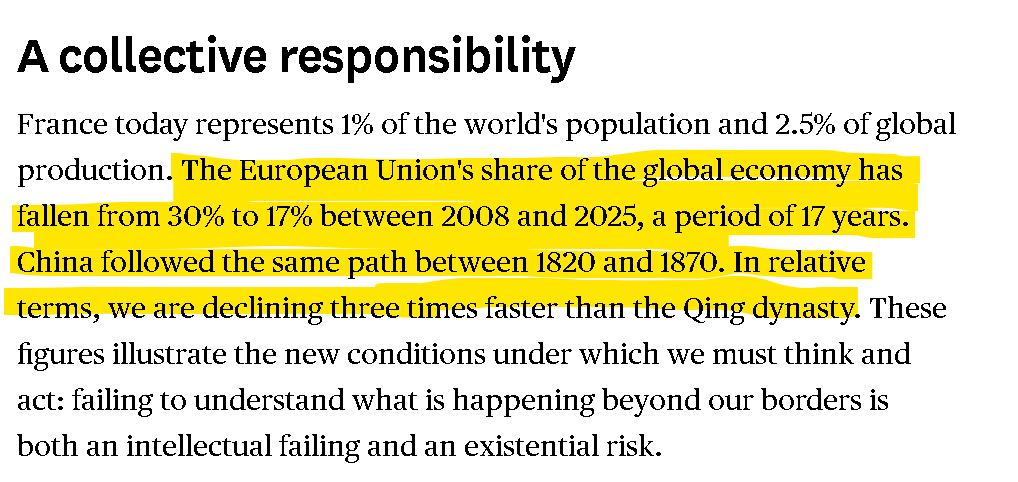
He calculated that the EU is declining 3 times faster than the Qing dynasty at the height of China's century of humiliation.
Back then, it took China 50 years to drop from 30% of world GDP to 17%, whereas it took the EU just 17 years (from 2008 to 2025).
Insane 😢 And, sadly, given the current direction and the EU's systematically suicidal policy choices (latest example: https://t.co/6EYJgdXVVo), it's just the beginning...
#PSG#Géopolitique Samedi soir, nous avons vu des groupes jeunes de la périphérie quitter leur "chez nous" pour aller "chez eux" - dans les quartiers bourgeois du centre, où ils se sentent complètement étrangers. C'est une forme de conquête temporaire d'un territoire ennemi, une prise de gage symbolique (et parfois matérielle), dont on aurait tort de négliger la dimension politique - même si elle n'est évidemment pas formulée comme telle par les intéressés.
Mon analyse @jdomerchet
https://t.co/I2zfDdHkwl
Hongrie : en dégelant des fonds de 16,4 milliards d’euros, l’UE acte « un fort vent de changement » dans le pays...interference confirmee de bruxelles https://t.co/NpiEDA67de
Vous vous souvenez de l'affaire du fantôme de Heilbronn ?
Entre 1993 et 2009, les polices allemande, autrichienne et française ont traqué une mystérieuse tueuse en série dont l’ADN avait été retrouvé sur quarante scènes de crime, à travers toute l’Europe... Avant de comprendre que cet ADN provenait en fait d’une employée de l’usine fabriquant les cotons-tiges utilisés pour les prélèvements.
Le monde de la recherche environnementale est en train de vivre le même scénario... Alors qu'il découvre que les particules issues des gants jetables portés par les scientifiques ont faussé les résultats de centaines d’analyses des taux de microplastiques dans l’environnement.
👇 https://t.co/4gTIgGuwb8
1/ L’ARCHITECTURE financière DE LA PANDÉMIE
Gilead Remdesivir Stock Rocket 2020 : le chart qui raconte tout.
Comment les fuites STAT, les annonces de Gilead et l’endossement de Fauci ont fait exploser l’action GILD… pendant que les données positives HCQ de l’IHU Marseille étaient mises en rouge.
Graphique FranceSoir à l’appui.
C’est pas de la volatilité. C’est le marché qui pariait sur quel business model allait gagner.
🚨 Il a touché 340 000 euros d’allocations en France alors qu’il était ministre aux Comores
Officiellement domicilié à La Réunion et déclaré sans ressources, Dhoihir Dhoulkamal exerçait en réalité les fonctions de ministre des Affaires étrangères aux Comores.
Une double vie qui lui a permis de soutirer plus de 340 000 euros aux organismes sociaux réunionnais pendant près de dix ans. Jugé en son absence, il a été condamné vendredi à deux ans d’emprisonnement ferme. Un mandat d’arrêt international a été émis.
Une fraude aux prestations sociales sur près d’une décennie
Le tribunal a reconnu Dhoihir Dhoulkamal coupable de déclarations frauduleuses et d’escroquerie au détriment de la Caisse d’allocations familiales (CAF) et de la Caisse générale de sécurité sociale (CGSS) de La Réunion. Les faits s’étendent du 1er janvier 2011 au 31 octobre 2020, soit près de dix ans de perceptions indues, relate L’Indépendant.
Au total, le préjudice dépasse les 340 000 euros : 253 525 euros ont été perçus auprès de la CAF sous forme de revenu de solidarité active, d’allocations familiales, d’allocation logement, d’allocations de rentrée scolaire et de primes de Noël. La CGSS a quant à elle été lésée de 87 482 euros supplémentaires.
Ministre aux Comores, allocataire à La Réunion
Titulaire de la nationalité française depuis l’an 2000 et officiellement domicilié sur l’île de La Réunion, Dhoihir Dhoulkamal résidait en réalité principalement aux Comores. Il y a exercé successivement les mandats de député puis de ministre des Affaires étrangères entre 2020 et 2024, percevant à ce titre des indemnités conséquentes — revenus qu’il n’a jamais déclarés aux organismes sociaux français.
Son épouse, présentée comme dépourvue de toute ressource, a adopté la même stratégie de dissimulation. Reconnue coupable des mêmes infractions, elle a été condamnée à un an de prison ferme assorti d’une interdiction du territoire français d’une durée de cinq ans.
L’immunité diplomatique, un verrou longtemps infranchissable
L’enquête, menée par la section de recherches de la gendarmerie de Saint-Denis de La Réunion, s’est heurtée pendant plusieurs années à l’immunité diplomatique dont bénéficiait l’ancien ministre en vertu de ses fonctions. Les enquêteurs n’étant pas parvenus à localiser l’intéressé pour l’entendre, le parquet avait dû recourir à un mandat de recherche à portée internationale.
C’est le remaniement gouvernemental intervenu aux Comores en juillet 2024, qui a privé Dhoihir Dhoulkamal de son portefeuille ministériel, qui a levé cet obstacle juridique. Jugé en son absence lors de l’audience de vendredi, l’ancien diplomate a été condamné par défaut. Le tribunal a prononcé à son encontre un mandat d’arrêt, confirmant ainsi la détermination de la justice française à obtenir son extradition ou sa comparution.
In 2016, the Netherlands Meteorological Institute adjusted temperatures at De Bilt, the country's main climate station. Daily maximums from 1901 to 1950 were lowered by up to 1.9C, which removed 16 of 23 heatwaves from the record.
The altered data were then used to claim modern heatwaves were unprecedented.
Four researchers challenged the changes, but the institute dismissed the criticism, so the analysis went to peer review. In 2021, it was published, conclusively demonstrating the method systematically erased historical heat extremes.
Today, the Meteorological Institute has quietly changed its approach, and as a result, seven erased heatwaves have been restored, including the extreme summer of 1947.
Here again, we have a government agency caught rewriting climate history. The Netherlands Meteorological Institute erased heatwaves of the past, ignored critics, and reinstated the truth only when the evidence became impossible to ignore.
Policies were built on that manipulated record.
Dutch farmers lost livelihoods.
Industry and the wider economy paid the price.
But accountability is coming.
De meest gevaccineerde plek ter wereld ligt in Ierland 🇮🇪.
Het is een plek genaamd Waterford.
Ze hadden het hoogste vaccinatiepercentage ter wereld.
Daarna leden ze onder het hoogste Covid-percentage in Ierland.
En toen hadden ze de hoogste oversterfte.
De lokale gezondheidsautoriteit kreeg een prijs van de Wereldgezondheidsorganisatie voor de manier waarop ze de pandemie aanpakten.
Ze hadden het hoogste sterftecijfer, na het hoogste vaccinatiepercentage te hebben gehad. 85% oversterfte op een bepaald moment.
– Andrew Bridgen @ABridgen
💰Un braquage en règle ? Où sont passés les centaines de milliards des réserves des retraites des Français ? Le FRR est passé de centaines de milliards à seulement 20,7 Md€ fin 2025. Des ponctions massives vers la CADES, pendant qu’on imposait une réforme « pour sauver le système »… Transparence totale exigée !
Article de @xazalbert en premier commentaire
@jon_delorraine Vous parlez de ce scandale ?
François Hollande encaisse sur sa société RDPA 762 000€ de bénéfice en 2023 .
Il fréquente Patrice Pichet fortune de 1,6 milliard, condamné pour #Corruption en 2023.
Et l'inauguration d'un 5 étoiles....
#CascadesdeGaronne#Quiaprofitédes25millions