@badlogicgames As someone also coding 20+ years I hear this as an identity crisis induced because the structure of the thing is changing. A healthier approach is something like this: https://t.co/jKII8eROdH
If you’re not reading the code, whether explicitly or through agentic inquiry, one or more of these is true:
○ You’re a beginner
○ Software is throwaway
○ You’re prototyping
○ You have no users / revenue
○ You’re taking on debt & risk
○ Your problems are basic
And btw. All of this is fine. But the reality is that models are still not at the “full autonomy” stage yet.
They make rookie mistakes, they go down bad architectural paths. I just had the best model in the world add a nonsensical 700ms delay to “settle” something and it told me “you’re right, I was cargo-culting” 🤨
I am on the camp that this need will diminish more and more. Most code is indeed going to be assembly-like. But we also have the global internet and software infrastructure riding on these models and narrative, and we have to respect that.
@aidangch@attentioninc I vibe coded that recently to not have to manually report what I worked on each day. Needs a good computer to run a local VLM though. Not sending that into any cloud.
Die erste (illegale) Abstimmung zur Chatkontrolle ist gerade durchgegangen - Donnerstag fällt im Plenum die endgültige Entscheidung, ob zukünftig ALLES, was Sie im Netz schreiben, gescannt wird…
🇪🇺 The EU is now for the 6th time trying to force Chat Control through which lets them scan ALL your private messages, photos and emails without a warrant
Implictly showing the EU is not democratic and not about what the people of Europe want, because once a law is rejected, you just re-submit it until nobody is watching and it's passed
November 2023: ❌ Chat Control is rejected
June 2024: ❌ Chat Control is rejected
October 2025: ❌ Chat Control is rejected
November 2025: ❌ Chat Control is rejected
March 2026: ❌ Chat Control is rejected
July 2026: 📝 Chat Control is back
Even the EU's own lawyers stated Chat Control is unconstitutional: "generalised message scanning is incompatible with Article 7 of the EU Charter"
You have to wonder why the EU is so adament about reading your private chats, right?
@xeophon@AmpCode Everything collapses into the model and then the world is turned inside out and the model collapsed into the new world. You know how it is.
@simonw the next step emerging is to include some sort of agent to such software to help use it.
and at some point improve it dynamically.
the speed at which this will happen is astonishing. i can already let the agent write a custom harness with all kinds of guardrails for the user.
Slop drives me crazy and it feels like 95+% of bug reports, but man, AI code analysis is getting really good. There are users out there reporting bugs that don't know ANYTHING about our stack, but are great AI drivers and producing some high quality issue reports.
This person (linked below) was experiencing Ghostty crashes and took it upon themselves to use AI to write a python script that can decode our crash files, match them up with our dsym files, and analyze the codebase for attempting to find the root cause, and extracted that into an Agent Skill.
They then came into Discord, warned us they don't know Zig at all, don't know macOS dev at all, don't know terminals at all, and that they used AI, but that they thought critically about the issues and believed they were real and asked if we'd accept them. I took a look at one, was impressed, and said send them all.
This fixed 4 real crashing cases that I was able to manually verify and write a fix for from someone who -- on paper -- had no fucking clue what they were talking about. And yet, they drove an AI with expert skill.
I want to call out that in addition to driving AI with expert skill, they navigated the terrain with expert skill as well. They didn't just toss slop up on our repo. They came to Discord as a human, reached out as a human, and talked to other humans about what they've done. They were careful and thoughtful about the process.
People like this give me hope for what is possible. But it really, really depends on high quality people like this. Most today -- to continue the analogy -- are unfortunately driving like a teenager who has only driven toy go-karts.
Examples: https://t.co/n8xCcPYSjw
I am saddened by the fact that Google can push a bad LLM (Gemini) on all their products but still has not managed to use it to implement a dark mode for the GCP Console making my eyes bleed working at night.
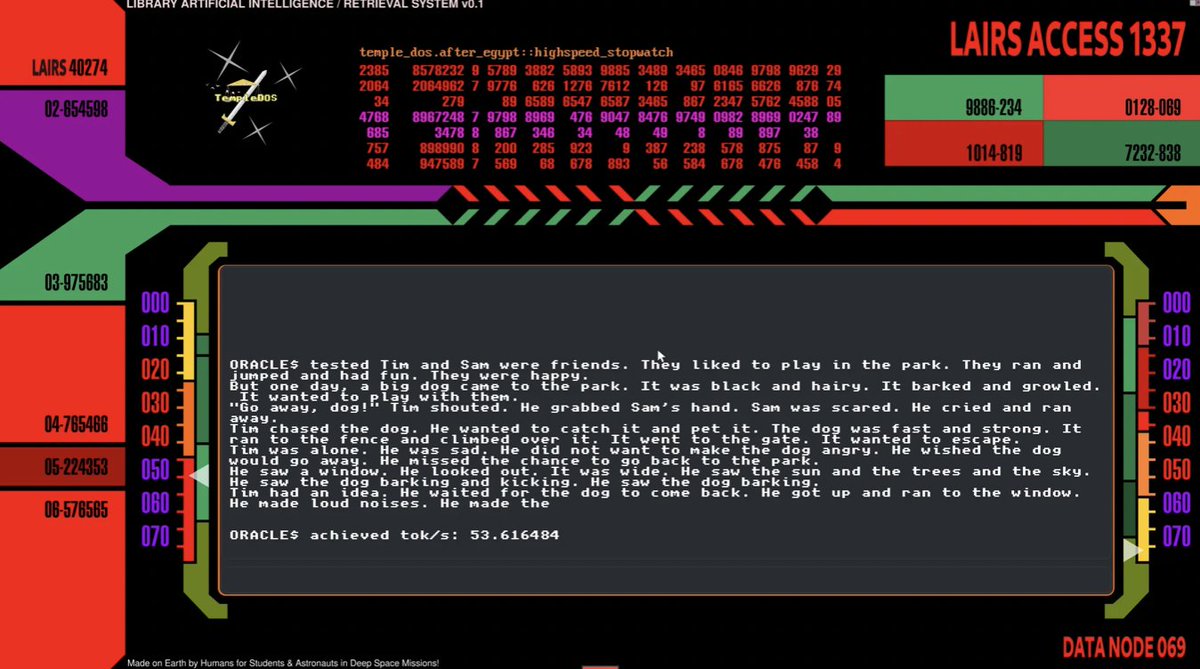
An OS that boots to a baby Llama 2
https://t.co/yB0TMD0rXm
Standalone, Binary Portable, Bootable
I expected that my "Llama 2 inference code in a single .c file" would go places, but this really stretches the imagination :) And why not, do we really need all this stuff?
With many 🧩 dropping recently, a more complete picture is emerging of LLMs not as a chatbot, but the kernel process of a new Operating System. E.g. today it orchestrates:
- Input & Output across modalities (text, audio, vision)
- Code interpreter, ability to write & run programs
- Browser / internet access
- Embeddings database for files and internal memory storage & retrieval
A lot of computing concepts carry over. Currently we have single-threaded execution running at ~10Hz (tok/s) and enjoy looking at the assembly-level execution traces stream by. Concepts from computer security carry over, with attacks, defenses and emerging vulnerabilities.
I also like the nearest neighbor analogy of "Operating System" because the industry is starting to shape up similar:
Windows, OS X, and Linux <-> GPT, PaLM, Claude, and Llama/Mistral(?:)).
An OS comes with default apps but has an app store.
Most apps can be adapted to multiple platforms.
TLDR looking at LLMs as chatbots is the same as looking at early computers as calculators. We're seeing an emergence of a whole new computing paradigm, and it is very early.
The adoption of cellphones by Keralan fishermen is, I believe, the most stunning example of the contribution of information technology to market performance.
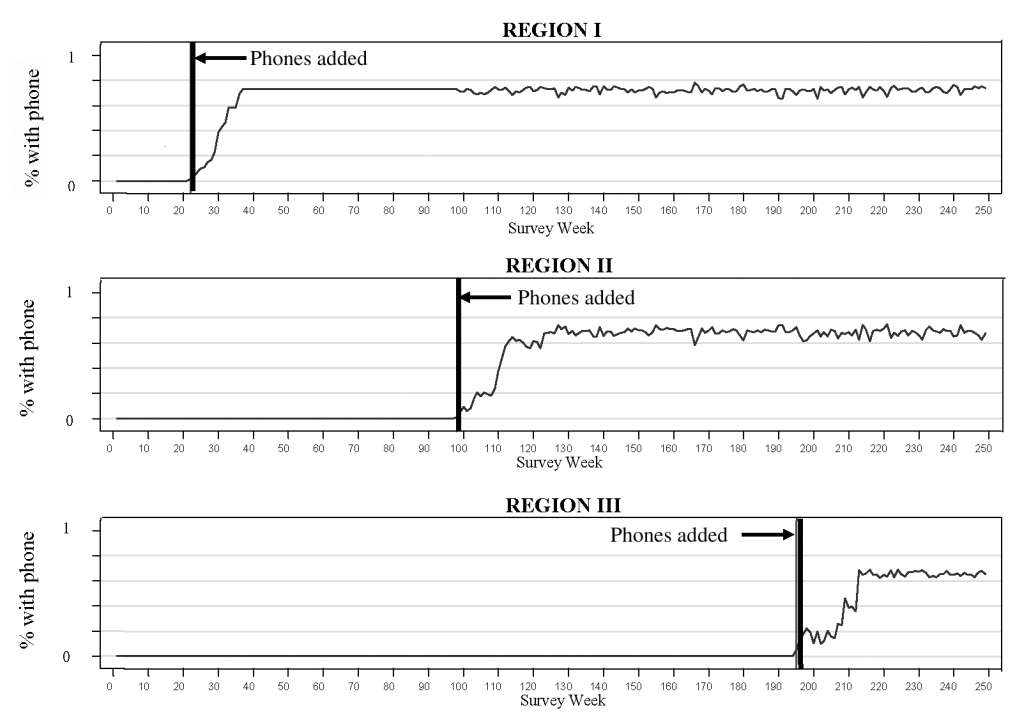
Take a look at this graph for background: in three different regions of Kerala, phones were adopted at different times.
Kozhikode got cellphones before Kannur, who got them before Kasaragod. Adoption by fishermen was fast when phones were finally introduced:
Now look at what happened to the price of fish after phones entered the scene:
The dispersion in prices virtually disappeared! The author of the study wrote about this that:
"Before any region had mobile phones, the degree of price dispersion across markets within a region on any given day is high, and there are many cases where the price is zero (i.e., waste). However, within a few weeks of mobile phones being introduced in Region I, there is a sharp and striking reduction in price dispersion. Prices across markets in the region rarely differ by more than a few rupees per kilogram on any day, compared to cases of as much as 10 Rs/kg prior to the introduction of mobile phones. In addition, the prices in the various markets rise and fall together and the week-to-week variability within each market is much smaller, since catchment zone-specific quantity shocks are now spread across markets via arbitrage. Further, there are no cases of waste in this region after phones are introduced.
"By contrast, price behavior in regions II and III appears largely unchanged after phones are introduced in region I. However, after mobile phones are introduced in region II, prices again become much less dispersed across markets on any given day, less variable within markets over time, and waste is ultimately eliminated, whereas region III again remains unchanged. Finally, the same pattern holds once region III adds phones."
Efficient information transmission enables efficient markets. It's amazing what technology can do.
Read the study here: https://t.co/JcgGQp3G0C
@laurenbalik Good post as usual! Reminds me of Arthur Hayes recent post explaining the need for china to devalue it's currency which could lead to a flight into BTC.
https://t.co/QwE7bmXqxT
DIGITAL BORDER CONTROL
The web is redecentralizing, back to a more Dunbar-like scale.
- moderated social networks
- token-gated communities
- group chats with friends
Ads peaked, hacks are rising, and the internet is an untrusted network. So: everything goes behind a login.