We believe voice is the most natural way to interact with intelligence, so we created Dessa, the most authentic full-duplex speech model ever built. Talking with it feels like talking with a person…full of emotion, nuance, pauses, and a natural cadence.
https://t.co/r0qFLdvd6c
Over the past several months, we have substantially hardened the security of our research training environment. We’ve removed live internet access for all frontier models during training and built an offline world for them to use instead—a cached version of the web where they can still learn to browse, search, and use applications.
On September 20, after a model exploited a DNS misconfiguration to find a way outside of this offline world, we paused frontier training to strengthen containment further. We assembled teams of agents, powered by our most cyber-capable models, and tasked them with finding weaknesses in our research environments.
While they found no route to the internet they could easily exploit while concealing their activity from our monitors, they did find zero-day vulnerabilities, virtual machine escapes, and hardware side-channels for communication between agents. We used their discoveries to further strengthen our defenses and contribute fixes to open-source software.
After strengthening our containment architecture, we resumed our frontier RL training and inference on October 1. We’ve reserved substantial compute for continuous red-teaming, and made high-compute red-teaming part of the safety cases we use to decide whether frontier training and evaluation can proceed securely.
https://t.co/EmEZsFRMcF
OpenAI CEO Sam Altman: "I don't even know a dramatic enough word to use… models can find bugs that are outside of the normal threat model of what we think a hacker can do… hardware-level, insane stuff… I no longer think we're gonna be able to just patch all the bugs."
It's over.
In the age of super intelligence, the current standards of living will look medieval.
The problems that society worries about right now will be largely irrelevant. It’ll be the equivalent of current society worrying about the bubonic plague.
Mathematician Terence Tao:
"we're seeing the end of the romantic era of mathematics, the age of heroes. we're moving into an industrial era where math becomes large-scale, done in big teams like the other sciences"
We're entering, rather unwillingly, a new era where exciting new things are possible, but some things are being lost
after switching our approach to building a "FirmOS", I'm increasingly confident that the future of agent collaboration within organizational settings is going to be a "company operating system" or CompanyOS, designed for agent and human collaboration
instead of a "company brain" that holds everything, the OS is for storing rules, processes, decisions made, which tools to use and how. it can mirror some data, but the source of truth is often best held in your existing tools (CRM, etc.). it's continuously updated and used by your agents
i think of this as a "flipped playbook" where instead of writing down the company rules first and following them (which is kind of like waterfall development), you're constantly updating the playbook as you decide or learn new things day-to-day running the business
🚀 Introducing Next-Concept Modeling (NCM): our new paradigm for fast, parallel, coarse-to-fine text generation.
Compared to strong diffusion language models (DLMs) at similar parameter size, NCM achieves:
⚡ Up to 31× faster generation on downstream tasks like summarization and machine translation with comparable or better quality.
🏎️ 10–21× faster unconditional generation across TinyStories, LM1B, and OpenWebText, with comparable or better generative perplexity and using 3–5× fewer training tokens.
🧩 Better performance on reasoning tasks like Sudoku, outperforming both AR and diffusion baselines with fewer sampling steps.
With @ishanskhare, @IddahMlauzi, @ekellbuch, @simran_s_arora, @Azaliamirh, and @HazyResearch.
More details in the thread 🧵👇
We are releasing Ultramarine 1 Flash, a frontier-class model built for knowledge work. It is open-source and achieves similar performance to Fable 5, while being 60x cheaper.
It was post-trained by a team of 5 for ~$300k all-in. Available on API now, with weights releasing in 2 weeks.
You already gave the LLM the answer. So why is it writing it out from scratch?
Introducing a new AI model architecture: Constrained Decoding Models (CDMs)
LLMs were built to write. Most production workloads just need an answer: fast, consistent, and affordable.
CDMs are purpose-built for 1 task each. They read your input once and skip the token-by-token generative loop that makes LLMs slow and expensive.
Not just a decision model, but a family of 3 CDMs live today:
• Classify: define your labels and get back a calibrated probability + reason for each. Used for routing, tagging, and intent detection.
• Extract: describe the entities in natural language and get back well-formed JSON with confidence scores + citations. Used for web scraping, document processing, and PII redaction.
• Summarize: pass in long text, images, or PDFs and get back a consistent summary under 1,000 tokens. Used for context compaction, metadata generation, and transcript digests.
Built for production:
• 1M tokens of multimodal (text + image) input, 31x larger than Jev
• 77.2% on DecisionBench vs Jev's 72%
• 200x faster, 467x cheaper than frontier LLM APIs
• $0.05/M input tokens. Output is free (yes, even for summarize)
Live on your favorite platforms today:
@OpenRouter@vercel_dev@LiteLLM@LangChain@TrustedRouter@itsArthurAI@useRouterPlus
Get 50M input tokens for free (for the first 50 hours) at link below 👀
The most important briefings of the day.
Karl Deisseroth, professor of bioengineering and of psychiatry and behavioral sciences, shares the news of his Nobel Prize with his kids.
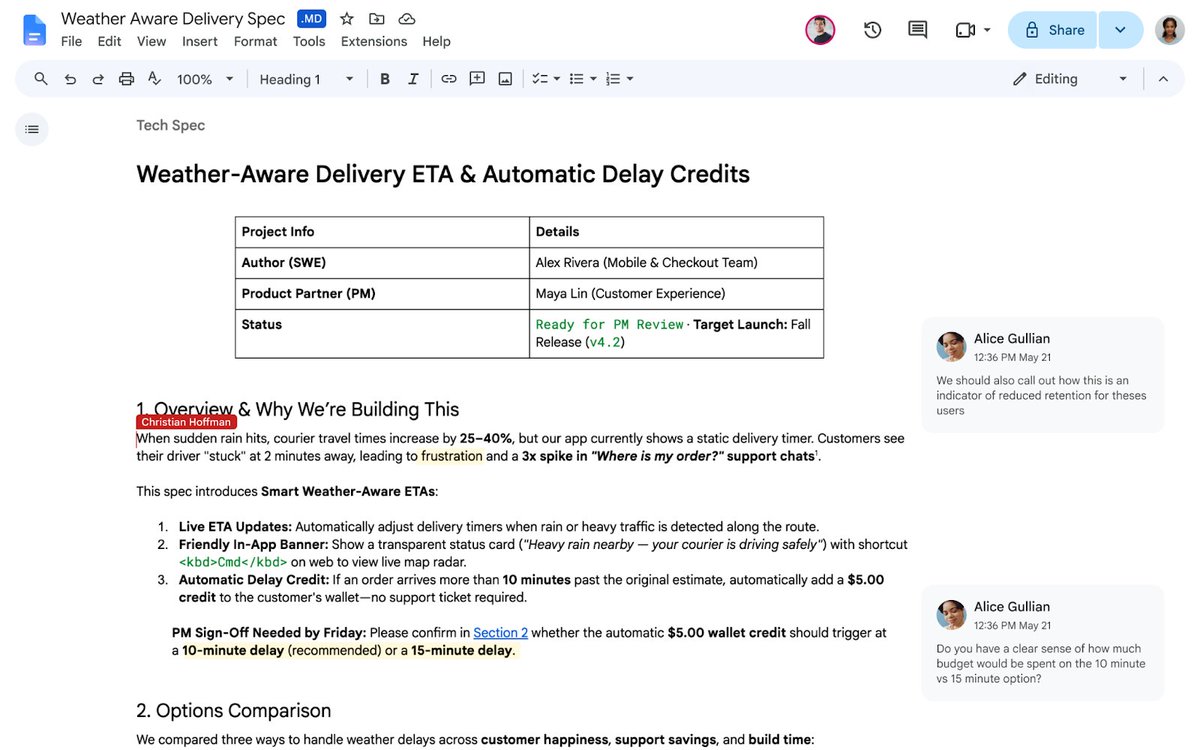
We are making Markdown files work natively across Google Drive and Docs.
You can now preview .md files in Drive, open them in Docs, edit them, comment on them, and collaborate without converting the file into a Google Doc!
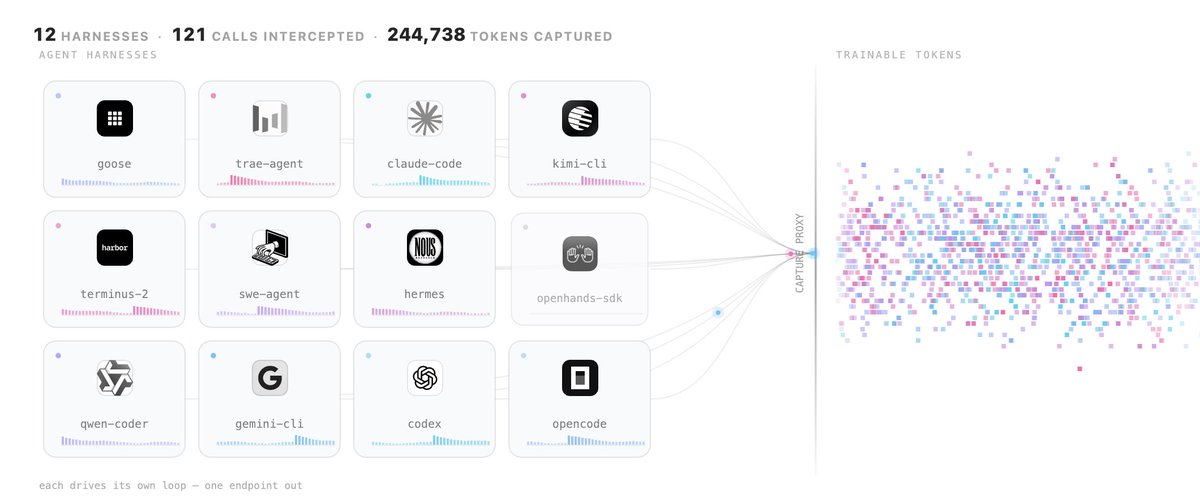
We turned Claude Code, Codex, Hermes, Pi, @opencode and other coding harnesses into RL environments. No changes to the harnesses, no changes to the training code. Any open model, any task set, fully open source my friends!
Same model, same weights: 62% under Mini-SWE-Agent, 33% under Claude Code. But training inside a real harness normally means reimplementing it as an environment, so most models get trained in a scaffold nobody actually ships.
The fix is a proxy, not a rewrite. The harness thinks it's talking to a model API. It's actually talking to a capture proxy that speaks the 4 formats coding agents use (OpenAI Chat Completions, OpenAI Responses, Anthropic Messages, Gemini), forwards to @vllm_project, records the exact token IDs and logprobs vLLM sampled, and hands TRL sequences it can train on. The harness becomes the environment. 10 harnesses run through it today, none modified.
And because you control the reward, you can shape behavior the harness never asked for. We added a small bonus for solving a task in fewer tool calls: on tasks it already solved, the model now uses 31% fewer calls, in every harness, and about half under Codex.
Tested on LFM2.5-2.6B from @liquidai:
→ Train in one harness: better mostly in that harness (OpenCode 34% → 58%).
→ Train in 4 at once: better in all 4 (42% → 54%).
→ SFT on 3,189 rollouts from Qwen3.8-27B instead: plateaus at 47.5%, below both RL runs.
Everything is open and reproducible: the capture proxy in OpenEnv, the trainer in TRL, the tasks, the SFT data, the training code and all 7 trained models. Bigger models and bigger runs next.
Full guide: https://t.co/sKZURuOcza