@mmpandit Dada, I had another question. The navnaths incarnated from Navnarayan. They were 9 sons on Lord Rishabdeva. In google search Lord Rishabhdeva is considered Bhagwan Adinath himself. So, are navnarayan incarnations of Mahadev? It’s a bit confusing.
Great question Sampada didi:
Q is ‘Can I read it in English as reading in Marathi takes a long time?’.
Ans:
Navnath Bhaktisaar (not Kathasaar) in Prakrit Marathi (old style Marathi) is a composition of Malu Kavi, a few centuries old. It is derived from Goraksha Kimayagaar.
It is a Shabari poem of superb power. Therefore like any other Shabar mantra or ANY other stotra or ANY other mantra, translation into English is almost completely non potent except to understand its meaning if that’s an issue (so there it’s useful).
But for anusthana purposes, not chanting it in Prakrit original is basically not likely to give any results.
I faced this issue acutely when I started Navnath Bhaktisaar in 1990’s as Marathi is not my mother tongue and it took me time to chant initially but luckily later on, some chapters I could chant at speed.
I suggest therefore to take one problem in life and look at which chapter is the best for that situation and then stick to chanting that one chapter daily for a year at least.
At minimum it will increase faith. At best it might solve the situation or give courage to face it.
QTing as others can benefit.
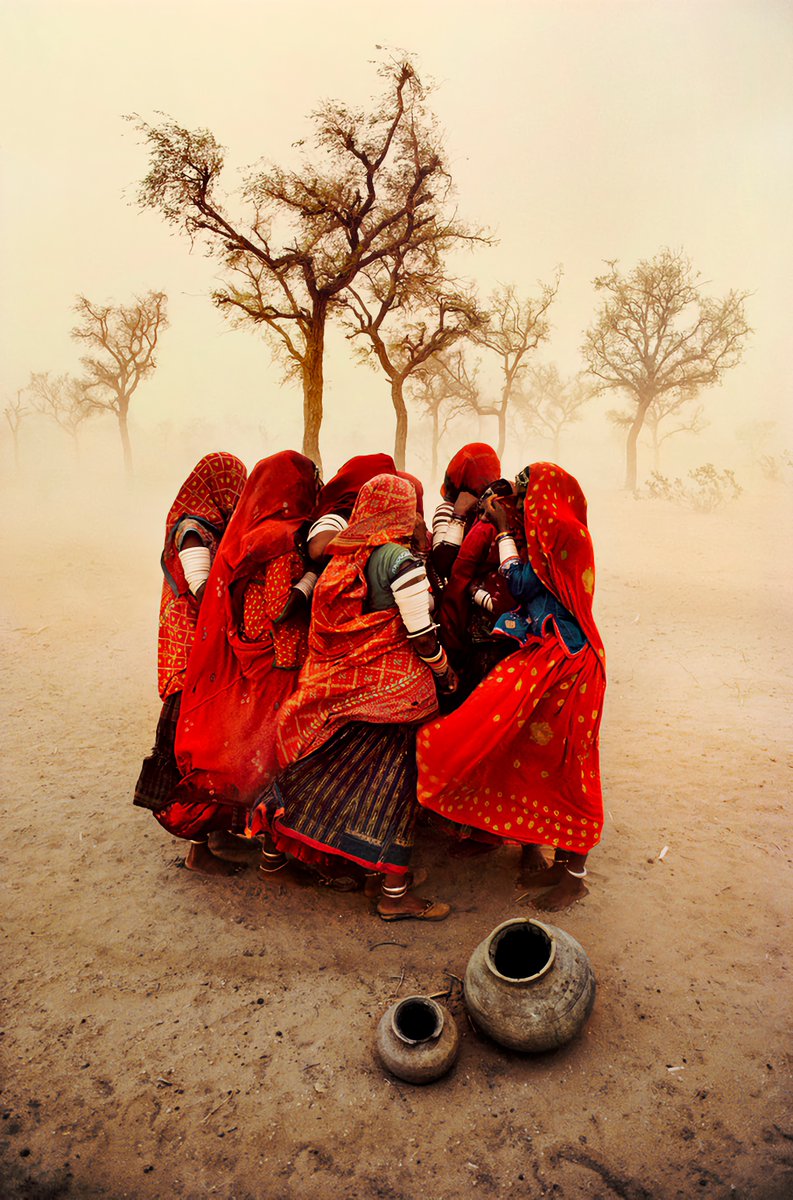
I came across this photograph by Steve McCurry, likely taken in Rajasthan, that really made me reflect.
As you see, it shows a dusty landscape with barren trees in the background, trees that seem almost lifeless without their leaves. In the foreground, though, there’s a striking contrast: a circle of women dressed in stunning, vivid red saris, standing closely together, with a couple of empty terracotta pots at their feet.
As I zoomed in on the details, I found myself contemplating.
Here are these women, living in what seems like such a harsh, arid environment, yet wrapped in such brilliant colors.
I thought about how, despite the tough conditions, they hold onto color as if it were a lifeline.
And wondered how would their spirits fare if their world was reduced to nothing but neutrals, just creams and grays, when life is already so challenging.
It made me think that maybe there’s a direct relationship between the presence of color and the human spirit in places where life is more demanding.
India, Peru, Bolivia, West Africa all face their share of hardships, but they also embrace vibrant hues in their clothing, homes, and everyday life.
Maybe, in a way, the more difficult the environment, the more important it is to hold onto color.
It seems that harsher the environment and more vibrant clothing and decoration are and more comfortable, wealthy, urban environments, more neutrals, minimalism, muted palettes.
Think of the Scandinavian minimalism (wealthy, stable societies), Japanese wabi-sabi (subtle, neutral aesthetics), Western luxury fashion (beige, black, white, gray).
Maybe that’s the quiet irony of it all. The harsher the life, the brighter the colors… and the more comfortable the world becomes, the more it fades into neutrals.
Maybe the price of wealth is losing the colors.
@homam108@ansible_cm I am just your follower Narashimaji, but super grateful for your predictions as it gives some insights into future so we don’t get shocked and can prepare a bit. Thank you 🙏
@mmpandit@Ranjannegi1984 Saints are guru. Hence people keep Sai Baba photo, paduka in their shrine. Lot of people worship Guru to activate Guru tatva in them.
@mmpandit I watched the first part of the podcast today, dada. Really very informative and fantastic Sadhana experiences you have shared continue to encourage people to follow the path of Sadhana. Jai Shri Hari, Har Har Mahadev! 🙏