After a year of work, we have released Basic Memory v1.0. Lots of changes, both in the local Open Source version and the hosted cloud service.
https://t.co/yfbaYFf7Tb
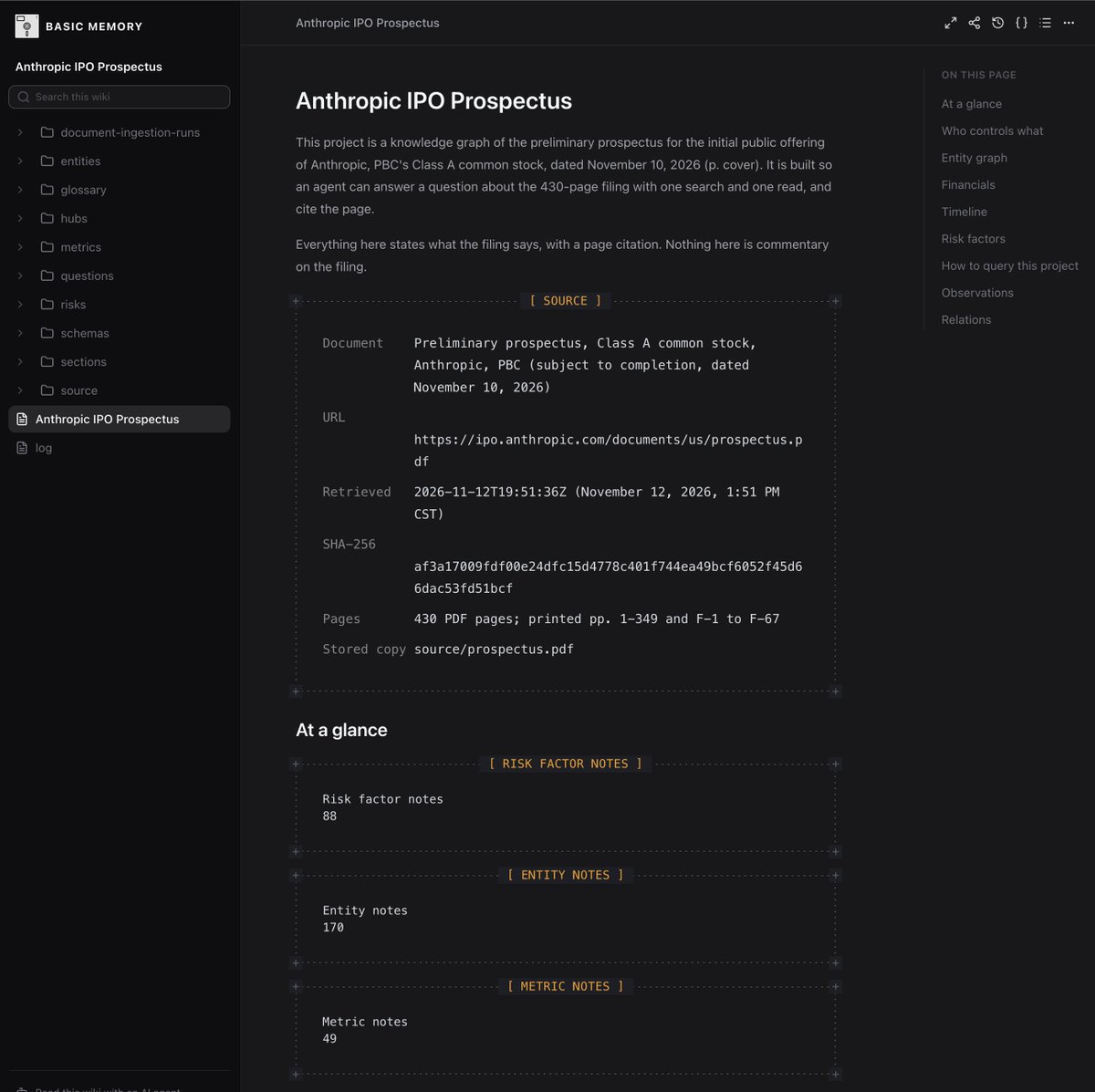
Trying to read the Anthropic IPO Prospectus and getting a little overwhelm?
We added it to Basic Memory so you can have an agent help you.
https://t.co/JasrWFG01N
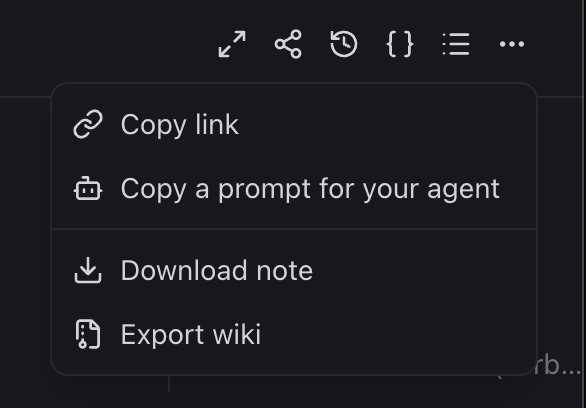
Give this prompt to your agent that speaks webmcp and it can query it for you.
Read the shared Basic Memory wiki for "Anthropic IPO Prospectus" at https://t.co/ovcFv5DC4b
Open it in the browser. The page offers WebMCP tools for this wiki:
- basic_memory.wiki_pages lists the pages, or one folder, with page_ids
- basic_memory.wiki_search answers a question with pages and matching line numbers
- basic_memory.wiki_read reads a page, a section, a line range or PDF pages
- basic_memory.wiki_context shows the links into and out of a page
- basic_memory.wiki_resolve_link follows a [[wiki link]]
- basic_memory.wiki_query runs a notes query
- basic_memory.wiki_open shows me the page you are reading
Use these tools rather than reading the screen. Read long pages in parts,
and cite the page and lines (or PDF page) that support each claim. The wiki is read-only.
Without a browser, fetch https://t.co/YFudomPZGy. It lists every page as a Markdown link.
This is my new goal for the next version of the Basic Memory UI. Except it will work in Claude and Codex, and the web. And all based on Markdown/Comark.
It's all mcpapps/mcp-extensions under the hood.
I actually want to open source it too.
Anthropic/OAI want to own intelligence + your thinking.
Open source AI wants to free it to everyone + every company on this planet to build their own based on their own preferences.
I want OSS from all nations to succeed. The world is too big, diverse, & beautiful to be controlled by 2 companies.
I like this analogy.
“everyone can cook at home but yet restaurants still exist. the floor is rising, but so is the ceiling. the best software will always be made by those who care.”
we don't have to live this way. senior engineers have the duty of building guardrails and teaching the next generation of programmers the practices that lead to high quality software.
AIs may write most of the code, but you still decide what ships. we should never lose our taste for quality software.
i made this analogy a while back: everyone can cook at home but yet restaurants still exist. the floor is rising, but so is the ceiling. the best software will always be made by those who care.
I build https://t.co/6aMhsRtOns, so take my argument from that context, but I find evals to be OK, for validating something "at that point in time" with "that model you are testing with".
But my experience has really been from constantly talking to users, getting feedback and iterating. I also quiz the AI models I use for coding incessantly to refine tool prompting and tool shapes.
Its very much an art. Not a science. Too many variables. One thing that become clear very quickly is that "memory" has to real shared meaning. Its different things to different people at different times.
For some things, it's "remember this customer likes these shoes last tuesday", for others its "find this item an all other related items, but make sure they are still relevant".
My take is - you have to make your memory something that YOU understand (in our case by just reading a markdown file), so that you can asses whether it works well with the AI for the task you are using it for.
Also - don't leave it in some vendors data store. Make sure you can take it with you.
For my first post, I’m sharing a letter @NVIDIA signed on why open models matter.
AI will transform every industry, power every company, and be built by every country.
Open models strengthen safety and cybersecurity, accelerate innovation and diffusion, and enable sovereignty.
The world needs both frontier closed models and frontier open models.
https://t.co/AUKzoQ5Ikb
Meanwhile DeepSeek founder Liang Wenfeng:
• “AI is large enough that it might eventually account for 10% of human GDP. You cannot monopolize such a thing. You must share it with others, or you won’t survive. If we tried to monopolize the benefits, we would be discarded by history. This is an objective law, a historical perspective.”
• “Those who take more get beaten by those who take less. You don’t even need to actually be taking more. If your ambition is to take more, you will be beaten by someone whose ambition is to take less.”
• “If your vision is to take more, you’ve already lost; you may face even greater difficulties. That’s just the way the world is.”
• “We must not imagine that we can claim a certain percentage of the world’s GDP for ourselves — the more you cling to that idea, the less likely you are to succeed. … The more restrained you are, the more likely you are to achieve AGI.”
I had Codex build a CPython bytecode compiler in Rust (`serc`).
It emits byte-for-byte identical output on the top 10,000 PyPI packages, 2-4x faster than the CPython implementation.
This was entirely an experiment, though we may ship it (opt-in) in uv.
@stevekrouse I've found every "cloud agent" setup to be more trouble than its worth so far, but I keep trying. I'm biased but Basic Memory does help because each agent can at least see the same context, so I can ask Claude/Codex/OtherAgent, etc about the same problem.
One of the tricks I learned from a mentor is to ask "What problem are we trying to solve here?..." when things go off the rails. Works with AI and IRL.
Recommended read, and basically a map of what we’ve been building. Basic Memory is agent memory as plain Markdown you own, and last week we shipped the agents that maintain it.
A few things we’d add 👇
Memory is what allows Claude to learn from experience. In a new Engineering Blog post, we share how “dreaming” helps Claude organize what it’s learned, correct its mistakes, and find what it needs more easily the next time. https://t.co/uUEN4bNkr9
Then a contradiction-check agent flags facts that disagree, for you to review as a diff, with full version history and one-click undo.
Drift stops being a silent failure you hope a background pass catches. It’s dated, visible, and correctable. That’s the real win.