Faculty search now open! BCS and @mcgovernmit
seeking candidates at any level including but not limited to cell/molecular and/or systems neuroscience, with a focus on translational neuroscience in nonhuman animals. https://t.co/7BNE5Cg9GM
Without nonhuman primates, the neuroscience field could miss out on insights into vision, motor control, cognition and development, according to our interviews with 17 neuroscientists.
By Alissa de Chassey
https://t.co/fmgiIT3ZkA
MIT Biology is hiring faculty positions! The department seeks candidates who are developing and using computational methods to address questions in molecular, cellular, or organismal biology. https://t.co/0KJsuG1c1B
Cognitive neuroscientist Earl K. Miller describes neurons in the cortex as “Humpty Dumpty sitting on a wall,” teetering right on the edge of firing. Oscillating electrical activity can alter the voltage gradient at the synapses that connect neurons, making them more or less likely to fire in the future.
https://t.co/UrVd1lftt5
1/ We’ve spent the last few years building ways to record enough of the brain at once to actually test theories of cortical computation.
Now we have major new funding to hire a postdoc to help us do it.
Here’s a 🧵 (or skip to end for job link!)
💼We're hiring! We're looking for an Executive Director to help drive scientific strategy and research development while leading our administrative and financial teams. https://t.co/e2JpZyYTmm #neuroscience#careers#jobs
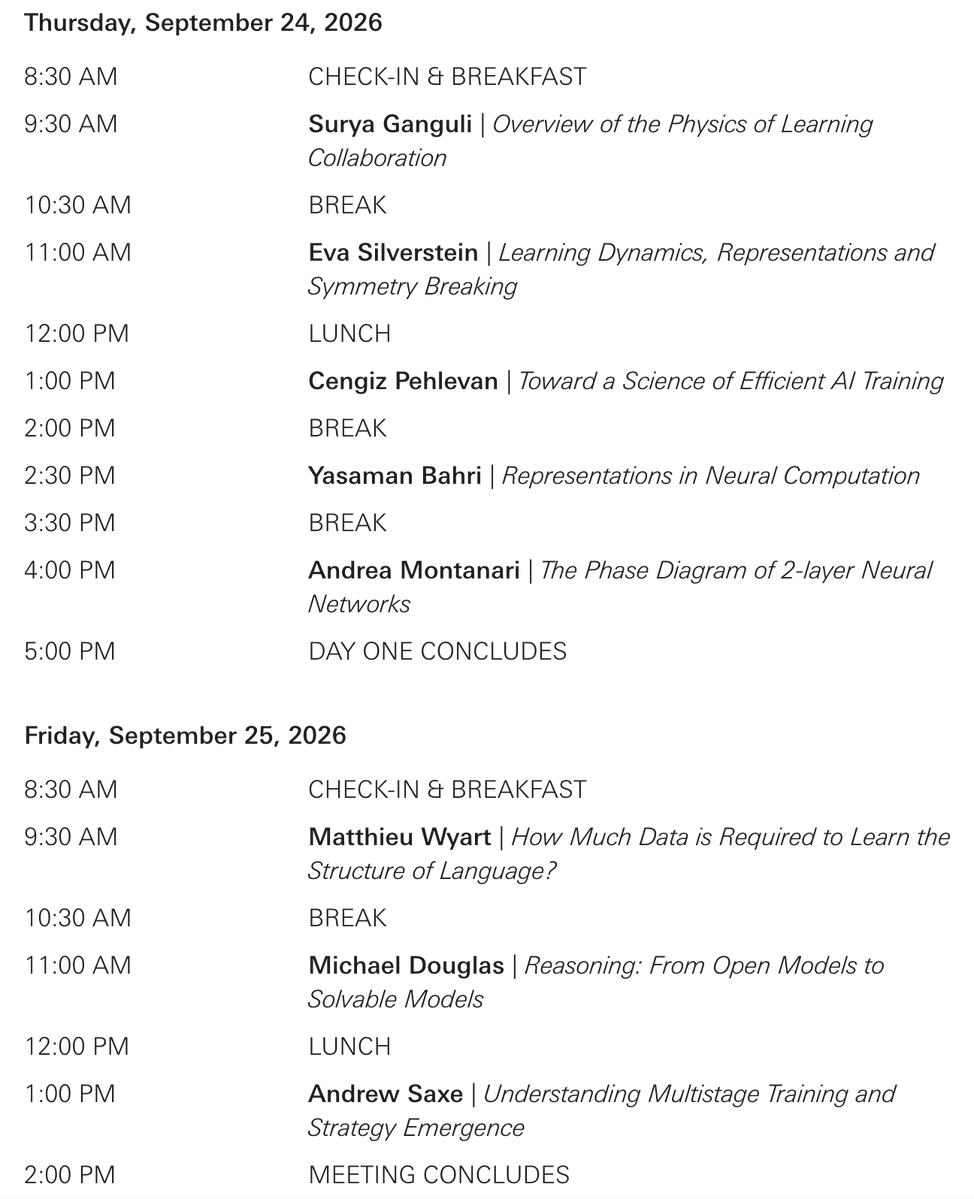
We are having our first @SimonsFdn yearly meeting on the Physics of Learning and Neural Computation Sept 24th-25th and all are welcome to join on this zoom:
https://t.co/nj0Aex9af0
We have an excellent set of speakers. Here is the agenda:
https://t.co/zpvY99bWMn
Join our webinar starting Sept 24th 9:30am ET to learn how the structure of data, architectures, and learning dynamics conspire to empower AI to learn, scale, compute, imagine, reason and collaborate!
See https://t.co/TfOKlQxCrE for more about our collaboration.
We’re sharing a solution to the Navier-Stokes Millennium Prize Problem, one of the deepest problems at the frontier of mathematics.
The proof was produced by a group of agents, using an OpenAI next-generation model significantly more capable than GPT-6 Astra.
The problem concerns whether the description of smooth three-dimensional fluid motion modeled by the Navier-Stokes equations can break down. It has remained unresolved for roughly 90 years.
We partnered with @AnthropicAI@OpenAI
to host the world's first math hackathon.
40 hours, $2M compute - solve, understand, and present an open problem.
Applications are live: https://t.co/3oSEmPPohL
Scientific terms should have precision. If we use the terms VLM, VLA, WAM in an indiscriminate fashion, as is becoming common in robotics, we are not helping clarity in communication. Let's keep the historical origins of these terms in mind. VLMs arose as multimodal extensions of LLMs-the training was for tasks like VQA (VIsual Question Answering). These capture the static semantics of the scene behind an image. No dynamics. World Models (e.g. @ylecun , Ha & Schmidhuber 2018) on the other hand are primarily dynamics models, which go back to control theory -1960 (Bellman, Kalman etc.) This makes them natural for robotics planning / policies- I am in a state s, what action a should I perform to get to state s'. In classical control, these models were written down a priori by modeling the physics of the system; today we think of them as learned neural networks trained from temporal data e.g. video, robot trajectories. But the concept is the same. We shouldn't mix this concept with VLMs.
This seems to be the Summer of Traveling Waves.
Traveling-wave transcranial alternating current stimulation (twtACS) causally links neural timing to cognitive function
https://t.co/bE1y0AMGgW
#neuroscience
Extended category training shifted category signals from frontal to sensory cortex, moving processing out of the brain's bottlenecked control system and into faster, more automatic circuits.
https://t.co/dgnzlLTOlB
#neuroscience
The amount of basic research done in industry is nowhere near the amount done in universities.
At various times, there have been industry labs that had fundamental research activities and have made important scientific contributions.
Examples in information technology include Bell Labs, IBM Research, Xerox PARC, GE, Phillips, NEC, and several other. That disappeared in the 1990s.
Microsoft Research picked up the torch in the 2000s, followed (to some extent) by Google and then Meta (for about a decade until recently).
But their innovations almost always built on top of academic work, and certainly profited from the whole research ecosystem.
We’re giving scientists, mathematicians, and engineers free access to our frontier models—starting with 10,000 researchers and expanding to 100,000 through 2027.
ChatGPT for Academic Researchers is built to accelerate discovery across disciplines.
We are heartbroken to have lost our founder, who provided so much inspiration, but we are all honored to carry on the science he loved so much. https://t.co/IR7QX8g0Q0 #neuroscience#biology
New results!
A new method that analyzes brain waves and spike timing together. This lets us pinpoint which rhythms neurons are locking to.
BAYESIAN STATE-SPACE MODEL FOR JOINT INFERENCE OF OSCILLATORY DYNAMICS AND POINT-PROCESS COUPLING
https://t.co/Qkkz9VzzZy
#neuroscience
This and related work move the field beyond “traveling waves exist” to a dominant pattern with defined speed, topology, and functional correspondence. Because function invariably follows organization, this mesoscale structure points to a fundamental computational motif.
Anesthesia may be humanity's greatest achievement, alleviating inconceivably vast amounts of suffering, and delivering profound evidence on the most fundamental question of existence, our own consciousness: the fact that chemicals can turn it on and off shows that it is a physical process. My Harvard colleague Emery Brown is studying how it works (believe it or not, we don't fully know) and how it can be administered without post-op delirium and dysfunction (his proposal for "closed-loop" real-time EEG monitoring and automatic calibration is a, pardon me, no-brainer). | What Happens to the Brain Under Anesthesia | Harvard Medicine Magazine https://t.co/PhrJKAbbIV)