VLC automatic subtitles generation and translation based on local and open source AI models running on your machine working offline, and supporting numerous languages!
Demo can be found on our #CES2025 booth in Eureka Park.
Quandoom is a DOOM port for quantum computers, using 70,000 qubits and 80 million gates. Runs at 10-20 FPS on classical hardware with a lightweight C++ QASM simulator.
👇source code in comments.
Des chercheurs en sécurité informatique ont publié un article sur un problème causé par le serveur #whois du TLD .mobi. Le problème est réel et le travail des chercheurs excellent, mais je souhaiterais ajouter quelques points.
https://t.co/9SneFklLxt
CesiumJS est une bibliothèque de représentation géospatiale écrite en JavaScript et WebGL permettant de représenterà peu près n'importe quel type de donnée avec une assez grande précision ⬇️
https://t.co/UuUFzwtiOF
Saviez-vous que le #soleil ne se lève pas à l'Est pour se coucher à l'Ouest ?
Avant de répondre que je dis n'importe quoi, j'aimerais vous parler de la course du soleil.
Si vous pensez que la #Terre est plate, vous risquez d’être perdu.
UN FIL 1/19
J’ai le plaisir de vous annoncer que je prendrai la parole dans le cadre de l’événement “Inside WeShare - Webinar - 35 ans d'évolution du protocole HTTP”. N’hésitez pas à y assister demain. https://t.co/Ingjv7s6HO
📚L'#ANSSI publie un guide sur les recommandations relatives aux architectures des services DNS.
Il couvre plusieurs sujets de #sécurité propres au protocole DNS et présente des recommandations pour la sécurisation des architectures de 3 services DNS.
🔗https://t.co/mtR8hRwuqa
Grand plaisir de relire "Confessions d'un voleur Internet" de @laurentchemla
Retour vers un passé ou tout était à créer, les accès à Usenet, les JC,JR,HSC et le toujours regretté René notre pote!
J'encourage les jeunes à lire ce beau résumé d'une époque
https://t.co/CIEnQwEfZX
In case you missed it -
Our own @izzylizard recently explained how our new character The Wraith is animated!
Check it out the full post here: https://t.co/yuaQ08n28s
Mount Etna ash plume captured from space!
These images were captured by @eumetsat MTG-I1 Flexible Combined Imager over Mount Etna on 23 July.
MTG-I1 is a geostationary satellite currently orbiting Earth some 36 000 km away; even at that distance, its Imager has a spatial resolution of 1–2 km delivering a full image of Earth every 10 minutes: stunning!
So, Google Chrome gives all *.google.com sites full access to system / tab CPU usage, GPU usage, and memory usage. It also gives access to detailed processor information, and provides a logging backchannel.
This API is not exposed to other sites - only to *.google.com.
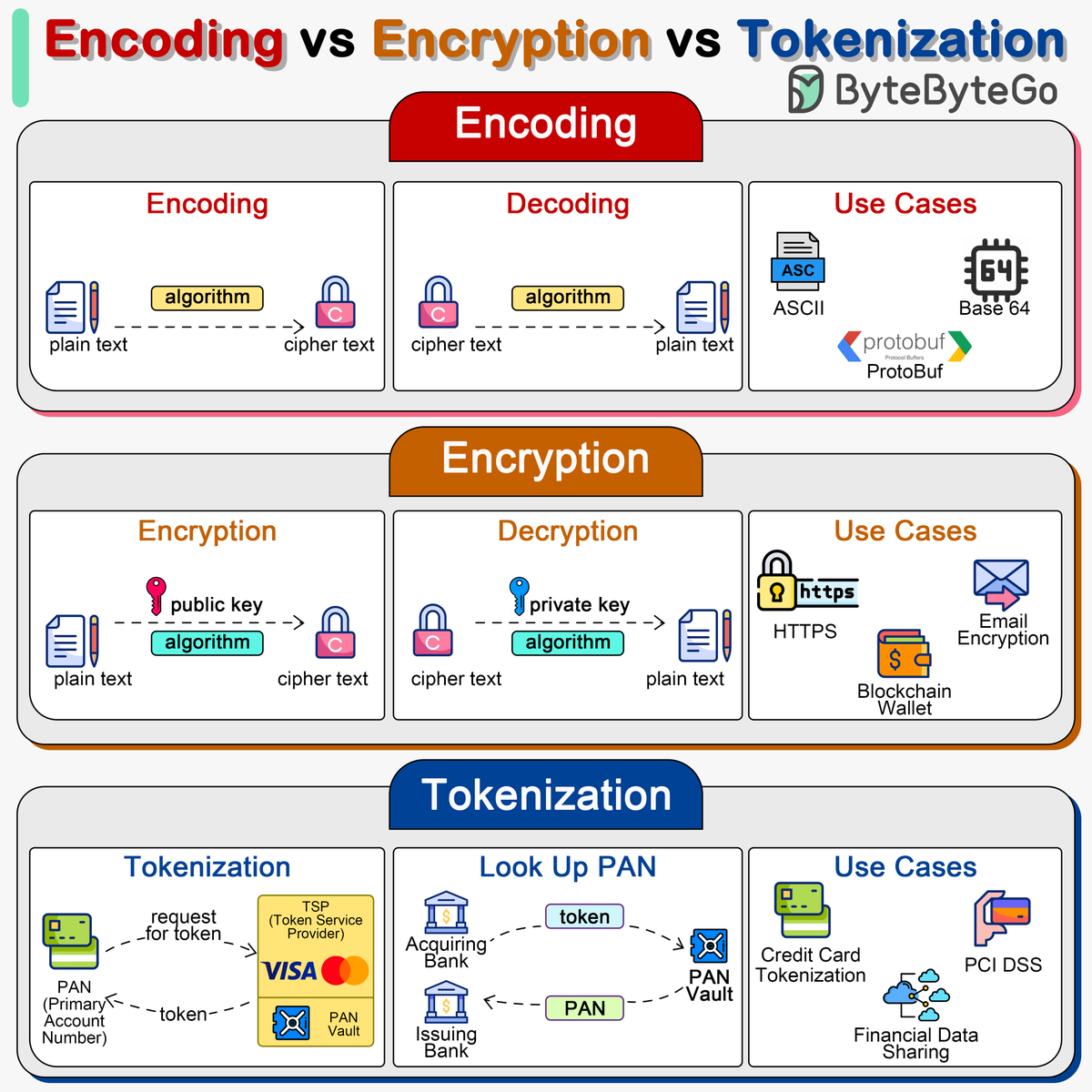
Encoding vs Encryption vs Tokenization.
Encoding, encryption, and tokenization are three distinct processes that handle data in different ways for various purposes, including data transmission, security, and compliance.
In system designs, we need to select the right approach for handling sensitive information.
🔹 Encoding
Encoding converts data into a different format using a scheme that can be easily reversed. Examples include Base64 encoding, which encodes binary data into ASCII characters, making it easier to transmit data over media that are designed to deal with textual data.
Encoding is not meant for securing data. The encoded data can be easily decoded using the same scheme without the need for a key.
🔹 Encryption
Encryption involves complex algorithms that use keys for transforming data. Encryption can be symmetric (using the same key for encryption and decryption) or asymmetric (using a public key for encryption and a private key for decryption).
Encryption is designed to protect data confidentiality by transforming readable data (plaintext) into an unreadable format (ciphertext) using an algorithm and a secret key. Only those with the correct key can decrypt and access the original data.
🔹 Tokenization
Tokenization is the process of substituting sensitive data with non-sensitive placeholders called tokens. The mapping between the original data and the token is stored securely in a token vault. These tokens can be used in various systems and processes without exposing the original data, reducing the risk of data breaches.
Tokenization is often used for protecting credit card information, personal identification numbers, and other sensitive data. Tokenization is highly secure, as the tokens do not contain any part of the original data and thus cannot be reverse-engineered to reveal the original data. It is particularly useful for compliance with regulations like PCI DSS.
–
Subscribe to our weekly newsletter to get a Free System Design PDF (158 pages): https://t.co/FIzCeaWsZV
Article très long mais très touffu sur la genèse de git. Un must-read écrit par @brachiosoft - partagé par le sieur @PierreArlais : https://t.co/rjAmPuyJws