Trading is a tool for life, not life itself
Yesterday, @jfsrev brought up a very profound topic that really resonated with me. I’ve already thanked him for those words. I experienced this myself after I quit my job. The first year was profitable—I earned twice as much as I had in the office—but then the market shifted.
It is particularly challenging when you previously headed an analytics department at a brokerage firm, but are now a trader who needs to adapt. You have to set your ego aside, stop searching for the reasons behind every market move, focus instead on the process and price action, and avoid looking back at former colleagues who chose a different career path.
Trading coach Steve Ward has described this primary psychological challenge of our profession very accurately:
"It is difficult to exert significant effort over a long period if there is no guaranteed reward at the end. In trading, you may work extremely hard, yet still face periods where you receive no financial reward. Just imagine what would happen if that were the case in a conventional job! As a trader, you must have clearly defined goals, maintain a positive outlook and a high level of self-confidence, and be capable of working long and hard—all while remaining aware that you might, in fact, never reach those goals, or at least not anytime soon."
I’ve written about this before, but I’ll say it again. Few people talk about it openly, but one of the primary fears traders harbor—yet keep to themselves—is the fear that all those years spent trading won’t actually translate into a better standard of living. This weighs especially heavily on those for whom trading has become their sole source of income and the foundation of their self-worth.
Therefore, when you lose money, you feel like a failure—not just as a trader, but as a person. In this regard, @steenbab argues that, to be productive in trading, one needs to draw energy from other areas of life.
Why is it so vital for us? If you have achieved success in sports, business, or a hobby, then a losing deal does not destroy your sense of self. You simply move on.
Trading is a constant process of suppressing emotions. If you don’t have an outlet where you can release them in a healthy way, they will build up and eventually erupt as "tilt." Sports are an effective and quick way to let them out.
It’s no coincidence that movies often show white-collar professionals playing squash, or that many Silicon Valley startup founders are into surfing. In fact, many entrepreneurs and executives who live under constant stress choose running. Lately, I’ve also resumed my morning runs and brought back intense physical workouts.
Consequently, to become a professional trader without burning out, you need to stop being one 24/7. You must accept that it is impossible to trade every single piece of news or event. This is especially challenging nowadays, when we always have our phones in our hands and any geopolitical development can trigger significant market movement. And, as Jeff said, don’t look around at what others are doing.
You're Not Behind In Life Because of Today's Market - You're Just Competing With Yourself.
If you're trying to transition into trading from a demanding career, here is a hard truth: you are going to feel behind in life, especially in this market situation. You look at friends and family on normal, predictable paths compounding steady promotions, titles, and linear progress, while you sit in front of screens fighting your own psychology and enduring drawdowns. Naturally, it feels like they are sprinting while you're stuck.
That comparison, however, is a complete trap. You aren't competing with them, and you never were; trading isn't a race against your peers. Behind the charts, numbers, and technical frameworks lies a deeply personal psychological trial where your real job isn't predicting candles — it's aligning your mindset, emotional triggers, and thought processes with the market's inherent nature of absolute uncertainty. When you constantly look sideways at what everyone else is doing, you get out of your own lane, start chasing setups that aren't yours, force trades, and ultimately lose touch with your process.
Breaking this loop requires intentional redirection. You must slow down and ground yourself in your own execution, knowing that when you stop rushing to keep up, your mental clutter clears and actual chart opportunities become visible. Release the pressure to explain your timeline or seek external validation from family or strangers, because true proficiency in markets takes the time it takes.
Finally, don't suffer in isolation; find a community or mentors who understand the raw realities of the craft makes all the difference on a journey that is undeniably difficult, but doesn't have to be lonely.
Trust your own timing.
💼 Current Open Positions
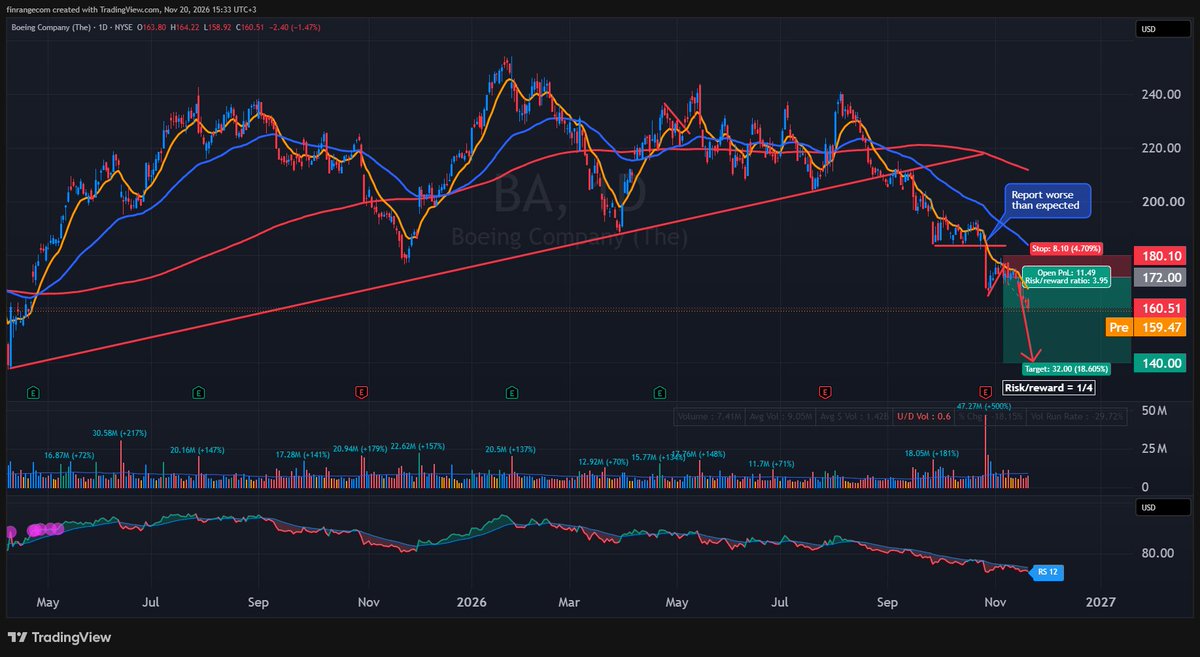
Short $BA (opened Nov 5), target: 140
Short $NFLX (opened Nov 16), target: $50
Short $CFG (opened Nov 17), target: $50
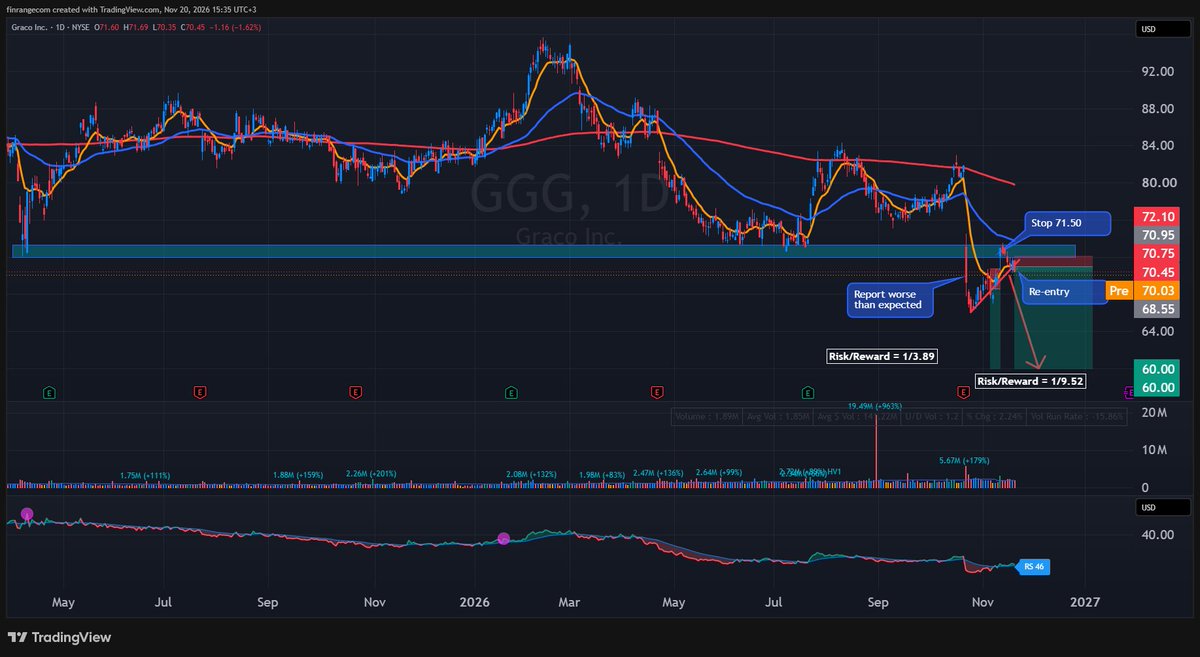
Short $GGG (opened Nov 19), target: $60
🔖 Market Overview for November 20, 2026 – Anthropic IPO Fails to Provide a Boost
Yesterday, U.S. indices opened with an upward gap in anticipation of the Anthropic IPO, but they reversed course almost immediately.
As I noted yesterday, IPOs of this scale absorb a significant amount of liquidity from the broader market—a dynamic that works against market growth.
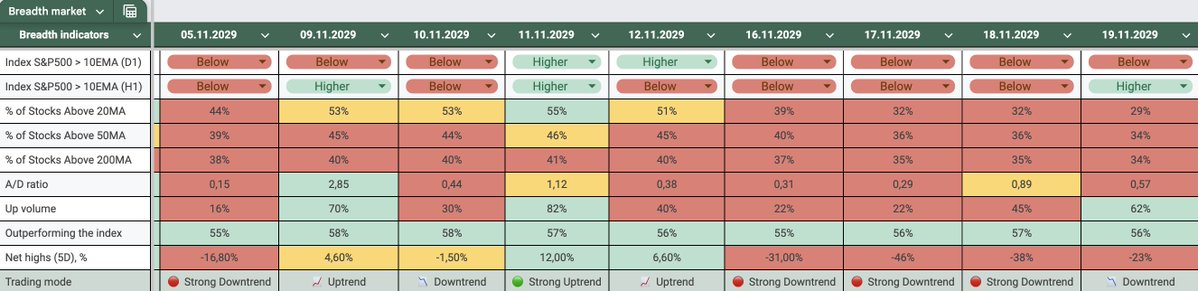
Furthermore, market structure and breadth indicators pointed toward a continued decline in equities. Everything unfolded according to my scenario, which is why I added another short position yesterday.
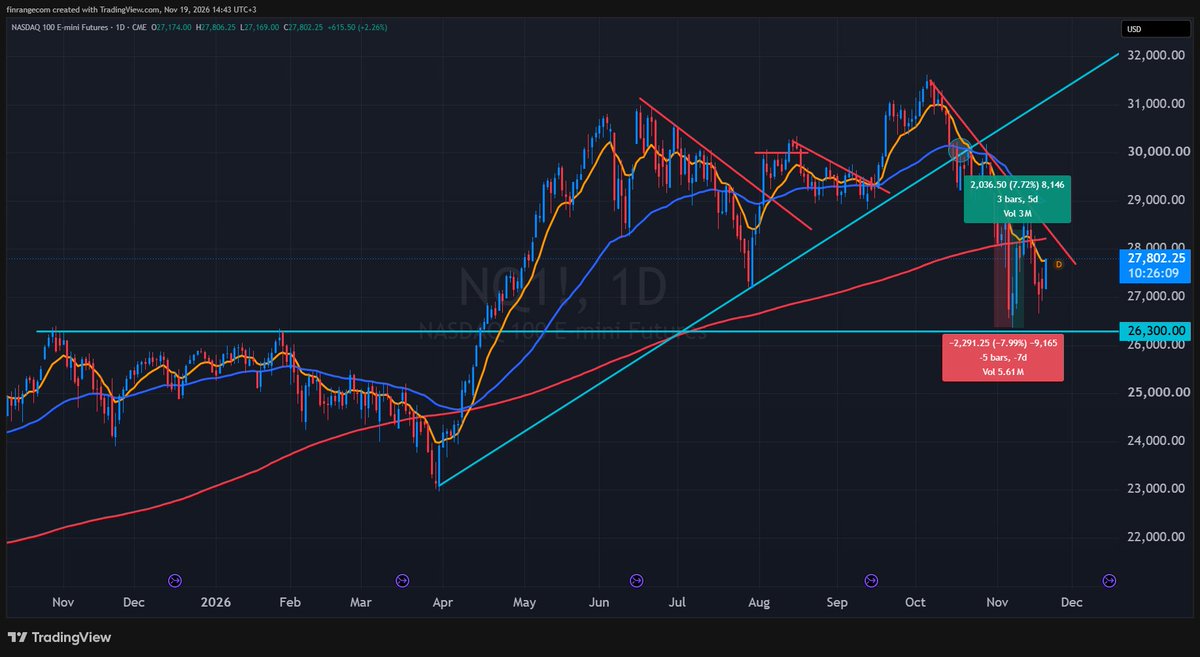
The final blow to the markets was the lackluster Anthropic IPO, with shares now down 10%. U.S. futures continue to slide today; consequently, I expect the market to open with a downward gap.
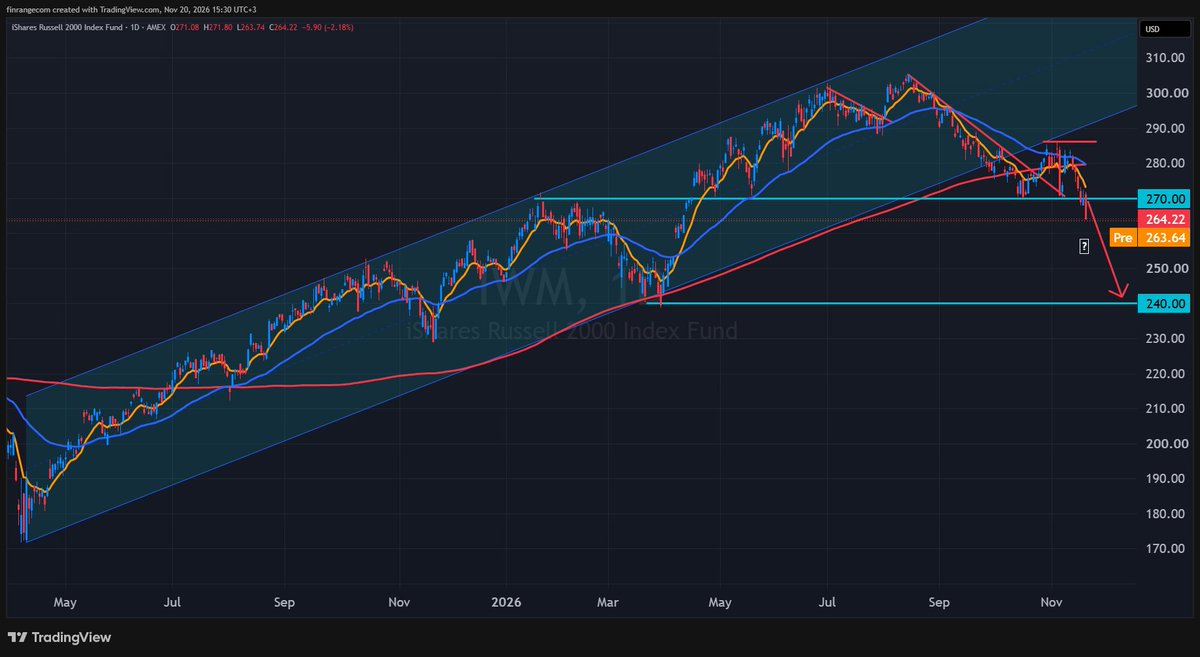
Given this decline, I intend to trim my short positions and move my stop-loss orders to break-even. After a drop of this magnitude, a rebound could occur at any moment—and in a bear market, such rebounds are often sharp, driven by short squeezes.
Therefore, it is prudent to lock in some profits. I could have potentially earned much more had I shorted high-beta stocks.
@markminervini, I completely agree with you. Let’s wait until the market closes. It’s better to miss the start of a move than to end up getting stopped out tomorrow.
I see that U.S. indices are rising today against the backdrop of negotiations regarding the Strait of Hormuz. Oil prices are down 4.5%, while U.S. Treasury yields and the VIX are both declining. I also observe an improvement in market breadth. Nevertheless, this looks like a short squeeze.
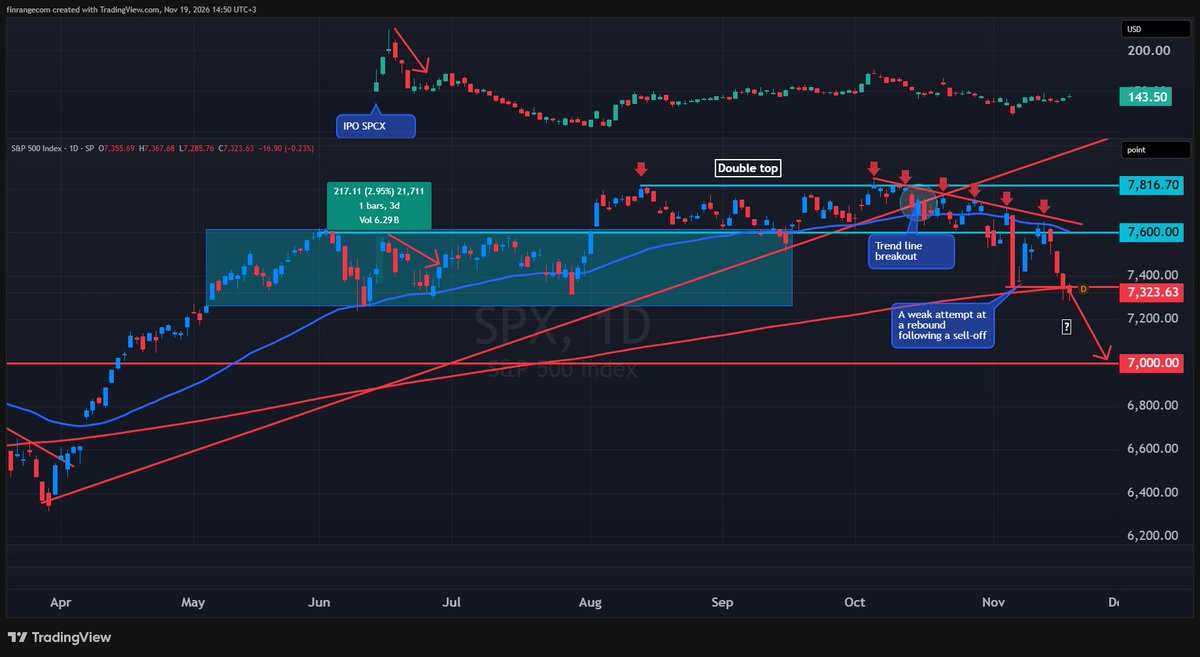
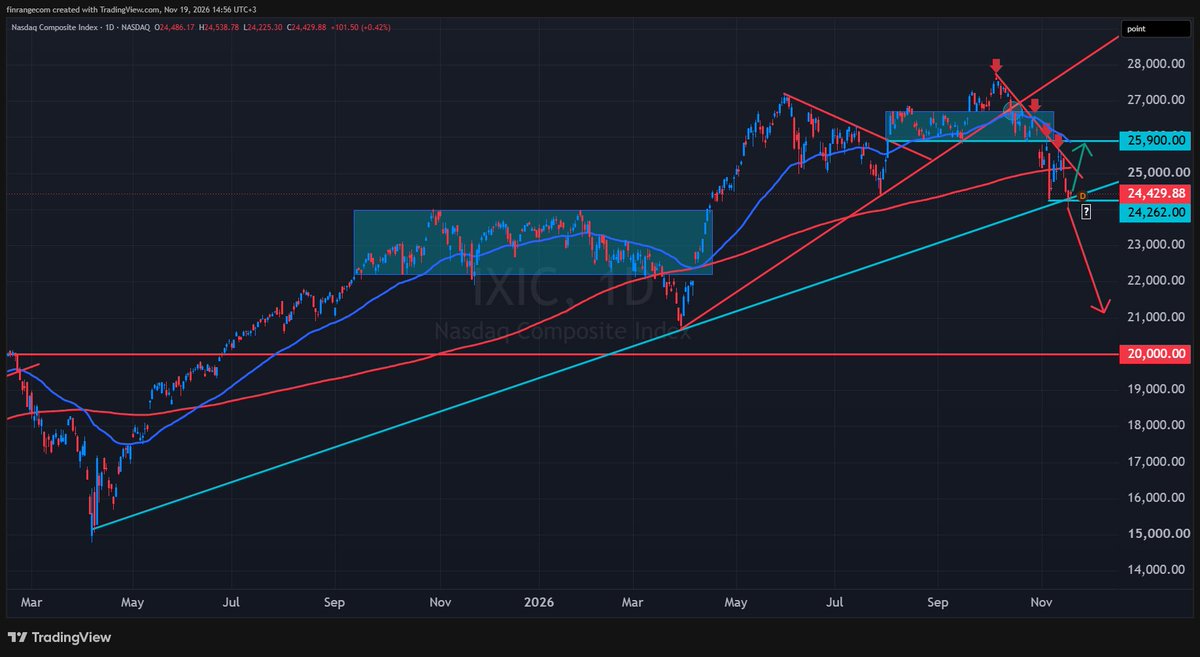
It is worth noting that the S&P index has formed a "double top" pattern against a backdrop of high oil prices, accelerating inflation, rising U.S. Treasury yields, and a war with Iran.
The Democrats' victory triggered a market sell-off, leading to a sharp decline of over 4% in a single day. The following day, the market attempted a recovery driven by the covering of short positions; however, prices turned downward again in the second half of the session, resulting in a weak close.
Everything suggests that it is best to refrain from opening long positions at this time. Today’s uptick may well be a false move. It will be interesting to observe how the index behaves near its 200-day moving average, especially since S&P futures failed to break through this level and instead pulled back from the 200 SMA.
I’ve re-entered a short position on #GGG at 70.95, with a tight stop at 72.1 and the same target of 60. Those who prefer less risk can set a wider stop at 73.55. The shares have once again bounced off the 73.5 resistance level. Today, following a strong market open, many indices and stocks immediately reversed downward and moved into the red—further confirmation of market weakness. Consequently, I am looking for entry points to re-enter positions.
@AmeetRai Thanks for sharing your thoughts, @AmeetRai. I also set alerts ahead of key levels. Additionally, I place alerts near my stop-loss and target levels so I can assess the situation and avoid slippage that might occur during an automatic position closure.
Today, all eyes in the U.S. stock market will be on the Anthropic IPO.
Against this backdrop, U.S. stocks are seeing a rebound. When $SPCX held its IPO, the index rose for three days alongside the stock, only for everything to subsequently turn negative.
We shall see how things play out this time. Market sentiment is different now compared to when
$SPCX went public in June; however, the overall market structure still favors a downward trend.
Today, all eyes in the U.S. stock market will be on the Anthropic IPO.
Against this backdrop, U.S. stocks are seeing a rebound. When $SPCX held its IPO, the index rose for three days alongside the stock, only for everything to subsequently turn negative.
We shall see how things play out this time. Market sentiment is different now compared to when $SPCX went public in June; however, the overall market structure still favors a downward trend.
🔖 Market Overview for November 19, 2026 – Anthropic IPO
Today, all eyes in the U.S. stock market will be on the Anthropic IPO.
Anthropic shares have been priced at $83 (above the proposed range of $70–78), resulting in a market capitalization of approximately $1.5 trillion.
Demand for the shares ahead of the public offering exceeded supply by more than 10 times.
Pre-IPO futures for Anthropic are currently trading 26% above the $83 offering price.
Against this backdrop, U.S. stocks are seeing a rebound. When $SPCX held its IPO, the index rose for three days alongside the stock, only for everything to subsequently turn negative.
We shall see how things play out this time. Market sentiment is different now compared to when #SPCX went public in June; however, the overall market structure still favors a downward trend.
I do not intend to trade these rebounds. It would take significant strength for the indices to break through their recent highs—perhaps $ANT could be the catalyst for that.
Nevertheless, we have seen two record-breaking IPOs in the span of just five months, both of which are absorbing a massive amount of liquidity from the broader market. This does not bode well for market growth.
Meanwhile, there is a widespread expectation that the Federal Reserve will raise interest rates in December 2026, as well as in January and March 2027.
Best regards, Dmitry!
@KynaKosling Regarding your message about traders on Twitter, I think algorithms that push emotional posts, as well as the market environment, are at play here. It's hurting a lot of people.
@kingstonstock85@MikeBellafiore@smbcapital You misunderstood me) You're talking about the drawdown itself and the series of losses. I'm asking about the nuances of risk management.
I read you and other Substack authors. And I don't understand why so many of you have had low reach in recent months. Despite all this, you have great content and a large number of subscribers. I think it's because you send emails. Not everyone opens the emails, and those who do open them don't go to the website or get any reactions. So, is that the end result of no reach?
Thanks, I’ve read it a few times, but I don’t recall the specific figures.
Here’s what I’m wondering: if a trader hits 3 consecutive stop-losses on a single stock—resulting in a loss of 3R or $300—are they prohibited from trading for the rest of the day? And if the daily loss limit is $500, does that mean they are allowed to continue trading?
@Muninn As I wrote previously in the article https://t.co/qXRxRDZDnS: "In the market, there is simply no such thing as a single 'correct' decision. There are only subjective trading rules that must be followed."
There are no perfect settings
Today I read an excellent article by @Muninn about entry points that he learned from Qullamaggie.
I liked his conclusion that there are no perfect settings. James says, "I chose one of the options and made peace with the result."
Nevertheless, his research is of great value. It allows you to view the trading of top traders from a different perspective. Based on this, you can optimize your own trading—but be careful not to overdo it.
I also liked his remark: "Stopping is the cost of a single attempt, not a final assessment of the idea itself." In other words, if the scenario remains valid, try again.
In most cases, @Qullamaggie will re-enter the same stock after a stop-loss. I find this difficult to do, but I make an effort to re-enter. I have a few rules for re-entry.
First: I can re-enter a trade up to two more times if it’s an "A+" setup. Three consecutive stop-outs on the same stock would result in a total loss of -3R. Furthermore, there’s a risk of falling into "tilt"—a state where you end up fighting against the stock or the market. Besides, a fourth re-entry makes no mathematical sense. I picked up this rule from @MikeBellafiore.
Second: I re-enter the market after at least an hour. If, during that time, the price fails to develop a trend and instead returns to its previous level—while the original scenario remains intact—I take this as further confirmation. Moreover, such a pause helps me avoid market noise and the risk of going on "tilt."
Ultimately, it is not some secret set of entry parameters that generates profit, but rather your ability to execute an idea systematically for as long as it remains viable.