🚨 Critical nginx vulnerabilities disclosed. Immediate action recommended.
If you run nginx, check whether your servers are affected and update to the patched version immediately. If you cannot upgrade, follow the mitigation guidance at https://t.co/ry2F1UMUVk
Today we’re disclosing nginx2root, five distinct vulnerabilities in one of the world’s most widely deployed web servers, each capable of unauthenticated remote code execution under affected conditions. One of these vulnerabilities affects nginx’s most common configuration. We’ve also demonstrated a fully remote, unauthenticated exploit chain that escalates from nginx RCE to root access on the underlying server, using a separate Linux kernel vulnerability.
Why this is so important:
One of these bugs has been hiding in nginx’s HTTP/2 implementation since 2015. That’s more than a decade in software that powers roughly a third of the web. Every official release from 1.9.5 through 1.31.8 contains the vulnerable code, including the master branch as of Nov 10, 2026.
A Xint researcher found the specific vuln that hits nginx in its default config. This discovery was around the same time he found another critical vulnerability in a different project that we cannot talk about yet due to the same concerns as nginx2root. We took those learnings and incorporated them into the harness as a new, general Xint feature (that is, not fine-tuned to nginx), which then found the other 4 critical nginx vulnerabilities with no human guidance.
We coordinated disclosure with the nginx maintainers and major cloud providers to help make fixes available before publication.
Technical details, affected versions, and remediation guidance:
https://t.co/ry2F1UMUVk
Pre-auth RCE in nginx is the bug every hacker dreams of finding. It almost never happens.
Today we’re disclosing nginx2root: five nginx vulnerabilities, and an exploit that takes an unauthenticated attacker all the way to root.
One of themhits the default config.
If you run nginx, patch now. Then read: https://t.co/rDQQAimLZP
CVE-2026-123007, CVE-2026-123634, CVE-2026-123633, CVE-2026-121810, CVE-2026-113425
Thrilled to learn our (@theori_io) CRS got first place in the AIxCC Semifinal competition. For the semifinal competition, we focused on implementing simple ideas in a robust way. I'm eager to implement our more ambitious ideas for the final event next year!
https://t.co/17NpbBlbuv
🚨 New Linux Kernel vulnerability (CVE-2024-27394) discovered & patched by Theori!
🔗 https://t.co/w5s8PTDvdl
Our researcher @v4bel at #Theori identified a critical #UAF vulnerability in TCP-AO caused by a race condition in the #RCU API. Using techniques from the ExpRace paper, we extended the race window to demonstrate its exploitability.
Curious how we did it?
Read our deep dive for the full details!
#Theori #Cybersecurity #LinuxKernel #TCP #VulnerabilityResearch #CVE #TechBlog
In a recent #APT simulation, #Theori uncovered 4 critical #RCE vulnerabilities in @cososys Endpoint Protector (EPP) that let us fully compromise the server & clients. Here’s a peek:
👾 CVE-2024–36072: Unauthenticated attackers can exploit a logging flaw to execute system commands with root privileges.
👾 CVE-2024–36073: With admin access, attackers can overwrite configurations and execute commands on client endpoints.
👾 CVE-2024–36074: Server access allows attackers to execute malicious files.
👾 CVE-2024–36075: Unauthenticated attackers can manipulate client configurations to potentially bypass security and achieve remote code execution.
Could your server be #hacked the same way? Find out through our blog post!
👉 https://t.co/PslFaFDbcF
Today, Angelboy (@scwuaptx) revealed his Kernel Streaming research! 🚀 Check out how he uncovered this overlooked attack surface, leading to pwning Windows 11 at #Pwn2Own Vancouver 2024:
https://t.co/sPrNqjPoDO
#WindowsKernel#MSRC
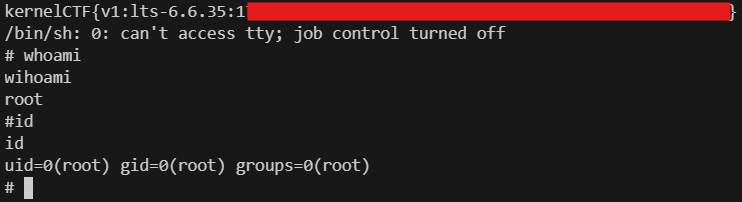
Our team member @v4bel and @_qwerty_po exploited kernelCTF lts with 0day vulnerability. It was really amazing work. They'll gonna share the detail soon.
Part 4 of our N-Day Exploit Series is LIVE! 🔥
➡️ https://t.co/7qm9IzDqYu
Unveiling CVE-2023-34044, an information leakage vulnerability in #VMware Workstation’s #VBluetooth device, found by our own @pr0ln!
It’s a variant of CVE-2023-20870 demonstrated by @starlabs_sg in #Pwn2Own2023 Vancouver.
Dive into the details.
#Theori #티오리 #VulnerabilityResearch #ndayfullchainexploit
We posted our third writeup of N-day full chain series:
Chaining N-days to Compromise All: Part 3 — Windows Driver LPE: Medium to System https://t.co/wEsseLMLDU
@qwqbebe Our team likes to share things, so 'maybe' we could make it public.
Before that, please look forward to the N-day chain blog series that will be posted soon. :)
Confirmed! Gwangun Jung (@pr0ln) and Junoh Lee (@bbbig12) from Theori (@theori_io) combined three different bugs to escape #VMware Workstation and then execute code as SYSTEM on the host OS. This impressive feat earns them $130,000 and 13 Master of Pwn points. #Pwn2Own
Wow! The Theori was able to exploit VMware Workstation with an additional Windows Kernel LPE vulnerability in the Virtualization category. They went from guest OS to SYSTEM on the host OS. They're off to the disclosure calls with details. #Pwn2Own