To understand how badly this country is broken, just imagine that I receive over 1,000 complaints every day from different parts of Kenya.
From companies, public institutions, private offices, banks, schools, hospitals, government departments, workplaces and ordinary citizens dealing with everyday injustice.
It is everywhere.
The problem is no longer just bad leadership. It is a rotten national culture where people abuse power, steal, intimidate, frustrate, neglect duty and expect victims to suffer quietly.
This country needs more than reforms. It needs a serious moral reset.
🦔Microsoft and Abu Dhabi-based G42's planned $1 billion AI data center in Kenya has stalled after the Kenyan government could not meet Microsoft's demand for guaranteed annual capacity payments. President William Ruto said the country would need to "switch off half the country" to power the facility at its full 1 gigawatt scale, since Kenya's total installed capacity sits at roughly 3,000 megawatts and peak demand hit 2,444 megawatts in January.
Nearly half of planned US data center builds this year have been delayed or canceled due to power infrastructure shortages, and Microsoft is spending $190 billion on capex in 2026 while adding one gigawatt of capacity every three months globally.
My Take
A foreign tech company asking Kenya to allocate one-third of its national grid to a single facility shows how the AI buildout has stopped fitting into any normal model of industrial development. The structure Microsoft wanted required Kenya to make guaranteed capacity payments regardless of whether the facility operated at full power, which makes sense for the hyperscaler and almost none for a country whose citizens already deal with rolling blackouts.
Kenya is the international version of what is happening in Saline Township, Tucson, Fayetteville, and Maine. Hyperscalers are running out of places to build because grid capacity is the binding constraint, and the strategy has shifted to finding jurisdictions where regulatory and political pushback is weakest. Kenya looked attractive because of the Olkaria geothermal complex and a government eager for foreign investment, until anyone actually counted the megawatts. Microsoft adding a gigawatt every three months is not a sustainable pace against current grid constraints, which is why projects keep getting canceled in the US and why the company looked at Kenya in the first place.
Hedgie🤗
La responsabilidad pública también implica la obligación moral de no mirar hacia otro lado.
Es un honor otorgar la Orden del Mérito Civil a una voz que sostiene la conciencia del mundo: @FranceskAlbs, Relatora Especial de la ONU en el territorio palestino ocupado.
IN PRAISE OF FRANCESCA ALBANESE
There is a question that visits me in the small hours, when sleep will not come and the mind turns over old stones. The question is this: “What would I have done in the 1930s, on the morning after Kristallnacht?"
Not what I say I would have done. Not what I hope I would have done. But what would I actually have done—when the trains began to run, when the neighbours grew quiet, when the cost of decency became the loss of everything?
Most of us, I think, would have done little. Not from malice. From fear. From the soft, creeping conviction that someone else will speak, that the situation is complex, that we must be 'reasonable'. Lest we forget, the ordinary is the extraordinary's alibi. And how we have clung to that alibi! How we still cling to it!
And then, every once in a terrible while, someone appears who does not cling. Someone who steps forward when others step back. Someone who speaks the name of the thing when everyone else is busy naming something else.
Francesca Albanese is that someone.
She stands before the world—alone, unarmed, armed only with law and language and a rare courage—and she says what the centrists will not say, what the foreign ministries will not say, what the editorial boards will not say. She says: "This is a genocide. And we are watching it happen."
Do not tell me that is hyperbole. Do not tell me the term is contested. She has not used it lightly. She has used it as a physician arrives scientifically at a diagnosis—not to wound, but to warn. Not to inflame, but to name.
And for that, they have come for her. Oh, how they have come for her. Smears. Investigations. Vicious editorials. Frozen bank accounts. Dispossession of the only apartment she had ever owned. The machinery of the respectable turned to crush her. Because the respectable cannot abide what she represents: a mirror held up to their complicity.
Let us, once again, travel back to the 1930s. Back to the few who stood up when the trains began to run laden with Jewish people.
There was Aristides de Sousa Mendes, a Portuguese consul in Bordeaux. He defied his own government. He signed thousands of visas, by hand, for hours, until his fingers bled. He saved more lives than Schindler. And he died penniless, disgraced, erased.
There was a German officer in Warsaw named Wilm Hosenfeld. He hid a Jewish pianist in the rubble. He did not save thousands. He saved one. But that one—Władysław Szpilman—carried the memory. And memory is "the only haven from which we cannot be expelled."
There was Raoul Wallenberg. There were the villagers of Le Chambon. There were the anonymous, the quiet, the furious few who said: “Not on my watch.”
Francesca Albanese is their heir. Not because she carries a gun. Not because she hides refugees in her basement. But because she does something equally dangerous in a world that has perfected the art of not seeing. She sees. And she speaks.
She does not speak as a diplomat. Thank Goodness she doesn't! Diplomats have given us the language of "there are arguments on both sides" and "restraint" and "proportionality." Diplomatic language is the perfumed grave of moral clarity. No, she speaks as a jurist. As a human being. As a woman who has looked into the abyss and refused to call it a "complex geopolitical landscape".
Edna O'Brien once described a character who "had the recklessness of those who have already lost everything worth losing." Francesca Albanese has not lost everything. She has her dignity, her office, her voice, her family. But she has calculated the cost of speaking truth to power. And she has decided that that cost is infinitely less than the cost of silence.
What is that cost? Let us name it. She has been called antisemitic—she, who stands on the ground of international law forged in the ashes of Auschwitz and the fires of Nuremberg. She has been called a conspiracy theorist—she, who cites every source, every footnote, every UN resolution. She has been called naive—she, who understands better than most the machinery of realpolitik.
These accusations are not arguments. They are the spittle of the threatened. Because Francesca Albanese threatens something very precious to the powerful: the right to commit atrocity without being named.
Friends, the 1930s did not arrive with jackboots and pogroms on day one. They arrived in small increments. With "reasonable" restrictions. With "proportional" measures. With the silence of the respectable.
We tell ourselves that we would have been different. That we would have been Sousa Mendes. That we would have been Wallenberg. But most of us, I fear, would have been the neighbours who later said, "I didn't know."
Francesca Albanese knows. And she refuses to pretend otherwise.
So let us praise her. Not with statues or awards she does not seek. But with something harder: with our own refusal to look away. With our own voices, raised in places that are safe for us but dangerous for her. With our own bodies, if it comes to that.
A brave woman, who was injured while demonstrating outside a US nuclear military base in 1982, the infamous Greenham Common, had told me that "the heart is a hunter for what it cannot have." But I say the heart is a hunter for what it will not lose. And what we will not lose is the memory of those who stood up when standing up cost everything.
Francesca Albanese is standing up now. In our time. In our name. Under our indifferent sky.
Let us stand with her.
Not tomorrow. Not when it is safe. Now.
[Extract from a speech in Athens on Sunday 3rd May 2026]
Borneo Rainforest estimated to be approximately 130 to 140 million years old
Yet Indonesia has destroyed more than 90% of Borneo’s primary forest
Imagine a species that pays more respect to a 100 year old building than 130 million year old forest
Earth is being obliterated
I have a friend whose life changed last June, when a small cottage brick company in Nyeri shut down due to losses and high taxes. That closure didn’t just end a business it left 380 people without jobs.
Brian was one of them. He had worked there for two years. Skilled. Disciplined. I first met him when he came to a school I was teaching at to deliver and install cabros you could tell he took pride in his work.
But since the closure, life has been unravelling for him. His wife left. He sold his cow goats hens. He no longer has electricity he used to have a small arrangement with his uncle, paying KSh 200 to stay connected. That’s gone now.
Today, he passed by my house after a month of not seeing him . I barely recognized him. He looked emaciated… broken. Beaten down by life. And at home, things aren’t any easier his father struggles with bipolar disorder and alcohol.
I’m not sharing this for pity. I’m sharing it because behind every closed business is a human story.
This has been weighing heavily on me, and I can’t stay quiet about it any longer.
I am 71 years old. I’ve been fortunate enough to attend five World Cups, starting in 1986. Those tournaments weren’t just events to me, they were life chapters. They were about connection, about culture, about standing shoulder to shoulder with people from every corner of the world, united by the game we love.
But what I’m seeing now breaks my heart.
The current dynamic pricing strategy for the upcoming World Cup feels completely detached from the very soul of football. Yes, this tournament is being played mostly in the United States, and yes, it’s a premium market. But football was never meant to be a luxury product reserved for the highest bidder. It belongs to the people. Always has. I looked back fondly at USA 94 and everything we did then to fill stadiums and bring the game to life for Americans who were just dipping their toes into the water of the beautiful game.
Right now, it feels like the average, passionate supporter, the ones who save for years, who travel across continents, who bring the color, the noise, the spirit, are being pushed out. Replaced by a model that prioritizes revenue over reality.
That’s a dangerous road because once you lose the authentic fan, you lose the essence of what makes the World Cup special.
I say this not just as a fan, but as someone who has spent a lifetime in and around the game. During my time at EA SPORTS, we stood shoulder to shoulder with FIFA when they needed it most. Our game kept millions of fans connected to football and to the World Cup when trust in the organization was at its lowest. We helped carry the flame.
Which is why this moment feels even more disappointing.
This may well be one of the last World Cups I have the chance to attend and I find myself wondering if the game I’ve loved all my life is slowly drifting away from people like me, and far more importantly, from the next generation who deserve to feel what I felt in 1986.
The World Cup should unite the world. Not divide it by price.
Football deserves better. And so do the fans. Come on @FIFAcom , sort this out… It’s not too late.
🦔 Oracle laid off between 20,000 and 30,000 employees Tuesday morning, roughly 18% of its global workforce, via a single email sent at 6am EST with no prior warning. System access was revoked almost immediately after. The cuts are expected to free up $8-10 billion in cash flow. Oracle's stock has lost more than half its value since September 2025 and the company now carries over $124 billion in debt, up from $89 billion a year ago, with free cash flow running negative $10 billion last quarter.
My Take
Oracle posted a 95% jump in net income last quarter and still eliminated 18% of its workforce by email before most people finished their morning coffee. This is not a company in distress in the traditional sense. It's a company that made an enormous debt-funded bet on AI infrastructure and is now converting its workforce into cash flow to service that debt.
We've covered Oracle's AI gamble for months. The $300 billion OpenAI deal through Stargate, $50 billion in capital expenditure this fiscal year, over $124 billion in total debt. Multiple US banks have pulled back from financing Oracle-linked data center projects. Bondholders have sued Oracle claiming it concealed how much additional debt the OpenAI deal would require. The credit default swap spread hit a three-year high earlier this year, meaning debt investors are genuinely nervous about getting paid back.
The workers who got that 6am email built the products Oracle has monetized for decades. The bet that eliminated their jobs was made by people who were already paid regardless of how it turns out. That is the part of the AI infrastructure race that doesn't show up in the capex announcements.
Hedgie🤗
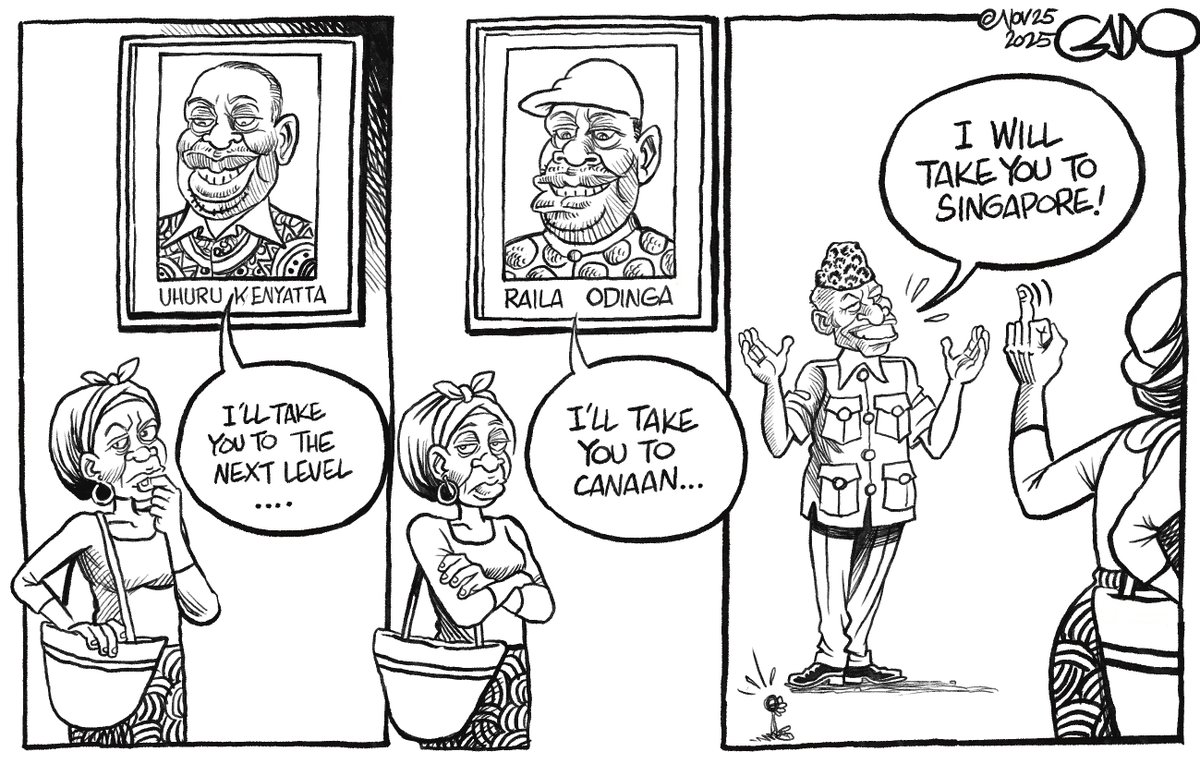
World bank and IMF know African leaders steal from the loans borrowed... The question is why still give out the money?
Simple: ENTRAPMENT! Let's keep these burgers on a leash.
During this rainy season, everyone is urged to exercise extreme caution. Earlier today in Maasai Mara National Reserve, a powerful bull elephant was forced to turn back after attempting to cross the heavily flooded Sand River. The strong current and rising water levels made the crossing too dangerous, even for such a massive animal.
This serves as a clear reminder to all driver guides and visitors that rivers can become extremely unpredictable during the rains. Please approach river crossings carefully and avoid unnecessary risks. Safety should always come first in these conditions.
🎥 Video by Enock Sayagie.
In the midst of this latest war of choice in the Middle East, one feels a profound sense of helplessness- angered by imperial America, disgusted by Israel’s aggression, bemused by Europe’s posture, ashamed of Arab officialdom, exasperated with Russia and China, disappointed by the UN, and deeply sorry for the Iranian people.
I've just been chatting with Nick Cullinan, the excellent new director of the British Museum, and I'm very relieved to say that the story put by the Daily Telegraph about the BM cancelling the name Palestine is a complete misrepresentation of the facts:
"To reassure you we are not removing mention from Palestine from our labels," Nick told me. "Indeed, we have a display on at the moment about Palestine and Gaza.
"I know this is something our curators have thought long and hard about - as you can imagine. We amended two panels in our ancient Levant gallery last year during a regular gallery refresh, when some wording was amended to reflect historical terms.
"To be honest, the even more frustrating and concerning thing is that I knew nothing about this until yesterday and has only been explained to me this morning. I hadn’t even seen that [UK Lawyers for Israel] letter despite asking for it until this morning. I’m disgusted by the whole thing."
The question remains why the Daily Telegraph would put out such a mischief-making story without first fact checking it with the Directors office.
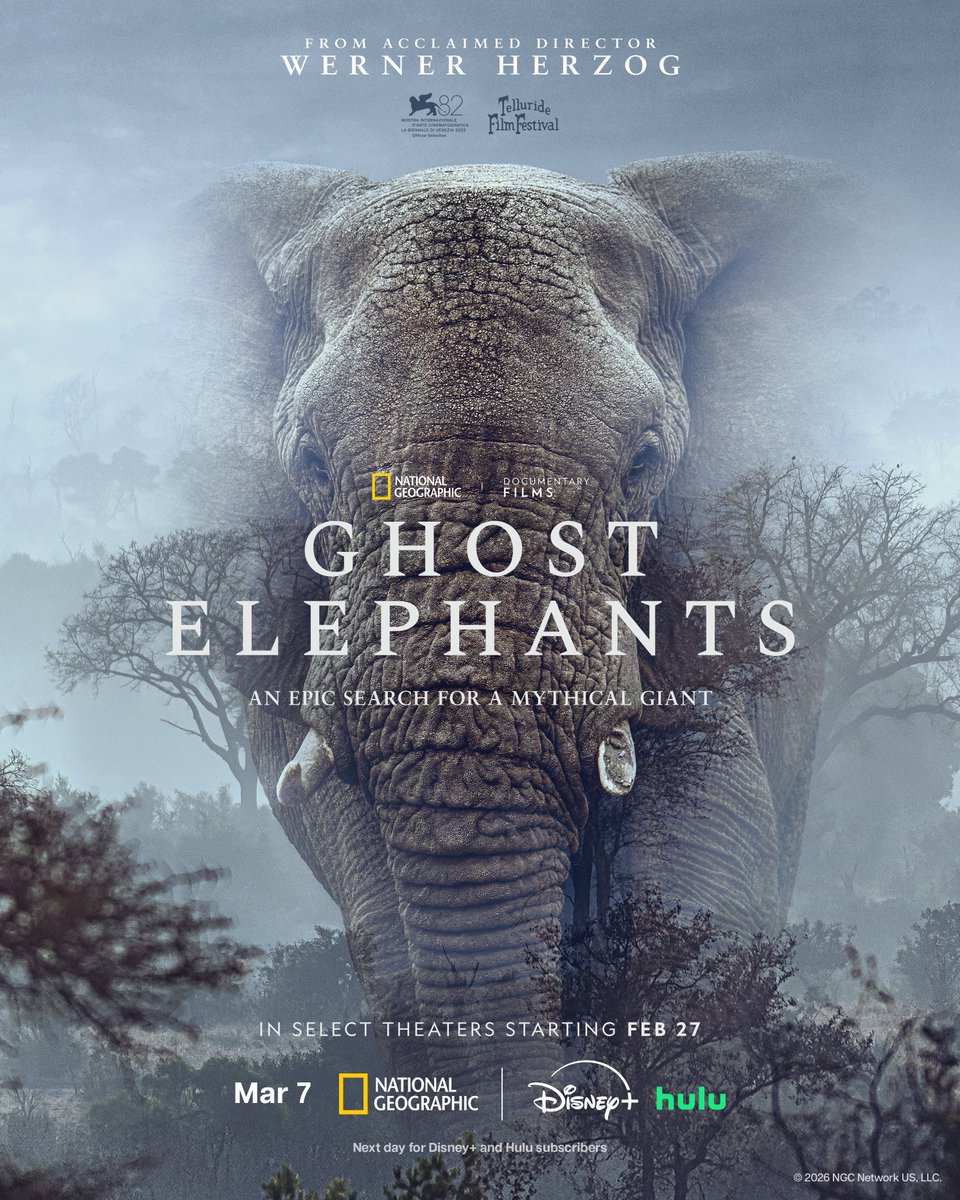
#GhostElephants follows an epic search for legendary elephants hidden deep in the highlands of Angola, led by National Geographic Explorer Dr. Steve Boyes and directed by acclaimed filmmaker Werner Herzog. In select theaters February 27. Premieres March 7 at 9/8c on @natgeotv. Streaming next day on @DisneyPlus and @hulu.


![yanisvaroufakis's tweet photo. IN PRAISE OF FRANCESCA ALBANESE
There is a question that visits me in the small hours, when sleep will not come and the mind turns over old stones. The question is this: “What would I have done in the 1930s, on the morning after Kristallnacht?"
Not what I say I would have done. Not what I hope I would have done. But what would I actually have done—when the trains began to run, when the neighbours grew quiet, when the cost of decency became the loss of everything?
Most of us, I think, would have done little. Not from malice. From fear. From the soft, creeping conviction that someone else will speak, that the situation is complex, that we must be 'reasonable'. Lest we forget, the ordinary is the extraordinary's alibi. And how we have clung to that alibi! How we still cling to it!
And then, every once in a terrible while, someone appears who does not cling. Someone who steps forward when others step back. Someone who speaks the name of the thing when everyone else is busy naming something else.
Francesca Albanese is that someone.
She stands before the world—alone, unarmed, armed only with law and language and a rare courage—and she says what the centrists will not say, what the foreign ministries will not say, what the editorial boards will not say. She says: "This is a genocide. And we are watching it happen."
Do not tell me that is hyperbole. Do not tell me the term is contested. She has not used it lightly. She has used it as a physician arrives scientifically at a diagnosis—not to wound, but to warn. Not to inflame, but to name.
And for that, they have come for her. Oh, how they have come for her. Smears. Investigations. Vicious editorials. Frozen bank accounts. Dispossession of the only apartment she had ever owned. The machinery of the respectable turned to crush her. Because the respectable cannot abide what she represents: a mirror held up to their complicity.
Let us, once again, travel back to the 1930s. Back to the few who stood up when the trains began to run laden with Jewish people.
There was Aristides de Sousa Mendes, a Portuguese consul in Bordeaux. He defied his own government. He signed thousands of visas, by hand, for hours, until his fingers bled. He saved more lives than Schindler. And he died penniless, disgraced, erased.
There was a German officer in Warsaw named Wilm Hosenfeld. He hid a Jewish pianist in the rubble. He did not save thousands. He saved one. But that one—Władysław Szpilman—carried the memory. And memory is "the only haven from which we cannot be expelled."
There was Raoul Wallenberg. There were the villagers of Le Chambon. There were the anonymous, the quiet, the furious few who said: “Not on my watch.”
Francesca Albanese is their heir. Not because she carries a gun. Not because she hides refugees in her basement. But because she does something equally dangerous in a world that has perfected the art of not seeing. She sees. And she speaks.
She does not speak as a diplomat. Thank Goodness she doesn't! Diplomats have given us the language of "there are arguments on both sides" and "restraint" and "proportionality." Diplomatic language is the perfumed grave of moral clarity. No, she speaks as a jurist. As a human being. As a woman who has looked into the abyss and refused to call it a "complex geopolitical landscape".
Edna O'Brien once described a character who "had the recklessness of those who have already lost everything worth losing." Francesca Albanese has not lost everything. She has her dignity, her office, her voice, her family. But she has calculated the cost of speaking truth to power. And she has decided that that cost is infinitely less than the cost of silence.
What is that cost? Let us name it. She has been called antisemitic—she, who stands on the ground of international law forged in the ashes of Auschwitz and the fires of Nuremberg. She has been called a conspiracy theorist—she, who cites every source, every footnote, every UN resolution. She has been called naive—she, who understands better than most the machinery of realpolitik.
These accusations are not arguments. They are the spittle of the threatened. Because Francesca Albanese threatens something very precious to the powerful: the right to commit atrocity without being named.
Friends, the 1930s did not arrive with jackboots and pogroms on day one. They arrived in small increments. With "reasonable" restrictions. With "proportional" measures. With the silence of the respectable.
We tell ourselves that we would have been different. That we would have been Sousa Mendes. That we would have been Wallenberg. But most of us, I fear, would have been the neighbours who later said, "I didn't know."
Francesca Albanese knows. And she refuses to pretend otherwise.
So let us praise her. Not with statues or awards she does not seek. But with something harder: with our own refusal to look away. With our own voices, raised in places that are safe for us but dangerous for her. With our own bodies, if it comes to that.
A brave woman, who was injured while demonstrating outside a US nuclear military base in 1982, the infamous Greenham Common, had told me that "the heart is a hunter for what it cannot have." But I say the heart is a hunter for what it will not lose. And what we will not lose is the memory of those who stood up when standing up cost everything.
Francesca Albanese is standing up now. In our time. In our name. Under our indifferent sky.
Let us stand with her.
Not tomorrow. Not when it is safe. Now.
[Extract from a speech in Athens on Sunday 3rd May 2026]](https://pbs.twimg.com/media/HHsnlr9WIAEr4Cw.jpg)


![DalrympleWill's tweet photo. I've just been chatting with Nick Cullinan, the excellent new director of the British Museum, and I'm very relieved to say that the story put by the Daily Telegraph about the BM cancelling the name Palestine is a complete misrepresentation of the facts:
"To reassure you we are not removing mention from Palestine from our labels," Nick told me. "Indeed, we have a display on at the moment about Palestine and Gaza.
"I know this is something our curators have thought long and hard about - as you can imagine. We amended two panels in our ancient Levant gallery last year during a regular gallery refresh, when some wording was amended to reflect historical terms.
"To be honest, the even more frustrating and concerning thing is that I knew nothing about this until yesterday and has only been explained to me this morning. I hadn’t even seen that [UK Lawyers for Israel] letter despite asking for it until this morning. I’m disgusted by the whole thing."
The question remains why the Daily Telegraph would put out such a mischief-making story without first fact checking it with the Directors office.](https://pbs.twimg.com/media/HBSOtg8bUAAQQoE.jpg)