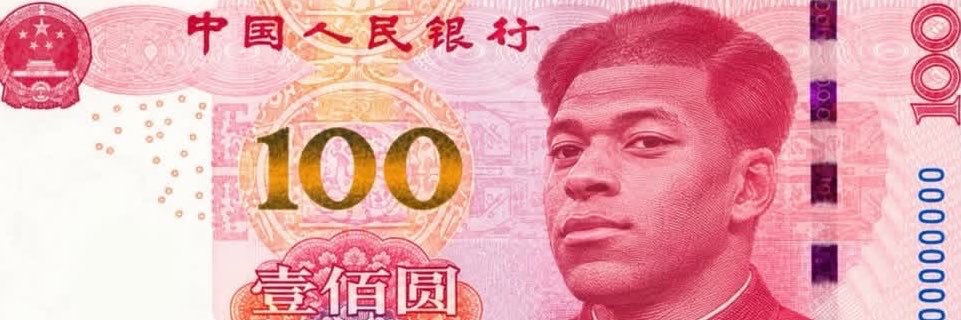
@mattvanswol@naomirwolf Spaniards, please take your stabbings with grace and acceptance of the doctors and engineers flooding into your homeland. Remember that Diversity is our Strength! Once they assimilate and take 10 year old girls as wives, things will be much better.
@LorientZpyt Boycott china. Check your labels. There are plenty of alternatives. Don’t buy a new phone. Keep your older electronics. Don’t fuel their economy.
The Party, the Firewall, and the Fake Voice of China
I recently came across a report about China setting up new internet access centers across the country, allowing authorized entities to connect to the global internet. One stated purpose is to help selected bloggers and institutions “讲好中国故事” — to tell China’s story well.
https://t.co/JdjmMF2myO
Xi Jinping has stressed since 2013 the need to “tell China’s story well” and “spread China’s voice.” In 2021, he went further, calling for China to present itself as “credible, lovable, and respectable.”
But here lies the institutional contradiction: to tell China’s story on YouTube, X, Facebook, Instagram, and TikTok, China’s own propaganda system first needs access to platforms that ordinary Chinese citizens are blocked from accessing.
So the state does not allow its own people to freely see the world, yet it encourages selected and approved voices to claim representation of China to the world.
I find this deeply disturbing, because the purpose is not genuine exchange. It is to shape, guide, and usually mislead audiences outside China.
Today I came across one such account on X: @ChinaAcademyORG.
It describes itself as “an intellectual content network dedicated to helping global audiences understand the key dynamics of how China sees the world.” It also says it is based in Hong Kong and claims to be “trusted by 150 million subscribers from 86 countries.”
So I went to its website. The “About Us” section offers no serious explanation of who is behind it. For an organization supposedly trusted by 150 million subscribers, there is not a single proper introduction, no visible leadership team, and not even photos of the people running it.
Then I found that one of its original productions is “China Now”. I dig further and found it’s connected to the ecosystem around “This Is China” — a program produced by Shanghai Media Group (a state owned media), with support from Fudan University’s China Institute, and https://t.co/C7e5YN0sB1 (a nationalistic Chinese media owned by Eric Li, an American VC guy operating in China https://t.co/GhKZkwkJH3). The key person is Zhang Weiwei, dean of Fudan University’s China Institute. That program presents itself as using “Chinese discourse” to explain the “China miracle” and to break the West’s “discourse monopoly.”
In reality, its function is to turn official narratives into something that looks intellectual, international, youthful, and consumable, or one would say United Front works.
Zhang Weiwei himself is well known on the Chinese internet for a number of controversial remarks, including: “Chinese migrant workers’ box meals are better than what the American middle class eats,” “China’s pandemic control was a public lesson in institutional confidence,” and “the more a place claims to have press freedom, the more ignorant and foolish it is.”
I have no objection to Chinese state media appearing on international platforms. But, state media should be clearly labeled and judged for what it is - not misrepresenting itself as some sort of independent entity based out of Hong Kong, while it’s a state entity out of Shanghai.
It is dishonest to present state-aligned messaging as if it were independent intellectual commentary. It is also a classic CCP technique to conflate the Party with China itself. “How China sees the world” really means “how the CCP wants the world to see China.”
The Communist Party is China’s ruling political party. It is not China. It is not the Chinese people. And it certainly has no right to claim that its worldview represents how all Chinese people see the world.
No one in the free world would seriously say that the worldview of the ruling party automatically represents how the entire country sees the world. Yet this is precisely the trick the CCP repeatedly tries to perform overseas.
Hong Kong's Court of Final Appeal today upheld a law that makes it a crime to publicly call on people to cast blank ballots or boycott elections. Among the five judges who voted to uphold the law was William Gummow, a former justice of Australia's highest court, who has sat as a non-permanent overseas judge on the CFA since 2013. Today he lent his name, and the standing of the High Court of Australia, to criminalizing a basic act of political expression.
The reasoning is, of course, thin. The court called the restriction "necessary" because calls to cast blank ballots risk "undermining the legitimacy" of Hong Kong's elections, a legitimacy the government has done the most to erode by barring opposition candidates from running. It drew a line between abstaining and backing a candidate, holding that only abstention threatens the system, while declining to mention that openly supporting pro-democracy candidates can itself land you in prison.
The foreign judges on the CFA have drawn little public attention since the resignations a few years ago in response to a global campaign led by @thecfhk. Today is a reminder of what their presence still buys Beijing: a veneer of common law respectability over rulings that hollow out the rights those judges were meant to protect. Justice Gummow should explain why he remains on the court.
Judgment summary: https://t.co/yCF37woF7r
My 2024 report with CFHK on Hong Kong's foreign judges, "Lending Prestige to Persecution: https://t.co/57aqvveOdF
This is really quite striking. The CCP has long said that they would cooperate with Triads as long as they were "patriotic," i.e. willing to support the party's efforts when called upon. The CCP has never really had a problem with criminality. The Comintern reported that the CCP sold opium to Chinese people from Yan'an to fund itself. Plus ça change...
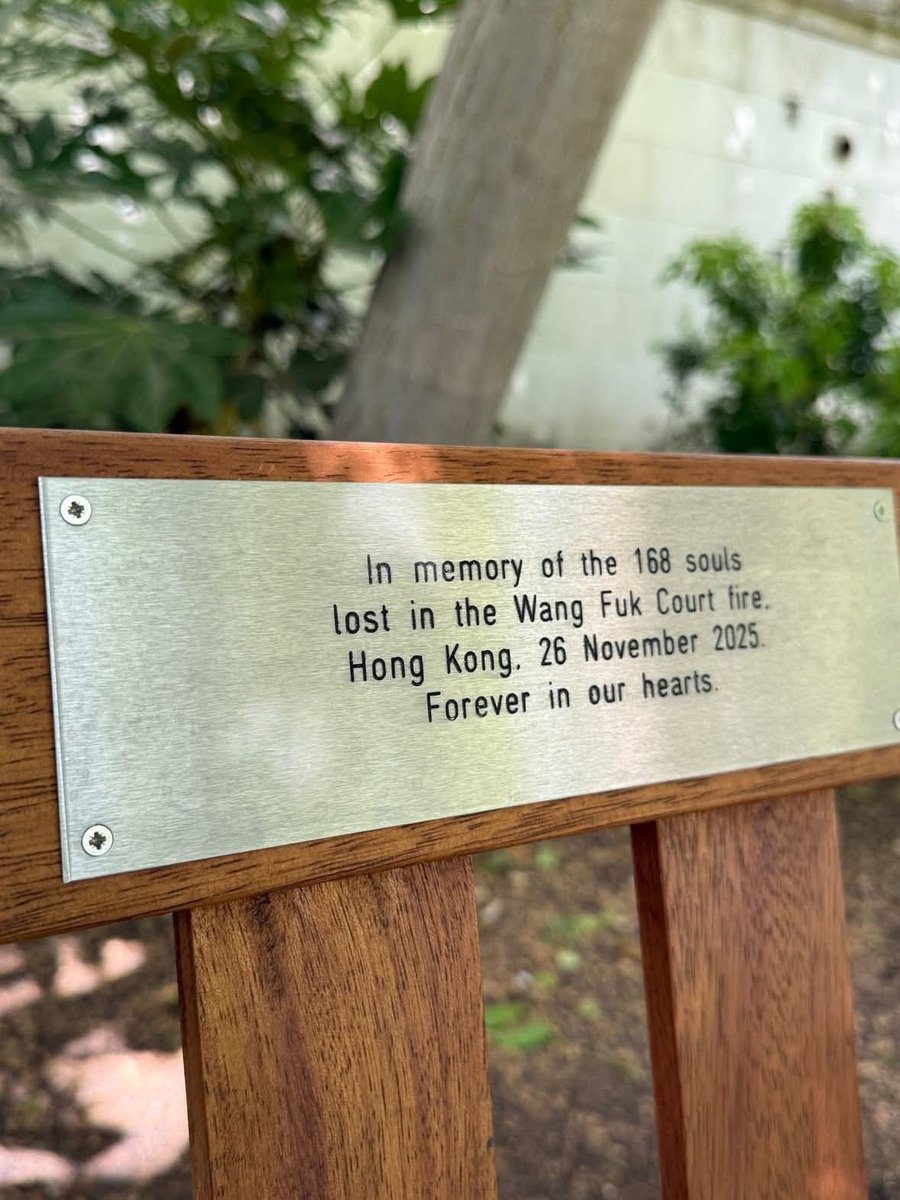
A memorial bench for the 168 victims of Hong Kong's Wang Fuk Court fire thst occurred in November of last year has been spotted at the Victoria Embankment Gardens in London. A kind gesture in memory of a preventable tragedy.
Photo by Catch Mouse in London, via Facebook
Nvidia and the Rope: How Beijing Turns Partners into Pawns
Jensen Huang’s viral interview—where he dismissed “China hawks” as unpatriotic—has caused a stir. I have a few thoughts.
First: Huang’s performance is a textbook example of Lenin’s old line: the capitalist will sell you the rope to hang him with. He casts Nvidia as indispensable to China’s AI future, framing U.S.–China ties as a relationship of mutual need. But Beijing doesn’t see him as a partner; it sees Nvidia as a stopgap—useful only until Chinese firms can replace it. Every chip Nvidia ships into China hastens that day, narrowing its window of dominance and eroding America’s edge. In effect, Huang isn’t strengthening his position—he’s selling himself into irrelevance.
History shows where this logic leads. The tech sector is full of such stories: Nortel, Nokia, and Ericsson once dominated China telecom industry before being undercut by Huawei and ZTE; IBM effectively seeded Lenovo by selling its PC division. Even domestic business elites during China’s reform era—including myself—believed we were building enduring partnerships, only to be discarded when the Party no longer needed us. The pattern is constant: the CCP consumes its capitalist partners once they’ve served their purpose.
Second: Huang badly misjudges his long-term relevance to China. The Party will move to replace him the moment it can. No amount of accommodation—bending the knee, flattering Beijing, or signaling loyalty—changes the fundamental fact that Nvidia is not a Party-controlled Chinese firm. It is an American company. And in Beijing’s eyes, that alone makes it politically suspect, strategically vulnerable, and ultimately expendable.
Third: We should resist the temptation to treat the business celebrity of the moment as a sage on every subject. Success often reflects circumstance more than foresight. Huang built GPUs for gaming; it was the rise of AI—not his design—that turned Nvidia into a trillion-dollar company. To his credit, he managed that wave brilliantly. But that reality should temper the weight we give to his broader insights, especially when he reduces a serious national debate to a cheap line about China hawks being “unpatriotic.”
In the end, this isn’t just about Huang or Nvidia. It’s about a larger, recurring dynamic: foreign capital mistaking access for permanence, only to learn that in Beijing’s game, partners are always pawns—and pawns are always expendable.
This Thursday at 9:00 AM ET, the House Select Committee on the CCP is holding a public roundtable on Hong Kong’s role as a safe haven for PRC money laundering and sanctions evasion. The discussion will look at how Hong Kong has become a key hub for illicit finance, including its role in helping the Chinese state and its partners move money, launder proceeds, and evade international sanctions.
Testifying will be Sunny Cheung (Jamestown), Kim Donovan (Atlantic Council), and myself. Watch the livestream here: https://t.co/HrAgc4y41w