Church Fathers
The Church Fathers: Teachers and Witnesses of the Apostolic Faith
An important group in the history of the Catholic Church is known as the Church Fathers. These were early Christian bishops, priests and theologians whose lives and writings helped explain, defend and transmit the faith received from the Apostles.
Traditionally, four characteristics are associated with recognition as a Church Father: antiquity, orthodoxy of doctrine, holiness of life and approval by the Church. Orthodoxy means that their teaching was substantially faithful to the deposit of faith received from Christ through the Apostles. Antiquity places them within the early centuries of Christianity. The patristic period is generally considered to end with St Isidore of Seville (c. 560–636) in the West and St John Damascene (c. 675–749) in the East. Holiness refers to their exemplary Christian lives, while Church approval means that their teaching has been recognised as an important witness to the faith of the early Church.
The Apostolic Fathers
Among the earliest Fathers are those known as the Apostolic Fathers, who lived during or immediately after the time of the Apostles.
St Ignatius of Antioch (c. 35–c. 107) was Bishop of Antioch and was martyred in Rome during the reign of Emperor Trajan. Later Christian tradition connects him closely with the Apostles, but it is safer historically not to state as established fact that he was personally a disciple of St Peter. On his journey to Rome for martyrdom, around AD 107, Ignatius wrote seven surviving letters. These provide remarkably early testimony concerning the Eucharist, the authority of bishops, the unity of the Church and the divinity and humanity of Christ. His Letter to the Smyrnaeans contains the earliest surviving written use of the expression “Catholic Church”, around AD 107.
St Polycarp of Smyrna (c. 69–c. 155) was Bishop of Smyrna. St Irenaeus of Lyons (c. 130–c. 202), who had heard Polycarp preach when he was young, testified that Polycarp had known people who had seen Christ and had been instructed by Apostles. Early Christian tradition particularly associates Polycarp with St John the Apostle. Polycarp was eventually martyred at Smyrna around AD 155–156.
The Fathers and the Development of Christian Theology
The Church Fathers did not invent Catholic doctrines. Rather, they helped explain, defend and formulate more precisely the faith handed down from the Apostles, particularly when Christianity encountered heresies and theological controversies.
St Cyril of Jerusalem (c. 313–386) became Bishop of Jerusalem around AD 350. His famous Catechetical Lectures, delivered around AD 348, provide an invaluable description of what Christians were taught before and after Baptism. His writings contain important early testimony concerning Baptism, Confirmation, the Eucharist, the Creed and the Real Presence of Christ in the Eucharist.
St John Chrysostom (c. 347–407) became Archbishop of Constantinople in AD 397/398. The title Chrysostom means “Golden-Mouthed,” reflecting his reputation as one of Christianity's greatest preachers. His homilies provide important insights into Scripture, Christian morality, the Eucharist, care for the poor and the Christian life.
St Augustine of Hippo (354–430) was ordained a priest in AD 391 and became Bishop of Hippo in North Africa around AD 395/396. His enormous body of writings profoundly influenced Western Christianity. Among his best-known works are the Confessions, written around AD 397–400, De Trinitate (On the Trinity), written over many years approximately AD 399–419, and The City of God, written approximately AD 413–426.
Augustine did not originate the doctrine of the Trinity. The Church's Trinitarian faith was already firmly expressed in the fourth century, particularly through the Council of Nicaea in AD 325 and the First Council of Constantinople in AD 381. Augustine's great contribution was to deepen and systematise the theological understanding of the Trinity, particularly within Western Christianity.
The Church Fathers and the Bible
The history of the formation of the canon of Scripture is also incomplete without the Church Fathers.
The books of the New Testament were written during the first century AD, but the Church gradually discerned which writings were to be received as inspired Scripture. This process took place over several centuries. Different local Christian communities initially had some variations regarding particular books.
An important milestone came in AD 367, when St Athanasius of Alexandria (c. 296–373) listed in his 39th Festal Letter the same 27 books of the New Testament that Christians recognise today.
Regional councils in North Africa subsequently listed the books received as Scripture. These included the Council of Hippo in AD 393 and the Councils of Carthage in AD 397 and 419. St Augustine of Hippo participated in this North African ecclesial environment and defended the canon received by the Church.
It is therefore more accurate to say that the biblical canon was discerned gradually within the early Church, rather than saying that one individual Church Father compiled the Bible.
St Jerome and the Latin Bible
St Jerome (c. 347–420) also played an extraordinary role in the history of Scripture.
In AD 382, Pope Damasus I (c. 305–384) asked Jerome to revise the existing Latin translations of the Gospels using the Greek manuscripts available to him. Jerome subsequently devoted many years to biblical translation and scholarship.
It is incorrect to say that Jerome translated the Bible from Hebrew into Greek. He worked primarily to produce and revise biblical texts in Latin. He revised portions of the New Testament from Greek and later translated much of the Old Testament directly from Hebrew into Latin, while also consulting Greek versions.
His work became the foundation of what later became known as the Latin Vulgate, which became enormously influential in the Western Church.
What About the Order of the Gospels?
The traditional order of the four Gospels is:
Matthew → Mark → Luke → John.
This order is ancient and was already well established in the early Church. However, modern biblical scholarship generally considers Mark to be the earliest written Gospel, usually dating it approximately AD 65–70. Matthew and Luke are commonly dated approximately AD 80–90, while John is often dated approximately AD 90–100, although precise dates remain debated among scholars.
It would therefore not be historically accurate to attribute the present ordering of the Gospels specifically to St Augustine. Augustine accepted and discussed the traditional order, but he did not create it.
Why Should Catholics Read the Church Fathers?
The Fathers are especially valuable because some of their writings take us remarkably close to the generation of the Apostles. When we read Ignatius of Antioch around AD 107, Justin Martyr around AD 150, Irenaeus around AD 180, Cyril of Jerusalem around AD 348, or Augustine in the fourth and fifth centuries, we encounter witnesses to how the early Christians understood and lived their faith.
Through their writings we learn about the Eucharist, Baptism, bishops and apostolic succession, the interpretation of Scripture, the Trinity, the divinity of Christ, Christian morality, prayer, martyrdom and the unity of the Church.
The Church Fathers therefore provide an important bridge between the Apostles and subsequent generations of Christians. They help us appreciate that Catholic theology developed through centuries of prayer, study, debate, councils and reflection upon the deposit of faith entrusted to the Church.
For anyone wishing to understand the Catholic faith more deeply, reading the Church Fathers is a journey back to the early centuries of Christianity—a journey that helps us understand the history of the Church, the development of Christian doctrine and the Bible itself.
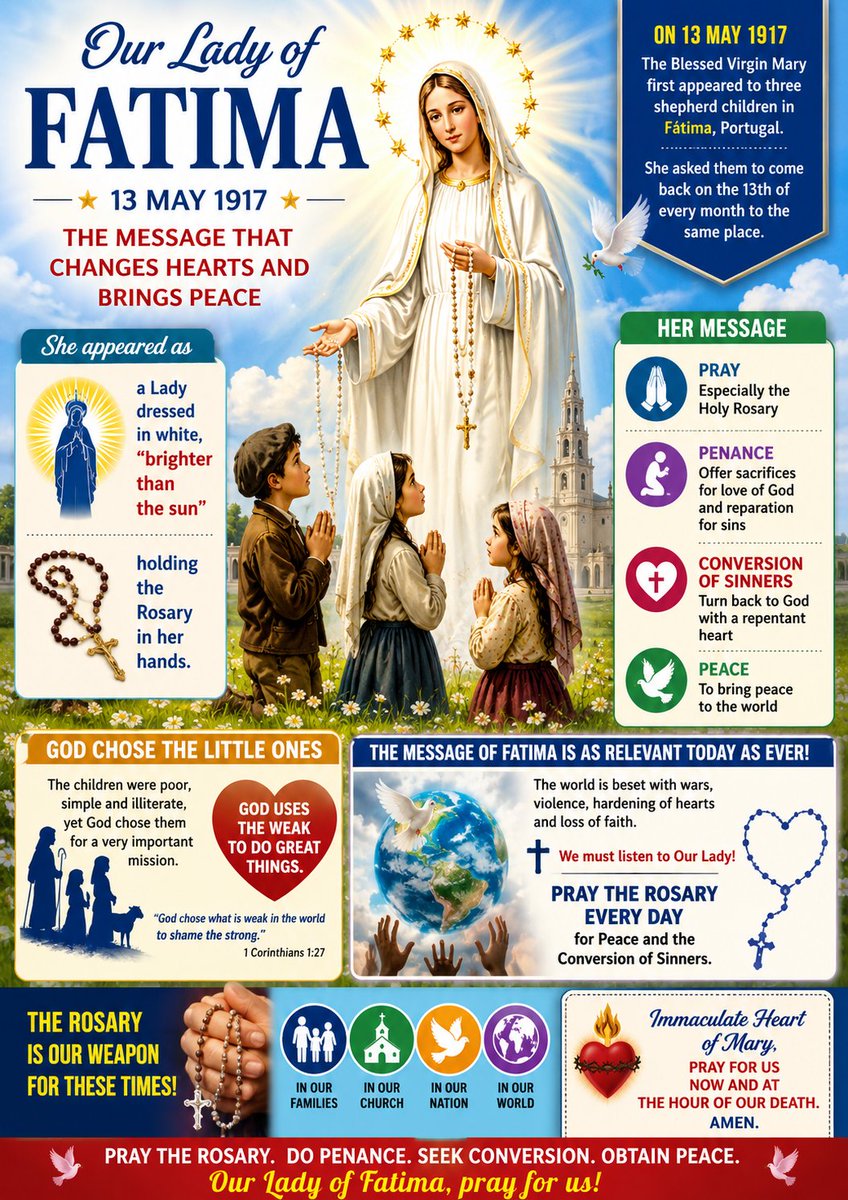
On 13 May 1917, the Blessed Virgin Mary first appeared to three shepherd children in Fátima—Lúcia dos Santos and her cousins Francisco Martoand Jacinta Marto. Our Lady instructed the children to return to the same place on the 13th day of each month. The children described her as a Lady dressed in white, “brighter than the sun,” holding a Rosary in her hands.
During her apparitions, Our Lady called for prayer—particularly the Holy Rosary—penance, repentance, and the conversion of sinners, so that peace might be restored to a world engulfed in the horrors of World War I.
It is significant that God chose three poor, humble, and largely uneducated children for such an important mission. In a world that often esteems wealth, power, and human learning while overlooking the poor and the lowly, the message of Fátima reminds us that God often chooses the weak and humble to accomplish great things, echoing the words of First Epistle to the Corinthians: “God chose what is weak in the world to shame the strong.”
The message of Fátima remains profoundly relevant in our own time. Our world continues to be afflicted by wars, violence, hardened hearts, and a growing loss of faith. More than ever, we are called to heed Our Lady’s message by praying the Holy Rosary, doing penance, and seeking the conversion of sinners, so that true peace may reign in our hearts, our families, and throughout the world.
First Anniversary of Pope Leo XIV
On the 8th of May 2025, an expectant crowd gathered in Saint Peter's Square, while the world at large fixed its gaze upon the chimney of the Sistine Chapel, waiting for the Fumata Bianca (white smoke) that would signal the election of a new Pope. Indeed, white smoke soon appeared to wild cheers, and on the Loggia of Blessings emerged Robert Francis Prevost, who would take the name Pope Leo XIV.
Like his predecessor, Pope Leo XIV is a Pope of many firsts. He is the first Pope from the United States of America and the first Pope from the Augustinian Order. Perhaps it was therefore fitting that one of his first foreign visits was to Algeria, the homeland of Saint Augustine of Hippo.
Pope Leo XIV ascended as the 267th successor of Saint Peter during a particularly significant moment in the life of the Church, as Catholics worldwide were celebrating the Ordinary Jubilee Year. Traditionally, a Pope’s choice of name often reflects the theme and priorities of his pontificate. By choosing the name Leo, recalling Pope Leo XIII—who led the Church during the Industrial Revolution—Pope Leo XIV has signalled his concern for the challenges of the Artificial Intelligence (AI) revolution and its implications for human dignity. It is therefore fitting that his first encyclical, expected on 15 May, will reportedly focus on artificial intelligence and peace.
Pope Leo XIV was born on 14 September 1955 in Chicago. He is the second Pope from the Americas, after Pope Francis.
He studied Mathematics and Philosophy at Villanova University before joining the Order of Saint Augustine in 1977. He was ordained a priest in Rome in 1982 and later obtained a doctorate in Canon Law.
Much of his priestly ministry was spent as a missionary in Peru, where he served for over a decade in formation, teaching, pastoral work, and diocesan leadership, particularly in Trujillo, and later as Bishop of Chiclayo from 2015 to 2023.
He also served as Prior General of the Augustinians for two terms, gaining significant global leadership experience. In 2023, Pope Francis appointed him Prefect of the Dicastery for Bishops, one of the Vatican’s most influential offices, and later elevated him to the College of Cardinals.
Known for his missionary spirit, academic background, administrative experience, and commitment to Church unity, Cardinal Prevost was elected Pope and took the name Leo XIV, becoming the first Augustinian Pope and one of the few modern Pontiffs with extensive missionary experience in Latin America.
Although he shares many areas of commonality with the late Pope Francis, Pope Leo XIV has already carved out his own distinctive style of leadership. He has continued his predecessor’s strong emphasis on peace, consistently calling for reconciliation in conflict zones, particularly in the Middle East, even when such appeals have been met with resistance from some of the world’s major powers.
St Catherine of Siena
Today, 29 April, we celebrate Catherine of Siena, one of the four female Doctors of the Church, alongside Teresa of Ávila, Thérèse of Lisieux, and Hildegard of Bingen.
St Catherine was a mystic, author, reformer and activist, despite her limited formal education. She was a member of the Dominican Third Order. She was born on 25 March 1347 in Siena, Italy, on the Solemnity of the Annunciation of Our Lord Jesus Christ. She was the 23rd child of Jacopo and Lapa Benincasa, and from a young age showed remarkable intelligence and deep religious devotion.
At the age of 18, she entered the Dominican Third Order and spent approximately three years living in seclusion, devoted to prayer, penance and austerity. Over time, a group of followers gathered around her, including men, women, priests and religious. Her letters, initially written for spiritual guidance, later expanded to address public, ecclesiastical and political matters.
Although she faced criticism and slander for engaging in both spiritual and secular affairs, she was examined and cleared of all charges by the Dominican General Chapter in 1374. She went on to play a significant role in promoting peace, particularly between Florence and the Papacy, and called for unity and reform within the Church.
St Catherine is especially remembered for her role in urging the Pope to return from Avignon to Rome, contributing to the end of the Avignon Papacy. In her final years, she lived in Rome, dedicating herself to prayer and supporting Pope Urban VI during a time of great division in the Church.
It is traditionally believed that, particularly in her later years, she lived almost entirely on the Holy Eucharist. This extraordinary fasting was accompanied by profound mystical experiences and deep union with Christ.
St Catherine died on 29 April 1380 in Rome, surrounded by her spiritual followers, whom she referred to as her “children”. In 1939, she and Francis of Assisi were declared co-patrons of Italy.
She remains a powerful witness of holiness, courage and unwavering commitment to the unity and reform of the Church.
Feast of St Mark
Today, 25 April, we celebrate the Feast of St Mark the Evangelist. St Mark was a cousin of St Barnabas and is traditionally associated with the early Church in Jerusalem. He is one of the four Evangelists, alongside Matthew, Luke and John.
His Gospel is one of the three Synoptic Gospels, together with Matthew and Luke. The word synoptic comes from Greek and means “seen together”, because these three Gospels contain many similar accounts of the life and ministry of Jesus Christ. Mark’s Gospel is widely regarded as the earliest of the four Gospels.
Although Mark was not one of the Twelve Apostles, he had strong links with them. He was closely associated with St Peter, and Christian tradition holds that his Gospel reflects the preaching and teaching of Peter.
Mark also travelled with St Paul and St Barnabas on their first missionary journey, but departed early, causing a temporary disagreement. He later reconciled with Paul, who described him as “useful” in ministry. Tradition also identifies Mark as the founder and first Bishop of the Church of Alexandria, where he was martyred.
St Mark is the patron saint of Venice, Egypt, lawyers, notaries, prisoners and stained-glass workers. As we celebrate his feast, we are reminded that God can transform initial fear and weakness into courage, mission and lasting witness to the Gospel.
Pope Francis: First Anniversary of His Death
The Catholic Church and the world at large mark the first anniversary of the death of Pope Francis on 21 April 2026, who died on 21 April 2025, during the Easter Octave. He was a Pope of many firsts.
He was the first Pope from South America, the first Jesuit Pope, and the first to take the name Francis.
Born in Argentina on 17 December 1936, he broke with tradition in several respects. He did not reside in the Apostolic Palace, but instead chose the more modest Casa Santa Marta. He expanded the Holy Thursday washing of the feet to include women and often performed the rite in prisons rather than in the Papal Basilicas.
Pope Francis never shied away from controversial issues, including the Church’s pastoral approach to gay people, abortion, the Traditional Latin Mass, and immigration. His papacy was built on simplicity and humility, in keeping with his chosen name, inspired by St Francis of Assisi.
A strong advocate for peace, he warned that the Third World War was being fought in a piecemeal manner, words that many have since regarded as prophetic in light of the current volatile global situation. During the conflict in Gaza, he demonstrated deep pastoral concern by making regular calls to the Church of the Holy Family in Gaza to check on their welfare.
A hallmark of his papacy was the Synod on Synodality, which spanned three years from October 2021 to October 2024, and sought to give every Catholic an opportunity to be heard. The fruits of this process are still being discerned and implemented.
His image as a Pope who broke with convention and embraced simplicity and humility remained evident even in death. After a period of illness in his later years—during which he continued to teach and show compassion—he died on Easter Monday, 21 April 2025. In keeping with his humility, he was buried in a simple coffin at the Basilica of Saint Mary Major (Santa Maria Maggiore), rather than at St Peter’s Basilica, where many of his predecessors are interred.
St Bernadette Soubirous of Lourdes
Today the Catholic Church remembers St Bernadette Soubirous, the simple and humble girl of Lourdes to whom the Blessed Virgin Mary appeared 18 times at the Grotto of Massabielle in 1858. Bernadette endured ridicule, disbelief and hardship, yet she remained firm in faith and faithful to the truth of what she had seen. In a world where faith is often dismissed and pushed aside, her example calls us to courage, humility and perseverance. St Bernadette died on 16 April 1879, and her incorrupt body lies in Nevers, France. To this day, Lourdes remains a place of prayer, healing and conversion, drawing millions of pilgrims each year to the Grotto, the Eucharistic Procession and the Rosary Procession. Thousands of cures have been reported there, and 72 have been officially recognised by the Church as miraculous. May St Bernadette inspire us to remain steadfast in faith, gentle in spirit and trusting in the maternal care of Our Lady.
He Is Risen: We Are an Easter People
As we celebrate Easter, we learn that sin and death will not have the last word. It is through the light of Christ that the darkness of sin has been overcome, as symbolised by the Easter Candle which ushers in light. In relation to death, St Paul says in 1 Corinthians 15:55–57, “O death, where is thy victory? O death, where is thy sting?” God kept His promise of a Saviour, as shown in Genesis 3:15, which is often referred to as the Protoevangelium or “First Gospel”. It declares: “I will put enmity between you and the woman, and between your seed and her seed; he shall bruise your head, and you shall bruise his heel.”
Through the various covenants God entered into with Adam, Noah, Abraham, Moses and David on behalf of His people, He remained faithful to His saving plan. During the Easter Vigil Mass, the seven readings from the Old Testament, which recount the history of salvation, show God keeping His promises despite human failings.
Despite facing numerous challenges in spreading the Gospel, the disciples carried on the flame of Easter with the greeting, “He is risen.” The Easter message remains deeply relevant in a world beset by wars and the persecution of Christians. At times, we may feel powerless in the face of such suffering. However, we learn from Christ, who stood against the worldly powers of His time with love, courage and prayer.
EASTER TRIDUUM – THE HEART OF HOLY WEEK
The Catholic Church has begun the Easter Triduum, the most sacred period in the liturgical year. During these holy days, we journey with Christ through His Passion, Crucifixion, Death and Resurrection.
These holy days invite the faithful to undertake an earnest reflection on their lives, so as to live in a manner worthy of the sacrifice that Christ made on the Cross.
During the Easter Vigil, many catechumens will be received into the Church through Baptism. This is a profound and joyful moment for them and their families, as the Sacrament of Baptism is the gateway to all the other Sacraments, marking the beginning of new life in Christ.
May this sacred season renew our faith, deepen our love, and strengthen our commitment to follow Christ.