Principal Engineer @atlassian • Leading Jira’s frontend • AI Workflows, Multi Agent , agentic SDLC • GDE for Web • CSS&JS • ☕️ , Sci-Fi, Comics • owner @htmlmag
My slides from today's talk. I talked about Micro Applications. I shared the idea of distributing the complexity of building SPAs to different levels for creating independent teams and improving the developer experience. #WeAreDevelopers2022
https://t.co/nSqvJPWZDL
Sözlerinizden anladığım, bu agentlar bedavaya çalışacak. Uygulamaların sunucu masraflarını, 99.999% uptime olmalarını, yedeklemelerini, güvenlik yamalarını, iç sistemlerden dışarıya yanlışlıkla bilgi girmesinin engellenme bize ücretsiz olarak sağlayacaklar ve benim bunun için hiçbir çalışan görevlendirmem, bu agentlar istenilen şeyi beklendiği gibi yapıyor mu diye düşünmeleri gerekmeyecek.
Özür dilerim ilk başta bu geleceği göremediğim ve cebimden beş kuruş para cikmadan, hiç sorun yaşamadan SaaS uygulamalardan çıkabileceğimi keşfedemediğim için. Sayenizde bunu gördüm.
@burhandemirt Sen benim mesajlarımı okumadan yargilamassin
Olay yapay zeka ile iş yapamazsın olayı değil. Agentlari herkes kullanıyor zaten. Olay farkında olmadan kendi ana işin olmayan küçük uygulamaları yönetmeye başlamanın maliyetinin SaaS için yaptığın masrafın üstüne çıkabilme ihtimali.
Öyle tabi. Benim ampirik hesabimla, eğer kaldırdığın ve içeride geliştirmeye başladığın her SaaS için aylık bir çalışan maliyetinin %20si gibi bir masraf yapıyorsan mantıklı gibi.
Atıyorum yillik 100K $ ödediğin bir SaaS’tan çıkıp, bu sefer yıllık 100K $ maaş ödediğin (sanırım yıllık sana maliyeti 130-140K $ a kadar çıkabiliyor) çalışanın tam zamanlı görevi olursa daha pahalıya geliyor.
We worked together in this version with @theilgaz. It was good to see that the agentic workflow worked with him nicely.
Usually when you work fully agentic, the team collaboration and different styles in different agents becomes sort of a bottleneck.
To reduce this problem over the last 1.5 years I’m building a workflow management called agent-paper-trail and in its current state, your guidelines now just works for local or cloud agents for small and large teams.
PanePeek v1.3 is released.
In this version @theilgaz helped to improve highlighting and stability.
Find now works in preview and edit screens.
Browsing large files and directories is two times faster.
Also `panepeek` CLI is available now, you can start app from terminal
@mertanir_ Kullanıcı sayısı az olunca dediğin doğru, çözülüyor. Zaten dedim ya eğer bir elemana verdiğin maaşın 5te 1inden az masrafa geliyorsa kendi yapman yapılır
@mertanir_ Şanslısınız o zaman. Gerçi ekip büyüklüğü ve kendi versiyonunuzu yazdığınız uygulamaların işiniz için ne kadar kritik olduğu da durumu etkiliyor
Öyle tabi. Benim ampirik hesabimla, eğer kaldırdığın ve içeride geliştirmeye başladığın her SaaS için aylık bir çalışan maliyetinin %20si gibi bir masraf yapıyorsan mantıklı gibi.
Atıyorum yillik 100K $ ödediğin bir SaaS’tan çıkıp, bu sefer yıllık 100K $ maaş ödediğin (sanırım yıllık sana maliyeti 130-140K $ a kadar çıkabiliyor) çalışanın tam zamanlı görevi olursa daha pahalıya geliyor.
Merak ediyorum, acaba kendi küçük SaaS kopyalarının da bakım, düzenli geliştirme, feature ekleme ya da bug giderme işleri ile uğraşmaya başlayıp, “biz bu yancı uygulamaların bakimlarindan kendi işimize bakamıyoruz” aydınlanmasına ne kadar kısa sürede ulaşacaklar.
Paribu, bu yılki hedeflerinden birinin SaaS aboneliklerinin tamamını iptal etmek olduğunu söyledi. Şirketin Ürün Direktörü Baki Er’e göre, yapay zeka bütün bariyerleri kaldırıyor.
#reklam | Swipeline Live, sponsorların katkılarıyla hazırlanmıştır.
Abi olay daha farklı, yani ben de kendi uygulamami geliştiriyorum. Ama baktığında, ek zaman, masraf. https://t.co/v8PVL29vYJ, kendi hobim ve merak ettiğim limitleri test etmek için geliştiriyorum. Dediğin gibi bug, yeni feature bir prompta bakıyor. Günün sonunda olay, ana işin bu mu, bunu ne kadar böyle sürdürebilirsine geliyorum. Mesela benzer bir uygulama ya da kafamdakine yakın birşey olsa, muhtemelen satın alırdım ben bunu. 40-50-60 belki 100$ verip. Ben bu ve birkaç başka şeyi kendim geliştirip, denerken ama sadece GitHub’a 100$ aylık veriyorum copilot etc düzgün çalışsın diye. Üstüne kendi ai subscriptions vs. Yani SaaS’tan çıkmak bazen daha masraflı olabilir demeye çalışıyorum
@gorkemcetin Ben bu tarz şeylere, ben bunu kendim yönetmeye çalışsam, bir elemanın aylık maliyetinin 5te 1ine ya da daha azına halledebilecek miyim gözüyle bakıyorum. Cevap hayırsa, hiç bulaşmıyorum
@GergelyOrosz I think Claude Desktop’s UI, interaction with AI and usability is horrible. Considering you need to read a lot, you need to interact a lot, the ui doesn’t provide a good way to that.
I have been using certain guardrails and quality gates to improve the agent's output. I'm focusing on producing high-quality work before locking in a decision or committing code.
I believe that once you decide on something and lock it in, you need to maintain that decision until you supersede it or remove it. Funnily enough, I was saying the same thing in many of my conference talks about "merged code" before our agentic development era.
"The time you merge your code, you start to maintain it. Think about which is more important: writing it in an hour or maintaining it for years? Pay close attention to what you deliver"
In my agentic workflow, I have multiple self-improving loops for the agents. The diagram is from my plan/prepare/review loop. The good part is that I can apply it to any work, from planning to design, writing to architecture or coding.
The loop starts with defining the scope of delivery and breaking it into smaller, manageable units with regular reviews. The key part of this loop is having agents self-review and improve their output before presenting it.
I have two complementary skills for this that agents use after they finish their initial work;
• `tighten`: focuses on simplification. The agent looks for unnecessary abstractions, possible similarities and reusability with neighbouring code or architectural elements, or unneeded details in suggested prose that don't add value.
• `probe`: focuses on failures, edge cases, weak assumptions or missing validations. Explores gaps, ambiguities, claims without evidence, or other planning, analysis and prose.
Both skills work with evidence and validation-based confidence. They test and validate their findings. Also, during this self-review, the model/agent tries to answer the question, "What would break in 6 months or a year when we deliver this?"
The earlier I explained my "critic-orchestration" skill to get a second model opinion. After `probe` runs, if the model couldn't set a good confidence level, e.g. "high confidence" in its review, it recommends a bounded independent review to improve the judgment-heavy:
• a hard-to-reverse architecture or migration decision
• cross-boundary behaviour with non-obvious invariants
• significant security, data, compatibility, rollout, or operational risk
• an unclear root cause or fix shape after local evidence is exhausted
After this self-review, the agent presents its work to the orchestrator or to me. I review the output against my thinking and how I initially planned the work, or, in short, according to my "taste". The orchestrator reviews the agent against the requirements I defined for the project, along with core engineering rules and task validation rules.
Based on final approval or review, the agent continues to the next unit or revises the unit to address the feedback.
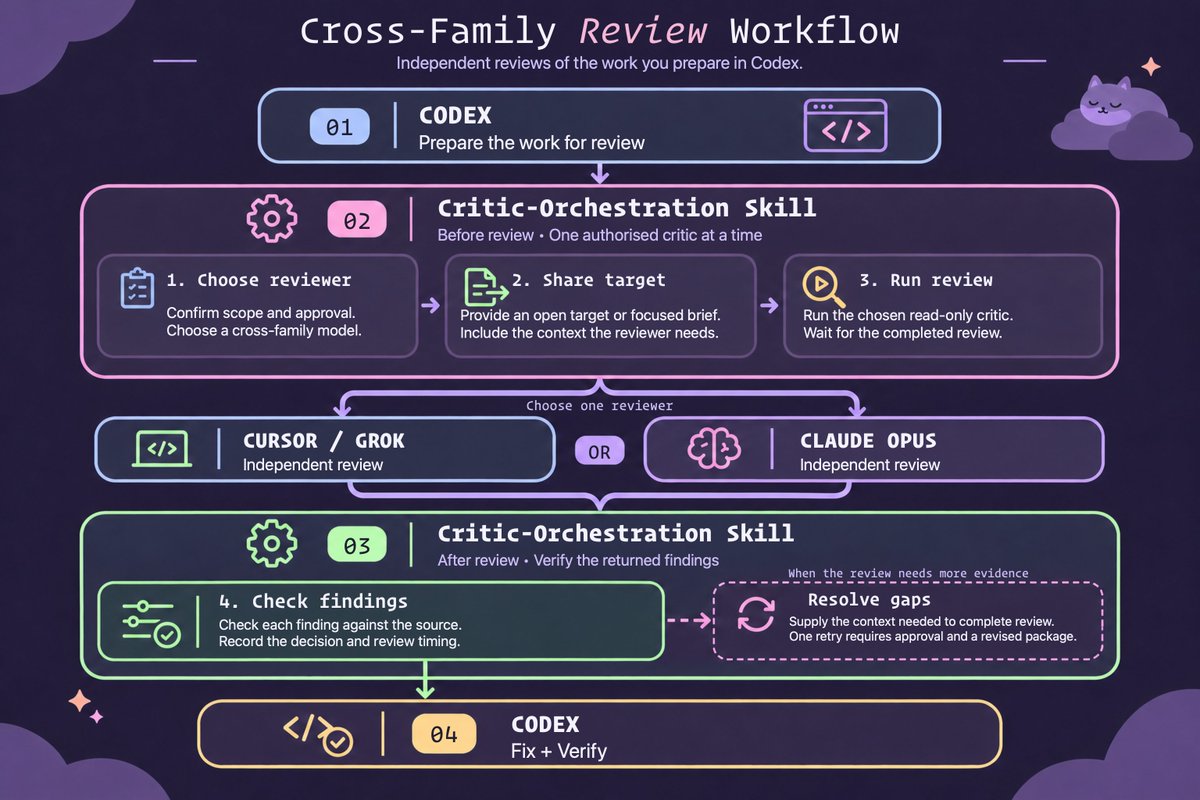
My friends and colleagues usually ask when I mention having a cross-family review of the work before finalising the code/creating a PR, or drafting an architectural or implementation plan.
I sketched the workflow;
Basically, how it works: either the orchestrator agent or I control the work and instruct the active agent to have a critic review. Most of the time, depending on the agent I'm in, I tell the agent, "discuss this with Claude", "discuss this with Codex", "get a review from Cursor", etc.
I have a "critic-orchestration" skill that tells the agents how to start a critic review with cross-family and which model to choose, and which reasoning level to choose. Also, depending on the review type, it gives instructions on whether they need to prepare a read-only review package or just say "check this code" or "check this design" for more free-style reviews instead of bounded ones.
The agent runs the cross-family agent's CLI (codex, cursor-agent or claude) with a particular setup and payload. After the critic finishes their review, they return a review document with a general verdict (_usually it always comes with "needs work" :D, feels like how we don't like other developers' work at first; they also tend to find things all the time_). Along with the verdict, they also share "must fix", "should fix" findings and follow up/optional simplification/hardening suggestions.
The agent automatically verifies the findings and fixes the must-fix and should-fix ones. Depending on the criticality, the agent shares optional follow-up ideas and asks my opinion, or the orchestrator agent's, on whether to implement them or create an issue/note to handle later.
The good part of the routine is that it works for architecture, design and even critical document writing like spec creation and plan preparation. It helps you spot problems before locking in decisions and reduces the overhead of reviewing tons of agent output. Believe me, I read far more documents daily than I used to write code.
With this routine, I was able to deliver much higher-quality work with less inference on my side. Also, when running multiple agents/orchestrations, this review workflow catches the issues before creating a PR, deciding on scope or implementation details.
I have been using certain guardrails and quality gates to improve the agent's output. I'm focusing on producing high-quality work before locking in a decision or committing code.
I believe that once you decide on something and lock it in, you need to maintain that decision until you supersede it or remove it. Funnily enough, I was saying the same thing in many of my conference talks about "merged code" before our agentic development era.
"The time you merge your code, you start to maintain it. Think about which is more important: writing it in an hour or maintaining it for years? Pay close attention to what you deliver"
In my agentic workflow, I have multiple self-improving loops for the agents. The diagram is from my plan/prepare/review loop. The good part is that I can apply it to any work, from planning to design, writing to architecture or coding.
The loop starts with defining the scope of delivery and breaking it into smaller, manageable units with regular reviews. The key part of this loop is having agents self-review and improve their output before presenting it.
I have two complementary skills for this that agents use after they finish their initial work;
• `tighten`: focuses on simplification. The agent looks for unnecessary abstractions, possible similarities and reusability with neighbouring code or architectural elements, or unneeded details in suggested prose that don't add value.
• `probe`: focuses on failures, edge cases, weak assumptions or missing validations. Explores gaps, ambiguities, claims without evidence, or other planning, analysis and prose.
Both skills work with evidence and validation-based confidence. They test and validate their findings. Also, during this self-review, the model/agent tries to answer the question, "What would break in 6 months or a year when we deliver this?"
The earlier I explained my "critic-orchestration" skill to get a second model opinion. After `probe` runs, if the model couldn't set a good confidence level, e.g. "high confidence" in its review, it recommends a bounded independent review to improve the judgment-heavy:
• a hard-to-reverse architecture or migration decision
• cross-boundary behaviour with non-obvious invariants
• significant security, data, compatibility, rollout, or operational risk
• an unclear root cause or fix shape after local evidence is exhausted
After this self-review, the agent presents its work to the orchestrator or to me. I review the output against my thinking and how I initially planned the work, or, in short, according to my "taste". The orchestrator reviews the agent against the requirements I defined for the project, along with core engineering rules and task validation rules.
Based on final approval or review, the agent continues to the next unit or revises the unit to address the feedback.