"China’s banking crisis in the 2000s was resolved by transferring the costs to households through financial repression—a decision that recapitalized the banks while exacerbating the structural imbalances that continue to shape the Chinese economy today."
As Chinese debt continues to surge, and as Beijing increasingly tries (so far unsuccessfully) to rein it in, it is worth remembering how China managed its last major debt cleanup, from 2002 to 2011, and what the consequences were for the economy. I discuss this in my latest piece for the Carnegie Endowment.
https://t.co/umeEjG3nH4
Back when I got into deep learning ~2019, it was not super obvious that the transformer had won. People were starting to come around on the idea, but it wasn't the default. So everybody was still trying weird things. "Deep learning research" usually meant architecture research.
After it became clear that decoder-only autoregressive transformers had won, there was an immediate rush to design a more efficient attention mechanism. We've been in that rush ever since. I think that this is not normal. It is abnormal, in fact, that everyone's attention, so many person-hours, have been poured into this one operator. Despite the fact that we all seem to have gotten used to this status quo.
To be fair, we have come a long way. Attention research been incredibly fruitful in terms of practical data and compute efficiency. With absolutely zero evidence to go on, just by vibes, I would say that there are probably 10x gains still on the table. But that's the thing. There's probably only ~1 OOM of efficiency gains to be had here. Who is to say there's not another recipe out there with 3 OOMs laying undiscovered? That could totally be the case. I think there probably is.
If you're a lab that wants to play it safe, continuing to scale transformers is the obvious choice. Run ablations on attention variants, data mixes, etc, and release incrementally stronger and stronger models. We know this works, it does not require any sort of belief in what lies beyond the horizon.
But from a wider historical lens, I think this is not such a good idea. Labs should be trying weird things, the way they used to. Especially now that it's possible to do this sort of idea generation and discovery autonomously.
I think this is probably the highest leverage thing to be working on right now. It's also probably the ONLY way to leapfrog OpenAI or Anthropic technologically. I have no idea if it's higher or lower EV than running a regular neolab and releasing incrementally better transformers. But it's probably worth doing anyway regardless of that.
As someone who ships LLM systems in production, this Mandelbrot video is the closest thing to a "why the thing you're measuring is a 2D shadow of a 6D object" explainer I've ever seen released for free.
Everyone thinks the Mandelbrot set and Julia sets are two different fractals. They aren't. They're one 4D object seen from two orthogonal planes. That's the exact reason tuning one knob at a time hides most of what your system does.
Bookmark & watch this weekend. Same z squared plus c, from a 1980 IBM printout to every eval grid you've ever squinted at.
Lots is being written since the yen intervention and the QRA language change. The idea is that the treasury is going to protect the long term bond market (suppress interest rates). That has direct consequences to currency markets. Over a year ago I described it as a choice between protecting spot money or future money. Here's the choices. BUT without dealing with the root problems eventually like in Japan you cannot protect either form of money.
Neoclouds: The Kimi K3 Scare
Kimi K3 caused a large scare in the AI trade as this Chinese open source model matched frontier models on benchmarks. Let me unpack what's actually going on.
Chinese Labs have much less GPUs than American Labs and yet are able to train "just as good" of a model. This implies that Chinese Labs have huge efficiencies that allow them to use much less GPUs in training. This is would imply less HBM, less datacenters, less cloud bills - the whole capex heavy buildout that the AI trade is predicated upon.
Now here's the big hole in all this logic. MoonshotAI, the Lab that made Kimi K3, is supposedly a magnitude more efficient in training than American Labs yet their inference compute consumption is the same or less efficient! Kimi K3 cost exactly the same as GPT 5.5 and slightly less than Claude 4.8 Opus High.
Some people are misunderstanding what expensive tokens mean. Yes the cost of the open source weights/topology is 0 but the amount of the compute/GPUs that you need to run the model is a metric of a efficient your inference is. Compute/GPU time is very expensive and cost of open source inference is very not free.
Now, it makes absolutely zero sense that MoonshotAI Kimi is so much more efficient in training but slightly less efficient in inference. Why? Training is a the forward pass plus backward pass and inference is the forward pass. This means that training efficiency improvements lead to inference efficiency improvements.
You know why MoonshotAI training and inference efficiencies are asymmetric? Because their "training efficiencies" come from distilling American models. If MoonshotAI had true training efficiencies they would also show inference efficiencies but they have no advantage in inference efficiencies!
AI Capex will still continue because:
1. If American Labs stop training capex, then Chinese models will also stop improving. AI progress will have stopped. American companies have never given up just because Chinese are trying to copy them.
2. Chinese model still consume alot of compute/GPUs for inference. Inference demand will outstrip training demand anyways.
Steve Cohen and PGA Golfers share the same performance coach.
For the next hour, he’s yours too.
@GioValiante is the world’s top performance psychologist.
We discuss why most people never reach their potential, how both confidence and fear shape performance, and what separates those who consistently excel from those who stay stuck.
Enjoy!
(Includes paid partnerships)
They are clearly telling 🗣️ you what’s coming… But few are listening. 👂
Amidst all the noise, Bessent’s speech last night is BY FAR the most important thing to listen to.
🖨️ 💵 => buy strategic equites on behalf of the people
=>Short circuit Populism by making everyone own stocks ✅
=> Compete with China 🇨🇳 ✅
=> Support the 2 big 2 fail market ✅
=> Inflate away the national debt ✅
Inference got a hundred times cheaper this year. The compute bill went up anyway.
If you understand why those two sentences are both true at the same time, you understand the most important thing happening in AI right now.
I work on inference for a living, at @nebiustf, where we run open-source managed inference at scale. Most of what follows is what I'm seeing from inside the bill.
12 months ago, the cost of 1M tokens of frontier-class reasoning was somewhere on the order of $60.
Today, an equivalent quality of output costs roughly $0.50.
Price /token of o1-level intelligence has dropped about a 128x in a year.
Price of GPT-4-level output has dropped roughly 100x since the original GPT-4 shipped.
By any normal reading of a technology cost curve, this should be deflationary. It should be saving customers money.
The opposite has happened. The total compute bill at every hyperscaler is going up, not down. Anthropic just signed multi-year capacity deals with both XAI and Amazon. Microsoft's Azure capex guide for 2026 starts with an eight. OpenAI is reportedly spending more on compute every quarter than it did in all of 2023. Nvidia paid roughly twenty billion dollars to acquire Groq, an inference-specialist company that did not exist as a serious commercial entity three years ago.
The cost curve and the demand curve crossed, and then the demand curve lapped the cost curve.
Here is what happened underneath.
A reasoning model burns roughly 10x the output tokens of a non-reasoning model on the same task, because it spends most of its tokens thinking out loud before answering. An agentic workflow chains roughly twenty times the requests of a single-shot completion, because it loops, calls tools, plans, retries, and synthesizes. A modern deep-research query (the kind a research analyst can fire off in fifteen seconds and then walk away from for ten minutes) costs more compute than 10 original GPT-4 queries combined. We made every individual token a hundred times cheaper, and then we built a generation of products that consume ten thousand times more tokens.
This is the Jevons paradox playing out at trillion-dollar scale, in compressed time, in front of everyone. Jevons noticed in 1865 that making coal-burning more efficient did not reduce coal consumption. It increased it, because efficiency unlocked uses that were previously uneconomic. Steam engines became more practical at smaller scales. Whole industries that could not afford coal at the old price suddenly could. Britain's coal consumption rose sharply, not despite the efficiency gains, but because of them.
The same thing is happening to AI compute right now and it is happening faster than any analogous historical cycle. Falling token prices did not contract demand. They unlocked agents, deep research, code-writing systems, multi-step reasoning, persistent memory, the entire next layer of AI products. Every product in that next layer consumes orders of magnitude more compute than the chat interfaces it is replacing.
The math at the aggregate level is brutal: 100x cheaper tokens times 10 000 more tokens equals a 100x larger total bill.
The implications stack quickly.
If you are running a hyperscaler, your 2026 capex guide is not a peak. It is a step on a curve. Inference is structurally always-on, twenty-four hours a day, in a way that training never was. Training is bursty. You spin up a cluster, run for weeks or months, and stop. Inference runs continuously, scales with usage, and the usage curve is exponential. Your power bill, your cooling bill, your transceiver count, your storage footprint, all of these were sized for a workload mix that no longer exists.
If you are running an AI software company built on top of someone else's closed API, you have a problem that did not exist a year ago. Your gross margins get worse as your customers get more value out of your product, because the more they use it, the more compute you pay for. The companies that win this are the ones that figured out vertical integration before the math caught them.
If you are watching this from a distance and trying to understand where the next bottlenecks form, the answer is everywhere downstream of "more inference compute, always-on, with massive memory state per session." The KV cache, the running memory state of a long conversation or an agent loop, is the silent monster of the inference era. It does not scale linearly with parameters. It scales linearly with context length and number of agent steps. A long agent session can hold tens of gigabytes of state per user, per session.
Multiply that by every concurrent user of every product, and you understand why $MU, $SNDK, $TOWCF, and the entire memory and packaging layer have re-rated the way they have.
The CPU-to-GPU ratio is evolving. Training is 1:8. Basic chat inference is 1:4. Agentic inference is 1:1, sometimes CPU-heavy. Google has split its TPU line in two, with a dedicated inference chip carrying tripled SRAM for KV cache. $INTC and $AMD just spent two earnings calls explaining that this shift is structural, not cyclical. The hardware map is redrawing in real time and the financial press is mostly still writing about training clusters.
The right framing of where we are right now is not that AI is hitting a wall. The framing a year ago that scaling was hitting a wall was the most expensive bad take of the cycle. The right framing is that AI got dramatically cheaper, dramatically more capable, and dramatically more useful, and the cost of running it at the new equilibrium of demand is much higher than the cost at the old equilibrium of demand, because the new equilibrium is enormous.
A meaningful share of what we actually do at Token Factory, day to day, is help customers stop their bills from running away from them. KV-cache management. Speculative decoding. Quantization. Routing. The kind of vertical integration that, eighteen months ago, every product team was happy to leave abstracted away behind a closed API. The reason this stack matters now is the same reason this whole essay matters: at the new equilibrium of inference demand, the cost of treating compute as a commodity is no longer survivable. The companies that figure out the layer beneath the API are the ones who keep their margins.
Cheaper tokens. More tokens.
Same coal as 1865.
"Just put it in the cloud."
This is what every AI vendor says.
Here's what they don't tell you:
- Federal agencies can't send classified or sensitive data to shared infrastructure. Full stop.
- Manufacturers are handing their production data — their competitive advantage — to someone else's servers
- Latency matters when inference is making real-time decisions on a production line or in a secure environment
- Cloud costs compound. Year 3 you're paying more than the on-prem hardware would have cost.
- When the internet goes down, your AI goes down. Your mission doesn't stop.
Cloud isn't bad. But federal, national labs, and manufacturers all have the same core need:
OWN your intelligence.
Your models. Your data. Your inference. On YOUR hardware. In YOUR facility.
This isn't an ideology. It's architecture. And for some organizations, it's the law.
Jukan (@jukan05) wrote a sharp memo on how the US let China's display industry grow unchecked while drawing the line at semiconductors. The strategic analysis is right. But there's a second layer he didn't touch, and it matters more if you actually invest in this space. China's display industry won. Its shareholders lost. And the same pattern is about to replay in memory.
BOE controls 25% of the global display panel market. Revenue approaching $29 billion. Net margin: 2.7%. ROE: 3.1%. The stock has gone nowhere for years.
Jukan's point is that the US made a mistake by not sanctioning China's display equipment imports the way it sanctioned semiconductor equipment. He's correct. BOE bought the same tools from Applied Materials that Samsung used. No CFIUS review, no Entity List, no restrictions. The result is exactly what he describes. China now holds 70% of global LCD production and just crossed 50% of OLED shipments. Korea is hanging by a thread.
But here's what the geopolitical framing misses. Even inside China, the winners of this industrial war weren't the display companies themselves. The value destruction mechanism has four moving parts.
First, the capex treadmill. A single Gen 8.6 OLED line costs $4-9 billion. BOE's latest Chengdu fab alone is $8.7 billion. The moment one investment cycle finishes, the next generation demands even more. Profits never accumulate. They get recycled into the next fab before shareholders see a cent.
Second, perpetual dilution. Every fab requires massive equity raises, JV structures with state-owned partners, and government co-investment. BOE's share count has expanded enormously over two decades while earnings-per-share growth has been negligible. The pie grows, but each slice keeps getting thinner.
Third, the principal-agent problem. BOE's six largest shareholders are SOEs from Beijing, Chongqing, and Hefei. Their KPI is employment, industrial upgrading, and supply chain control. Return on equity was never the objective. When the people running the company don't care about stock returns, the stock doesn't return.
Fourth, self-inflicted overcapacity. Four Chinese firms are building Gen 8.6 OLED lines simultaneously. They compete on price against each other, not just against Samsung. Panel prices recover, producers ramp utilization, prices crash again. BOE's gross margin sits at 14%. Even at the top of the cycle, current prices barely keep panel makers above break-even.
Market dominance and shareholder value destruction, simultaneously. The industry won. The stocks lost.
Now watch CXMT and YMTC.
CXMT is pursuing a STAR Market IPO at roughly $42 billion valuation, raising $4.2 billion. YMTC plans to list in H2 2026. CXMT posted cumulative losses exceeding 30 billion yuan across 2022-2024, then reported its first profitable year in 2025, timed perfectly for the IPO window, during the hottest memory supercycle in years.
Check the four forces against them.
Capex treadmill? CXMT plans to expand from 200,000 to 300,000 wafers per month this year, then to 400,000. The IPO proceeds of $4.2 billion are earmarked almost entirely for fab expansion and R&D. Not a dollar returns to shareholders. YMTC is breaking ground on its third Wuhan fab, targeting production in 2027.
Perpetual dilution? CXMT's IPO alone issues 10.62 billion new shares. This is round one. Scaling to 400,000 wafers requires tens of billions more in capital that doesn't exist yet. More raises will follow.
Principal-agent misalignment? CXMT was founded by the Hefei government. YMTC is a creation of Tsinghua Unigroup and the National IC Fund. The controlling interest is the state. The mission is memory self-sufficiency, not EPS.
Self-inflicted overcapacity? Both are scaling aggressively at the same time. UBS estimates Chinese memory capacity expansion could reach 120,000-140,000 additional wafers per month in 2026, with further increases in 2027. When this capacity hits the market, commodity DRAM and NAND pricing will compress. Samsung and SK Hynix will respond with price cuts in segments where their fabs are fully depreciated. CXMT and YMTC, running brand-new fabs with heavy depreciation, get squeezed hardest.
Jukan asks whether the West's semiconductor hegemony will last. That's the right question at the geopolitical level. At the investment level, the question is different. Even if CXMT and YMTC succeed in displacing Samsung and Micron from commodity memory segments, their shareholders will likely suffer the same fate as BOE's. The pattern is structural, not accidental. When the state's objective is industrial displacement and the industry requires perpetual multi-billion-dollar reinvestment, market dominance and shareholder value destruction travel together.
So how do you actually profit from this?
You don't buy the miners. You sell them pickaxes.
Every dollar CXMT raises in its IPO, every dollar of government subsidy flowing to YMTC, a significant portion ends up as revenue for semiconductor equipment suppliers. These companies capture the capex regardless of whether the end customer ever earns a return on its fabs.
Three names sit at the center of this flow.
Naura Technology is China's largest equipment maker, now ranked sixth globally. Revenue growing 30%+ annually, net margins around 17%, ROE of 17%. That margin profile is six times BOE's. The product portfolio spans etch, PVD, CVD, ALD, furnaces, and cleaning.
AMEC is China's etch specialist, founded by a former Applied Materials executive. Revenue expected around 12.4 billion yuan in 2025, up 37%. Etching tools deployed across more than 100 production lines. R&D intensity runs at 30% of revenue, aggressively expanding from etch into thin-film deposition.
ACM Research focuses on cleaning and electroplating. Smaller and more specialized, but cleaning is one of the most repeated process steps in memory manufacturing. Dual-listed on STAR Market and Nasdaq.
The asymmetry is clean. CXMT and YMTC will spend tens of billions building fabs. Their shareholders will be diluted, margins will compress, and the cycle will punish them. The equipment suppliers earn 17% margins selling the tools that build those fabs, cycle after cycle.
One risk. Naura was added to the US Entity List in December 2024. If Washington extends restrictions to Chinese equipment makers more broadly, the thesis gets complicated. And none of these trade cheaply. Naura sits at 52x earnings.
But the structural logic holds. In the display industry, the correct trade was never BOE. It was the companies selling BOE the tools to build its fabs. The same logic applies to memory today. Jukan is right that China's display dominance is a cautionary tale for the West. For investors, the cautionary tale is different. The industry succeeds. The value just accrues somewhere else in the chain.
Gold and silver are not acting well in a period of rapidly rising geopolitical risks. We have an Iran War, Strait of Hormuz blockade, rising volatility. In the old framework, that setup should be close to ideal for gold. But once you understand what is now driving gold, this move makes perfect sense.
Something fundamental changed after the US and Europe froze Russian reserves in 2022. For decades, surplus countries parked their excess savings in US dollar assets, mostly Treasuries. The freezing of Russian reserves combined with the current administration's explicit push to discourage foreign countries from parking excess savings in US financial assets, forced surplus countries to rethink where they store reserves.
And those countries haven't changed their domestic policies that generate the excess savings, so those savings have to be placed somewhere. The result is that gold and silver have increasingly become the obvious “neutral” reserve assets.
That’s why gold decoupled from the three factors that used to explain it…real interest rates, volatility, and liquidity. Now reserve accumulation flows have become the primary driver.
That shift has a consequence I don’t think most investors have thought through. If gold is now primarily driven by reserve flows from surplus countries, then gold has become pro-cyclical.
Reserve growth is driven by export revenues, trade surpluses, economic growth in surplus economies. When the global economy is strong and surplus countries are generating large export revenues, their excess savings grow, their reserve accumulation accelerates, and gold catches a bid. When that surplus generation is disrupted, the bid weakens or reverses.
This is exactly what is happening with the blockade of the Strait of Hormuz.
The GCC countries are major reserve/gold buyers and now their export revenues are collapsing. They likely need to liquidate some reserves to cover fiscal obligations, and gold is one of their most liquid assets. Even if the reserve sales aren’t excessive yet, the market can see their reserve accumulation has stalled and probably reversed. That flow, which was a meaningful source of gold demand, has gone to zero at best.
There are also secondary effects on other surplus economies. China is the world's largest oil importer. An energy shock of this magnitude slows Chinese growth, and compresses Chinese surpluses, which slows Chinese reserve accumulation. That same growth shock ripples through Korea, Taiwan, Japan, and the rest of Asia.
The whole chain that has been driving gold higher, surplus countries generating excess savings that need a home outside the dollar system, is being disrupted by an event that in the old model would have been unambiguously bullish for gold.
This doesn't mean the structural case for gold is broken. The dollar standard is still ending. Surplus countries still need an alternative to Treasuries and gold is still the most obvious destination. But it does mean gold is going to be more volatile along that structural trend than most people expect, and the volatility will correlate with global growth and surplus generation rather than with the old drivers. Gold rallies when surpluses expand. Gold sells off when surpluses contract. Even if the reason for the contraction is rising geopolitical risk that, under the old model, should have sent gold to the moon.
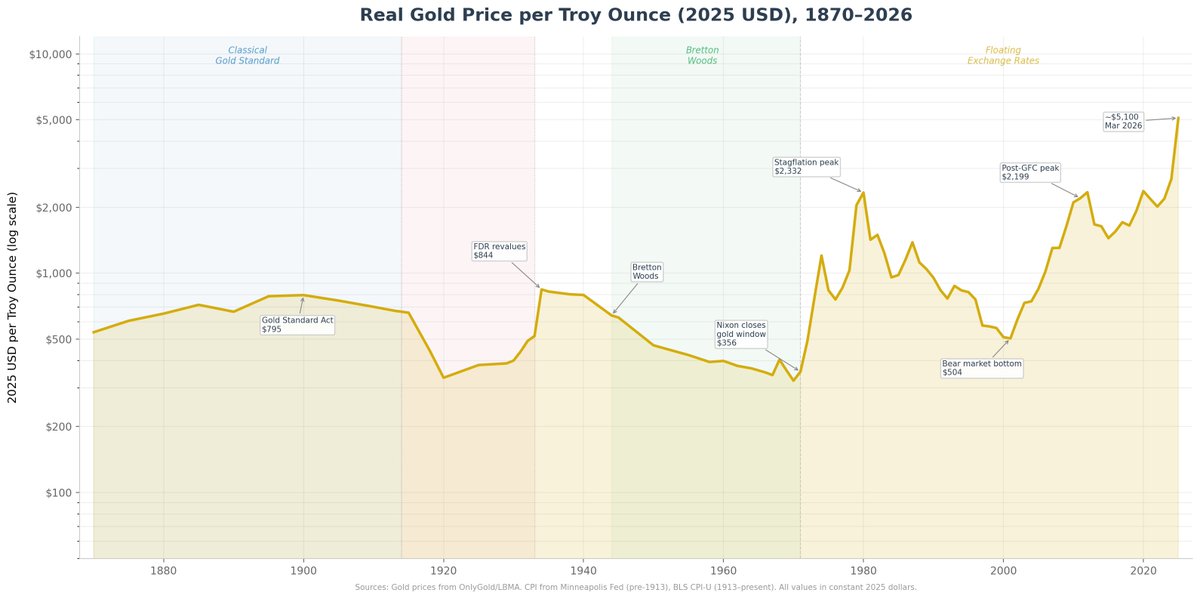
In my previous post I looked at the real price of gold over 155 years:
https://t.co/ukrS9FNfuj
The natural follow-up is: Does gold work as a safe asset? Does it tend to do well when equities do badly?
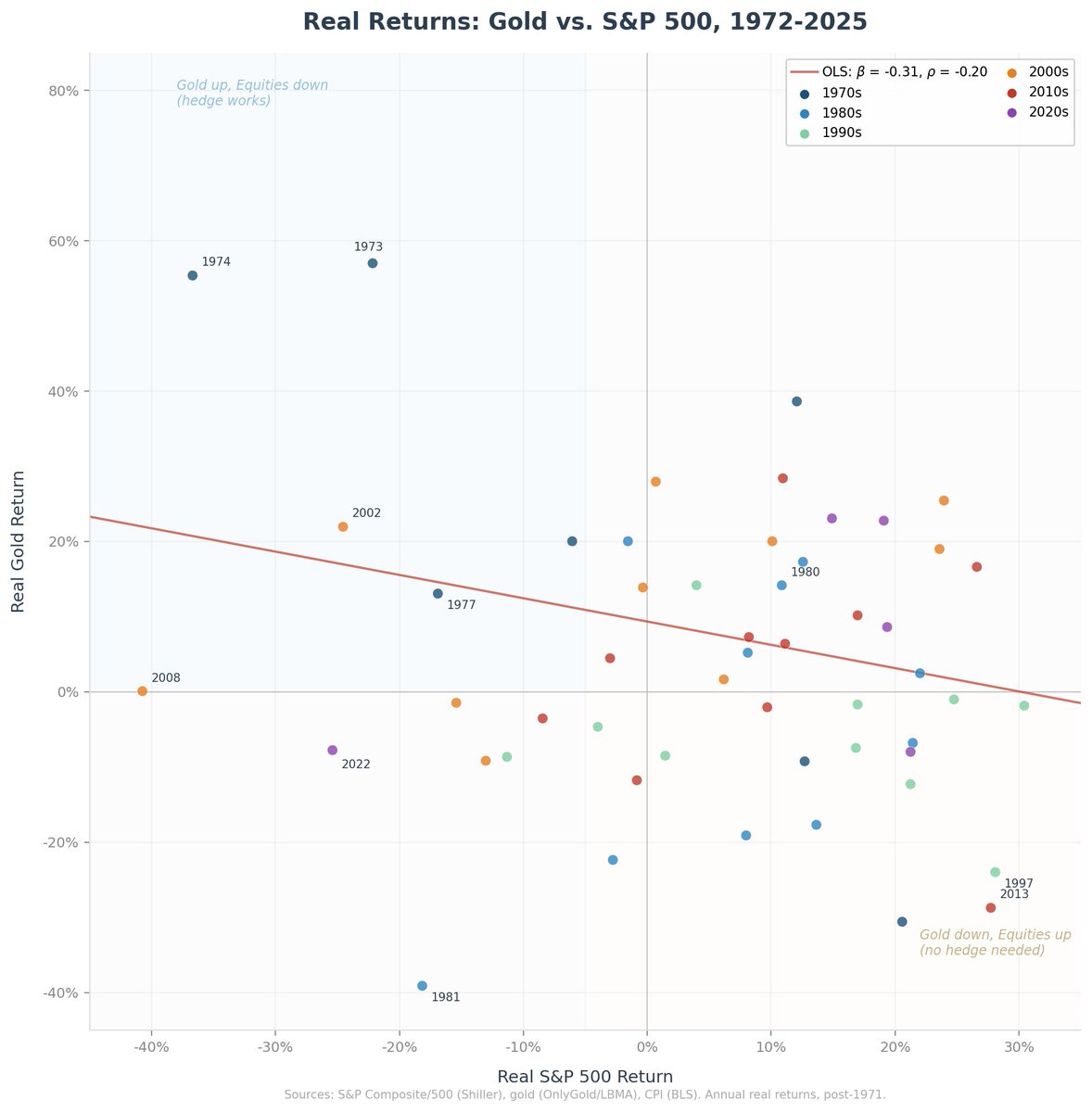
The exercise is simple. I computed annual real returns on gold and on the S&P 500 (the S&P Composite before 1957) from 1875 to 2025, deflating both by the CPI. I then asked how the two co-move.
Start with the full sample. The unconditional correlation of real gold returns with real S&P returns is -0.13. Negative, which is the right sign for a hedge, but small and not statistically distinguishable from zero. A regression of real gold returns on real S&P returns gives a beta of -0.17, a t-statistic of -1.26, and an R-squared of 0.017. The S&P explains essentially nothing about gold over 150 years.
But the full sample mixes two completely different regimes. Before 1971, the gold price was set by law and conveyed almost no information. The pre-1971 correlation is -0.01, which is zero. So set it aside and focus on what happened after gold became a market price.
Post-1971, the unconditional correlation strengthens to -0.20, and the beta rises to -0.31 (t-statistic -1.52, marginal but more respectable). The conditional results, however, are more informative than any regression. In the 19 years when the S&P posted negative real returns, gold averaged +9.9% in real terms. In the 35 years when the S&P was up, gold averaged +6.6%. Gold does better when equities fall, though it earns positive real returns in both states. That second fact is useful in itself if you are building a portfolio.
The individual episodes tell the story better than any correlation coefficient. In the worst equity years since 1971, gold delivered +57% real in 1973 (S&P down 22%), +55% in 1974 (S&P down 37%), +22% in 2002 (S&P down 25%), +13% in 1977 (S&P down 17%), and roughly flat in 2008 (S&P down 41%). In four of the five worst years for equities, gold was strongly positive.
The big exception is 1981. Volcker's rate hikes simultaneously crushed both equities (-18%) and gold (-39%). This was not a minor footnote. It tells you what gold is pricing. Gold hedges against the loss of institutional credibility. It does not hedge against its restoration. When a central bank is aggressively and credibly fighting inflation, gold falls, because the very thing gold prices (the risk that nobody is minding the printing press) is being resolved.
The mirror image holds too. In the best equity years, gold suffers: -29% real in 2013 (S&P up 28%), -24% in 1997 (S&P up 28%), -2% in 1995 (S&P up 30%). When equities are booming and confidence in institutions is high, nobody wants gold.
One finding surprised me. The conditional correlation is -0.40 in equity-up years but only -0.12 in equity-down years. The negative co-movement is stronger when things are going well. Gold is more reliably a contrarian bet in good times than a hedge in bad times. In crashes, gold usually rallies, but the relationship is noisy. In 2022, the S&P fell 25%, and gold fell 8%. Both declined together.
What do I take from this? Gold is not a perfect hedge against equity risk. No single asset is. But it has a mildly negative beta, a positive average real return, and a tendency to perform well precisely when investors need it most. The exception to remember is 1981. If the source of the crisis is a central bank restoring its credibility, gold will not help you. Gold prices the absence of credibility, not its presence.
The rally in the price of gold over the last two years or so has been striking: from slightly over $2,000 an ounce at the start of 2024 to nearly $5,100 as I write these lines, a 2.5x multiplier.
To see how unusual this is, I searched the entire historical series for comparable windows of roughly two to three years in which the real price of gold multiplied by at least 2.5.
I first plotted the price of gold per troy ounce in constant 2025 dollars from 1870 to the present, using a logarithmic vertical axis. The nominal price series comes from statutory rates during the gold standard and Bretton Woods eras and from London market prices thereafter. I deflate by the US Consumer Price Index, using Minneapolis Fed estimates for the pre-1913 period and the BLS CPI-U series from 1913 onward, with 2025 as the base year. Expressing the price in real terms tells us the quantity of goods and services that one ounce of gold could purchase at any given moment in time.
In 155 years of data, a real multiplier of 2.5x or more over a two-to-three-year window has happened three times. All three were in the 1970s: from 1971 to 1974 (the Nixon shock and the oil embargo, a 3.4x real multiplier), from 1976 to 1979 (the second oil shock building, 2.7x), and from 1977 to 1980 (the stagflation peak, 2.7x). The last two overlap and are really part of the same episode. For comparison, the FDR revaluation of 1934, a 69% devaluation of the dollar by executive order and the confiscation of privately held gold, produced a real multiplier of only 1.7x.
The figure shows two different regimes: pre-1971 and post-1971. Pre-1971, the nominal gold price was (largely) set by law. When the general price level rose, the real price of gold fell. This is visible in the downward drift from 1870 to 1920, when the statutory price remained at $20.67 while the price level rose by roughly 60%. The same pattern repeats under Bretton Woods: with gold fixed at $35 nominal, the postwar inflation eroded its purchasing power from about $840 in 2025 dollars in 1934 to $356 by 1971. A holder of gold was taxed by inflation for the better part of a century.
Post-1971, three features of the series are worth noting. First, the two previous real peaks, the stagflation episode of 1980 and the aftermath of the global financial crisis in 2011, reached approximately $2,300 in 2025 dollars. Despite occurring three decades apart under very different conditions, they produced nearly identical real prices. This is suggestive of a mean-reverting process around a long-run real value, interrupted by episodic crises.
Second, the bear market trough of 2001, at roughly $500 in real terms, brought gold back to where it stood during the Bretton Woods era. Two decades of credible monetary policy under Volcker and Greenspan, combined with the fiscal consolidation of the 1990s, effectively restored the real price of gold to its previous administered level.
Third, the current level, approximately $5,100, is without historical precedent. It is more than double the previous real peaks. And the speed of the move has no parallel outside the collapse of the Bretton Woods system and the stagflation that followed.
The usual suspects are central bank reserve diversification following the freezing of Russian assets in 2022, persistent fiscal deficits across advanced economies, and declining confidence in the dollar-based international monetary architecture. Whether this represents a new “normal” or an overshoot is an open question, but the magnitude of the departure from historical norms is itself informative.
The broader lesson I get from the figure is simple. The price the market assigns to gold is largely determined by the risk that the institutions that govern fiat money will fail to maintain their credibility. When those institutions are trusted, gold is cheap. When they are not, gold is dear. The graph is, in this sense, a 150-year running scorecard of monetary and fiscal governance.
In my next post, I will examine whether gold serves as a hedge against equity risk. In asset pricing, risk by itself is not what matters. What matters is covariance. So the question is not whether gold is volatile, but whether it tends to rise when everything else falls. The answer turns out to be more interesting than a simple yes-or-no.
P.S. A bit of shameless self-promotion. If you are the kind of person who finds utility in Greek letters, my paper with Daniel Sanches on the working of the gold standard might be of interest:
https://t.co/1JpX6eywOH.
If Greek letters are not your thing, the post above covers the main intuitions just fine.
Some people suggest that Trump's China strategy is hard to spot and foreign officials can't detect it. I don’t know what they’re looking at, because the strategy has been stated openly and repeatedly. It’s not subtle. It’s a full stack industrial plan to unwind US dependence on China across every chokepoint supply chain, starting with critical minerals and rare earths.
Read the administration’s speeches from the Critical Minerals Ministerial last month because it makes the logic explicit. The minerals market isn't a normal market. It's been systematically distorted by subsidies for years. Projects get years into development, financing nearly in place, and then foreign supply floods in, prices collapse, and the project dies. It's a price weapon. And as long as that weapon exists, private capital can't solve the problem, no investor will commit to a decade long project if China can always dump and destroy your economics.
So the administration is doing the only thing that actually works. Direct investment, offtakes, stockpiles, and enforceable price floors. Public balance sheets underwriting long duration capacity. A preferential trade zone where strategic dumping becomes a sanctionable offense. A national strategic reserve as an offtake signal so projects can finally clear financing. They announced two primary rare earth smelters last month, the first built in this country since 1980.
Also read Jamieson Greer's Davos speech to see the intellectual logic underneath it all. He frames the entire strategy as a return to the American System (Hamilton, Clay, Carey, Lincoln) and argues that hyperglobalization was the historical aberration. Every major industrial power learned the Hamiltonian playbook from us and never stopped using it. We forgot it for thirty years but we're finally remembering.
Countering China and reducing US supply chain dependence isnt just a part of the administrations economic and security strategy it IS the strategy. When you realize that a lot of things that look like noise stop looking like noise and you can see it fits into a coherent strategy.
The administration is instituting an investment growth model, which is a set of policies that incentivizes production relative to consumption, and ensures that higher savings (savings = production - consumption) gets recycled into fixed investment. One of those tools are tariffs. And every investment growth model in history has used them. Tariffs are certainly disruptive, but that disruption serves the vital purpose of forcing companies to rebuild resilient, secure supply chains before a crisis makes orderly transition impossible.
The administration's defense reindustrialization push is the capex engine. It forces factories to get built, it anchors demand, and it creates export demand from allies who are rearming.
They are also attempting to redesign the global trading and capital flow system that has been defined by mercantilist policies and created structural capital inflows into dollar assets that kept currencies from clearing properly, and resulted in persistent current account deficits and industrial hollowing out.
The entire stablecoin push is an attempt to build a payments rail so they can price foreign hoarding of US assets without blowing up the dollar payments system. The goal is to keep the dollar as the world's transaction rail without agreeing to absorb unlimited foreign savings into Treasuries, and the structural trade deficit that comes attached. Stablecoins separate these two functions. Dollar denominated tokens circulate globally for payments but carry no yield and accumulate no claims on US assets. So the dollar maintains its position as a medium of exchange but without the burden of being the financial asset held to balance trade.
The fight over Fed comes back to China as well. The entire point is to coordinate monetary and fiscal policy. You can’t run this shift if monetary policy is acting like it operates in a vacuum while fiscal and industrial policy are trying to redirect the economy’s demand mix.
Meanwhile they need Fed cooperation on financial deregulation in order to free private balance sheets help fund the buildout.
This isn’t just an economic program. The administration continuously touts the slogan that economic security is national security. The entire US military strategy is organized around the central objective of countering China and denying them regional hegemony in Asia. That requires allies who can defend their own regions, a home base that isn't strategically exposed, and the industrial depth to sustain a long conflict.
Defense and economic vulnerability aren’t separate problems. They’re the same problem viewed from two angles. The US is strategically vulnerable because it offshored the upstream capacity that underwrites both economic resilience and military power. The administration is moving to rectify that across every dimension simultaneously.
Every piece points at the same objective. Rebuild the defense industrial base so that deterrence rests on actual production capacity, not platforms we can't replace. Massive military buildout. Make long duration projects financeable through price support and demand guarantees. Shift spending from consumption to investment. Shrink the external deficit. Eliminate China's leverage over the chokepoints.
This is an economic and military reorganization two centuries in the making that was interrupted for thirty years and is now being resumed. The China strategy is the industrial policy is the defense strategy.
If you can’t detect the strategy, that says more about you than it does about the administration.
After shipping hardware at Intel, Xiaomi, Lenovo, Amazon and ByteDance, I joined a robotics startup as COO. Put in a year of my life, my savings, and my family's patience.
The company died. These 6 lessons cost me a lot. Maybe they'll save you something.