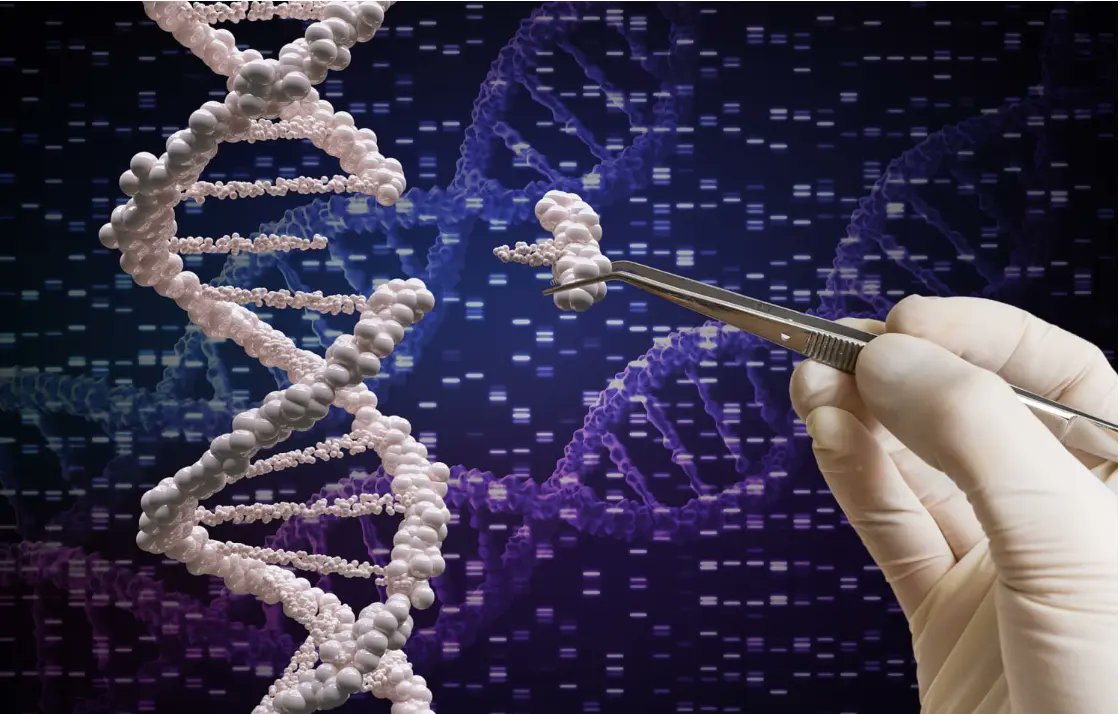
Exploring the frontier where biology meets computation. Brain-computer interfaces • Synthetic biology • Longevity • Bio-AI. Rewriting the code of life.
Dr. David Sinclair says his lab at Harvard grew a miniature human brain in a dish.
Then two small black dots appeared on its surface.
They were eyes.
These brains are grown from single human cells.
They develop the same structures found in a full human brain...
They even have measurable brain waves...
And under a microscope, you can see calcium signals firing like fireworks.
This indicates neurons are communicating with each other in the same way neurons in your brain are firing right now as you read this.
After about a year, the firing fades and the brain loses function.
Sinclair says when his team treats these aging brains with three "longevity" genes called OSK, the firing comes back on.
They have also introduced Alzheimer's disease into these brains.
Using the same three genes, it reverses.
He says this technology is not limited to brains.
His lab has reversed aging in the eye, liver, kidney, and skin.
Every tissue responds to the same treatment.
Now the first human trial is coming.
— David Sinclair (@davidasinclair) on Tom Bilyeu's (@TomBilyeu) podcast
PS. David Sinclair is speaking at SynBioBeta on May 6th this year, discussing the science of slowing and reversing aging.
Tickets available in the comments below.
Kenneth was diagnosed with ALS in 2024 and is losing his ability to speak.
Through Neuralink’s brain-computer interface technology, he is working towards regaining not just the ability to speak, but to speak in his own, original voice.
See how this is made possible.
MIT researchers just replicated human muscles with AI-controlled fibers.
Inside each fiber is a sealed tube of electrically charged liquid and a tiny electric pump.
When the pump activates, one side contracts while the other relaxes, just as your biceps and triceps do when you bend your arm.
How it works:
> The pump injects electrical charge into the fluid
> This creates ions that drag the liquid along with them
> No motors, no external pumps, completely silent
Because they're fibers, they bundle together just like real muscles, scaling up force by adding more strands.
In demos, these fibers were strong enough to bend a robotic arm and curl a dumbbell... but gentle enough to shake someone's hand.
From prosthetics to exoskeletons to industrial robots, this is what happens when engineers stop building around motors and start building around biology.
Generative design of intrinsically disordered proteins based on conditioned protein language models: Data is the limit
1. The study frames IDR design as conditional generation: given target ensemble descriptors (e.g., radius of gyration Rg or end-to-end distance Ree), a model generates amino-acid sequences predicted to realize those properties.
2. Core method: an encoder–decoder Transformer (T5-like) called IDR-Prop2Seq, where the encoder ingests continuous numerical descriptors and the decoder autoregressively emits sequence tokens; conditioning is enforced via cross-attention (not via discrete prompt tokens).
3. Conditioning is “descriptor-tokenized”: each of 15 descriptors becomes its own embedded token, letting the encoder learn relationships among constraints through self-attention (rather than concatenating all values into one vector).
4. Practical feature: partial conditioning is supported by learned “missing-descriptor” embeddings. During training, descriptors are stochastically masked so the model learns to design from incomplete constraint sets (e.g., only Rg, only Ree, or only length plus a subset of other properties).
5. Key message: data scale dominates controllability. Two training regimes differ by ~2 orders of magnitude in dataset size: h-IDRome (~20k human IDRs) vs b-IDRome (~10.8M bacterial IDRs). Accurate matching of target Rg/Ree emerges only with the large-scale dataset.
6. Evaluation strategy: generate 100 sequences per target, repeat across 1,000 randomly sampled target values from training-set distributions, then re-annotate generated sequences with the same pipeline used to build training labels (ALBATROSS for ensemble descriptors; idr.mol.feats for physicochemical descriptors).
7. Results for single-property control: the b-IDR-Prop2Seq model shows much tighter absolute-error distributions for Rg and Ree than the h-IDR-Prop2Seq model; large errors concentrate in underrepresented regions of descriptor space (especially extreme target values).
8. Results for multi-property / partial conditioning: when enforcing one core descriptor (Rg, Ree, or length) plus ~40% of remaining descriptors, b-IDR-Prop2Seq generally maintains control (median variance-normalized MAE ~0.29), but certain descriptor combinations and rare target regions produce a long tail of failures.
9. Diversity and distributional behavior: embeddings (XL-ProtT5 + PacMap) indicate generated sequences broadly cover the same manifold as training data, while SHARK similarity scores remain low both within batches and versus matched training sequences—suggesting high diversity without obvious memorization.
10. Broader implications: the work argues for a data-centric paradigm for IDR engineering—expanding high-quality sequence–ensemble datasets may yield larger gains than architectural tweaks. It also notes limitations of current labels (predictor-derived disorder and ensemble properties) and points to richer ensemble targets (e.g., contact probabilities) and contextual conditioning (environment, domains, PTMs) as next steps.
📜Paper: https://t.co/IgVJIa8M69
#IntrinsicallyDisorderedProteins #IDR #ProteinDesign #ProteinLanguageModels #Transformers #GenerativeAI #ComputationalBiology #ProteinEngineering #DataCentricAI #Bioinformatics
Life with ALS or a spinal cord injury often means navigating a gradual or sudden loss of independence.
Neuralink aims to restore autonomy to those with unmet medical needs—starting with device control and communication, and expanding toward vision and other applications.
For years, the gold standard for spotting early Alzheimer’s was the amyloid PET scan, which could detect brain plaques 10 to 20 years before symptoms appeared. However, a groundbreaking study has identified a “pre-early” warning sign.
Researchers found that a blood test for pTau217 (phosphorylated tau 217) can predict amyloid buildup and cognitive decline even when initial brain scans appear perfectly normal. This discovery could shift Alzheimer’s screening from expensive, invasive scans to a simple, scalable blood test during routine checkups.
https://t.co/gdpoNNutKY
#Alzheimers #neuroscience #health (1/3)
What is neuron degeneration?
Skyler, a machine learning engineer at Neuralink, shares how brain-computer interfaces could bypass neural pathways that are broken due to ALS, helping restore the ability to speak to those who have lost it.
Last night I spoke with Brad Smith @ALScyborg, the first person with ALS to have @neuralink implanted. He has his voice back through AI and can even make dad jokes again. Absolutely incredible technology changing lives and bettering humanity. Thank you @elonmusk!
Before organoids learned to play Pong or wetware hit the lab, Itzhak Bentov was already modeling the human body as a resonant biocomputer.
In 1977 he described 7 Hz aortic standing waves, holographic storage, and the brain as a transducer — 50 years ahead of Cortical Labs' CL1 and FinalSpark.
https://t.co/0W5hgQjmGU
#Biocomputing #Wetware #Consciousness #OrganoidIntelligence
🧬 New funding opportunity now open on @ResearchHub: Next-Gen Human Enhancement — Muscle, Cognition, and Mood.
We're looking for high-impact research into compounds and strategies for human enhancement across three domains: muscle performance, cognitive function, and mood regulation.
💰$10,000 in seed funding for the best preregistered proposal. Open to PhD students, postdocs, and faculty worldwide.
This is HUGE: AI just learns 100× faster using logic instead of brute force
Scientists have developed a new kind of AI that combines neural networks with symbolic reasoning.
Instead of blindly guessing millions of times, this system actually reasons before acting.
In their neuro-symbolic design, the AI uses structured rules like shape, order, and planning to guide decisions, rather than relying only on pattern recognition.
Results were shocking 👀!
It achieved 95% success, compared to just 34% for traditional models and still solved harder unseen tasks with 78% accuracy, where others completely failed.
And Training took only 34 minutes, instead of over 36 hours, while using 100× less energy.
This could change everything, because modern AI systems already consume massive amounts of electricity, and that demand is rapidly growing.
By making AI think instead of guess, this approach could unlock faster, cheaper, and far more efficient intelligence.
Some of the most underinvested areas in frontier biology that could accelerate civilizational progress:
- Cheap, large-scale DNA synthesis (writing entire chromosomes or full organisms)
- Real-time, non-destructive RNA sequencing in living cells
- Highly accurate AI-powered polygenic scores for complex traits (disease risk, cognition, longevity) → enabling full genome design
- Ultra-precise, multiplex genome editing (far beyond CRISPR) with minimal off-target effects, scalable across millions of cells
- Safe, efficient, tissue-specific in vivo delivery systems
- Safe and effective human germline engineering
- Accelerated clinical trials via testing on decedents (with consent)
- Next-gen human enhancement: muscle, cognition, mood — beyond GLP-1s
- Ectogenesis / artificial wombs
Who’s actually building in these areas? Drop names, companies, or researchers below 👇
🚨BREAKING: 8 weeks of gratitude practice physically rebuilds the neural pathways between your memory and reward centers.
Your brain physically rewires itself every time you feel grateful.
Eight weeks of intentional gratitude practice creates measurable structural changes in the neural pathways connecting your hippocampus to your ventral tegmental area. The memory center starts talking to the reward center in a fundamentally different way. New synaptic connections form. Existing ones strengthen. The physical architecture of how you process positive experiences rebuilds itself.
Most people approach gratitude like a mood they can choose to feel. A psychological vitamin they remember to take when life gets difficult. The neuroscience reveals something far more profound.
Gratitude is a biological intervention that sculpts brain tissue.
Researchers tracked participants practicing gratitude exercises for two months using brain scans. They watched new neural highways construct themselves in real time. The anterior cingulate cortex developed stronger connections to the medial prefrontal cortex. The brain learned to route positive emotional experiences through higher order thinking centers instead of storing them as fleeting feelings.
Every positive experience you’ve ever had exists as a neural trace in your memory network. Most sit dormant, accessible only when something external triggers the specific sensory combination that originally encoded them. You smell coffee, suddenly remember a conversation from years ago. Random. Unreliable. Outside your control.
Gratitude practice systematically rewires that retrieval system.
After two months, participants could voluntarily access positive memories with increasing ease. Their brains had built stronger pathways between memory storage areas and emotional processing centers. They experienced deeper emotional resonance during memory retrieval. The quality of remembering itself had improved.
The participants also started noticing positive details in their present environment they had previously filtered out. Their attention systems recalibrated. The same neural pathways pulling positive memories forward were scanning current experiences more thoroughly for elements worth encoding as positive memories.
Their brains became biased toward collecting evidence that life contains meaningful moments.
Most cognitive interventions try to change how you interpret negative experiences. Gratitude practice changes how thoroughly you notice positive ones. It teaches your visual and emotional processing systems to detect opportunities and pleasures that were always present but neurologically invisible.
The timeline reveals something crucial about neural plasticity.
Weeks one through three showed minimal structural changes.
Participants felt slightly more positive, but brain scans looked identical to baseline. Weeks four through six showed the first measurable increases in gray matter density. Weeks seven and eight revealed entirely new neural network formation.
Two months. Your nervous system can physically restructure itself with consistent practice.
The method was almost embarrassingly simple. Participants wrote down three specific things they felt grateful for every evening, explaining why each mattered. No meditation apps. No guided visualizations. Just pen, paper, and the requirement to identify gratitude targets with enough detail that their brains had to actively search for positive elements.
Specificity drives the neural development.
General statements like “I’m grateful for my family” generate different brain activity than precise observations like “I’m grateful my daughter laughed at my terrible joke during dinner because it showed me she still finds me funny despite growing more independent.”
The brain needs detailed targets to practice connecting memory specifics to emotional rewards.
After eight weeks, participants developed a fundamentally different relationship with their attention and memory systems. Someone whose brain automatically scans for and emotionally amplifies aspects of experience that make existence feel worthwhile.
The neural pathways remain permanent after practice ends.
Gratitude carves lasting roads through consciousness.
Another brain-computer interface company just came out of stealth.
Epia Neuro of San Francisco is building an implant that sits in the skull and pairs with a motorized glove to help stroke patients regain hand function.
My story for @WIRED: https://t.co/leKJdT8PfN
This video nails it: even 'how to center a div' now burns coal through half the planet's infrastructure.
.
Silicon AI is hitting the energy wall hard.But biology already solved this , the human brain does complex thinking on ~20 watts.
.
#Biocomputers aren't sci-fi anymore. They're the efficient, adaptive future we need. Sooner than we think.
#Biocomputing #AIEnergy
The brain runs on ~20 watts. Today's AI data centers? Megawatts and climbing.
.
Neuromorphic chips mimic it in silicon. Wetware uses actual living neurons.
.
We break down both — and why their hybrid future could redefine computing.
.
New deep dive: Neuromorphic vs Wetware → https://t.co/LnenxJj44Z
#Biocomputer #Wetware #Neuromorphic #OrganoidIntelligence