Somewhere in your firm there's a data strategy deck with a lake on page three. Somewhere else, a dozen people are running their own AI experiments. Neither effort has reached the place where an advisor prepares for a client review, and the people funding both are starting to ask why. The two efforts rest on opposite myths, and both fail for the same reason.
The first myth says the key first step is a data strategy that gets all of the company's data into a lake, warehouse, or lakehouse so AI has context. It has serious backing. McKinsey, the consulting firm, wrote on Sept. 15, 2023: "If your data isn't ready for generative AI, your business isn't ready for generative AI." Gartner, the research firm, predicted on Feb. 26, 2025 that through 2026 organizations "will abandon 60% of AI projects unsupported by AI-ready data." Piyush Gupta, chief executive of Singapore's DBS Bank, told McKinsey on Feb. 10, 2025: "You have to be thoughtful about how you create and architect your data lakes." He said the cleanup and migration took "more than ten years and about a 100-person data factory." He also described building demonstrable use cases along the way to show value.
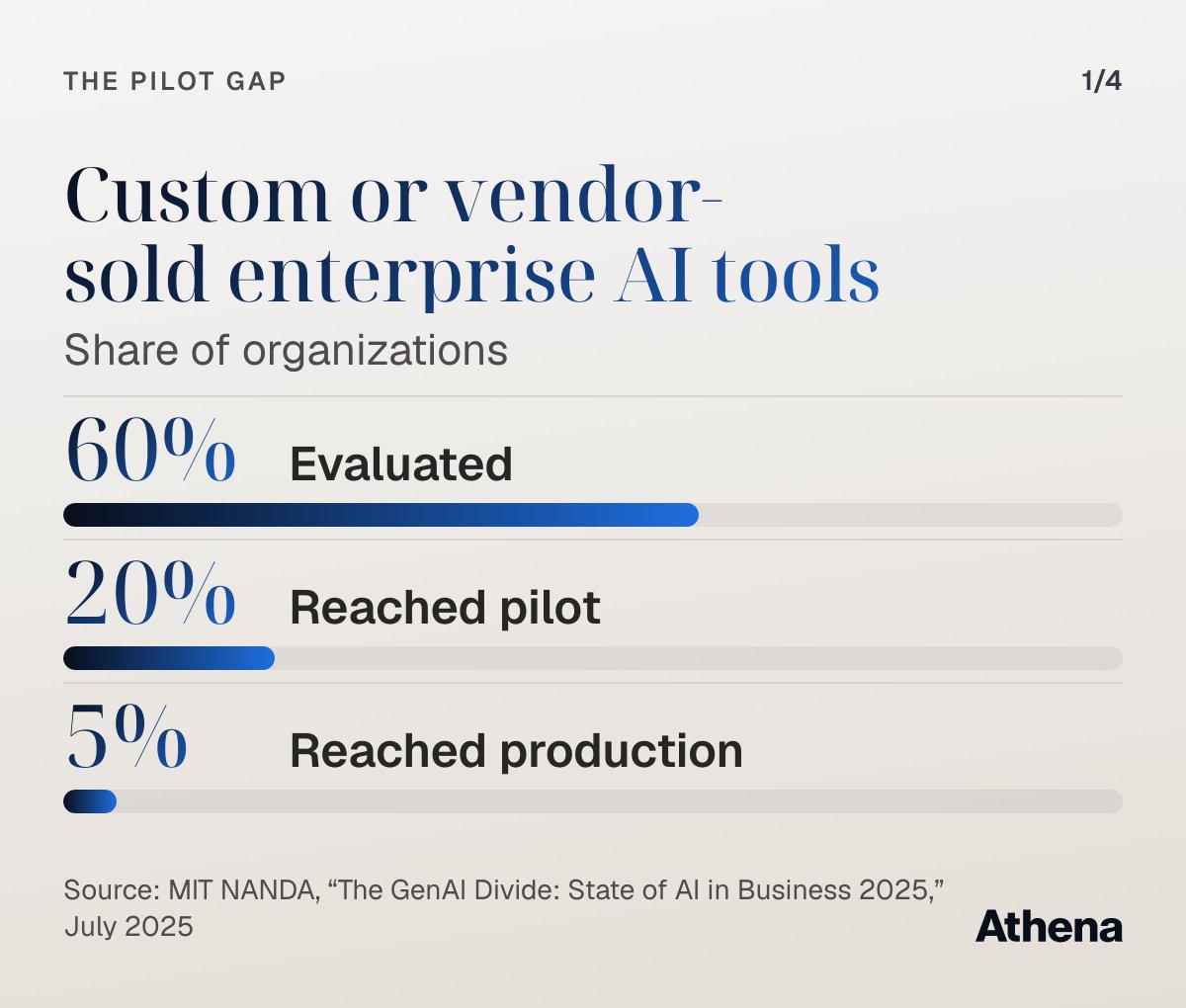
The second myth says to let every employee build their own small AI prototypes and expect them to add up to an enterprise capability. The results so far say otherwise. MIT's NANDA initiative, a research group at the Massachusetts Institute of Technology, studied this in its July 2025 report "The GenAI Divide: State of AI in Business 2025." It found 95 percent of organizations getting no measurable P&L return from generative AI. For custom or vendor-sold enterprise tools, 60 percent of organizations evaluated them, 20 percent reached pilot, and 5 percent reached production. The authors did not blame the models. They pointed to brittle workflows, a lack of contextual learning, and poor fit with day-to-day operations.
Data quality matters, and experiments have value. What fails is the sequence and the expectation of scale.
Gartner's 2024 roadmap "AI-Ready Data Essentials" says AI-ready data "must be representative of the use case." It adds that this readiness "is not something you can build once and for all, nor that you can build ahead of time for all your data." The first stage is to assess data needs depending on the AI use cases.
The record on big, ahead-of-time data programs is worse than the pitch. Gartner warned on July 28, 2014, in "Beware of the Data Lake Fallacy," that without descriptive metadata and a way to maintain it, "the data lake risks turning into a data swamp." Qlik, a data analytics vendor, quoted a Sept. 26, 2017 Gartner note in a press release: "Through 2018, 90 percent of deployed data lakes will be rendered useless, as they're overwhelmed with information assets captured for uncertain use cases." That was a prediction, not a measured failure rate, but the diagnosis is specific: data captured for uncertain use cases. McKinsey reported on Aug. 1, 2018 that one industrial company invested $15 million in big data infrastructure and did not start to see a payoff for at least three years. On Feb. 28, 2025, McKinsey wrote that most banks made significant data-transformation investments "in the past five to ten years," and that "most banks either could not finalize them or could not realize their expected impact." Unfinished programs left fragmented warehouses and lakes and "elevated costs from maintaining multiple complex environments."
McKinsey's March 4, 2024 guidance on generative AI names the alternative. Companies that do this well "tie their data quality and augmentation efforts to the specific AI/gen AI application and use case." In the same piece it says "you don't need this data foundation to extend to every corner of the enterprise."
A pilot proves that something can work for one person on one afternoon. A workflow has to work for a team, every week, with the same inputs and the same checks. The experiments are everywhere. Microsoft and LinkedIn's Work Trend Index, a May 2024 survey of 31,000 knowledge workers in 31 countries, found that 75 percent use generative AI at work, and 78 percent of those users bring their own AI tools. Salesforce, the enterprise software company, found in a November 2023 survey of more than 14,000 workers that more than half of generative AI users at work had no formal employer approval, and nearly 7 in 10 had never received training. Activity that wide, with no shared workflow behind it, rarely turns into production systems.
IDC, the market research firm, in research commissioned by Lenovo, the computer maker, and reported by the trade publication https://t.co/CXnu4U3b2K on March 25, 2025, found that for every 33 AI proofs of concept a company launched, only four reached production. IDC's authors blamed low readiness in data, processes, and IT. Ashish Nadkarni, a group vice president at IDC, said many proofs of concept are "born at the board level" and are "highly underfunded or not funded at all." Brian Jackson, a principal research director at Info-Tech Research Group, an IT research firm, offered the fair counterpoint: "even the failures are not failures if there are good lessons learned."
McKinsey's AI survey, fielded in July 2024 among 1,491 respondents and published March 12, 2025, found more than 80 percent not seeing a tangible impact on enterprise-level earnings before interest and taxes (EBIT) from generative AI. Only 21 percent of those reporting gen AI use had "fundamentally redesigned at least some workflows." Of 25 attributes McKinsey tested, workflow redesign had the largest effect on EBIT impact. Its State of AI survey of 1,993 respondents, fielded from June 25 through July 29, 2025 and published Nov. 5, 2025, found 88 percent using AI in at least one function, yet nearly two-thirds had not begun scaling it across the enterprise. The same survey found use-case-level cost and revenue benefits, and 64 percent of respondents said AI was enabling innovation.
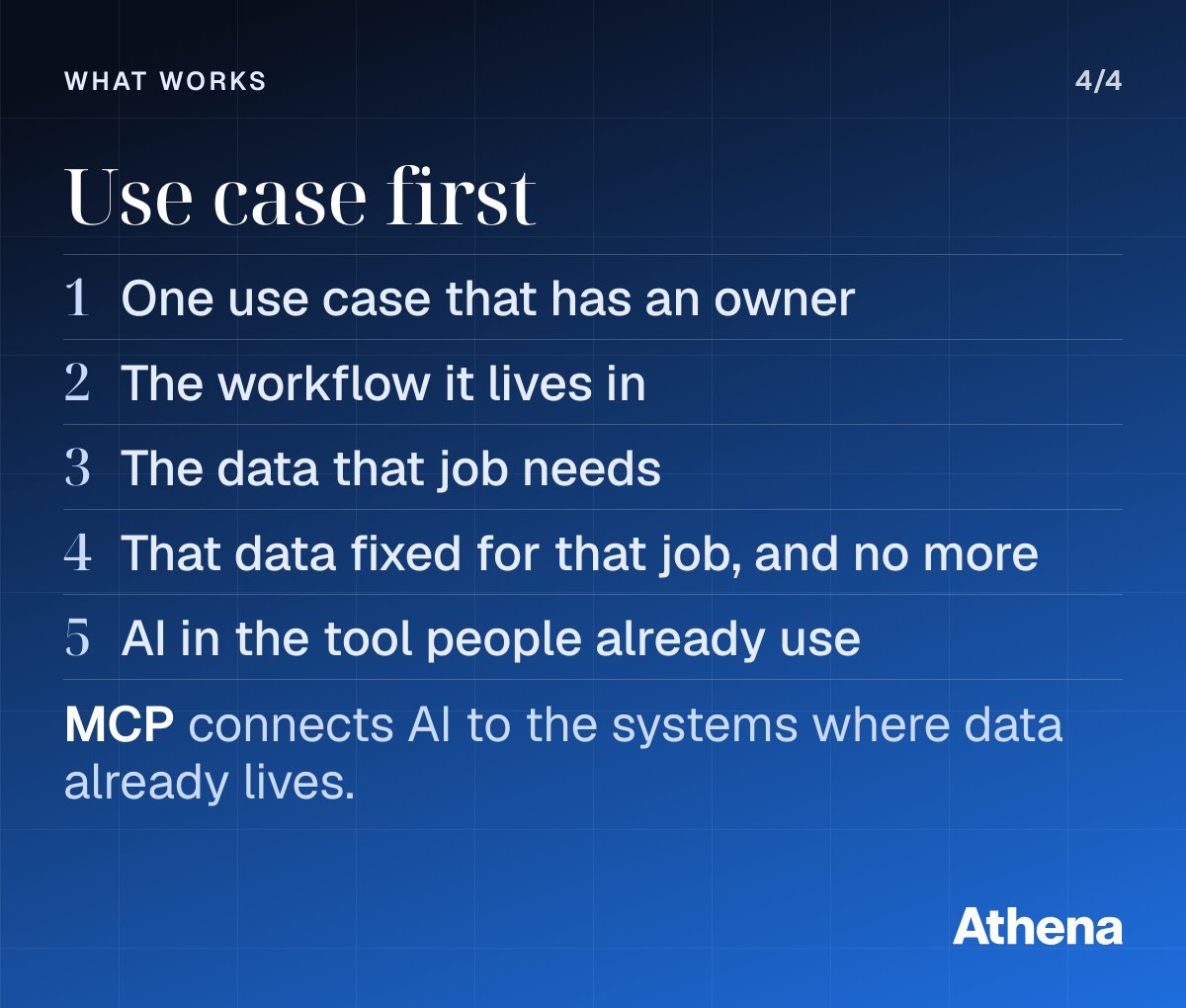
What gets AI into production is a short sequence. Start with one use case that has an owner and a place in someone's week. Pick the workflow it lives in, such as preparing for a client review or drafting the follow-up after one. List the data that job needs, and find where that data already lives. Fix the quality of that data for that job, and no more. Then build the AI step into the workflow, so the person doing the work meets it in the tool they already use.
The connection step used to be the hard part. Model Context Protocol, or MCP, is an open way for AI tools to connect to the systems where data already lives, so teams don't have to move everything into one lake first. Amazon Web Services, the cloud arm of Amazon, described the pattern in a Sept. 4, 2026 post on its Big Data Blog: instead of moving all data to one place, "let AI agents talk directly to the systems where data lives. Model Context Protocol (MCP) makes this possible." A lake can still earn its place. Ernst & Young (EY), the professional services firm, wrote in its 2026 paper "Model context protocols vs. enterprise data platforms": "The EDP governs the data; MCP governs the AI's access to that data."
Each use case that ships this way leaves behind cleaner data, a working connection, and a team that has seen the result. The next use case starts from there. Scale happens one workflow after another. It does not require a decade of preparation, and it does not come from a hundred scattered experiments that never meet.
Athena works with very large institutions and smaller RIAs. It's the AI-native platform built for how advisors work, and our MCP connection is live. We also help firms with their AI implementation.
https://t.co/z0V1NmrX9z
𝗪𝗵𝘆 𝗔𝗱𝘃𝗶𝘀𝗼𝗿 𝗔𝗱𝘀 𝗕𝗿𝗶𝗻𝗴 𝗖𝗹𝗶𝗰𝗸𝘀 𝗯𝘂𝘁 𝗙𝗲𝘄 𝗖𝗹𝗶𝗲𝗻𝘁𝘀
𝟭𝟮,𝟬𝟬𝟬 𝗔𝗱 𝗖𝗹𝗶𝗰𝗸𝘀, 𝗔𝗯𝗼𝘂𝘁 𝟱 𝗖𝗹𝗶𝗲𝗻𝘁𝘀
Late on a Tuesday night, someone clicks a firm's ad. They read the landing page, work through what the firm offers, and decide they aren't ready to talk to an advisor. They close the tab. The firm paid for that click.
That scene repeats all year. Here's what it adds up to.
𝗧𝗵𝗲 𝗳𝘂𝗻𝗻𝗲𝗹, 𝘁𝗼𝗽 𝘁𝗼 𝗯𝗼𝘁𝘁𝗼𝗺
A firm buys 1,000 clicks a month, which is 12,000 a year. Unbounce's Conversion Benchmark Report (2024) found that the median landing-page conversion rate for investing pages is 3.9%. The report counts any page action as a conversion, such as a form fill or a guide download. Apply 3.9% to 12,000 clicks and you get about 468 people.
From there, assume a hypothetical 90% drop-off at each step. The full path looks like this:
1. 12,000 clicks over the year.
2. 468 form fills or other page actions, which is 3.9% of those clicks.
3. 47 booked meetings, a 90% drop.
4. About 5 paying clients, another 90% drop.
Divide 12,000 clicks by 5 clients and you get roughly 1 client per 2,400 clicks. The firm pays for all 2,400 clicks to get one client.
𝗪𝗵𝗮𝘁 𝗮𝗱𝘃𝗶𝘀𝗼𝗿𝘀 𝗿𝗲𝗽𝗼𝗿𝘁
Kitces Research published "How Financial Planners Actually Market Their Services" in 2026, a survey of advisors about 2025. It found that only about half of practices using advertising and sponsorships could attribute even a single new client to it over the prior year.
𝗪𝗵𝘆 𝗰𝗼𝗹𝗱 𝘁𝗿𝗮𝗳𝗳𝗶𝗰 𝗰𝗼𝗻𝘃𝗲𝗿𝘁𝘀 𝘀𝗹𝗼𝘄𝗹𝘆
Cold social traffic is made up of people who weren't looking for an advisor. The timing of a hire comes from somewhere else. In a 2021 MagnifyMoney survey, 60% of people with a paid financial advisor hired one after a specific life event: a job change, an inheritance, a bonus, or approaching retirement.
Many people who click today are months or years from that event. A landing page built to book a meeting asks for a decision the visitor has no reason to make yet, so they leave.
𝗪𝗵𝗮𝘁 𝘁𝗵𝗶𝘀 𝗱𝗼𝗲𝘀 𝘁𝗼 𝗮𝗱 𝘀𝗽𝗲𝗻𝗱
Nearly everyone who clicked, including most of the people who filled out a form, ends up with no relationship with the firm.
Email follow-up reaches only the people who shared their details. Everyone who left without sharing them is out of the firm's direct reach.
There are three common responses: tighter targeting, email follow-up, or giving the click a place to return to.
𝗔 𝗳𝗿𝗲𝗲 𝗮𝗽𝗽 𝗮𝘀 𝘁𝗵𝗲 𝗻𝗲𝘅𝘁 𝘀𝘁𝗲𝗽
The third response is an app. The ad leads to the firm's own client app, branded with the firm's name and free to the end user, with financial tools and advice built in. The visitor doesn't have to be ready for a meeting. They get something useful to open on their phone.
ChartMogul's Conversion Report (2026) is a software benchmark. It found that companies with free products turn about 9% of website visitors into free users. Applied to 12,000 clicks, that's about 1,000 people who get the app in a year.
These are downloads, and many won't stay active. Adjust (2025) found that finance apps keep about 2% of users at day 30. The app has to earn repeat use with useful advice and tools.
The payoff comes late. In a 2021 interview, Personal Capital's David Eckerly said, "we regularly convert users who have been with us for two, three, five, even 10 years," because their financial lives got more complex. Personal Capital offered free financial tools alongside paid advice from an advisor.
𝗧𝘄𝗼 𝗳𝗶𝗿𝗺𝘀 𝗮𝘁 𝘆𝗲𝗮𝗿-𝗲𝗻𝗱
Take two firms that each buy 12,000 clicks.
The first ends the year with about 5 clients and nothing else.
The second has the same 5 clients plus roughly 1,000 people who have had its app on their phones. Over the coming years, many of them will hit one of those life events. The ones still using the app will already know the firm.
𝗕𝗮𝗰𝗸 𝘁𝗼 𝗧𝘂𝗲𝘀𝗱𝗮𝘆 𝗻𝗶𝗴𝗵𝘁
The person who closed that tab was early. If the ad had led to the firm's app, they would have left with useful tools and the firm's name on their phone. When the job change or the bonus arrives, the firm is already there.
At Athena, we have technology that can help: a free app for clients, branded for the advisor's firm. From that app, clients open and fund their accounts at Schwab, and trading happens at Schwab based on the advisor's models.
Get the overview: https://t.co/z0V1NmrX9z
@MichaelKitces The subsidized-token point is the one most firms skip. If your plan to grow without hiring assumes today's AI prices, you've handed your margins to a supplier. A junior planner checking the AI's work is a cost you actually control.
More on it here: https://t.co/rBFlaotDvA
Your AI Growth Plan Is a Bet on Someone Else's Compute
Picture an RIA owner planning next year. They watch a model turn one meeting transcript into a client summary, a recap email, and a set of CRM tasks in a single pass. The plan writes itself: each advisor carries more clients, the next hire waits, and the fee holds.
That plan works if the tool does next year what it does today, at about today's price. That's a forecast about a supplier's compute, and most plans treat it as settled.
The suppliers are moving toward this work. In September, Anthropic launched Claude for Financial Advisors, which connects Claude to custodians, portfolio platforms, and CRMs, with skills for meeting prep, post-meeting notes, rebalance explanations, and estate and tax briefs. Others will likely follow. As they do, more of an advisory firm's output will come from outside the firm.
Anthropic's S-1 shows how a provider thinks about the capacity behind a product like that. It manages compute "as a single, fungible pool" and directs it between workloads "based on where the marginal unit is expected to be most productive at any given time." Those workloads include research, customer demand, and Anthropic's own use of Claude. The allocation is the vendor's call.
And capacity isn't guaranteed to keep growing on schedule. On November 5, AI stocks had one of their worst days in years as investors worried that opposition to data centers and the midterm results could slow the buildout. If capacity tightens, your firm's volume is one claim among several on the same pool.
Price and terms carry the same uncertainty. If a provider raises prices or changes terms for its heaviest users, a firm that sized its fees and team to today's cost absorbs the difference. Volume compounds it. A firm that runs every meeting and every client through the tool uses far more than a firm trying it on a few cases, so the price per task can fall while the monthly bill rises.
None of this is a reason to wait. A firm can use these tools well this year without assuming cheap, abundant supply forever. The trouble starts when it builds commitments on that assumption: a fee schedule, a service model promised to clients, a team sized to the output, a book grown to match. Those are monthly obligations, and they don't flex the way a vendor's allocation can. If the tool gets scarcer or pricier than planned, the owner pays. Some comes out of margin, some goes to clients as higher fees, and some goes back to people doing work the firm expected to hand off, on a team it chose not to build.
Growth that depends on an assumption you don't control is a bet on someone else's future. Make it knowingly.
This is how I think about it at Athena. I build for firms where a few advisors serve many clients, so the core of the work, the planning math and the year-by-year cash-flow projections, runs on my own engine and doesn't cost more with every client you add. AI helps on top of that foundation, not underneath it.
@amasad Finance went through this with texting. Firms banned it, people did it anyway, and the fix was firm-run tools that keep the records. Agents will go the same way, and whoever builds them on firm systems with a real audit trail wins.
The full piece, with who charges to connect, who doesn't, and the question every firm should ask its vendors before the next renewal: https://t.co/vi0Wa6m03y
One wealthtech platform is charging for access and another is considering it. Anonymous vendors quoted $2,000 to $20,000 a month to stay connected to the first, which confirmed no amounts. Citywire reports Envestnet is weighing MCP access fees for integration partners.
@a16z Chaos proves demand, not value. Finance ran this test. Bankers and advisors smuggled texting and WhatsApp into work for years, and since Dec 2021 the SEC has fined 100+ firms over $2 billion for not keeping those records. The smuggled AI chat is the next exam finding.
@finplan@CharlesSchwab Read Schwab's own disclosure. Its affiliated ETFs are exempt, and if a sponsor pays the fee from fund assets, it lands in the expense ratio, so clients pay with no line item. Fidelity has charged a similar fee, up to 15% of the management fee, since late 2024.
@a16z Documents aren't the bottleneck. On a benchmark of real regulated documents, top systems read 92 to 98% of mortgage-form fields correctly. That compares well with a person retyping them, and Athena already does it for advisors' held-away statements, trusts, and tax returns.
@HamelHusain Advice work is a clean case of lopsided costs. A missed compliance flag on a client trade costs far more than a reviewer clearing one extra false alarm, so those checks should be tuned for recall. The default 0.5 almost never fits regulated work.
@cullenroche Most of those knowns are in the financial plan: the tax payment, the tuition date, the next car. The plan and the portfolio sit in separate systems, so those dates never become cash flows the portfolio is built to meet. Connect the two and ALM stops being a special project.
@a16z@TownAI The usual answer in regulated verticals is that the labs are suppliers you're glad to have. They won't build custodian integrations or keep SEC books and records for an advisory firm. I'm less sure that holds once their agents can do most of that work.
Is 10²⁵ FLOPs Still the Frontier?
A new Anthropic-written safety bill is circulating on Capitol Hill. Some of its ideas could be reasonable if limited to true frontier companies. As written, however, it will eventually sweep in most of Silicon Valley, damaging the startup ecosystem.
The bill defines the “frontier” as any model trained on 10²⁵ FLOPs — the EU standard from 2023. Biden’s executive order, California’s SB 53, and New York’s RAISE Act used 10²⁶ (ten times more). 10²⁷ is where the frontier actually is today (e.g., GPT-6 Astra).
Astra was reportedly trained on 100,000+ Grace Blackwell GPUs. A 10²⁵ model can be trained on as few as several hundred GB300 chips in three months. That is not frontier in 2026.
The definition is also cumulative: it adds FLOPs from fine-tuning, reinforcement learning, or other material modifications. In practice, that captures almost all meaningful post-training — work that is becoming commonplace in the enterprise.
The enterprise trend is toward thousands of smaller custom models built for specific workloads. These pose no frontier risk. Treating them as frontier systems would impose large compliance costs across corporate America for no safety gain.
Dario has claimed that Anthropic designs rules to disadvantage frontier companies like his own while advantaging smaller competitors. This definition does the opposite.
A stale 2023 cutoff favors incumbents who already clear the bar and can absorb the costs. It hobbles the open model ecosystem that threatens Anthropic’s pricing power.
The frontier keeps moving. Any definition meant to track risk should move with it.
Anthropic should clarify if they really believe 10²⁵ FLOPs represents the frontier.
@MarianaKrym@emollick Assumptions. Missing accounts are obvious gaps. A return or spending figure the model supplied looks finished, so it can survive until a client questions it. That's why I'd show the two buckets separately.
@finplan@noahstjohn Before blaming habit, I'd check the review step. If a senior advisor has to reread the whole AI summary before it's client-file ready, typing their own notes is faster.
@a16z The advisor version is new client onboarding. Paperwork, account transfers, and custodian rejections can take weeks, with a stall risk at every handoff, so an agent that owns it from signed agreement to funded account is worth more to an RIA than another email drafter.
@levelsio I see this firsthand with financial advisors. Meeting notes, account paperwork, and compliance records eat up a big part of their week, and once one firm automates that with client data kept under its control, the rest will have to follow.