Interesting post by @CFR_org@BennSteil@bdellarocca explaining why “the gap between central-bank bond holdings and bank reserves is a fairly reliable indicator of where inflation is headed” and much more
Link: https://t.co/gZ5AZYOv3y
The Chinese government is betting the house on keeping new homes popular and profitable, write @BennSteil and @bdellarocca. What does this mean for China’s economy? https://t.co/NiVJNENPWU
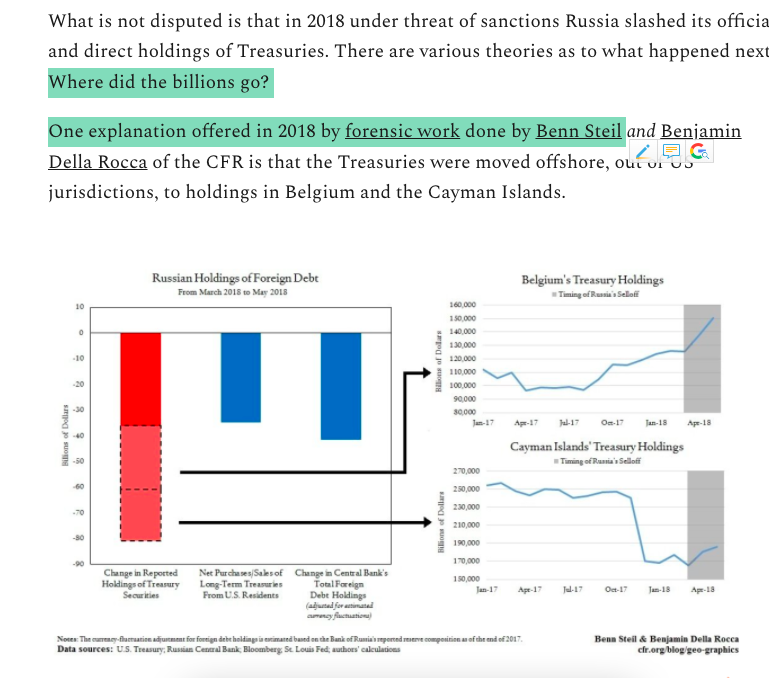
Russia may have hidden billions of dollars offshore that it can use to keep funding its war in Ukraine. If the West wants to use sanctions to punish Russia, it should follow the money, write @BennSteil and @bdellarocca.
https://t.co/MwUM8u19a4
If the West is to use sanctions to effectively pressure and punish Russia, it should assess how the Kremlin may have prepared to operate despite such restrictions—for instance, by hiding money in offshore accounts, write @BennSteil and @bdellarocca.
https://t.co/TDiYv6Nb4U
Western sanctions against Russia may be less watertight than reports suggest, write @BennSteil and @bdellarocca. There is evidence that the Kremlin has stashed billions in offshore accounts, beyond the reach of sanctions and asset freezes.
https://t.co/WQQhzBywnB
"We believe Putin’s regime may actually hold tens of billions of dollars’ worth of U.S. Treasuries that cannot currently be traced to Russia" WOW... @bdellarocca & Ben Steil highlight how important it is for the West to trace money flows in real-time https://t.co/a0qtZhYyHw
China may have helped Russia hide money and shield it from international sanctions, write @BennSteil and @bdellarocca. Evidence suggests that the Kremlin may have stashed billions of dollars in offshore accounts that it can draw on in a pinch.
https://t.co/erzvIYJ563
Is China helping Russia evade sanctions with $38 billion stashed near EU headquarters in Brussels? @BennSteil & @bdellarocca investigate https://t.co/20gCk0Tb2W
We’re also excited to announce the winners of our 5th annual Student Essay Competition, on new issues in employment and labor law. Congrats to @jcolinbradley (@nyulaw ’21, @Princeton PhD ’23) and @bdellarocca (@YaleLawSch ’22)! Read their Essays in Forum: https://t.co/qrCMGas0N8
Beijing knows its trajectory is ultimately unsustainable. But history suggests it won’t change course anytime soon, write @BennSteil and @bdellarocca. https://t.co/ag7o5bi7qL
With Evergrande, though President Xi is trying to “send a warning that no firm is too big to fail,” history suggests that overborrowing is more likely to shift than to fall.
My latest with @BennSteil for @ForeignAffairs
https://t.co/xhqDWBOW1Y
Does Evergrande’s fall from grace mark the end of debt-fueled growth in China?
Read @bennsteil and @bdellarocca in @ForeignAffairs. https://t.co/oQJiJ7NStv
"Fed officials are trying to maintain “credibility” by doing what they predicted they would do—even though current inflation data no longer validate those predictions," argue @BennSteil and @bdellarocca. https://t.co/uGPJPQJZlP
My latest with @BennSteil for @WSJ.
"The market is not looking for the Fed to be omniscient about its own behavior, which is mindlessly easy," but to "adapt[] policy to developments it did not foresee."
https://t.co/sbQOFGrTPT
Read @BennSteil and @bdellarocca on the consequences of Trump’s steel tariffs, the rise in the U.S. steel industry’s fortunes over the past few months, and the value of cooperative trade relations:
https://t.co/6K8bQeBSCg