Researchers at the University of Tokyo developed Lunavity, a drone backpack designed to help people jump higher.
Its rotors provide upward thrust, allowing users to jump two to three times higher than normal.
It also helps them float down slowly, creating a feeling of reduced gravity.
Trained on zero real-world data.
Learned to walk, pick up boxes, and follow multi-step instructions...
in the REAL world. ( 📌 Paper below)
Researchers from Amazon FAR, Berkeley, Stanford, and CMU scanned real rooms with an iPhone, rebuilt them as 3D Gaussian Splatting scenes, then generated 48,000 synthetic trajectories of a Unitree G1 walking, grasping, and placing objects inside those virtual replicas. They rendered the robot's first-person camera view from each run and paired it with the matching language instruction and motion data.
That's the dataset every humanoid team needs and nobody has: synced egocentric video + language + kinematics, at scale. Instead of collecting it in the real world, they manufactured it.
They trained a vision-language-kinematics policy on that synthetic data alone, then deployed it on the physical G1 across five task types: navigation to a named object, lifting boxes of three different sizes with no per-size tuning, chained multi-step tasks, robustness to mid-task layout changes and flickering lights, and multi-minute long-horizon runs.
No real-world fine-tuning at any point.
Real-world interaction data has been the hard limit on humanoid learning... slow, expensive, and small. If scanning a room once and synthesizing thousands of labeled interactions holds up as a general recipe, that limit moves. Data stops being the bottleneck robotics teams have to solve for.
📌 Paper: https://t.co/5aRuWIQiNl
Project: https://t.co/Qu4B282Lar
——-
Weekly robotics and AI insights.
Subscribe free: https://t.co/9Nm01QUcw3
Another awesome robotics company raised funds in Europe. 🇪🇺
This time a company that is shipping robots that build!
@BuildMonumental has raised $32M Series B led by Khosla Ventures, and its fleet of autonomous bricklaying robots has already built more than 100 real structures across Europe.
Houses. A school. A community centre. A hotel. Canal walls.
Founded by @salar al Khafaji and Sebastiaan Visser, the co-founders of data visualisation firm Silk, acquired by Palantir in 2016, this is a team that knows how to build and sell a company.
The technology is serious:
→ Fleet of 100+ electric autonomous robots operating on live job sites today
→ Advanced sensors, computer vision and small cranes laying brick to millimetre precision
→ All driven by Atrium, their proprietary AI software platform
→ Nearly half of all homes built in the last three months alone, pace is compounding fast
The business model is also worth taking a look at. Contractors don't buy the robots. They hire Monumental as an autonomous subcontractor and pay for finished wall. So in the end you only pay for the output.
This is the same forward-deployed engineering model Palantir pioneered in software. Monumental brought it to physical robotics years before anyone else in the industry caught on.
The backdrop makes this urgent. US construction is short 200,000-400,000 workers every month.
Since 1945, US manufacturing productivity rose eightfold. Construction gained just 10%, and has actually declined since the 1960s.
LET'S MAKE CONSTRUCTION BUSINESSES SEXY AGAIN! 🧱
~~
♻️ Join the weekly robotics newsletter, and never miss any news → https://t.co/GoA3ZuwoPB
Your NVIDIA Jetson coding setup just got an AI upgrade. 🛠️
@JetsonHacks' walkthrough shows you how to set up Claude Code in VS Code, connect via remote secure shell, and unlock specialized skills all in one workflow.
Watch the full video ➡️ https://t.co/4AUphYZKgk
Your robot can now see in depth 👀📏
LeRobot v0.6.0 adds real end-to-end depth support. Plug in an Intel RealSense, set use_depth: true, and depth maps join your RGB observations automatically: captured in millimeters, compressed into compact 12-bit depth video alongside your normal camera streams, and decoded back to physical units at training time.
Depth renders live while you record and in the dataset viewer, and it works across SO-100/101, Koch, OpenArm, reBot, Unitree G1 and more. You also get full control over how everything gets encoded, RGB or depth, codec, quality, presets, all of it.
More on how it works: https://t.co/MQ7j0fcGAI
One professor at the University of Bonn quietly put his entire robotics curriculum on YouTube: SLAM. Sensor fusion. State estimation. Probabilistic robotics. Self-driving cars. Motion planning. Photogrammetry.
Cyrill Stachniss has been uploading full university lectures for years!
Each topic is a complete playlist; the kind of material that normally costs a semester of tuition.
He's one of the most cited researchers in mobile robotics and mapping. His students go on to build the navigation stacks powering real autonomous systems.
If you're serious about understanding how robots know where they are... this is the place to start.
Free. On YouTube.
📌 [https://t.co/INqnqzEBD7]
——
Weekly robotics and AI insights.
Subscribe free: https://t.co/9Nm01QUcw3
This #CVPR2026 paper from our research team is trending #1 on @HuggingFace 🤗
Meet LocateAnything: a vision-language detection model that rethinks bounding box prediction. For AI agents and robots, “seeing” is only useful if a model can pinpoint where something is fast enough to act.
Trained on 138M high-quality samples, LocateAnything decodes bounding boxes in parallel instead of one coordinate at a time, improving localization accuracy while dramatically increasing throughput for visual grounding and detection.
Project page: https://t.co/O7JMe8tzFM
Rust for Robotics Workshop formally accepted to IROS 2026!
We believe that this could be a great opportunity to highlight the work of passionate rust roboticist at a prestigious academic conference.
More info at: https://t.co/ZjfSrtvVD7 :)
#iros#rust#robotics
Heading to #ICRA2026 in Vienna?
Join us to explore the latest in physical AI and robotics research, from robot learning and simulation to perception, humanoid robotics, and real-world deployment.
Discover our keynote, accepted papers, and workshops. ➡️ https://t.co/XF28e6UGll
Can AI truly empower robots to invent their own solutions?
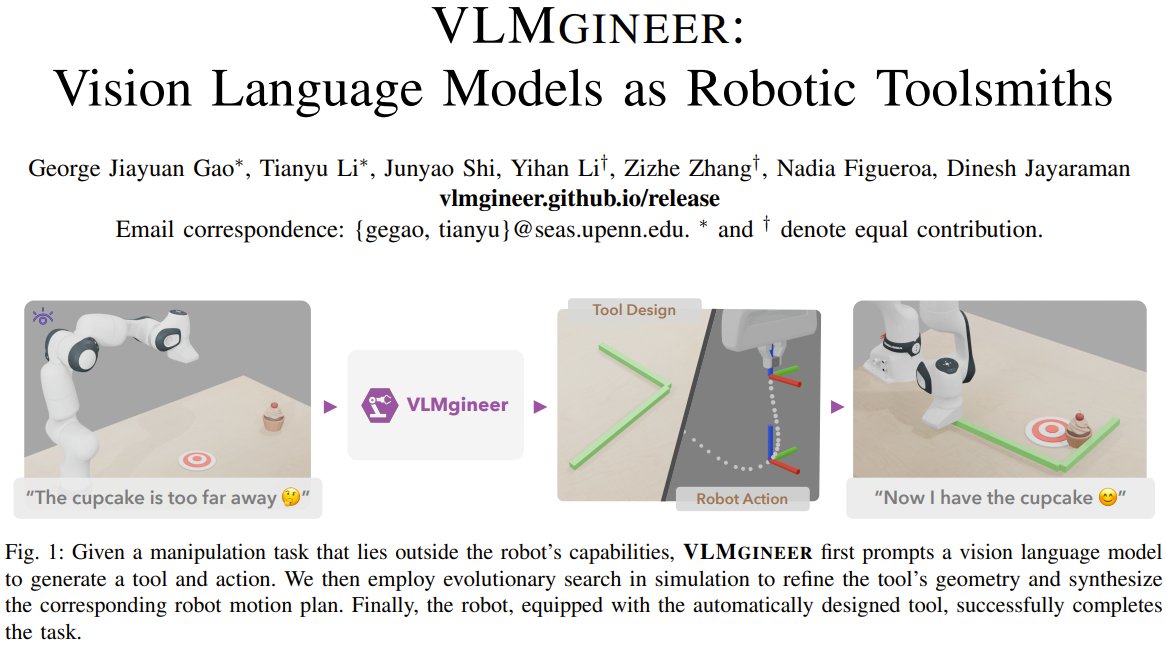
George Jiayuan Gao, Tianyu Li, and colleagues from UPenn present VLMgineer.
This framework leverages Vision Language Models (VLMs) to brainstorm initial tool designs and action plans. It then refines these ideas using evolutionary search in simulation, optimizing both the tool's geometry and how the robot uses it.
VLMgineer consistently outperforms existing human-crafted tools and VLM-generated designs from human specifications across diverse, challenging everyday manipulation tasks, transforming complex robotics problems into straightforward executions.
VLMgineer: Vision Language Models as Robotic Toolsmiths
Project: https://t.co/luRm4pJSNk
Paper: https://t.co/YmWLTIiKA7
Our report: https://t.co/ADnAKbe6Os
📬 #PapersAccepted by Jiqizhixin
Math isn't just about numbers - it's about finding complex patterns in our world.
And there are many ways that you can apply mathematical concepts in programming, beyond what you might've learned in school.
In this guide, Tiago discusses the architecture of math – and how you can use it in your code.
https://t.co/mH2DFQBGXy
Training humanoid robots needs high‑fidelity human motion data, and BONES‑SEED is a big step forward for the community.
Learn how to go from experimentation to reliable robotic systems deployed at scale: https://t.co/aV6aMcT5mO
Learn more about the new BONES‑SEED dataset. 👇
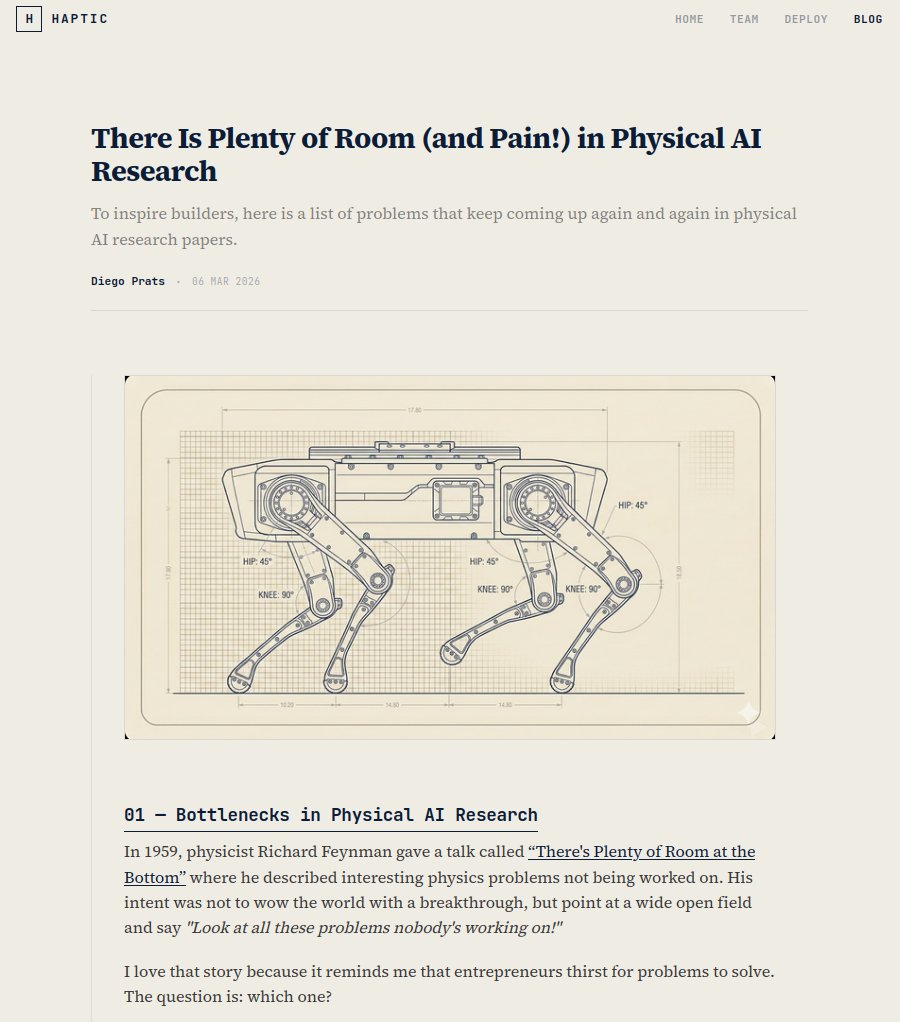
Robotics lacks infrastructure, not intelligence.
Everyone wants to build bigger robot models, but most Physical AI papers complain about the same things:
data collection is slow, sim-to-real is fragile, teleop is painful, evaluation is messy, long-horizon control still breaks.
Agent Skills for Firebase is a powerful way to give your AI agents context-specific instructions 📝
Learn how to build custom Agent Skills and integrate them with Gemini CLI for improved development workflows.
Chapters:
0:45 - What are Agent Skills?
1:23 - Adding domain-specific context
2:56 - Making Agent Skills
4:47 - Agent Skills for Firebase
6:29 - Get started with Agent Skills for Gemini CLI
Your Openclaw / Agent can now control Drones via Mavlink on Dimensional.
Programming physical space can now be done via natural language.
Query: “Follow the next white car that comes through the intersection”
Repo dropping soon stay tuned. Reply for early access.
Want to bring open-source vision language models to the edge? 💻
Check out our @huggingface article on deploying NVIDIA Cosmos Reasoning 2B across the NVIDIA Jetson family with vLLM and a Live VLM WebUI.
📖 https://t.co/Tp0tZtjgRp


![IlirAliu_'s tweet photo. One professor at the University of Bonn quietly put his entire robotics curriculum on YouTube: SLAM. Sensor fusion. State estimation. Probabilistic robotics. Self-driving cars. Motion planning. Photogrammetry.
Cyrill Stachniss has been uploading full university lectures for years!
Each topic is a complete playlist; the kind of material that normally costs a semester of tuition.
He's one of the most cited researchers in mobile robotics and mapping. His students go on to build the navigation stacks powering real autonomous systems.
If you're serious about understanding how robots know where they are... this is the place to start.
Free. On YouTube.
📌 [https://t.co/INqnqzEBD7]
——
Weekly robotics and AI insights.
Subscribe free: https://t.co/9Nm01QUcw3](https://pbs.twimg.com/media/HKhIU75WYAAi0mF.jpg)