The Union Government of India used its entire ecosystem including police, media and social media followers to get 4 kids to post apology videos. A very impressive achievement.
“क्या भारत की राष्ट्रपति जी की पोती और आपके घर की कामवाली की बेटी की पढ़ाई की फीस एक होनी चाहिए क्या?”
-धर्मेंद्र प्रधान
ये वीडियो दोबारा देखिए…बार-बार देखिए…फिर अपना माथा दीवार के करीब ले जाइए.
@firefox It's been several years since I left Chrome and staarted Firefox. Looking at your declining user share, I won't lie-sometimes I think that, God forbid, if anything ever happened to Firefox, I'd fork it and maintain it myself :)
The BJP is planning to bring back the 131st Constitution Amendment Bill that failed in the last session of Parliament in April 2026
The failed Bill purported to reserve for women one-third of the seats in the Lok Sabha and the State Assemblies but its real purpose was to pave the way for delimitation and, possibly, gerrymandering of constituencies
The Constitution of India was already amended by the Constitution 106th Amendment Act to provide reservation for women in the Lok Sabha and the State Assemblies. Hence there was -- and there is -- no need for a new Bill to provide reservation for women
After splitting the TMC, the BJP is reportedly wooing the NCP(SP) and the DMK to garner the crucial votes to support the new version of the failed Bill
NCP(SP) and DMK have been clear-headed about the real purpose of the failed Bill and it is expected that they will stand firm in the future too
Any support to a new version of the failed Bill -- whose real purpose is delimitation -- will be a betrayal of their own conscience that guided them in April 2026
Delimitation of constituencies under the present formula will cause grave injustice to the rights of States that had faithfully followed the National Population Policy and contained the growth of the State's population
States' rights must be fiercely guarded against the rampaging BJP
@mkstalin@supriya_sule
सुप्रीम कोर्ट में जो हुआ वह दुखद है। माननीय जस्टिस ने संयम और उदारता का परिचय देते हुए उचित ही कोई एक्शन नहीं लिया। यह बात तारीफ़ के क़ाबिल है। सुप्रीम कोर्ट का कंधा चौड़ा होना चाहिए और दिल बड़ा। इस बात को भी संज्ञान में लेना चाहिए कि समाज में न्याय को लेकर हताशा फैलती जा रही है। उसकी निष्पक्षता पर संदेह बढ़ता जा रहा है। अधिकारियों के ख़िलाफ़ कार्रवाई नहीं होती। कोई किसी का एनकाउंटर कर दे रहा है, किसी का घर गिरा दे रहा है। नागरिक अपने सवालों को लेकर कोर्ट की सीढ़ियाँ चढ़ता है लेकिन दीवारों से टकरा जा रहा है। इन्हीं कारणों से हताशा बढ़ती जा रही है। उम्मीद है, ऐसी घटना दोहराई नहीं जाएगी। यह भी कि न्याय व्यवस्था अपनी उदारता के साथ साथ विश्वसनीयता को बेहतर करेगी। उम्मीद की आख़िरी मंज़िल कोर्ट है और उस मंज़िल का बने रहना ही हताशा का इलाज है।
Statement : Shutting down Telegram is a band aid solution and is a disproportionate answer to exam fraud
The Internet Freedom Foundation objects to the directions announced today in the National Testing Agency's press release on action against the Telegram platform. On the NTA's recommendation, the Ministry of Electronics and Information Technology has, under Section 69A of the Information Technology Act, 2000, restricted access to the whole of Telegram in India until 22 June 2026, and has separately ordered the platform to switch off message-editing for every Indian user until 30 June 2026. This is a blunt, nationwide measure aimed at the conduct of rampant fraud rackets, and on the Government's own admission is constitutionally incompatible.
At the outset it is important to note that Section 69A and the Blocking Rules of 2009 framed under it allow the Government to block access to specific “information” on a computer resource. They do not extend to switching off an entire intermediary, still less to ordering a company to redesign its product by removing a feature for a whole country. In Shreya Singhal v Union of India, the Supreme Court upheld Section 69A because it is narrow and hedged with procedural safeguards. Reading it to authorise shutting down a platform that lakhs use is an overbroad restriction by the NTAs own admission. For the message-editing direction the release identifies no source of power at all. If one exists, the order must say so.
The release argues against itself
A restriction on access has to be the least intrusive measure that achieves its aim as per the constitutional test of proportionality laid down in Justice K.S. Puttaswamy v. Union of India (2017) and applied in Anuradha Bhasin v. Union of India (2020). The NTA's own narration shows the block fails its nodal agency, the release says, “has secured the prompt take-down of a substantial number of Telegram channels, groups and bots”, and this targeted work “is the reason the harm caused by these rackets has been contained to the extent it has”. If channel level takedown contained the harm, the case for a blanket block collapses and hence the Government has reached for a heavier tool while conceding that a lighter one was working. The collateral cost sits on the record too as noted in the press release. The block, the NTA accepts, “affects lakhs of citizens who use the Telegram platform for legitimate personal, educational, professional and informational purposes”. The release also says there is "no such paper available outside the secured examination chain" and that “the security of the examination is unaffected by the action taken”. If the exam is secure and no leak exists, what is being suppressed is rumour, and rumour cannot justify closing a platform when specific blocking and criminal prosecution remain available.
Students use of Telegram
The block of telegram is reactive and ineffective and will punish ordinary users instead of addressing the systemic source of exam leaks. This blocking comes in the final days of NEET preparation, when thousands of students depend on Telegram for study groups, doubt-clearing, and shared resources. Also, it is important to consider that the source of exam papers leak will occur from inside the system, among insiders and across the printing and logistics chain, with the platform being the most downstream channel for distribution. Hence, switching off Telegram, is merely a deflection from the repeated failures that will continue while media attention is directed towards this Telegram ban.
Lack of transparency
At present only a press release from the NTA has been provided, which recommended the block but the reasoned order of MeitY, the authority that issued it, has not been released. The Anuradha Bhasin decision requires that orders restricting access be published so they can be tested in court. Here the order, and the reasoning of the committee behind it, stay out of view, and we do not know whether Telegram was heard at all. An announcement of a block is no substitute for an order the affected party can challenge.
Blunt to enforce and very easy to evade
Usually, app-level blocks run through IS-level DNS and IP filtering. They are over inclusive, sweeping in lawful use, yet simple to evade as a determined exam leak racket moves to a VPN or a mirror within minutes while ordinary users lose the service for a week.
We ask the Government to:
1) Publish the MeitY Section 69A order and the NTA recommendation behind it, with reasons;
2) State the legal basis for the message editing direction, or withdraw it;
3) Confirm whether Telegram was given a hearing under the Blocking Rules, and place the committee's record before any court that hears a challenge; and
4) Lift the platform-wide restriction and rely on the targeted takedowns the NTA itself credits with containing the harm.
We emphasise that the NEET (UG) 2026 re-examination is worth protecting and it concerns the future of lakhs of aspirants. It requires securing the entire process of examination rather than reaching for purported band aid solutions that instead cause more harm. The State cannot switch off a service used by lakhs to answer the wrongdoing of a few, and cannot do it through an order no one affected is allowed to read. On its own facts, the Government has done both.
New Delhi, 16 June 2026.
Respected Gadkari ji,
As a child, I had read that Sher Shah, during his five-year rule, built a road from Sasaram to Peshawar. Alongside those roads, he had fruit-bearing and shady trees planted, and inns constructed at regular intervals.
Gadkari ji, Sher Shah lived five hundred years before us. Yet he had enough common sense, enough understanding, to know that there should be trees along the roads.
I am currently traveling on the Purvanchal Expressway, one of the roads built under your ministry. It stretches over 325 kilometers — and not a single tree can be seen along the entire length.
You do know what a tree is, right?
The same tree you might have occasionally seen in photos.
Or the one you get photographed with during Van Mahotsav (Tree Plantation Festival).
A tree — it rises from the earth and stands tall day and night.
It has branches and leaves.
It gives shade — not just to humans but to
animals too.
It used to, at least. Because wherever your roads have been built, all the trees have been cut down and erased.
Forget people, even birds have no place to rest under your regime!
I don’t want to spoil your mood further by reminding you of the law made during the time of Nehru and Indira — which made it mandatory to plant a new tree for every one that was cut down.
Just one more point:
On these expressways, the toll you charge — arbitrarily and forcefully — is already unjustified. And the few rest stops that have been built, seem to have only one contractor, who also enjoys the freedom to loot travelers with sky-high prices.
Seeing all this on your roads reminded me of Sher Shah.
I offer my respectful salutations to him.
You too should occasionally read about him — it might do you some good.
- Gunjan Sinha
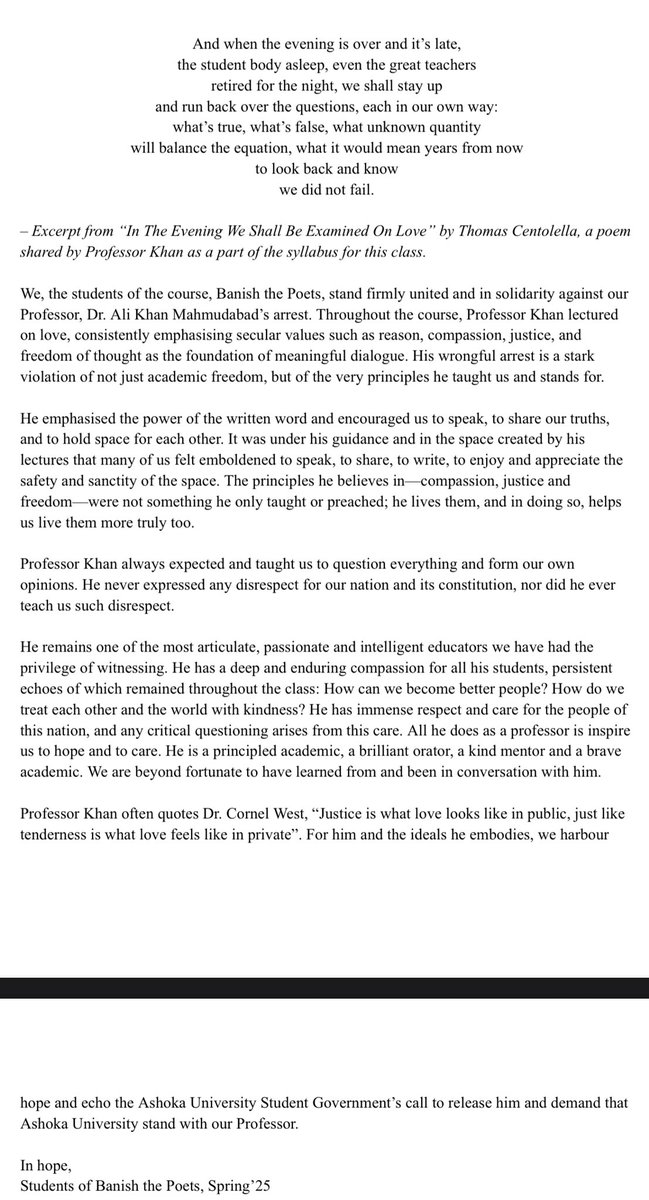
The SC bench led by Justice Suryakant today while granting interim bail to Prof Mahmudabad imposed draconian conditions virtually preventing him from saying anything about the Indo-Pak issue.
It also made some unnecessary remarks, making it look as if the SC was batting for police. Very unfortunate
#StoryAlert🚨
In Prof. Mahmudabad’s case, rather than confronting the dubiousness of the FIRs or offering categorical relief, Justice Surya Kant’s bench has chosen to cloak an absolutely punitive approach in the garb of liberty.
My column 'Case In Point': https://t.co/HU0YQI4zJA
Courts of India.
One man insulted, dehumanized and demeaned women.
The second one used a difficult language, so got SIT, no foreign travel, and barred from writing anything on social media.
One Hindu. One Muslim.
Jai Hind.
A youtube channel with 5 million followers made an amazing 30 minute video about ISRO.
But the Indian RW attacked the channel in comments for showing an incorrect Indian map of a few seconds in the video.
How did we get so isolated in the world? This is how.