Professional racing driver Ollie Millroy thanks competitor Loek Hartog for saving his life after getting into a fiery crash over the weekend in China.
Millroy says he'd be dead if Hartog hadn't jumped out of his car to pull him out of his burning car.
"I am still alive tonight, entirely thanks to one man. Loek Hartog stopped instantly with no flag marshalls or fire crews in sight, and risked his own life to get me out of the car."
"I don’t remember anything between 30 seconds before the crash and 1 hour after it, but I will remember his incredible act of bravery for the rest of my life..."
"I’m laying here tonight with 5 broken ribs, broken collar bone, broken hand and finger and a bruised lung, but it could have been much worse."
"Thank you Loek. I owe you my life for your selfless act today."
‼️ A public PoC shows how CrowdStrike Falcon’s macro remediation can be abused for privilege escalation.
FalconFlank works on fully updated Windows 11 25H2 and Windows Server 2025. CrowdStrike has not yet commented.
Read: https://t.co/yN3FInp26x
The oldest financial trick in history is being used on you right now. Ancient Rome couldn't stop using it either, and it played a part in bringing down the whole empire...
For two hundred years the Roman denarius was one of the most trusted coins in the world: under Augustus it was struck from silver that ran around 95% to 98% pure, a small disc of real metal that a soldier or a shopkeeper could hold and believe in. It held its value across the whole Mediterranean because there was something genuinely valuable inside it.
Then the emperors discovered a trick that every government since has been tempted by. If you melt down the coins, mix in a little cheap copper, and mint them again, you get more coins out of the same silver. To the eye, nothing has changed. The face on the front is the same. But now the state has more money to spend, and it costs them nothing to make.
Nero began it after the great fire of Rome in AD 64, dropping the silver to about 90%. It was barely noticeable, which was precisely the point. But once the door was open, no emperor could resist walking through it. Each one who needed to pay the army or fund his ambitions shaved off a little more.
By the reign of Septimius Severus the denarius was down to about half silver. His son Caracalla went further, and by the time of Gallienus in the 260s the coinage that had once been nearly pure held around 5% silver. It had become a copper token dipped in a thin silver wash, and everyone knew it...
The result was exactly what you would expect, and exactly what we fear today: prices spiraled. The more coins the mint stamped out, the less each one was worth, and the cost of everything climbed to catch up. Trust in the money collapsed so completely that soldiers began refusing to be paid in it and demanded grain and goods instead.
The same thing is happening to your money right now: according to the U.S. Bureau of Labor Statistics, the dollar has lost more than 96% of its purchasing power since 1913, the year the Federal Reserve was created. What a single dollar bought then takes more than thirty dollars to buy today.
The coin was silver and the modern equivalent is paper, but the pattern is the same that ate the denarius: a slow, relentless erosion of value that the people holding the money can feel but cannot stop.
Keynes called it by its real name: theft. "By a continuing process of inflation," he wrote, "governments can confiscate, secretly and unobserved, an important part of the wealth of their citizens." And Milton Friedman put it even more bluntly: "Inflation is the one form of taxation that can be imposed without legislation."
This is one of the most important lessons Rome has to teach: a currency almost never dies in one dramatic stroke, it is always worn away a little at a time by rulers who tell themselves that this once, in this emergency, it will be fine, and by citizens who do not notice until the coin in their hand is copper wearing a thin coat of silver. As Ludwig von Mises, who watched the great European currencies collapse in the twentieth century, put it:
"Government is the only agency that can take a useful commodity like paper, slap some ink on it, and render it totally worthless."
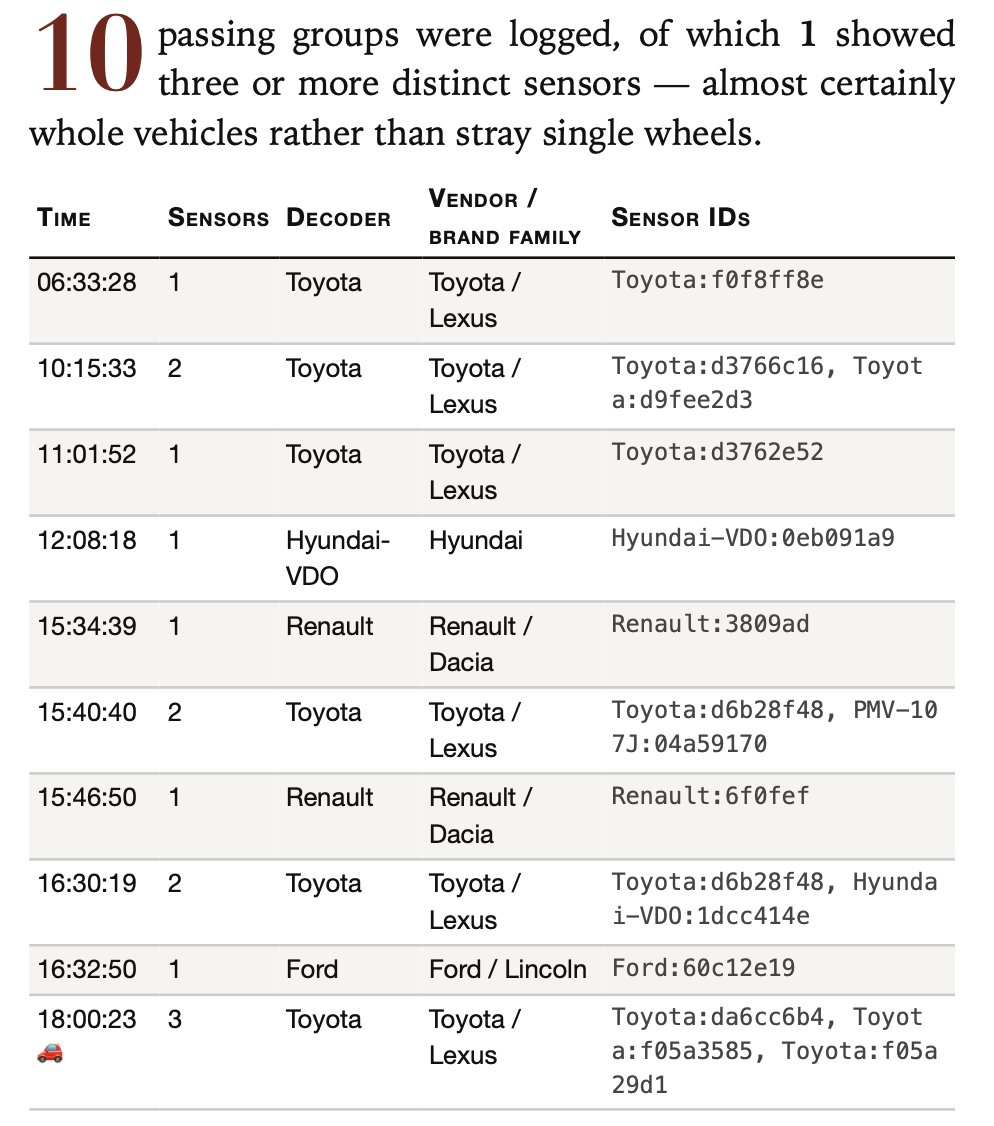
Did you know your car's Tire Pressure Monitoring System transmits uniquely identifiable information whenever you're driving? I hooked up a radio dongle to my computer and monitored the neighborhood for an evening. This is what Claude inferred from the data.
Jako Farms is an amazing place.and is owned and operated by even better people. We get beef, raw butter, raw honey and other products there. This Greek Yogurt is unbelievable. #Kansas
Stanley Druckenmiller renders an unfavorable opinion of Treasury Secretary Scott Bessent's use of buybacks to defend against higher yields in a market that is functioning normally.
"I have spent five decades trading on a simple premise: Markets aggregate information no committee possesses, and prices are how that information reaches decision makers. The long-term Treasury yield is the most important price in the world. It is also the only fiscal disciplinarian the U.S. has left."
"Every basis point of artificial yield suppression is a subsidy to procrastination."
"Return buybacks to their stated purpose: small, scheduled, off-the-run liquidity operations announced at quarterly refundings, never off-cycle responses to yield levels. Term out the debt honestly and pay the price the market sets."
"If the 30-year must trade at 5.5% to clear, that isn’t a crisis. It is an invoice. Then do the only thing that durably lowers long-term yields: address the primary deficit."
https://t.co/Xe8Vi38WiI