Google DeepMind just launched Humanity's First Exam to test whether AI can pass basic human tasks reliably
Somehow Opus 5.5 is worse than Hydrogen on it
I was looking for a way to share with my parents how Humanity’s First Exam (the benchmark we published yesterday on @kaggle) works.
So I gave our paper to @Gemini_Notebook and created a podcast out of it! Super approachable and engaging way to consume research (I do it all the time).
🇬🇧 version: https://t.co/bY9kQzZ2ZL
🇩🇪 version: https://t.co/bvVDjw1bod
Why can frontier AI models write complex code, yet still occasionally stumble when asked to identify the colors of five simple objects in order or verify what's not in an image?
That disconnect is called jagged intelligence and measuring it scientifically is critical to advancing AI reliability.
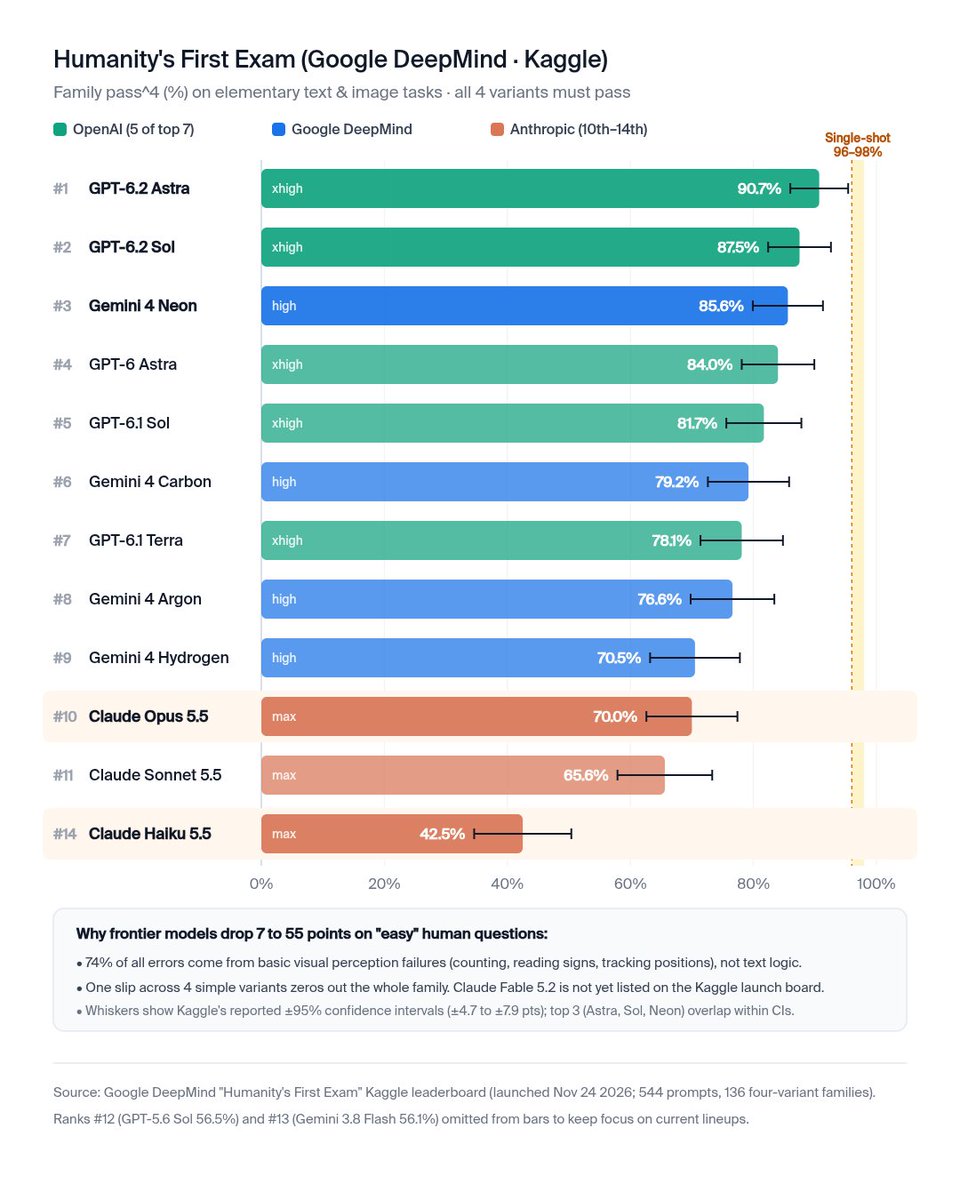
Today, @GoogleDeepMind is launching Humanity's First Exam on Kaggle, a benchmark designed to measure "floor reliability": whether models get simple tasks right every time, not just once. It spans 544 text and multimodal prompts across 20 foundational subcategories, in 136 four-prompt families.
Some early findings, across 18 frontier models:
• High single-shot accuracy masks inconsistency: Top five models reach 96%–98% pass@1 and 100% family pass@4, yet average only 85.6% on family pass^4 (80.5%–92.4%), with a 7.6–80.1 percentage-point Family Reliability Gap across all 18 models.
• Visual perception drives 74% of wrong answers: Extra thinking time helps far less on visual tasks than on text.
• Single-step slips are common: In 39% of failed prompt–model pairs, the answer is off by one or has a single wrong element; this holds for 167 of the 298 counting errors.
Current leaderboard:
🥇 GPT- 6.2 Astra (xhigh) - 90.7%
🥈 GPT- 6.2 Sol (xhigh) - 87.5%
🥉 Gemini 4 Neon (high) - 85.6%
Help us stress-test these models. Join the Humanity's First Exam competition: submit everyday tasks that almost anyone gets right in a minute or two, but frontier AI models still get wrong.
💰 Prize: $50,000 in Kaggle swag
⏰ Deadline: December 15, 2026
Compete and explore Humanity's First Exam here: https://t.co/2RnNQbwAkq
Hill-climbing metrics on pass@k with k>1 incentivizes model to develop a jagged frontier.
Today we introduce Humanity’s First Exam (HFE), a benchmark evaluating how well models do simple tasks (and their variations) correct consistently.
Check out our technical report at https://t.co/wEcwt0cLeb and join the hackathon from our friends at @kaggle: https://t.co/Z3bL0g61wo
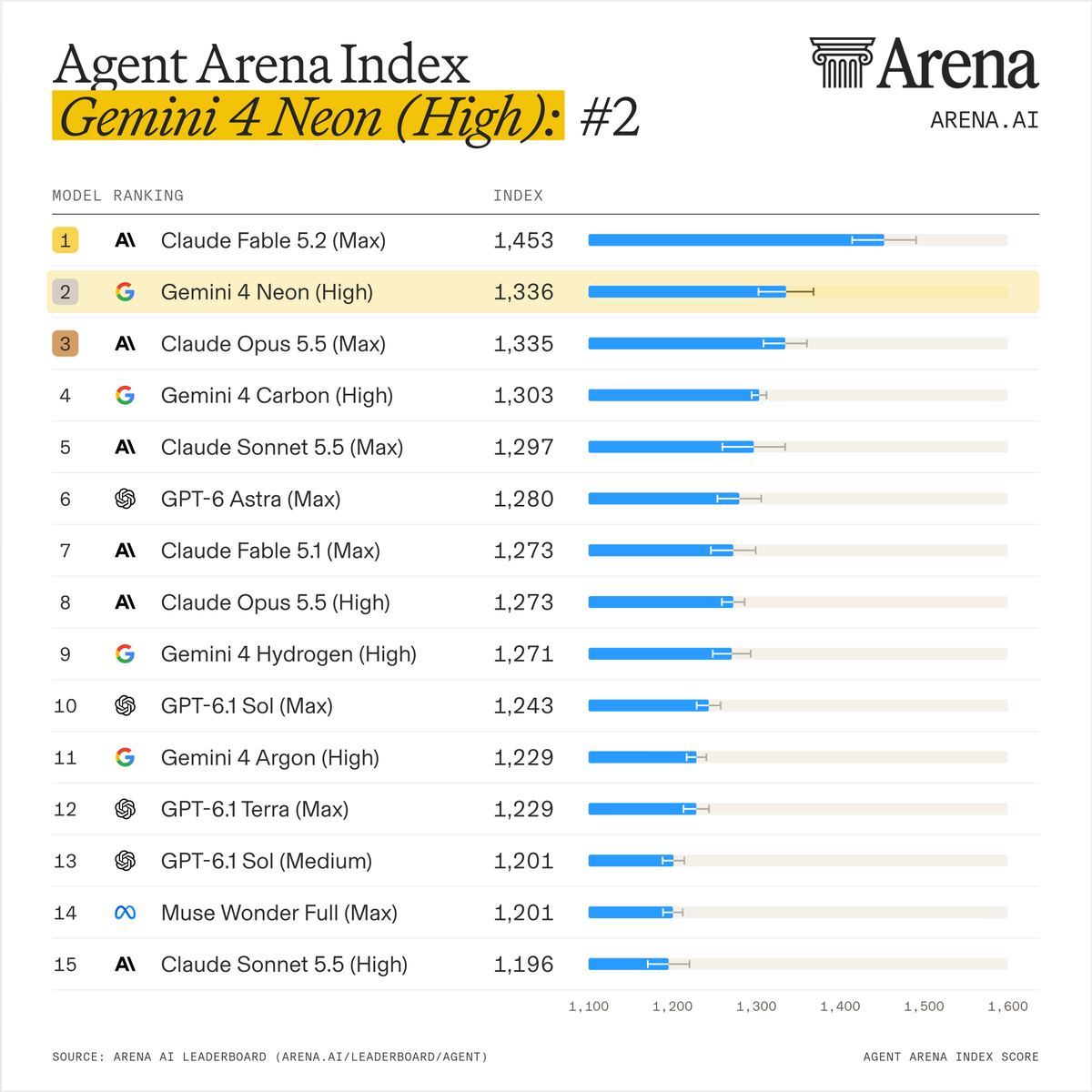
Big news: Gemini 4 Neon (High) is the best @GoogleDeepmind model on the Agent Arena Index, ranking #2 overall and reshaping the Pareto frontier!
With 1336 pts based on 4.2k real-world agentic sessions from Arena’s global community, it surpassed:
- #4 Carbon (High): 1303 pts
- #9 Hydrogen (High): 1271 pts
- #11 Argon (High): 1229 pts
Neon is on the Agent Arena Pareto frontier at $2.82 median cost per task. It scores higher than #3 Claude Opus 5.5 (Max) for 53% less per task, and is 69% less per task than #1 Claude Fable 5.2 (Max). See Pareto in thread.
It's strong across key signals:
- #2 Praise vs. Complaint: 1539 pts (user satisfaction with the agent’s outcome)
- #2 Steerability: 1298 pts (how well an agent responds to user corrections)
- #3 Task Completion: 1316 pts (explicit confirmation of task success from users)
See where it landed in the Code Arena: WebDev and Text Arena below in thread.
Congrats to the team at @GoogleDeepmind on another huge release!
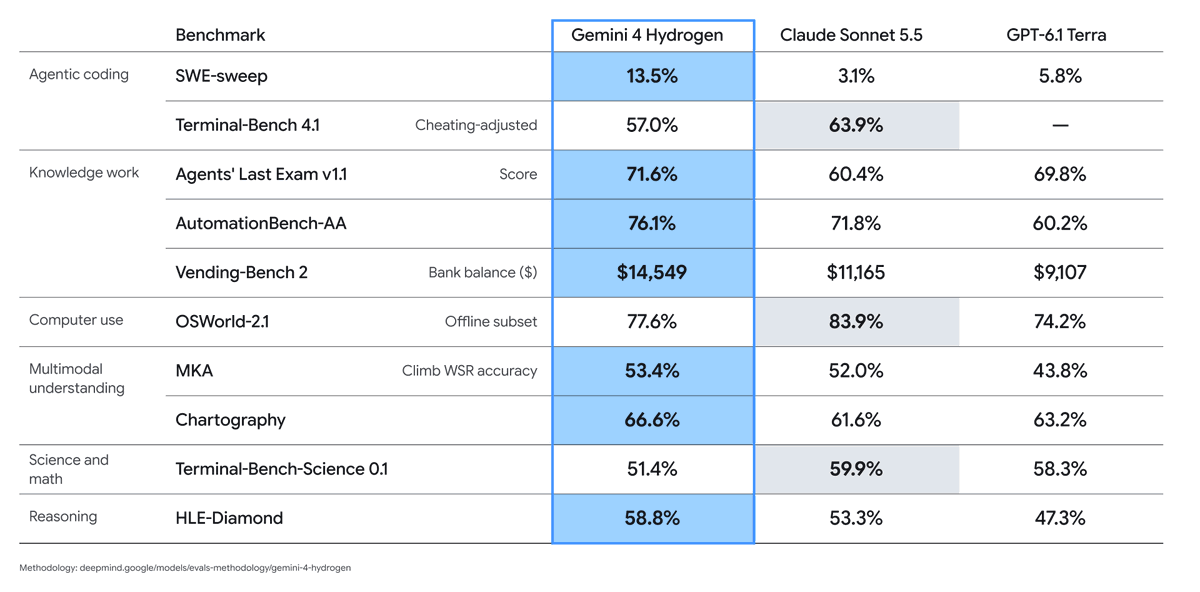
Meet Gemini 4 Hydrogen: built for rapid coding, multimodal synthesis, and everyday workflows.
It finishes tasks 2.5x faster than 3.8 Flash and surpasses Argon on the @ArtificialAnlys Intelligence Index.
Today we are rolling out Gemini 4 Argon globally in the Gemini API, to Pro + Ultra in Gemini App, and Ultra subs in Antigravity!
Argon is a huge step forward for Gemini, and a labor of love. This model has been battle tested by over 100,000 people at Google over the last month, with so much new innovation, ambition, and hard work baked into this release. The team has been heads down over the last 6 months working to make this possible across the stack (research, infra, safety, eng, etc).
We rolled the model out to cyber defenders as part of our fairwind program and early access customers over the last 2 weeks, it has been amazing to see and talk to folks who are now using this model daily. Seeing the models writing capability, raw knowledge and persistence for coding, paired with new features like 1M token output when the model needs to work more has gotten me even more excited about our path ahead.
This is just the start of the Gemini 4 era. As you saw with 3.5, 3.6, 3.7, and 3.8 Flash, our iteration speed with Gemini is fast : ) Now with Gemini 4 Argon to work from, I am cannot wait to see the progress continue, and most importantly see what this new model enables for the world.
This is such a special moment in the arc of technology, as millions of people everyday tackle problems they could never have thought possible before. Gemini 4 Argon was built to help you tackle the hardest problems. I have personally felt this spark with Argon and hope you do too. Onwards!!