Worth internalising early: when you trade options, what you're actually trading is volatility.
Hedging or speculating, the decision to buy or sell comes down to a view on how much an asset will move.
The options market is that view, updating in real time.
FOR THE FIRST TIME IN 53 YEARS, THE KNICKS ARE NBA CHAMPIONS 🏆
New York defeats San Antonio 4-1 in the NBA Finals, capturing their third championship in franchise history!
"Let's play basketball now. Be smart. Stick together. We've come back from worse. Chip away"
— Jalen Brunson, just before the largest comeback in NBA Finals history.
#AlwaysKnicks
México y el gas de Texas: riesgos, dependencia y volatilidad en 2026
Por: @inhedgeoficial
El 5 de enero de 2026, el gas natural en Texas se vendía en 1.846 dólares por MMBtu (la unidad con la que se mide el gas, parecida a un litro o kilo pero referida al contenido energético).
Dieciocho días después, ese mismo gas costaba 14.498 dólares. Casi ocho veces más caro. Cuatro semanas más tarde, en febrero, el precio volvió a estar por debajo de los 2.50 dólares...
Lee la nota completa aquí: https://t.co/AgiUUXLcWl
🟢 El rally del #cobre se reanuda
El Cobre #LME Cash cotiza en $13,163/mt tras rebotar con fuerza desde los $12,528 de marzo, poniendo a prueba nuevamente los máximos de febrero.
Lectura completa con gráficas y datos en el enlace 👇
https://t.co/uF55KKUWZf
⚡️What the study is actually measuring is the extent to which the mobile internet has been damaging human cognition at scale.
Two weeks without it produces improvements that rival or exceed clinical interventions. Which means the baseline state most people are in is significantly impaired compared to what their brain is capable of. The impairment is being actively caused by continuous exposure to the device in their pocket.
This is not a surprising finding if you think about it mechanically. The human attention system evolved to handle environmental stimuli at roughly the rate the environment produced them. The mobile internet delivers novel stimuli at a rate that is orders of magnitude higher than anything the attention system was built for. Continuous exposure to that rate trains the brain to expect constant novelty, to switch context rapidly, to disengage from any stimulus that doesn’t produce an immediate reward. That pattern is literally the opposite of sustained attention. So of course sustained attention collapses when you use mobile internet heavily. That’s exactly what would happen mechanically.
The mental health finding follows from the attention finding but also has its own dynamics. Mobile internet is an anxiety delivery system in the literal sense. Every notification is a small dose of uncertainty about what’s on the other side. The cumulative effect of hundreds of those per day, every day, for years, is chronic activation of the threat detection system. That chronic activation shows up clinically as anxiety and depression. Remove the source and those symptoms reduce.
The finding that mobile internet blocking outperformed antidepressants is the part that will be ignored most completely because it has massive implications. If the primary driver of mental health decline in the developed world is a specific environmental exposure, then the entire mental health treatment industry is operating downstream of the actual cause. Billions of dollars spent treating symptoms that are being continuously recreated by a device everyone carries. The honest intervention would be to change the exposure. But that’s unprofitable, unpopular, and unenforceable. So the treatment industry will continue growing while the cause goes unaddressed.
The deeper thing the study hints at but doesn’t state directly is that the last fifteen years of human cognition has been a mass experiment with no control group.
Everyone on the planet has been simultaneously exposed to the same novel stimulus at scale. We have no idea what humans would be like right now if mobile internet had never existed.
We only have the before and after, and the after is clearly worse on multiple measurable dimensions. Attention down. Mental health down. Reading comprehension down. Memory down. Focus down.
All of these measurable declines track the adoption curve of the smartphone.
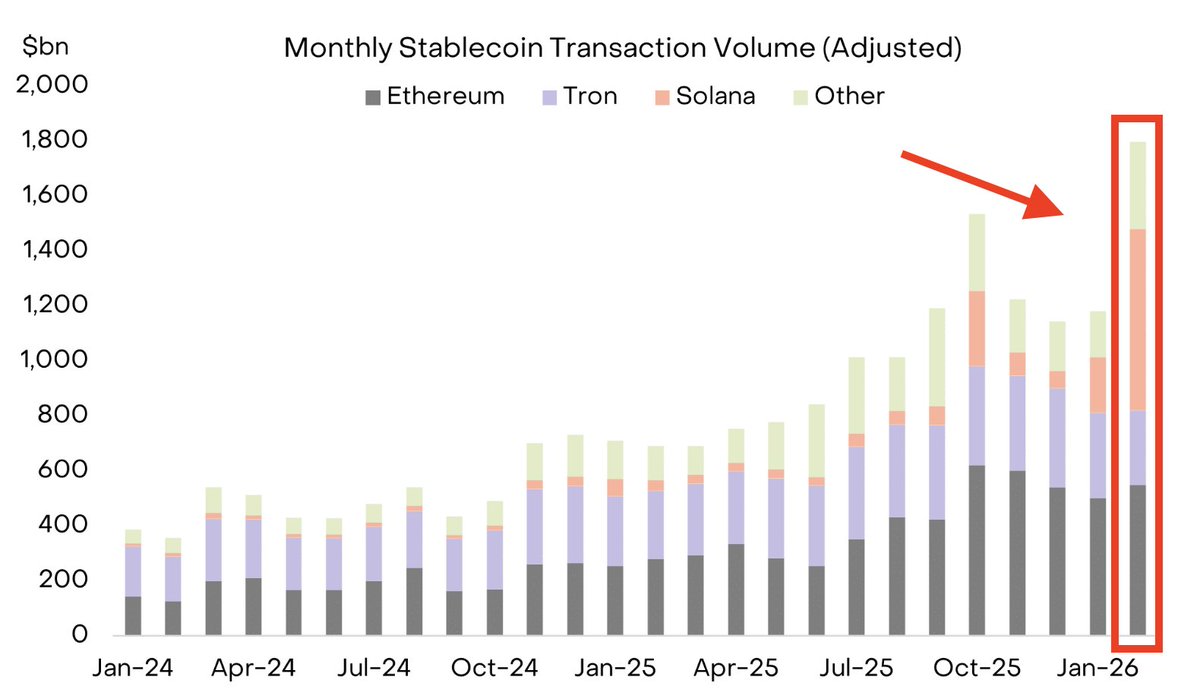
BREAKING: Solana processed a record $650 billion in Stablecoin transactions in February 2026.
As a result, aggregate Stablecoin transaction volume is now nearly a record $2 trillion per month.
Stablecoin volumes on Solana nearly TRIPLED month-over-month, with another surge expected in March amid the Iran War.
The surge in volume comes after the launch of Western Union's $USDPT, Jupiter's $JUPUSD, which has gained traction amid its goal of returning a yield back to the ecosystem.
To put this into perspective, CME Group futures trading in gold just hit a record $208 billion per month.
In other words, Stablecoin transaction volumes are now nearly 9 TIMES the size of gold futures traded on CME.
Cursory thoughts ...
1. The delivery squeeze at Cushing. April WTI expires March 20, which is 12 days away. Anybody short April WTI who doesn't want to deliver physical oil has to buy it back before then. Anybody long who wants to take delivery needs to be ready to accept 1,000 barrels per contract at Cushing. In a normal market, this is routine. In this market, physical barrels at Cushing are becoming scarce relative to demand because Gulf Coast refiners who normally supplement Cushing connected supply with waterborne imports (which are largely Brent priced, much of which transits Hormuz) have lost that supplementary supply. They're pulling harder on pipeline connected domestic supply. Cushing is the nexus. The short squeeze into expiry is amplified by the physical tightness.
2. The export arb is breaking. The US exports roughly 4 million bpd of crude. That export flow exists because WTI normally trades at a discount to Brent, so traders buy cheap WTI, pipe it to the Gulf Coast, load it onto tankers, and sell it into the global Brent priced market. When WTI approaches or exceeds Brent, that arb dies.
3. Physical versus financial settlement. This is the part nobody is saying out loud. WTI delivers real oil. Brent settles cash. When the market is genuinely afraid that physical supply is being destroyed, the contract that gives you actual barrels in a pipeline connected storage facility in Oklahoma is worth more than the contract that gives you a check based on a price assessment of North Sea crude that you still have to go find and transport. Cash settlement is a claim on nothing. Physical delivery is a claim on oil. In a supply crisis, that distinction reprices.
4. The Russian waivers are Brent negative, WTI neutral. Treasury's waivers let Indian refiners buy Russian Urals crude. Urals prices against Brent, not WTI. Millions of barrels of Russian crude are now flowing to the waterborne market, providing marginal relief to Brent's pricing complex. None of those barrels touch Cushing. So Brent gets eased at the margin while WTI doesn't.
The SEC just handed crypto its most important win of the year so far, but nobody’s really talking about it.
Here’s what actually happened today, and what comes next.
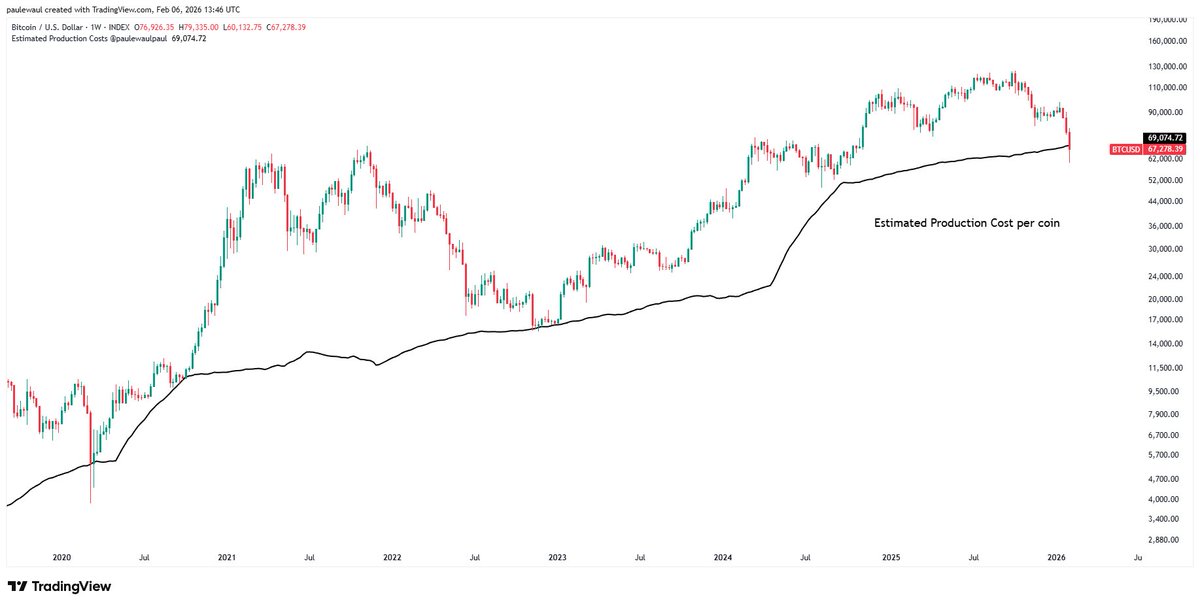
Bitcoin prices are now trading roughly around where production costs are estimated to be. That’s a very healthy situation for a commodity, and commodity traders are happy buying at these levels.
By definition, USD liquidity is currently tight. #Bitcoin