statistics obsessor, economics enjoyer, currently building data software #Python/#rstats & everything social science; (some) opinions revised regularly
Every time I open this report, I find a new methodological choice to marvel at.
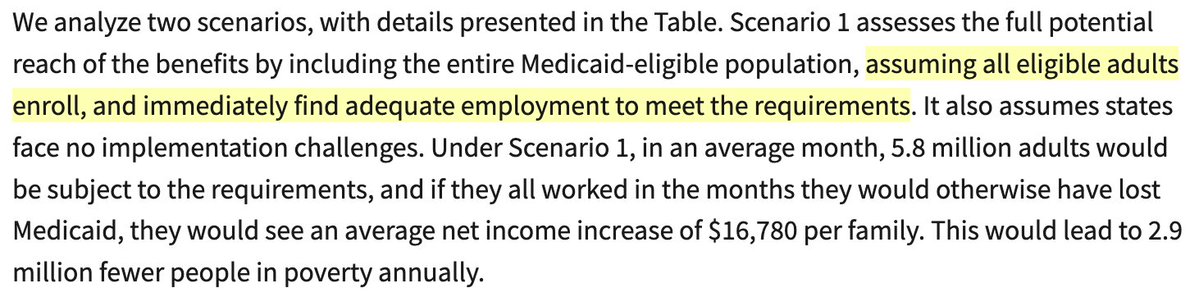
If your model assumes sunshine and rainbows, your result will be sunshine and rainbows.
Our paper "Estimating within-cluster and between-cluster spillover effects in randomized saturation designs" just appeared at Social Networks: https://t.co/u1pbiPUEsm It was motivated by Edward Miguel's Neyman Seminar on a cash transfer experiment in Kenya https://t.co/t4jDUF4CUX
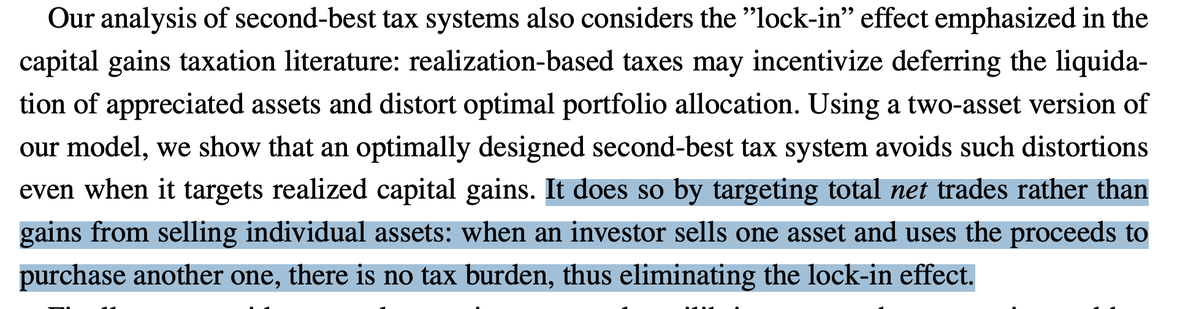
@MattBruenig@mattyglesias The logical solution is to only tax net trades which in this case would be zero. This also avoids the lock-in effect. See section 4.4 here https://t.co/F3w7pZe5I4
Earlier today, @DrOzCMS claimed that large numbers of Marketplace enrollees aren’t “legit” on the grounds that some enrollees don't file a claim in any given year. Re-upping this thread on why this argument is seriously flawed.
my main takeaway from this isn't "oh, this is cool! BM25 works on hidden activations!" but "we understand so little about retrieval that models have an entire sparse indexable work we knew almost nothing about".
future's bright, tons of work to do.
A reminder that Poland is a legitimate success story, but their per capita growth statistics over 2021-23 or so need an asterisk as they don't count Ukrainian refugees in their population even though they're contributing to economic activity.
https://t.co/ziIfXsNykI
Epidemiologist Donna Spiegelman sez: SUTVA is “mostly not necessary for valid causal estimation and inference most of the time”
https://t.co/btowTUCAj4
I love this. Rust also has it as std::hint::unreachable_unchecked. If you have another way to prove the branch in indeed unreachable, it allows the compiler to optimize the chain of branches that lead to it.
Female #students taught by same #gender professors in smaller classes are more likely to receive a top exam grade, but no such effect is found in larger classes. @maurer_se, Guido Schwerdt and @SimonWiederhold suggest why: Close interaction matters.
https://t.co/UfeoSFWQCD
@pangram The authors of that study also find that evidence of LLM use drops to 4.7% or lower once you disable copy-paste or enable Qualtrics bot-checks --- which matches my experience running a recent Prolific study. So there are some pretty effective mitigations.
https://t.co/Wvb7168yj0
Any new standard error formula should prominently discuss how it performs under selection on significance. Many reduce power and thereby increase bias in a real-world setting where nulls are repressed.
As it becomes clearer that the tech sector is a key fulcrum in the US vs. EU PPP/productivity debate, I'm increasingly worried that part of what's driving the wedge (or lack of wedge) is differences in computer/software hedonic adjustment between US and EU statistical authorities
The anti-LLM protectionist movement is being driven precisely by the people who do the worst work. The debate is uniquely bad because the people engaging in it are already the ones you'd want to replace with a bot.
Cloudflare Sandboxes 🤝 Cloudflare Tunnel
You can now expose a service running inside a Cloudflare Sandbox using a Cloudflare Tunnel
Both quick tunnels and named tunnels are supported
@ScottGoetz_ Build a replacement that absorbs functions over time should be a general approach to effective policy reform. So much easier than trying to reform an old institution.
People underreact when inferring states, yet overreact when forecasting from the same signals. Fan, Liang & Peng show the question type triggers different heuristics—similarity between available and elicited statistics determines which shortcut dominates.
https://t.co/8HbVZvgleA