Things Codex Likes to Say, Translated:
- smoke test (test, which is not clearly designed and organized as a unit, integration, or regression test)
- seam (module interface)
- gates (conditional check in code, or as a defined workflow development milestone condition)
- signal (test result, log value, or runtime input)
- surface (UI or API interface)
- knob (any configurable value)
- load-bearing (causally critical)
- runbook (instructions)
- bring up (initialize and start)
what am I missing?
Codex 5.5 hack:
"Are you 100% confident in this strategy? If not, find all possible loopholes, suggest proper fixes and run this loop until you are factually 100% confident in the new startegy"
This works like charm. It makes Codex 5.5 high perform even better than codex 5.5 extra high.
Why? Codex 5.5 is the only model i noticed that is self aware. It never makes high claims unless the model verifies everything.
This doesn't work with Opus 4.7 cuz that's a very insecure model. You can paste this prompt over and over again, the model keeps saying "you're absolutely right,....."
But with codex, after 2-3 iterations you'll notice yourself it actually patched all loopholes and this genuinely sounds like a good strategy.
Try this out, thanks me later.
Very impressed with Pi (coding agent). It's like claude code barebones & customizable.
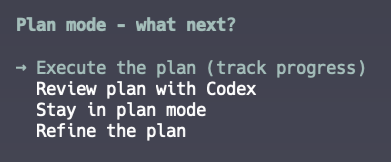
Added custom plan mode: asks opus for plan, then have the option for codex to review it. A workflow I do a lot and now seamlessly integrated. Works w/ Qwen 3.6 as orchestrator.
@RhysSullivan Yep it's really good. No reason not to jump to codex now. And right now codex cli verbosity is also like Claude code ish which I think a lot of dev were accustomed to and feels just like using cc cli, only better 😁😁
@levelsio I too code in production since the time I saw you said it was working for you. I think it was when you were building the mmo plane thingy. Haha now I'm doing it on a daily basis since , and I use the yolo mode too
I'm 50.
If I could go back and tell my 25-year-old self one thing about client meetings, it would be this:
Stop telling the truth.
I’m not saying to lie.
But stop answering benign questions honestly like you're sitting with a mate at the pub.
"How's your week going?"
If you answer that question honestly, you've already lost the deal.
I learned this the hard way in 2006.
Fund manager asks me: "How are things?"
I said: "Bit of a tough week, honestly. Two deals fell through but I'm optimistic about this one."
Thought I was building rapport, and that “being real” would make me relatable.
Meeting ended 10 minutes later.
Never heard from him again.
Took me months to realize what I'd done.
He wasn't my therapist.
He was my counterparty.
Prospects are always judging to see if you’re worth their time.
And the assessment never stops.
How you look.
How you speak.
The quality of your pen.
Whether your watch is fake.
Whether you look like the kind of person they'd trust with their daughter or their capital.
High-status people take every benign question as an opportunity to increase their credibility.
So here's what I'd tell my 25-year-old self:
Have your answers predetermined before you walk in.
If you've done seven things today and six were shit, talk about the seventh.
Ideally, talk about something that reinforces the thing you're about to sell them.
"How's things going?"
"Brilliant. Just had the Director from [Massive Firm] take a significant allocation this morning. Market's moving fast."
Doesn't matter if that happened at 9 AM and the rest of your day was a slog.
That is the only reality that exists for this client.
They know almost nothing about you.
So they will weigh every single word you say with massive importance.
If you sound like a loser, they'll treat you like one.
Stop "being yourself."
Start being the High Status Closer they need to see.
I once needed money, so I joined an offshore software outsourcing company in Ukraine as a shit-coder for $100/month.
I had just finished university and had no experience as a coder. In my first week at work, they gave me a bug to fix. The application was https://t.co/0soRTHa58g (it's funny that the application still exists and looks as shitty as I remember it 25 years ago).
The application had a huge codebase in ColdFusion; it was written in India by folks who asked slightly more than $100/month for their work, and it looked and worked accordingly.
As I said, I had zero experience with debugging such a large application, so I asked my manager's manager for help.
He looked at the error message that mentioned the file where it failed, then went to the directory with this file, searched for the variable that caused the issue, then saw in what file this variable was mentioned. Then he mounted like that about three levels, found the file where it was created and what values it could contain at the creation time, compared the observed value and the expected one, and figured out what was wrong at the time the variable was created.
I was so impressed that one could start in some unknown place and, by doing variable tracing to the source through files using simple string match, come to the place where it all becomes clear.
With time, I realized that this is a pattern that a software developer uses most of the time when debugging: string search -> file search -> string search -> file search.
This is why good developers keep their codebase neat: this simplifies the manual search and understanding of what to search for next.
The LLMs have learned this simple but powerful pattern the moment they were given access to grep and glob with one difference: they don't need the code to look neat; they don't analyze the text the same way humans do. So, for an LLM, it doesn't matter whether you, a human, think that its code is maintainable *by you* or not. It's maintainable by using the attention-glob-grep combo, and that's enough.
Saying that you don't accept AI-generated code because you cannot maintain it by hand is the same as saying that you don’t accept mass-produced electronics because you can’t manually fix or replace every component.
GLM-4.7 running locally just:
1. Vectorized 600mb of tweets
2. Setup a new skill for itself for retrieving tweets
3. Used it to get the exact tweet I was thinking of
I am very excited, MiniMax-M2.1 and GLM-4.7 are the first local models I would pick over sonnet
Very successful run.
When I created Claude Code as a side project back in September 2024, I had no idea it would grow to be what it is today. It is humbling to see how Claude Code has become a core dev tool for so many engineers, how enthusiastic the community is, and how people are using it for all sorts of things from coding, to devops, to research, to non-technical use cases. This technology is alien and magical, and it makes it so much easier for people to build and create. Increasingly, code is no longer the bottleneck.
A year ago, Claude struggled to generate bash commands without escaping issues. It worked for seconds or minutes at a time. We saw early signs that it may become broadly useful for coding one day.
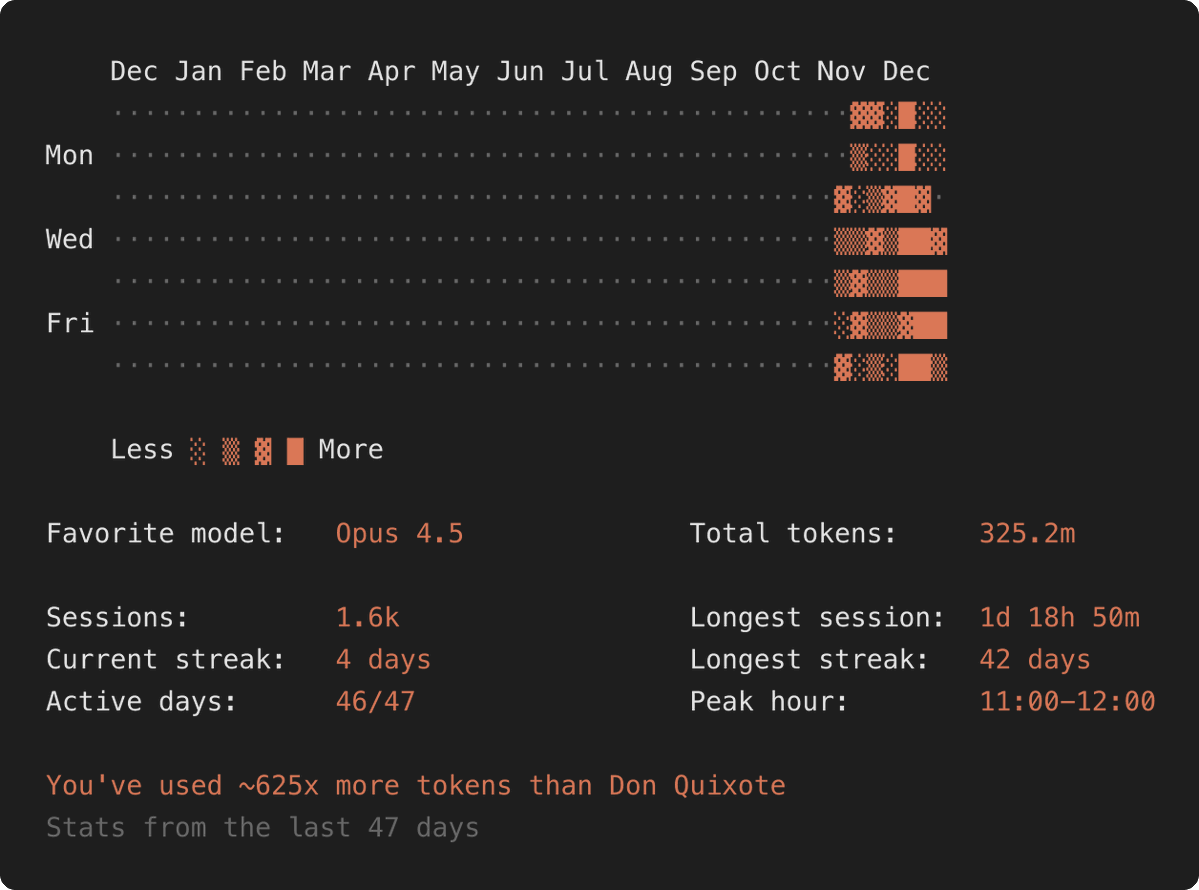
Fast forward to today. In the last thirty days, I landed 259 PRs -- 497 commits, 40k lines added, 38k lines removed. Every single line was written by Claude Code + Opus 4.5. Claude consistently runs for minutes, hours, and days at a time (using Stop hooks). Software engineering is changing, and we are entering a new period in coding history. And we're still just getting started..