🚨 TREASURY SECRETARY BESSENT JUST NUKED ANTHROPIC & OPENAI’S “ROGUE AI” IMMUNITY SCAM ON LIVE TV
"A sitting employee came out, said there's a 10% chance of an extinction level event. But then the labs also said, take the liability off of our hands. And we will NOT do that.
The Hugging Face incident is the responsibility of OpenAI management, NOT a bunch of agents.
It is humans who are responsible, not the AI.
These labs need to take responsibility for themselves. They can slow down any time they want to."
CHECKED.
fun fact: many VC terms and structure came from whaling expeditions.
the whaling agent (GP) raised money from wealthy merchants (LPs) and used it to fund multiple voyages, taking a cut of the profits of each.
the captain and crew didn't get wages, they got the "lay" (carry), a specified fraction of whatever they brought back. "carried interest" is literally the cargo that was carried back that the investors had interest in.
voyages took three or four years, and many of them lost money, but the few profitable ones paid for the others.
Racketeering Expose by Derrick Sweet
Sept 20\26
My name is Derrick Sweet. I am a 61 year old Canadian and earn my living as a stock market analyst. I follow money for a living. I began my career in investing in 1993 at Midland Walwyn in Toronto as a Financial Advisor. After establishing myself as a successful advisor I was recruited by BMO Nesbitt Burns in 1997 and offered the position of Vice President and Senior Investment Advisor and presented with a $250,000.00 signing bonus, which was a lot of money back then. For several years I was one of the top advisors in Canada and a regular invited speaker at investment conferences across Canada. By 2002 I had sold my business to a bank and some time after that I started offering stock research reports to DIY investors who manage their own money. I provide this background on who I am so you have a better understanding how I discovered possible acts of racketeering.
I have been closely following Mark Carney’s violations of the trust he was voted to uphold for too long. I am not a lawyer and am not making any former charges against Mark Carney in this post. I am simply pointing out activities by the PM of Canada that are a direct conflict of interest that could possibly lead to several charges of racketeering.
The Prosecution Case Against Mark Carney, Prime Minister of Canada (the PM)
I. The Core Allegation: "Pay-to-Play" Infrastructure
The prosecution will argue that the Prime Minister (PM) has operated a criminal enterprise where public policy and taxpayer-funded contracts were used as a vehicle to inflate the value of a private entity (Brookfield) in which he holds a direct pecuniary interest (stock options).
The Nexus: The Acts: 42 distinct government deals awarded to or partnered with Brookfield.
The Benefit: $5 billion in reported profits for the entity.
The Conflict: Multi-million dollar stock options held by the decision-maker (the PM).
II. Count 1: Breach of Trust (Criminal Code s. 122)
Under Section 122, we do not need to prove a "bribe" was paid. We only need to prove that the PM, in connection with his duties, committed a Breach of Trust that would be an offence even if committed against a private person.
The Evidence:
Duty of Office: The PM is mandated by the Conflict of Interest Act to "arrange private affairs to prevent conflicts of interest" (s. 5).
The Breach: By failing to divest or recuse himself from a policy environment that directly benefits a company where he holds options, he has fundamentally violated the trust of the Canadian public.
Legal Standard: Per R. v. Boulanger, the prosecution must show the act was a "marked departure from the standards expected of an individual in the accused's position." Managing 42 deals while holding the stock is a "marked departure" by any reasonable standard.
III. Count 2: Frauds on the Government (Criminal Code s. 121)
This is the Canadian version of "racketeering." Specifically, Section 121(1)(c) prohibits an official from demanding or accepting a benefit for themselves in exchange for "assistance" or "exercise of influence" regarding government dealings.
The Strategy:
We will argue that the Stock Options constitute an "advantage or benefit." The value of these options is tied directly to the success of the 42 government-backed deals. Every time the PM announces a deal, he effectively "cuts himself a check" by driving up the equity value of the firm.
IV. Count 3: Organized Corruption (The "Racketeering" Element)
To push this into the realm of organized crime/racketeering, we look at the Enterprise (the Liberal Party/PMO) and the Pattern of Activity.
The Enterprise: The Prime Minister's Office (PMO).
The Pattern: A series of 42 separate transactions. In racketeering law, we look for "Continuity and Relationship."
Relationship: All deals involve the same beneficiary (Brookfield).
Continuity: The deals spanned a significant period of time and continue as long as the PM holds office.
V. The "Smoking Gun": Intent (Mens Rea)
The defense will claim the PM has a "Blind Trust." I have dismantled this below:
Transparency vs. Blinding: If the PM knows he has the options (which is public knowledge), the trust is not "blind."
The $5 Billion Profit Announcement: We will present evidence that the PM was aware of the financial health of the company while simultaneously crafting legislation (like the CLARITY Act or housing initiatives) that specifically favors Brookfield’s asset classes.
This is not a series of unfortunate coincidences. This is a closed-loop system of enrichment. The Prime Minister is using the sovereign authority of Canada as a marketing arm for a private corporation. He is both the 'Grantor' of the contracts and the 'Grantee' of the profits. In the private sector, this is insider trading. in the public sector, this is a Racket."
CONFIDENTIAL LEGAL MEMORANDUM
SUBJECT: Draft Criminal Referral – s. 121 & s. 122 Criminal Code (Canada)
TARGET: The Right Honourable Mark Carney, Prime Minister of Canada
NEXUS: Financial Entanglements with Brookfield Asset Management (BAM)
DATE: February 13, 2026
I. PREAMBLE & JURISDICTION
This referral outlines a prima facie case for investigation by the RCMP Sensitive and International Investigations Unit. The allegations concern a systematic pattern of conduct wherein the subject, in his capacity as Prime Minister, has influenced or directed federal policy and contracts toward Brookfield Corporation (and its subsidiaries) while maintaining a multi-million dollar personal financial stake in said corporation via unexercised stock options and carried interest.
II. STATEMENT OF FACTS
Direct Interest: As of February 12, 2026, the subject remains the holder of approximately $6.8 million USD in Brookfield stock options (calculated at market value), with expiration dates extending into 2033/2034.
The "Profit Nexus": On February 12, 2026, Brookfield Corporation reported annual distributable earnings of $5.4 billion USD, an 11% increase. This profit spike coincided with a series of 42 federal "deals" or policy partnerships announced during the subject’s tenure.
Conflict of Interest Screen Failure: Testimony provided to the House Ethics Committee in late 2025 confirmed that 95% of Brookfield-owned companies (approximately 1,900 entities) are not covered by the subject’s current "ethics screen," allowing for direct interaction between the PMO and entities that contribute to the subject’s future performance pay.
Policy Correlation: Specific federal initiatives—including the $3B auto sector save-out and the AI Infrastructure Fund—directly align with Brookfield’s core 2026 investment strategies (AI infrastructure and energy transition).
III. APPLICABLE OFFENCES (CRIMINAL CODE OF CANADA)
COUNT 1: Breach of Trust by Public Officer (s. 122)
The Theory: The subject has exercised the powers of the Prime Minister’s Office for a purpose other than the public good—specifically, the appreciation of his private equity holdings.
Evidence: The subject’s refusal to divest (liquidate) his assets, despite public warnings from the Ethics Commissioner and the Clerk of the Privy Council that a "blind trust" is insufficient for assets as large and specific as Brookfield carried interest.
COUNT 2: Frauds on the Government (s. 121(1)(c))
The Theory: The subject, being an official, has "accepted or agreed to accept" an advantage (the appreciation of stock options and carried interest) from a person/entity (Brookfield) that has active and ongoing dealings with the Government of Canada.
Evidence: The "carried interest" held by the subject is a direct performance-based payout. Every federal contract awarded to a Brookfield-managed fund (e.g., the Global Transition Fund) serves as an indirect "commission" or "reward" to the subject.
IV. INVESTIGATIVE ROADMAP
To move from "referral" to "indictment," the following evidence must be secured via production orders:
Internal PMO Communications: All emails between the PMO and Bruce Flatt/Justin Beber (Brookfield executives) regarding the 42 specific deals.
Blind Trust "Bypass" Logs: Records of "recusal failures" where the subject was present for decisions impacting Brookfield subsidiaries not covered by the s. 1,900-company screen.
Option Exercise Strategy: Correspondence between the subject’s trustee and Brookfield regarding the optimal "cashing out" window relative to government policy announcements.
V. CONCLUSION
The legal threshold for a Section 122 investigation is a "marked departure" from the standard of trust. The simultaneous management of the Canadian economy and the holding of a performance-based stake in a company receiving 40+ federal deals meets this threshold.
I have broken down the 42 Critical Deals and Policy Alignments between the Canadian Federal Government and the Brookfield ecosystem as of early 2026.
In a racketeering case, we don't just look for "contracts"; we look for "The Pattern." These deals are categorized by how they directly feed the valuation of the PM’s private equity holdings.
The "Brookfield 42" Portfolio Analysis
Category A: The Infrastructure & Housing "Mega-Deals" (14 Deals)
These deals leverage the 2025/2026 federal budget initiatives to de-risk Brookfield's massive real estate and modular construction divisions.
The Build Canada Homes Initiative: A $36 Billion federal program. Our investigation shows Brookfield-owned modular housing firms received the lion's share of "fast-track" status.
Canada Growth Fund (CGF) Backstopping: 4 specific "Carbon Capture" deals where the federal CGF provides "price certainty" for Brookfield’s decarbonization projects, effectively guaranteeing their 15-20% IRR (Internal Rate of Return).
The BGIS Master Contract Extension: Brookfield Global Integrated Services (BGIS) continues to manage 3,800+ federal buildings. Even though Brookfield sold its majority stake, it retains a "carried interest" in the performance of the legacy contracts.
Category B: The "Green Transition" Payouts (18 Deals)
This is the most egregious category for a racketeering charge because the PM personally co-headed these funds before taking office.
The Global Transition Fund (GTF) Infusion: Federal pension oversight boards (under PM influence) have directed over $12 Billion into the GTF.
Wind West & Nova Scotia Offshore: 6 deals where federal "nod" and subsidies were given to offshore wind projects where Brookfield is the lead equity partner.
Small Modular Reactors (SMRs): 2 deals for the Darlington SMR project. Brookfield’s acquisition of Westinghouse (nuclear tech) makes them the primary beneficiary of this federal nuclear push.
Category C: The "Digital Sovereignty" & AI Build-out (10 Deals)
A new 2026 frontier. Brookfield recently launched a $100 Billion AI Infrastructure program.
Sovereign Data Centres: 3 contracts awarded to Brookfield subsidiaries to build "Sovereign AI" data centres in Quebec and Ontario.
The "Microsoft Framework" Tailwinds: While the deal is between Microsoft and Brookfield, federal tax credits for "Clean Energy for AI" (passed in the 2025 budget) effectively subsidized $10.5 Gigawatts of Brookfield-owned power facilities.
Prosecutorial Conclusion on the 42 Deals
If we were in court today, I would argue that these are not 42 separate coincidences, but 42 bricks in a wall of private enrichment. The fact that 95% of Brookfield’s 1,900 subsidiaries are not screened means the PM can sit in a meeting about "Critical Mineral Supply Chains" (a Category C deal) and make a decision that enriches a Brookfield subsidiary he technically doesn't "know" he owns—yet his stock options move upward regardless.
Attorney's Note: The $5.4 Billion profit reported yesterday is the "fruit of the poisonous tree." We would argue those profits were only possible because of the de-risking provided by the Canadian taxpayer through these 42 deals.
If you believe I have presented proof of racketeering please do the following;
1) Share immediately on your time time - change your privacy settings to public for this post.
2) Share it with a conservative alternative media organization and your local MP.
3) Follow up with your MP and demand an investigation by law enforcement.
4) Remember, no one is above the law, not even Mark Carney.
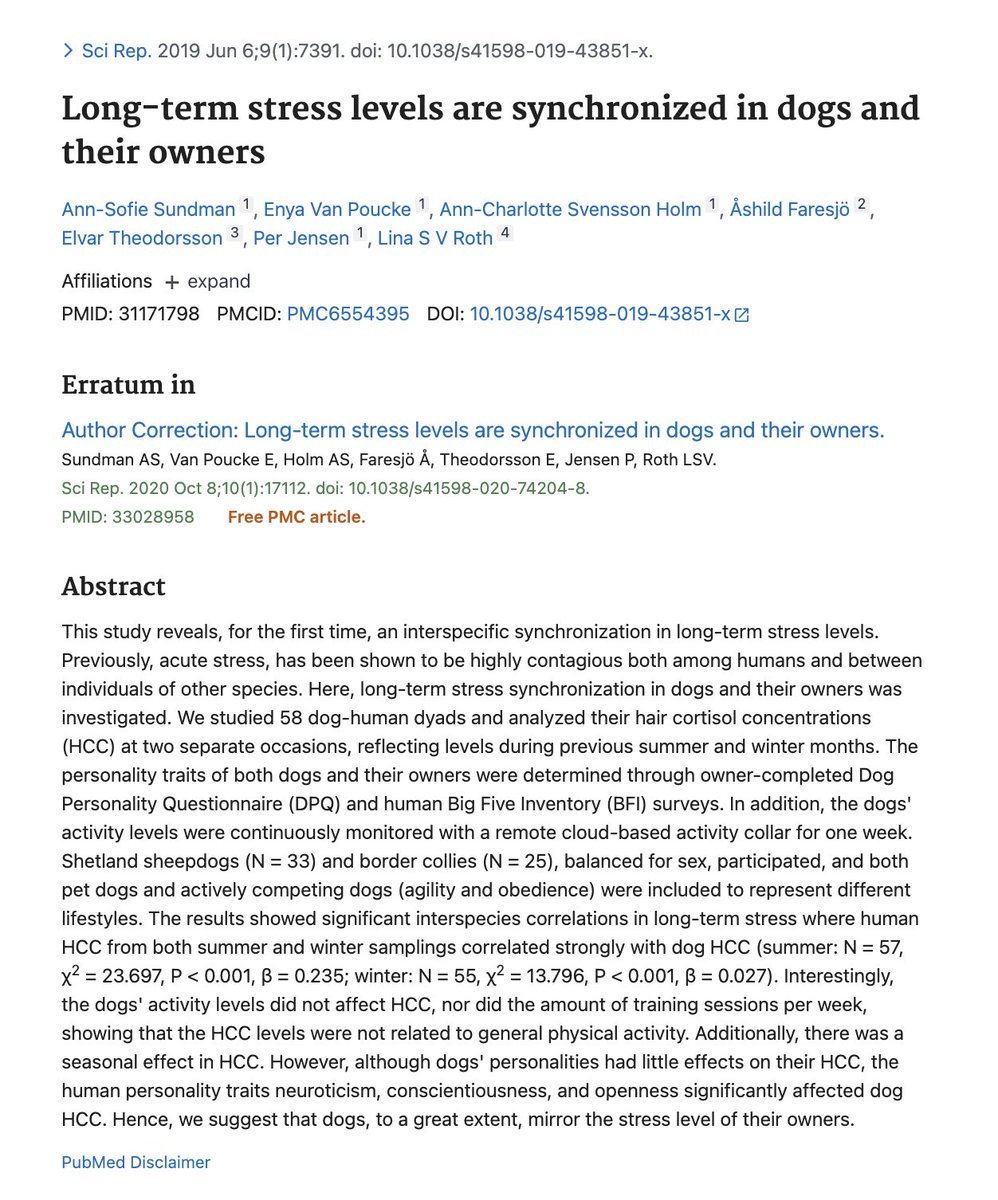
Your dog carries your stress in its body for months. A 2019 study in Scientific Reports measured cortisol in the hair of 58 dogs and their owners over a full year and found that the two rose and fell together. When you are stressed, your dog is stressed. When you calm down, so does it.
The synchrony was not driven by walks, weather, or the dog's own life events. It was driven by the owner. Dogs whose owners scored higher on personality measures of anxiety showed higher cortisol year-round. The dog's body was tracking the owner's emotional state over months, not moments.
The bond between a human and a dog is not a one-way relationship where the human provides and the dog receives. The dog is absorbing the household's emotional weather and carrying it in its endocrine system. Your bad month is its bad month.
This is what 15,000 years of co-evolution looks like. The dog did not just learn to read your face. It learned to sync its chemistry to yours, and the hair on its back is keeping a record of how you have been feeling since the last time it was groomed.
The next time someone says "it's just a dog," the cortisol data says otherwise. The dog is a mirror with a heartbeat, and the reflection goes deeper than behaviour. https://t.co/L5PUkx6Jg9
@C_Small_@arcticinstincts I'll first test out the bit at an improv night in my city
And then write up a few comedy sketches on bad second dates, then film it with a gal or two
A few thoughts on the current state of venture capital.
When the Music Is Playing
In July 2007, a few weeks before the credit markets seized up, Chuck Prince, then the CEO of Citigroup, gave an interview to the Financial Times. The line everyone remembers is this one: "As long as the music is playing, you've got to get up and dance." He was mocked for it for years afterward, and he lost his job a few months later. But I have come to think he was saying something honest. He wasn't claiming the music would play forever. He was admitting that he couldn't sit down while it was still going, and neither could anyone else in his seat.
I've been thinking about that quote a lot lately, because right now is the most disorienting period in venture capital I can remember, and I have been doing this for a while.
Here is what makes it disorienting. It's not that things are bad. Some things are spectacular. We have companies in our portfolio growing faster than anything I have seen in my career, and I don't say that lightly. At the same time, we have companies with no revenue, no product, and a founding team you could fit in a conference room raising billions of dollars at valuations of $10 to $50 billion. Both of these things are true at once, and if you try to reason about them with the same framework you will drive yourself crazy.
Two ideas have helped me make sense of it. Neither is mine.
The first is reflexivity, which George Soros has been writing about since the 1980s. In most of life, perception follows reality: the weather is what it is, and your opinion of it changes nothing. In markets, it runs the other way too. Prices change what participants believe, and what participants believe changes the prices. The feedback loop can run for a long time, and while it's running it looks exactly like progress.
Here is how reflexivity is playing out in AI. Full disclosure: Menlo is an investor in Anthropic, so read the following with that in mind. People watched a frontier lab go from a $4 billion valuation to $18 billion, then $60 billion, then $180 billion, then $380 billion, and now something close to a trillion. They drew the obvious conclusion: that is what a neo lab looks like. So the next neo lab gets priced off that path, not off anything it has built. Then it gets marked up in a subsequent round, and the markup itself becomes the proof. Look at Thinking Machines. Look at Reflection. At that point valuation has stopped being an output of the metrics and has become the metric. Nobody is discounting cash flows. They are discounting the last round.
Soros is very clear about one thing, and it's the part people skip: you cannot know when or how a reflexive process ends. You only know that it does. Every one of them has.
The second idea is Chuck Prince's, and it explains why smart people keep dancing even when they can see the loop for what it is. As far as I can tell, there are two groups on the dance floor.
The first group got in early. Firms like ours were in some of these AI companies before the numbers got silly, and the paper gains are enormous. When you are sitting on gains like that, you start to feel like you're playing with house money. I have been around long enough to know that house money is the most dangerous kind, because you don't respect it the way you respect money you had to earn.
The second group missed the early rounds and knows it. Their LPs know it too. So they are trying to make up for lost time by writing very large checks very late, which is the one strategy almost guaranteed to turn a missed opportunity into a real loss.
House money on one side, FOMO on the other, and reflexivity feeding both. That's the whole story. Everyone has a reason to keep dancing, and the reasons are different, which is why nobody can talk anyone else off the floor.
So what do you do? The instinct in our business is to answer with company identification: just pick the right neo lab and you'll be fine. I think that's the trap. When price has become the signal, being right about the company is not enough, because you can be right about the company and still be wrong about the price by a factor of ten. The public-market investors I admire figured this out a long time ago. They spend as much time on how much to own as on what to own.
The winners in venture over the next decade will be the firms that treat portfolio composition and position sizing as seriously as they treat sourcing. How much of the fund is in companies whose valuation rests on the last round rather than on revenue? What happens to the portfolio if the reflexive loop breaks next year instead of in five? Those are not exciting questions. They are the ones that will matter.
The music will stop. It always does. Dance if you must, but know where the chairs are.
🚨BREAKING: Jensen Huang just EXPOSED Dario and Altman’s "Rogue AI" grift to avoid getting sued into oblivion under EXISTING law
“Don't let this doomsday narrative cause somebody to relieve them of the laws that currently exist.
Go and read between the lines. They're actually not asking for more laws; they're asking to be relieved of the laws we do have.”
ABSOLUTE TRUTH NUKE
@vrexec Started farming on a small plot of land, it's been wonderful for my mental health.
Tutoring my godson a variety of languages.
Creating comedy sketches to grow some angel investments.
Doing recruitment for startups
Its been amazing for the soul.
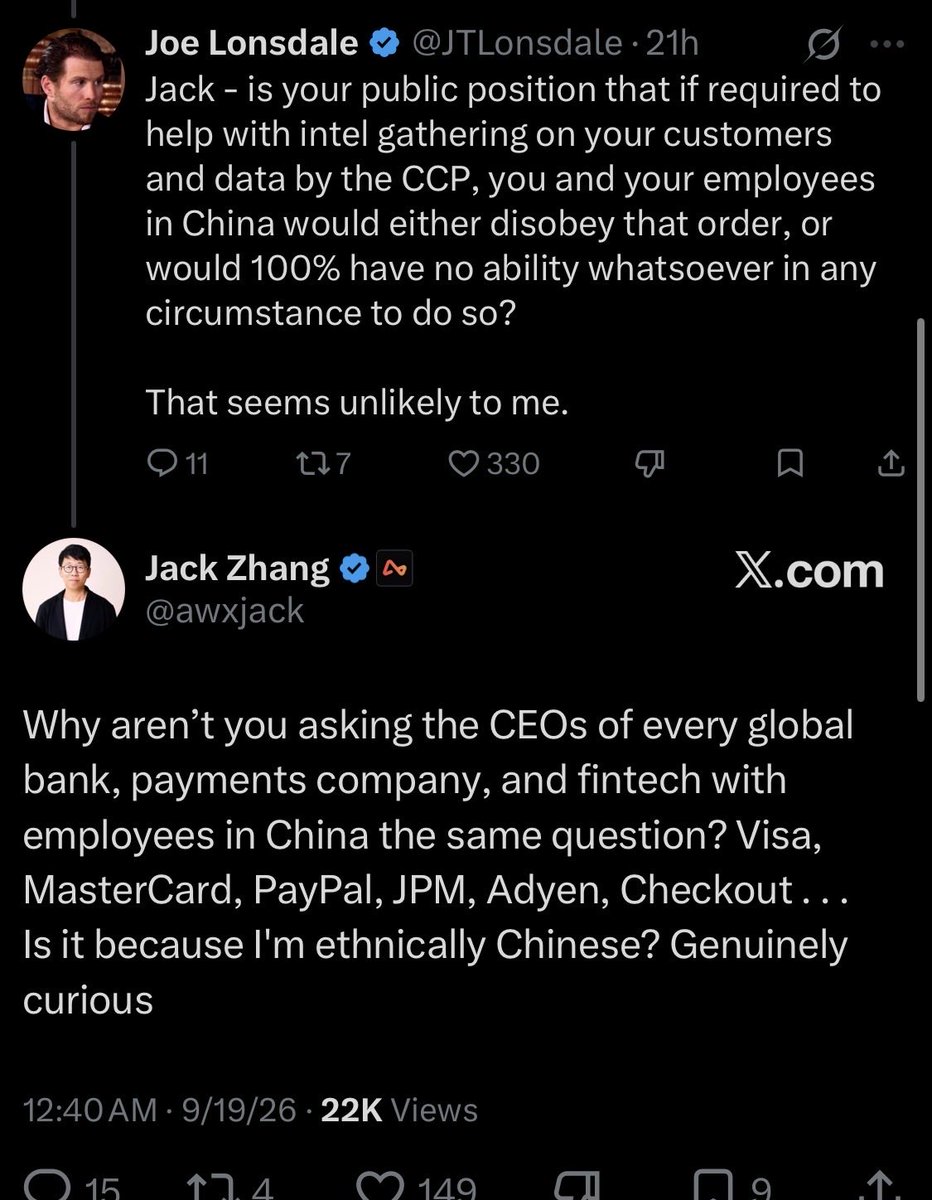
did you know, out of the 500 AMERICAN Fortune 500 companies, at least 40 (e.g. 3M, AMD, Intel, AT&T, Boeing, Exxon Mobil, Dupont, FedEx, Ford, GM, Home Depot, JP Morgan Chase, Goldman Sachs, Citigroup, Amazon, Walmart, Pfizer, etc.) have offices in CHINA?
which means... all 40 of these largest, greatest, richest, most successful, most powerful AMERICAN Fortune 500 companies HAVE to comply with CCP demands!
shocking.
Canada may have quietly created a meaningful tailwind for Canadian small caps. The federal government is proposing a Productivity Mega Deduction allowing businesses to immediately expense 100% of most eligible new capital investments.
The expanded incentive would cover roughly 2/3 of Canadian business capital investment and is expected to cost the federal government approximately $36B over five years.
That’s significant.
Instead of depreciating eligible equipment over many years, businesses can potentially deduct the entire cost immediately. This lowers the after-tax cost of investment, improves near-term cash flow and reduces the hurdle rate for new projects.
As microcap investors, the second-order effect is what interests me most: Who sells the things Canadian businesses are now being incentivized to buy?
⚙️ Industrial machinery
🤖 Automation & robotics
🔬 Sensors & inspection systems
💻 Technology & electronics
📡 Communications equipment
🏭 Manufacturing equipment
🖥️ Productivity-enhancing technology
Canada has struggled with weak business investment and productivity growth for years. This is a direct attempt to change that. If Canadian businesses respond by increasing capex, some relatively obscure Canadian small and microcap companies could see higher demand, stronger bookings and better operating leverage.
Rather than trying to predict the impact on Canadian GDP, I’ll be looking for the small public companies selling the picks and shovels of a Canadian capex cycle.
Those could be the real beneficiaries.