Jerry Hand started as a tiny type specimen scrap.
Loose. Wobbly. Full of rhythm.
It grew into a character.
Then it needed a straight man.
So I built Jerry Book.
Together they’re not a family.
They’re a rough but usable system.
Hand for the shout.
Book for the structure.
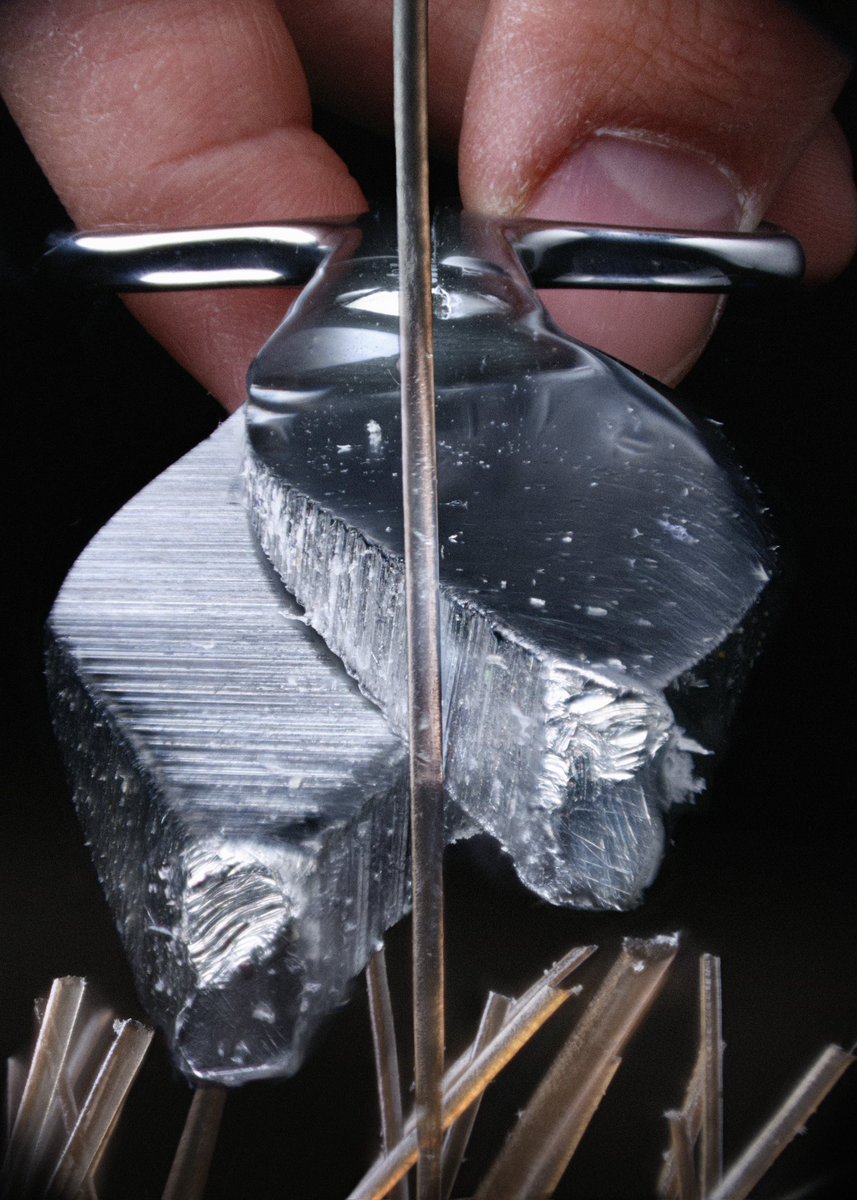
Single Crystal CVD Diamond
Have no doubt, you are at the dawn of an industrial revolution. There is a string of breakthroughs happening throughout upstream industries that all compound.
Diamond manufacturing is now able to produce CPU size single crystals wafers.
Currently these are marketed as heat spreaders because they have thermal conductivity of 2,200 W/mK which means they move heat incredibly effectively.
However, that somewhat misses the wood for the trees…
Diamond has physical and electrical properties that exceed traditional silicon, making it uniquely suited for high demand applications.
Thermal Conductivity: Heat is the enemy of electronics. Diamond conducts heat better than almost any other known material, about 5 times better than copper and over 10 times better than silicon.
A diamond chip can act as its own heat sink.
Ultra Wide Bandgap: Diamond can handle massive amounts of voltage and operate at incredibly high temperatures without electrical breakdown.
This makes it perfect for high power applications like electric vehicle inverters, power grids, and aerospace technologies.
High Frequencies: Electrons move very quickly through diamond, allowing chips to operate at much higher frequencies, which is ideal for advanced telecommunications and radar.
Radiation Hardness: Diamond is incredibly resilient to radiation, making diamond based chips ideal for satellites, space exploration, and nuclear facilities.
To make a material act as a semiconductor, you have to "dope" it. To do this you inject impurities into the crystal lattice to create a positive (p-type) or negative (n-type) charge.
Diamond's atomic structure is so tightly packed that forcing other elements into it is hard. While p-type doping (with boron) has been figured out, reliable n-type doping (with phosphorus) remains a massive hurdle.
Theoretical ceilings
Band gap
Silicon wafer = 1.1 eV
Diamond CVD wafer = 5.5eV
Clock speed
Silicon wafer = 5-6 GHz clock wall
Diamond CVD wafer = 1-2 THz clock wall
Max Running Temp
Silicon wafer = 150°C
Diamond CVD wafer = 1,000°C
Whilst we etch silicon with photolithography and Extreme UV light, this doesn’t really work with chemically inert diamond.
Diamond CVD is currently etched with oxygen plasma etching, but this lacks the precision of EUV.
However, we can etch diamond to extreme precision with electron projection lithography. EPL was invented in the 90s by Bell Labs, IBM and Nikkon but abandoned as it was harder than EUV.
Electrons repel each other so the beams blurrs too readily.
What if we built a femto electron beam?
What if we built it to extreme such that it was a ‘single electron’ pulse?
What if we build a microscopic "bed of nails" containing millions of nanoscale tungsten or silicon tips (photocathodes). You shine a massive, highly complex femtosecond laser system across the entire array.
Every time the laser pulses, millions of tiny tips each fire a single, perfectly straight electron at the exact same time.
Turns out, research teams at likes of MIT and Stanford are currently experimenting with exactly this, laser driven nanotip electron emitters.
Pair that tool with Diamond CVD substrate tech and we approach the material limits of both semiconductors and nanotechnology.
Would require asynchronous logic to escape fatal clock skew and operate at full capability.
But I think I will live to see it.
Stray cats were seen riding capybaras in Panama, after locals said the city had pushed them too far.
For months, people near the river noticed something strange happening to the stray cats that used to roam the streets.
They weren’t hanging around the alleys as much anymore. They were disappearing toward the river.
At first, locals thought the cats had simply run away and decided to live closer to the water. But soon, photographers and researchers noticed the truth was stranger than anyone expected.
The cats had found shelter with the capybaras.
They weren’t just following them around. Kittens were seen sleeping beside the capybaras, older cats stayed close to the group, and some were even captured riding on their backs.
The ironic part is that cats are known for hating water, but the capybaras seemed to let them climb on top while they crossed the river, carrying them from one side to the other like it was normal.
Nobody knows exactly when it started, but many believe the cats found safety with the capybaras after being pushed away from the city.
@EvilMopacATX I joke in love. Though to paraphrase a KXAN article about drop shafts being built for I-35 construction, an engineer had this to say: “We’ll call it Texas size, right? That’s how we reference it here at TxDOT."
This is how Ludwig Göransson made the iconic The Mandalorian (2019) theme: a single improvised note on a bass recorder. Jon Favreau and Dave Filoni heard it and instantly said, “This is the sound.”
Three Oscars. Black Panther. Oppenheimer. Sinners. The Odyssey is next.
I was doing some thinking earlier today with cultural knowledge around base level 'world building' like convenience stores and this is kind of the inverse of that. Funny but kind of profound cultural translation too.
First time at an American drive-thru. I did not own a car. I did not think this would matter.
I walked up to the tall speaker. The pole. I assumed it was a small roadside shrine. You speak to it, you leave an offering, the gods provide food. Not so different from home.
A voice came out of the pole. The god was awake. I bowed deeply. When a god greets you, you bow.
The god asked for my order. I requested a burger and fries. It also asked how I was doing, so out of politeness I told it about my whole week. It waited. A very patient god. A long line of cars sat behind me, all bowing their heads, I assumed, in worship.
Then the god said, "please pull up to the window." I had no car. So I walked. On foot. Slowly. With great dignity.
The window opened. A teenager looked down at me. A grown man, no car, standing in the lane where cars go. We held eye contact for a long time. Neither of us had words.
He handed me the food anyway. I believe it was mercy.
In America, can you worship the pole on foot, or have I offended the drive-thru god?
I ordered one pancake in America. The waitress wrote it down and said, "one short stack."
Short. I am a small and humble man. A short stack sounded perfect for me. I waited with a calm heart.
She returned carrying three pancakes, each the size of my face, stacked into a tower, with a block of butter on top sliding down the sides like slow lava.
This was the short one. I did not dare ask what the tall one looked like. Some knowledge a man is not ready for.
I ate for forty minutes. I was not full. I was afraid. The tower did not shrink. I am fairly sure it was growing back faster than I could eat it.
I had to surrender. I left half. In Japan, leaving food is a deep shame. So I leaned in close and apologized to the pancakes directly, in a low voice, one by one.
The waitress asked if I wanted a box. I did not know food could be taken into custody. I declined. I did not want it following me home.
In America, is the short stack truly the small one?
I need time to prepare my spirit before I ever face the tall one.
Liftoff of Starship V3, from the dunes right outside the pad.
This is the most insane shockwave action I have ever seen on video. Absolutely mad.
📽️ Me for @WeAreSpaceScout
Promising new #motiongraphics and #compositing tool #Caddis combines an #AfterEffects style timeline with the 'procedural power of a node graph inside every layer'
https://t.co/DOfn7PpBUr
The app - developed by Shopify motion design lead Mike Gaynor - is currently free in beta