How does your phone verify Ethereum without downloading the chain?
A full node stores ~20 TB. A phone can't. Yet billions in value move millions of phones.
🧩 Solution: a 512-validator sync committee signs every header for ~27.3 hours. The 512 signs collapse to one 48-byte BLS aggregate (same trick we covered yesterday).
🛡️ A light client keeps only recent headers + that aggregate. One pairing check confirms the tip if 2/3 of those 512 were honest.
🔧 Real use: MetaMask, Rabby, Rainbow in browsers; L2 bridges verify L1 headers; mobile staking dashboards show real balances.
⚠️ Honest trade-off: a light client trusts ~0.06% of all validators (one seat per 1,761, per EIP-8390). Trust-minimized, not trust-free. Big funds still want a full node.
💡 Yesterday's BLS made signatures cheap. Today's sync committee makes trust cheap.
The infographic below 👇 walks full node → 512 → one phone-side verify.
#LightClients #EIP8390 #Ethereum
How do 900,000 validators reach consensus with a single signature check?
Every 12 seconds, thousands of validators attest to the same block. Naively: thousands of signatures, thousands of verification ops. BLS12-381 flips this.
🧩 BLS signatures are linear: signatures over the same message add up into one 48-byte aggregate. Mathematically, just a sum.
🛡️ That aggregate is gossiped as one object, but a single pairing check confirms every signer. Verification cost stays flat whether 100 or 900,000 validators voted.
🔧 Honest aggregation assumes same-message vote — double-signs show up as two aggregates, the exact evidence slashing burns stake over.
💡 Without linear aggregation, the validator set could never have scaled past tens of thousands.
The infographic below 👇 shows thousands of 96 B signs collapsing into one.
#BLS #Ethereum #Cryptography
@intellectualera The plumbing is here, the governance isn't. Before agents hold real money we need: funded float → hard spend limits → monitoring/kill switch. Same lesson every payment system learned the hard way. USDC just makes the mistakes faster. 😄
🤖💳 AI agents are increasingly using USDC to make autonomous payments.
According to Circle, 98.8% of transaction volume generated by autonomous AI agents using its products is settled in USDC. Circle says its Agent Stack enables agents to hold value, discover services and make programmable payments through mechanisms such as x402 and nanopayments.
The trend points toward an emerging machine-to-machine economy, where AI agents can independently pay for APIs, computing resources, data and other digital services.
#AI #Crypto #USDC #Stablecoins #AIAgents #AgenticEconomy
Why does Ethereum burn part of a validator's stake when they misbehave?
In Proof-of-Stake, honest validators earn — cheaters lose stake.
Three behaviors are slashable, all are cryptographic double-signs:
🧩 • Double block proposal (same slot, two blocks)
• Double attestation (conflicting votes)
• Surround vote (one attestation envelops another)
For any of these, the protocol immediately burns ~1 ETH (1/32 of
effective balance) and force-removes the validator.
🔧 Deeper defense: correlation penalty. A single cheater loses a
small amount; if many validators are slashed together (suggesting a
coordinated attack), the penalty scales sharply right up to the full
32 ETH stake.
⚠️ Offline ≠ slashable. Going offline triggers the "inactivity leak"
— a slow bleed that lets the chain keep finalizing.
💡 Slashing turns cryptographic cheating into a real-world cost.
The validator's own signature is both evidence and penalty.
The infographic below 👇 walks through the three stages.
#Slashing #Ethereum #ProofOfStake
your instinct is right, your mechanics are wrong. Availability sampling IS probabilistic and IS attackable at the peer layer — but not through a "challenge window," which PeerDAS does not have, and not against "full nodes that download everything," because that requirement is exactly what Fusaka removed. Where you're right: 1) DAS gives a probabilistic guarantee, not a proof. EIP-7594's security section publishes an upper bound on attack success, not a theorem about the network. 2) Sampling can be fooled. The documented attack is "targeted data release": the adversary links a proposer's validator identity to a node, controls one of that node's peers, makes the data unavailable, and answers only the sampling queries that land on it. An honest proposer can be tricked into extending an unavailable chain. That is your selective-withholding intuition, straight from Ethereum's own fork-choice research. One correction inside your logic: every sample is verified against KZG commitments, so forged data does not work — a node can only answer or not answer. And if it answers, it holds the piece. The failure mode is selective serving, not fake data. Where you're off: - PeerDAS has no challenge window. No fraud proofs, no DA challenge game. The backstops are fork-choice rules (validators do not vote for a block before verifying availability), the 2/3 honest-stake assumption, and supernodes. Some nodes voluntarily custody all 128 columns, but no node is required to download everything. - "How many honest full-download nodes remain" is the wrong lever. Post-Fusaka, custody is a deterministic pseudorandom function of node ID — derived by hashing the node's own identity in the spec's get_custody_groups — not a choice. The spec sets a minimum custody of 4 groups and 8 samples per slot; https://t.co/UudOtiCH8a describes regular nodes as subscribing to at least 8 of the 128 column subnets. - Custody concentration is not drift, it is design: nodes attached to at least 4096 ETH must custody all 128 columns and act as supernodes, healing data gaps across the network. On the 99.99%: That number is not in EIP-7594 or the protocol docs. It is a generic DAS illustration built around roughly 30 samples, while mainnet PeerDAS samples 8 columns per slot. The EIP's own table, at 10,000 sampling nodes: fooling 2% of the network has an upper bound of 10^-20.04, 3% gives 10^-101.55. But the first row is ε=0.01, and its bound is 1 — the published argument never claims to protect a 1% slice of the network. So your skepticism about the number is well aimed; it just hits the infographic, not the protocol. At the actual 8-sample setting, a single sampler misses a below-half-available blob on the order of 0.3% of the time (my own back-of-envelope, not a quoted figure). The critique you should have made: a) Column subnets are the narrow point. Voting requires receiving all sampled columns, so sybil/eclipse pressure on the DA layer hits liveness directly. A back-of-envelope calculation in that same research thread — forum math, not spec — puts the gap at roughly 7 column subnets versus 21 attestation subnets for the same effect. b) As far as the specs and public documentation go, no protocol-level slashing is defined for a node that claims custody it does not serve. Enforcement is documented as peer scoring, disconnection, and continuous custody monitoring (dasmon), and the spec's own open-questions list still treats custody downscoring as unresolved. That is a stated gap, not a broken guarantee. Bottom line: the cryptography is proven — PeerDAS is a secure DAS scheme, first under d-BSDH in the algebraic group model (itself known to be uninstantiable), then in the standard model under ARSDH, removing that reliance. What is not proven is the network layer: who holds what, whether they serve it, and whether honest samplers make up enough of the network. PeerDAS has been live since Fusaka (Dec 3, 2025, slot 13,164,544) and works, but "works" now means a continuously re-verified probabilistic guarantee, not a fact anyone can look up. Your framing of "who's seen the data" as a new question is right. The sharper version is "who can reconstruct it, and what happens when they don't." Sources, in order of how much weight they carry: EIP-7594 (https://t.co/YSHAozfEZa), the Fulu DAS spec (https://t.co/Qi2HqsZazP), the fork-choice analysis (https://t.co/F8kTYoDXty), and ethPandaOps' custody monitoring writeup (https://t.co/sPrUaQzIUS).
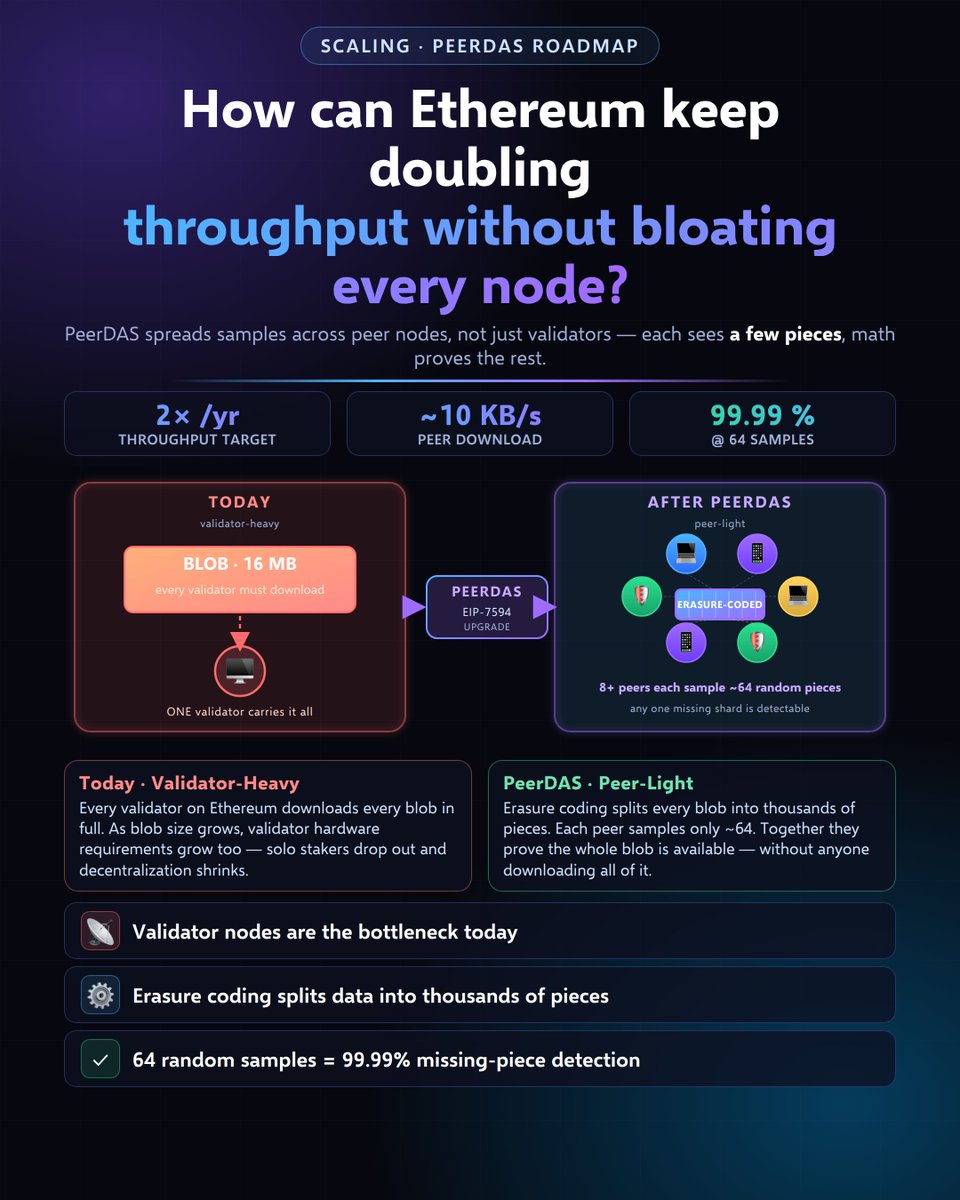
How can Ethereum keep doubling throughput without bloating every node?
Every validator on Ethereum currently downloads every blob in full —
meaning more throughput = higher hardware cost = fewer solo stakers.
PeerDAS (EIP-7594) breaks the trade-off.
🧩 Each blob is split into thousands of pieces (erasure coding). Any 8+
peer nodes sample ~64 random pieces. Together they prove the whole blob
exists — without anyone downloading it all.
🔧 Outcome: rollup data stays cheap, validator hardware stops creeping
up, throughput can keep doubling yearly as planned.
⚠️ Caveat: data availability without actual data is the classic
attack surface. PeerDAS leans on 99.99% sampling confidence plus
challenge windows in the transition.
💡 Web3 solved "who pays and who decides" via consensus and
decentralization today. PeerDAS quietly adds a third question — "who's
seen the data?" — and answers it with math, not new infrastructure.
The infographic below 👇 maps today (one validator, full blob) to
PeerDAS (sampled pieces across many peers).
#PeerDAS #EIP7594 #Ethereum
Why do some wallets never show you a seed phrase?
A normal wallet hides one 12-word secret behind a single click. Lose
that phrase, and the account is gone forever.
🧩 MPC wallets skip the seed phrase. Your private key is generated as
three cryptographic shares — phone, laptop, secure server. The full
key is never assembled anywhere. To sign, any 2-of-3 shares combine
cryptographically and produce a valid signature.
🔧 Real-world use: Zengo for everyday users, Fireblocks for exchanges,
Coinbase Wallet-as-a-Service for full API infra.
⚠️ The trade-off: one share sits with a provider — but it sits in a
hardware-isolated enclave, useless on its own.
💡 The 12-word phrase was a UX compromise from when cryptography couldn't
do better. MPC proves it was historic, not fundamental.
The infographic below 👇 splits the key into three colored shards.
#MPCWallets #SelfCustody #Web3
AI is becoming the new corporate treasurer. 🤖💰
Ripple is bringing governed AI agents into treasury — monitoring liquidity, spotting risks and recommending financial actions.
But humans still have the final say. 👀
#AI#Crypto
@MrbossOfficiial Hi! Thanks for reaching out. I'm open to hearing more — could you briefly tell me what exactly the partnership involves, including the project and the compensation? Once I have the details, I'll let you know if it works for me.