The rain-slicked streets of Delhi glisten under the glow of streetlights. Inside a electronics shop, a small crowd gathers around a flickering black & white TV set.
On screen, 4 sharp young students stand under the studio lights of a national television quiz show. The quizmaster leans into the microphone:
"Name the hero of the Trojan War who was dipped in the River Styx by his heel."
W/o missing a beat, a boy rings the buzzer: "Achilles!"
The crowd gasps in admiration. The quizmaster smiles & flips his card for the next question:
"In the ancient epic Ramayana… who was the mother of Lord Rama?"
Silence. Dead, suffocating silence. The students look at each other, blank-faced.
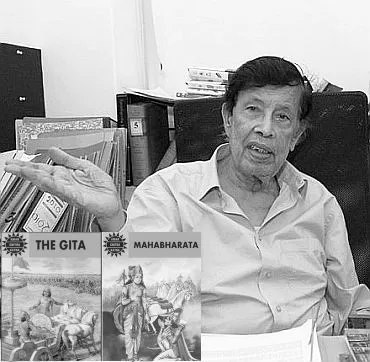
Standing in the back of that shop, a 38 yr old chemical engineer named Anant Pai feels a sudden, sharp pang in his chest. His heart sinks. Here was the generation of independent India, fluent in Greek mythology, completely severed from their own soil.
In that single, quiet moment, a spark ignited. Anant Pai decided to risk everything to give Indian children back their stolen stories.
Anant Pai was an orphan by the age of 2. Raised by his grandfather in a quiet village in Karnataka, he arrived in Bombay with little money, unable to speak a word of fluent English. Yet, through sheer grit, he earned a degree in chemical engineering. But chemicals did not pull at his soul, stories did.
After quitting his secure job at The Times of India to pursue his vision, he pitched his idea of Indian mythological comics to top publishers. They laughed in his face.
"Indian kids want Phantom, Superman & western fairy tales," publishers told him. "Nobody buys Indian stories in comic book format."
When G.L. Mirchandani of India Book House (IBH) finally agreed to publish his project, the initial rollout was an absolute disaster. The 1st 10 titles were not Indian at all, they were forced by distributors to be translated European fairy tales like Cinderella & Red Riding Hood. They bombed on the newsstands.
Anant Pai was facing complete ruin.
Defying publisher demands, Pai threw away the western scripts. He sat down, wrote the script for Issue #11: Krishna himself & teamed up with artist Ram Waeerkar.
When Krishna hit the stands in 1970, the market resisted. Bookstores refused to display them. Over the 1st few yrs, they sold only a few 1000 copies combined across all titles. His publishers begged him to shut it down.
Pai refused. He personally packed boxes, traveled from school to school across India, convincing reluctant principals that comics were not "brain-rotting trash," but cultural heritage.
Then, the miracle happened.
Word-of-mouth spread among parents. Children began trading ACK comics in schoolyards. Krishna blew up, getting reprinted 60+ times. By the late 1970s, Amar Chitra Katha was selling 5M copies a yr. Anant Pai became "Uncle Pai" to an entire nation.
Finally, the orphan who once had no voice had given an entire nation its memory back. He built the ink & paper soul of modern India.
Holding an internal shockwave in check (I went through personally this week) so that the ecosystem around us does not collapse/panic requires a massive amount of mental RAM.
The ancient Indian knowledge system has a beautifully engineered psychological framework designed exactly for this runtime environment. It comes from Sāmkhya philosophy & was later practicalized in the Bhagavad Gitā through the concept of Sthitaprajña (स्थितप्रज्ञ) which translates logically to "The Decoupled Intellect."
The Sāmkhya system states that our identity is split into 2 distinct layers:
- Prakriti: The active machine. This is our body, our professional role, our responsibilities & our emotional processing unit.
- Purusha: The silent, unshakeable observer. This is the deep consciousness that watches the machine run.
When catastrophic/unexpected news hits, a typical system crash happens because the person merges completely with the news.
The Sthitaprajña model tells us to decouple. We recognize that the personal shock is happening inside the emotional buffer zone of Prakriti, but our front-facing execution code (our duty to our family/our team/our clients) can run on a completely separate thread. We do not deny the pain; we simply refuse to let it corrupt the processing power needed for our immediate duty.
Bhagavad Gita also uses a highly specific physical analogy for a crisis:
Yadā samharate cāyaṁ kūrmo’ṅgānīva sarvaśaḥ
Like a tortoise drawing its limbs cleanly back into its shell.
When a crisis occurs, our energy normally leaks outward in the form of panic/erratic micro-expressions/anger, which instantly infects the people looking to us for stability.
By pulling our emotional expressions "into the shell" temporarily, we create a fireproof container. We are consciously deciding: The processing of this grief will happen later, in a safe space. Right now, the perimeter must hold.
Also, Karmasu Kauśalam philosophy redefines "strength" not as a lack of emotion, but as operational efficiency under stress.
The system recognizes that our professional life & the people dependent on us have a right to a stable interface. Showing a strong face & executing our duties cleanly while our personal world is shaking is not fake; it is the ultimate expression of control. It means our intellect governs our actions, not the passing storm.
If any1 of you also are walking through this exact scenario today, know that you are executing a very high-level mental protocol.
The goal is not to never feel the blow, the blow is real. The goal is to hold the line for the next few hrs because others need you to be the anchor. You can dismantle & process the shock when the laptop is closed & the door is shut. But until then, trust your capacity to keep the threads separate. The machine can still run beautifully even when the background code is heavy.🙏🙏
I’m a dermatologist. I’m supposed to say there is no amount of safe sun exposure.
But I won’t, because that’s a lie.
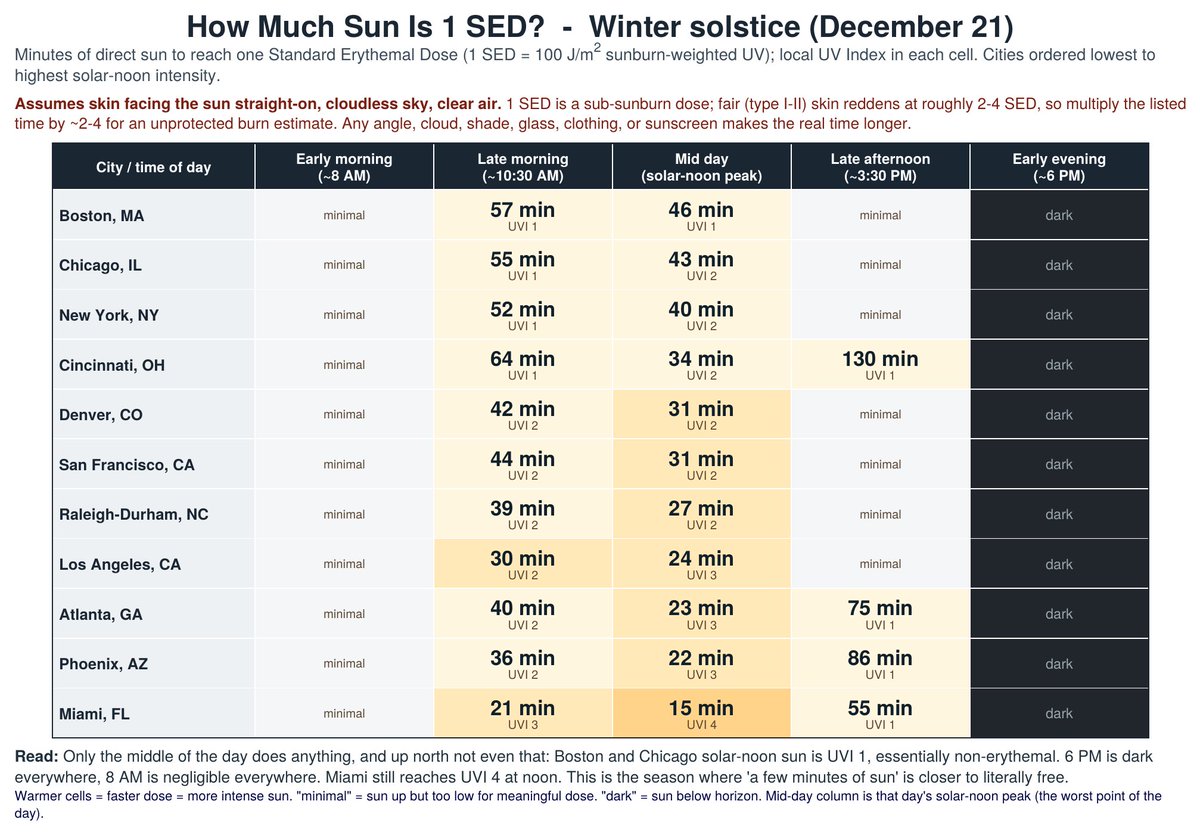
The attached shows how much sun is safe in different cities at different times of year.
What do I mean by ‘safe’?
I mean this: UV causes DNA damage and skin cancer.
But, shockingly, your body repairs that damage. As long as the damage doesn’t outpace repair and start accumulating it shouldn't increase your risk of skin cancer.
Data just came out that tells us how much UV you can get without damage accumulating.
They took the people most susceptible to DNA damage from UV and exposed them to UV, then did skin biopsies to measure the damage, then more skin biopsies to measure the repair, and repeated it daily for 4 days.
At 1.6 ‘Standard Erythemal Dose’ (SED) there was no accumulation of damage.
So, the attached charts show how much sun it takes to get 1 SED in different cities at different times of the year at different times of day.
And there are extra safety margins built in. It assumes a perfectly clear day with zero air pollution and that the sun is hitting your skin perpendicularly. Unless you’re laying flat, most sun is hitting you at an angle, which isn’t nearly as intense.
But a bigger question you might be asking is ‘Why would a dermatologist be telling you to get sun in the first place?’
Because getting sun reduces your risk of death.
Mostly by reducing your risk of heart attacks and strokes. That is very well proven.
But it’s also very likely that sun exposure reduces your risk of autoimmune disease, dementia, cancer and depression. It’s just not as well proven as the protection against heart attacks and strokes.
And before you reply and say ‘just take vitamin D!’, know that it has been ROBUSTLY proven that vitamin D has little (if any) benefit for preventing any of the above. Vitamin D is mostly useful as a marker of if you’re getting enough sun.
What do I do myself and what do I tell my patients?
Get as much unprotected sun exposure as you can without getting a burn.
That’s my GUESS as to what has the best risk/benefit ratio. Dying of skin cancer is actually really rare, especially when compared to the risk of heart attacks, strokes, autoimmune disease, dementia and other cancers.
But I’ll admit it’s not for sure best to get as much sun as possible, since sun does increase the risk of skin cancer and it might be the case the benefits plateau at a low level.
So, if you’re really worried about skin cancer stick to the charts.
The best science I can find says that amount won’t cause skin cancer.
The takeaway?
Sun is good for you, just don’t get a burn.
In 1967 India ran one of the most inconvenient heart studies of the century, almost by accident, and the field has been quietly looking away from it ever since.
Dr S.L. Malhotra had a researcher's dream sitting in front of him: the Indian railway workforce, well over a million people. Same employer. Same medical cover. Comparable pay and hours. Scattered the length of a subcontinent. Strip all of that out and one great variable remained. Diet, which in India meant geography.
In the north, in Punjab and Rajasthan and UP, the railwaymen ate the way their grandparents had. Ghee. Milk fat. Curd. As much as nineteen times more fat than their southern colleagues, and nearly all of it the saturated animal fat that Ancel Keys was at that very moment teaching the West to dread.
In the south the plate was rice, sambar, and seed oils, groundnut and sesame, with far less fat overall. By the brand-new rules being drafted in America, the southerners were the ones doing everything right.
Then Malhotra counted the bodies.
Heart disease deaths in the south: 135 per hundred thousand. In the ghee-soaked north: 20. Seven times the disease in the men eating the wholesome seed oils. Among the railway sweepers, the leanest and hardest-working of the lot, the gap yawned open to fifteenfold.
He chased down every other explanation within reach. Smoking ran the wrong way, the north smoked more. Activity gave no clean signal. Wealth made things worse if anything, executives dropping dead while the sweepers carried on. The one thing that tracked the dying was the fat in the pan.
It was published. Peer-reviewed. British Heart Journal, 1967.
It landed in the exact decade the West was pouring concrete around the opposite belief. Heart associations were prescribing vegetable oils. Factories were tooling up to turn them out by the tanker. A study showing the seed-oil eaters dying seven times faster was not a study anyone with a budget wished to repeat.
So nobody did. Almost sixty years on, the finding still stands, unrefuted and unloved.
It has never once troubled a dietary guideline.
The connection b/w the South Indian Murukku (that crunchy, coiled, savory snack we all love) & the ancient medical treatise of the Sushruta Samhita is 1 of the most brilliant, hidden examples of how ancient Indian snack food was originally engineered as preventative medicine.
When people think of the Sushruta Samhita, they immediately think of plastic surgery, rhinoplasty & complex surgical tools. But Sushruta was a holistic genius. He knew that the ultimate goal of medicine was to ensure a patient never needed surgery in the 1st place.
Volume 1 (Sutra Sthana, Chapter 46) contains an entire, massive section dedicated to Ahara-tattva (the nutritional science of food). And this is where the fascinating origin story of the Murukku begins.
In the Sushruta Samhita, Sushruta categorizes deep-fried pastry items under the broad family of Bhakshyas (cooked, chewable foods). Among them, he singles out a distinct item called Śaṣkulī. Over centuries, as the Sanskrit word Śaṣkulī traveled across different regions of India, it underwent phonetic shifts: In the North & West, the word evolved through Prakrit into Chakli (retaining the circular, coiled meaning).
In the South cultures translated the physical action of making it, twisting the dough giving us the beautiful descriptive name Murukku (which literally means twisted in Tamil).
Sushruta was deeply concerned with the concept of Agni (metabolic digestive fire). He categorized foods based on whether they were Guru (heavy to digest)/Laghu (light to digest). He noted that deep-frying grain dough in ghee makes it highly caloric & strength-giving (Bala-vardhana), but it can be incredibly heavy for the stomach.
To fix this chemical problem, ancient Indian cooks did something brilliant that Sushruta documented: they introduced Masha (Black Gram/Urad Dal) into the rice flour matrix. By mixing rice flour with roasted, ground urad dal, they created a complete amino acid profile (rice is low in lysine but high in methionine, while dal is high in lysine but low in methionine).
A few might think why did Sushruta spend time documenting a fried, coiled snack in a medical text meant for surgeons? Because of shelf-life & thermodynamics.
In ancient India, monks, traders & soldiers traveling across vast empires needed food that met 3 strict scientific conditions:
- It could not contain moisture (water causes bacterial spoilage).
- It had to be compact & physically rigid so it would not crumble into dust in a horse carriage.
- It had to be nutrient-dense to sustain high physical exertion.
By taking the Śaṣkulī dough, piping it into tight, concentric, interlocking coils (which structurally reinforces the snack against breaking) & deep-frying it until 100% of the water content evaporated, ancient Indians invented the ultimate preservative-free, shelf-stable survival ration.
When you hear the crunch of a Murukku today, you are literally tasting a recipe that was vetted, chemically balanced & medically approved by the Father of Surgery himself, Acharya Sushruta, 1000s yrs ago.
So, the next time you serve Murukku/Chakli with tea, you can proudly tell your guests: You are not just eating a snack. You are consuming a highly engineered, ancient Ayurvedic military ration designed to preserve human tissue :))
This is Audrey's pinned tweet. It is hilariously ironic that Audrey quotes Nilakantha Dikshita’s Kalividambanam (Verse 1). She clearly missed the joke.
Nilakantha was satirizing fake scholars who do not know their subjects.
When he wrote 'Na boddhavyam, na sravyam... jhatiti prativaktavyam,' he was mocking charlatans who refuse to understand the subject, refuse to listen to opposing evidence & just scream immediate replies to look smart.
If she had actually read the very next verse in Nilakantha’s text (Verse 2), she would have realized she was walking into a trap. Nilakantha goes on to list the 5 ways these fake scholars try to win an argument when they lack substance:
असंभ्रमो विलज्जत्वम् अवज्ञा प्रतिवादिनि l
हासो राज्ञः स्तवश्चेति पञ्चैते जयहेतवः ll
Remaining unbothered, sheer shamelessness, showing utter contempt for the opponent, mocking them & praising the ruling powers (the King)... these 5 are their keys to victory.
This is the exact operational playbook of modern ideological historians when cornered by hard evidence.
Let me further quote the verse 3 also to get the full context:
अशिक्षितेषु वक्तव्यं सभ्येषु महता कलिना l
शिक्षितेषु तु वक्तव्यं मध्यस्थोऽयं विमत्सरः ll
If the judge is uneducated, just shout loudly to win. If the judge is smart, immediately accuse him of being biased!
Whenever an Indian scholar/community group exposes a factual error in her work using hard data, the response is rarely a factual counter-argument. Instead, she immediately claims she is being harassed/attacked by nationalists.
She & others use institutional victimhood as a shield to completely avoid answering legitimate, evidence-based academic critiques.
I do not get angry at the trolls but see them as Intellectual Refugees. They are people who are still living in the Deficit Era (1990s) while the nation has moved into the Surplus Era (2026).
"But China..." is a new argument trend & this is a psychological condition called Relative Deprivation Syndrome, mixed with a heavy dose of Pathological Comparison. It is the tragedy of the Indian middle class: we have been conditioned to view our progress not as an absolute climb, but as a race where we are always losing to a specific neighbor.
China’s progress is Top-Down (State-Driven). India’s progress is Bottom-Up (People-Driven). It is mathematically easier to build a bridge when you can displace 10000 people with a single signature. It is infinitely harder & more resilient to build a bridge in a vibrant, chaotic democracy where every pillar requires a consensus.
India’s 0% Power Deficit/UPI Revolution happened despite the friction of 1.4 billion opinions. That is a Stress-Tested Success. China’s success has not been stress-tested by internal dissent yet.
Also, India’s data, statistics, & growth are audited by the world. When we hit 0% power deficit, it is a verified physical reality. When China reports growth, even their own provincial governors have admitted to adjusting the math.
Anyway, taking pride in India is not about being better than China; it is about recognizing that India is the world's largest Living Experiment in how a poor, colonized nation can become a space-faring, energy-surplus superpower w/o losing its soul/its vote. Jai Hind!
Now that the 131st Amendment Bill failed, allocation of Lok Sabha seats will be based on 2026 census data.
As per current estimates, seven States will likely lose 35 seats: AP (-5), Telangana (-3), TN (-10), Karnataka (-2), Kerala (-7), Odisha (-4), and WB (-4).
Four States will likely gain 34 seats: UP (+12), Bihar (+10), MP (+5), and Rajasthan (+7).
BJP is widely believed to be the potential beneficiary of redistribution of seats to States based on 2026 population.
In a stunning act of self-denial, the NDA government came forward to freeze the current share of States based on the 1971 census data. There could be many reasons for BJP committing to such a freeze - putting the nation above the party, paving the way for expanding their footprint in the South, or avoiding a divisive issue when the nation has to focus on growth and prosperity in the face of global challenges. Whatever be the motivation of BJP, the seven States that lost share of population are offered an unexpected gift. You don't look a gift horse in the mouth!
Surprisingly, the parties which have great stakes in the South and East have scored a spectacular self goal. This is a classic case of cutting the nose to spite the face.
In 2001, as the freeze in seats was expiring, I was deeply involved in persuading the then Vajpayee government to continue the freeze in the number of seats allocated to States for another 25 years. An unwieldy coalition and the economic challenge posed by external sanctions after the Pokharan explosion demanded national unity, and the parties responded with the 84th Amendment. Now again a priceless opportunity arose, and the Opposition squandered it without any strategic thinking.
If political animosity makes you oblivious of your own interest, or larger interests of fostering unity and focusing on growth and harmony, it is a sign of dysfunctional politics.
I appeal to all parties to come together and find a harmonious solution to the thorny problem of seats allocation in the face of demographic imbalances. National unity and our quest for opportunity and prosperity for all demand a fair and swift resolution.
In the long run migration will resolve the imbalances. Already millions of migrant workers are building and sustaining the economies of several States in the South, West and North. That is why, despite low fertility rate, Maharashtra's share of the population is increasing.
In the US, dramatic internal migration changed the demography and representation over the years. People move freely to States where there is growth and jobs are created. In a century, Florida increased its representation in the US Congress from 4 to 28, California from 11 to 52, Texas from 18 to 38, and Washington from 5 to 10. Owing to outward migration, New York lost seats, from 43 to 26, Pennsylvania from 36 to 17, Illinois from 27 to 17, Ohio from 22 to 15, and Missouri from 16 to 8.
We should make it easy for people to migrate to other States and recognize and respect their constitutional rights everywhere and make their life easier and safe. That will resolve our demographic challenges. Most states reached low fertility levels, and Bihar, UP, MP, Rajasthan and Jharkhand too are going to reach there in a few years.
We need a reasoned and pragmatic approach to grow together and become strong. Let us persuade parties to shed inflammatory and divisive rhetoric and focus on quality education and skills and opportunities for all.
El guitarrista polaco de 26 años, Marcin Patrzałek, responde a quienes afirman que su música es falsa.
Creó este video tutorial para mostrar exactamente cómo toca tan increíblemente bien y sí, todo está interpretado en vivo con una sola guitarra.
👏🏻👏🏻👏🏻