Imposter syndrome dies with evidence
You aren’t who you say you are
You are what you do
And if you do great work
You have become your inspiration
Now you get to set the bar higher
And strive for more
So focus on doing and becoming
myself + @BejayMulenga partnered together to create #JoyfulManhood - "How Black Men Loose Their Smile?" inspired by @Bashy track
😀 100+ men
🎙️20+ contributors
✊ Personal pledges for 2025
💪 fitness & life coaches on the night giving expert advice
Collaborating with @bpi_music for a new startup accelerator focused on music related businesses. Grow Music will help London-based scale-ups grow their companies while training new angel investors to support that growth Discover more & sign up https://t.co/KAAp14SwbE
It's launch day for Open Angel, spearheaded by @Andy_ayim 🎊🎊
If you're interested in Angel investing or a founder looking for Angels definitely check out this free resource https://t.co/RHrgk7F5nw
Twenty-five of the companies were founded or co-founded by women, including International Energy Products. Other female founders include Ama Amo-Agyei who set up the Reading-based hair and skincare brand Plantmade (@weareplantmade) ⬇️
https://t.co/swj3kNJsVv
Every college graduate knows the feeling:
You’re done with school and life is yours for the taking.
But if you were anything like me, you graduated broke with no clue how to build wealth.
So here are 9 small ways to save money to kickstart your wealth-building journey:
New graduates are more than likely to have these money-related problems:
• You're entirely responsible for your own bills
• You have to find a job (and hopefully one you enjoy)
• You may (or may not) have loans that you’ll soon have to make payments on
And to top it all off, chances are you were not given very much instruction on how to do things like:
• Do your taxes
• Open an IRA account
• Build yourself a financial foundation that doesn’t feel like a house of cards
We have formal education and tests on parallelograms to thank for that.
Even people who are four or five years out of college continue to struggle with understanding the right way to go about saving money. And the most unfortunate part is that it doesn’t take much. Twenty dollars here, fifty dollars there adds up fast, and if you can be diligent about keeping track of your finances, you will save yourself a whole lot of stress worrying over your bank account’s future.
Here are 9 clever ways you can begin shaving a few extra dollars off the top and letting that side pile of money start to grow:
1. Set an automatic deposit on the same date as your paycheck.
This is rule number one.
The day you get your paycheck, set an automatic transfer from your primary account to a savings account that automatically deducts 10% from the top.
Most people can’t fathom doing this. They say, “I can barely pay my bills as it is!” Ok, that’s not a valid excuse, and worse, it’s one that will keep you trapped forever. If all of sudden your job really did pay you 10% less, you would have to figure something else out. You would pick up a side hustle. So impose that 10% tax on yourself and let your savings start accumulating.
Trust me, whatever you were going to spend it on right now, you won’t remember a year from now.
But what you will remember is the extra $1,000+ you have in a savings account from this tactic.
2. Turn off your lights. Seriously.
This sounds overly simple but the month you have an expensive electric bill you’re going to be shocked.
Utilities — electricity, gas, Internet, etc. — all add up fast. One of the worst habits you can have is to leave the heat on all day when you’re gone, or never turning off your lights. And if you really want to get competitive with it, go use something like ElectricRate so you can find the least expensive provider.
It’s a no-brainer.
You take the time to get your utilities down to the lowest cost possible, you set up automatic payments, and then you never have to worry about them again.
3. Use a spending tracker to see where your frivolous spending is, and then cut it.
Start to review your accounts and credit cards. Most will let you organize your spending based on categories you select.
At the end of each month, you’ll get a pretty good sense of where your money is going.
When you do this, you’ll quickly realize that those $2.49 coffees you buy every day add up, fast. So take that, buy a coffee maker, and see if you can cut that spending in half.
Then take the half you’ve saved, and put that in your savings account each month.
It adds up.
4. Make your lunch instead of eating at restaurants.
I made my lunch every single day at work for four years after college.
The only time I would eat out at a restaurant was Friday night, which was my “treat” to end the week.
It’s amazing how much money you save when you buy groceries and cook for yourself instead of eating at a restaurant. The average restaurant bill for a casual meal is around $20. You can make the same meal at home for roughly $7.
Again, track how much you spend at restaurants, trade out some of those meals for home-cooked feasts, and put the difference in your savings account.
5. Look for social events with free entry.
When you’re young, and especially if you’re trying to save money, there’s plenty of things you can do for fun that don’t require an entry fee.
Depending on where you live, these could be street fests, outdoor music festivals open to the public, local art exhibits that have open-house days, etc.
You can also peruse local websites — in Chicago almost everything that’s going on appears on The Local Tourist — for upcoming events that are free to attend.
Save the costly events for special occasions.
6. Buy things in bulk.
Ever heard of Costco?
Buying in bulk saves way more money than people give credit. Things like paper towels, toilet paper, soap, you already know you’re going to need these things.
So instead of buying them at their standard price every month or so, buying them in bulk for cheap and then just store them in a closet somewhere.
Sure, someone going through your apartment might think your plan is to open a Bed, Bath, and Beyond, but the extra money will do your savings account well.
7. Take public transportation instead of cabs.
There are certainly times when it’s easiest (and fairly cost-effective) to just take an Uber, but most of the time public transportation is the way to go.
Especially if you’re keen on saving money as fast as possible, this is one of the best ways to keep your costs low.
When you’re young, you really only have a handful of big bills: rent, transportation, and food. Rent, you can reduce by living with friends or roommates. Food, as we’ve said, can be reduced by cooking your own meals instead of eating out.
So when it comes to transportation, grab a train pass instead of taking an Uber everywhere you go.
8. If you’re going to shop online, download Honey.
This is probably one of the best browser widgets I’ve ever seen, and the first time I used it I was instantly hooked.
Honey scans the web for coupons and discount codes before you check out and purchase products as soon as you go to check out. It’s super fast and extremely easy to use.
There are so many tools, websites, and services out there dedicated to helping you save money. If you’re looking to cut back in any particular area, chances are you just need to do a quick search and something will come up to help you. Use Mint as a guide to see where in your finances you are over-spending.
9. Do not, under any circumstance, accumulate credit card debt.
This is more of a best practice, but it’s also a Cardinal rule — right up there with putting 10% of your paycheck directly into your savings account.
Do not, ever, for any reason, accumulate unnecessary credit card debt.
I’m not talking about the kind that comes with starting a business (not my particular way of going about things, but it’s a strategy many employ, and do so because they have to). I’m talking about the kind that comes with online shopping, or extravagant vacations, or “keeping up with the Joneses.”
Credit card debt, and the debilitating interest rates that come with it, will make it so unnecessarily difficult for you to begin building a sound financial foundation for yourself.
So, avoid the issue all together. Spend within your means, and save as much as you can.
You’ll thank yourself later.
If you’re from the diaspora and serious about making a direct change to the African continent then check out @JoinKwanda - the financially transparent charity funding local-led projects in african communities: https://t.co/A4HdihmFWc
Donate as little as £5/$6.30 #walkthetalk
12 short reflections
1. Content creation rewards you for being prolific or extremely thoughtful. Most people fail because they are neither.
2. Data-informed > data-driven.
You can miss the bigger picture if you rely purely on data to make your decisions.
3. The VC funding game is stacked against you. Empower yourself with revenue and traction.
4. Build distribution and game design into your product from the start.
5. Adding the right amount of friction is powerful.
6. Too little research and you make poor decisions. Too much and you’re just procrastinating. Do enough research to take the first step.
7. What you focus your work on is more important than how hard you work.
8. Taking one day to talk to a few of your customers will save you more time than 99% of productivity apps.
9. If you resist AI, you are ignoring some of the most valuable parts of the internet and technology.
10. Think hard about how you position your product. Think harder about what market you position your product in.
11. If your user experience design is bad, you will lose B2B customers slowly and B2C customers instantly.
12. Do the things that matter most in the morning.
Move faster. Slowness anywhere justifies slowness everywhere.
2021 instead of 2022. This week instead of next week. Today instead of tomorrow.
Moving fast compounds so much more than people realize.
Train the Trainer: Free media literacy program launches to support UK teachers, as 90% call for media literacy to be taught in schools https://t.co/27Hp4hGufF
Train the Trainer: Free media literacy program launches to support UK teachers, as 90% call for media literacy to be taught in schools https://t.co/rnVv1BDyHP
Bellingcat isn't just a news site, we have a collection of tools and resources on our page to help individuals in the open-source research field. You can find the full archive here: https://t.co/yl3oOJatFp
Your network is your net worth:-
Love stuff like this.
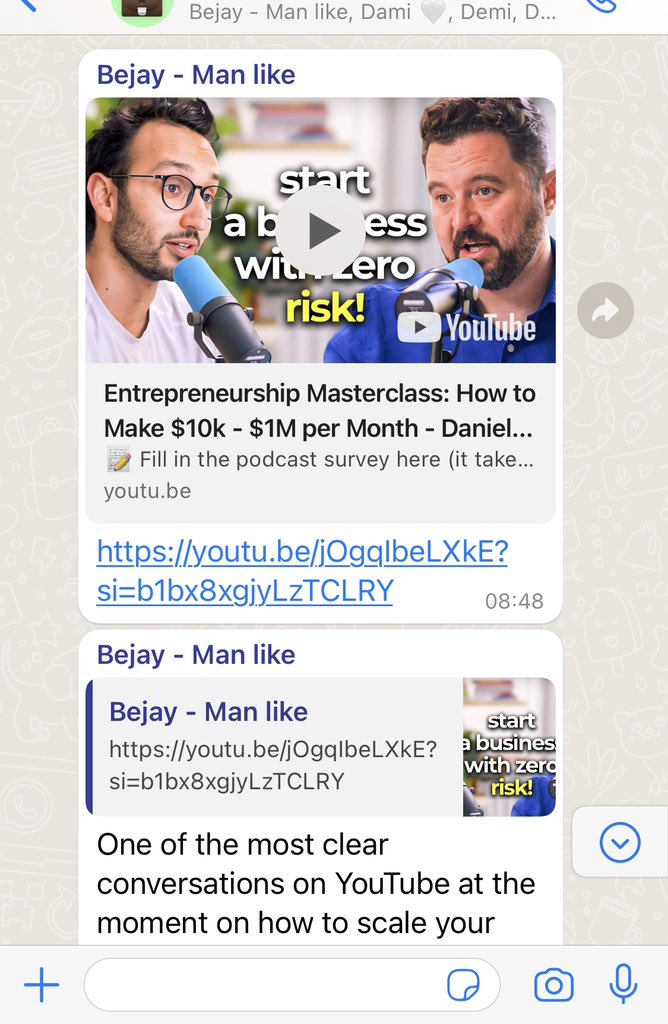
@BejayMulenga sharing hot information from @DanielPriestley to the WhatsApp group
I agree the video is 🔥🔥🔥