Our latest: The taxonomic resolution of 16S sequencing doesn't stop at the species level when using modern long-read techniques. Serovars from 16S...
https://t.co/PIWBigas4l
#NCStateMicrobiome
Love that @bejcal called using data only in the original paper “a crime against data” - make it findable & usable so it has many lives/uses! #NMDC#ASMicrobe
Our latest: The taxonomic resolution of 16S sequencing doesn't stop at the species level when using modern long-read techniques. Serovars from 16S...
https://t.co/PIWBigas4l
#NCStateMicrobiome
@QIIME2 2023.5 is now available & includes new parallel computing support w @ParslProject, ability to resume failed pipeline runs, provenance replay, decontam actions, and much more. Thank you to all who contributed! #microbiome#bioinformatics https://t.co/KBaEQ37oPB
Excited to finally share our work showing the diversity of Gardnerella in the vaginal microbiome!
When I started this project a few years ago, all Gardnerella was considered a single species. Here we add to the rapidly expanding knowledge of the diversity of this genus.
Did you know: It is not rare for every known genomospecies of Gardnerella (all 14!) to be present in a vaginal microbiome sample? And how ecologically different are these Gardnerellas?
Our latest preprint, led by Hanna Berman:
https://t.co/uzz0LTamAI
#NCStateMicrobiome
STAMPS @ MBL is back in 2023! Jul 19-29 in Woods Hole ☀️🏖️💻
STAMPS has trained thousands of microbial ecologists (of all stripes!) in the bioinformatic and statistical analysis of microbiome data 🌟🧠🦠
Join us for #STAMPS2023 and be one of them! 😻🥳📈
DADA2 1.26 release is live on Bioconductor. The package now natively compiles and runs on ARM architectures like the Apple M1/M2 chips.
https://t.co/XoV26hl0dR
Calling all students and microbiome professionals! Join the IMMSA Bioinformatics Working Group to address "How do we define how accurate a microbiome profile is?" https://t.co/9rRZnRE72x. Meeting will be on zoom Thursday Nov 10, 2022 at Noon eastern time!
Our researchers aren’t just solving problems, but also sharing their expertise with early-career scientists!
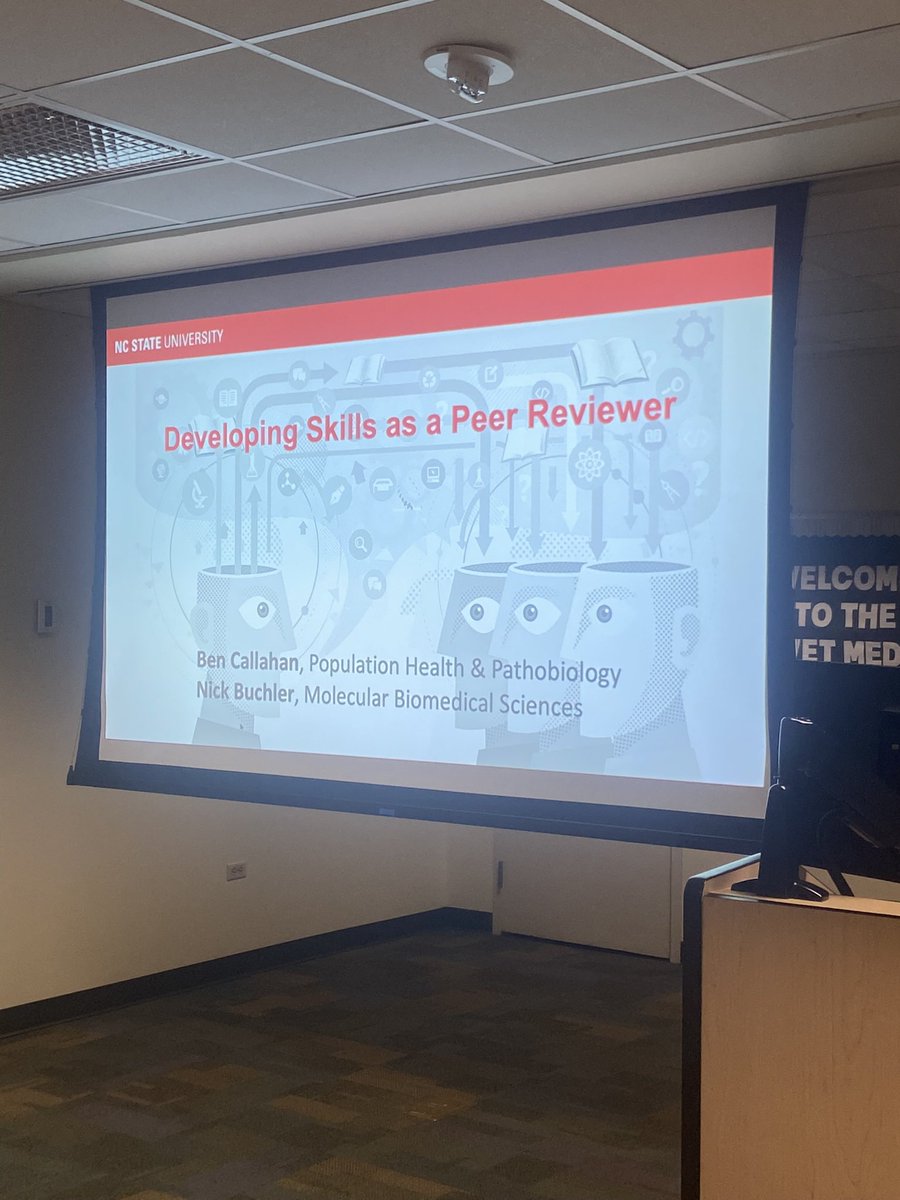
Yesterday, @bejcal and @buchler_nicolas gave a fantastic seminar to our postdocs on the skills and importance of peer reviewing!
@bejcal This manuscript addresses the mixed and inconsistent findings related to the associations between the vaginal microbiome and preterm birth in current literature. 1/
The Nucleic Acid Observatory project at MIT is hiring an experimental scientist to help lead our efforts to develop an environmental metagenomics monitoring system to detect catastrophic biothreats
https://t.co/bZ00GXyIDN
Thanks to @CraigGin for help all along the way, and our co-authors who helped us understand and effectively use their primary research. (and apologies for not knowing your twitter handles!)
Out latest work led by @DavidHuangCZ1 is out on medRxiv: "Meta-Analysis Reveals the Vaginal Microbiome is a Better Predictor of Earlier Than Later Preterm Birth"
https://t.co/XkbtGYqYU7
Congrats to CVM's Dr. Ben Callahan (@bejcal), Assistant Professor of Microbiomes and Complex Microbial Communities, on being awarded the American Society for Microbiology's Microbiome Data Prize!
New preprint alert! 🚨🥳😻
When we first put out the “MWC model” paper, there was a lot of concern about how negatively impactful the problem of unequal detection efficiencies in microbiome taxonomic profiling is.
A thread🧵…
1/
This preprint builds on our previous work developing a quantitative model for taxonomic bias in metagenomic sequencing: https://t.co/r3hA34uZlp
Thanks to our collaborators @AmyDWillis@archaearama and @JTNearing
Our latest work led by @mikemc423 on bioRxiv goes deep on "Implications of taxonomic bias for microbial differential-abundance analysis": https://t.co/JIuwpvteoh
Metagenomic sequencing is biased. When are differential abundance (DA) results still valid?
#NCStateMicrobiome 1/
A few quick hits: There are right(er) and wrong(er) ways to measure absolute abundances. Great care is needed to correctly estimate small non-zero differential abundances. And while taxonomic bias can interfere with DA analyses, it doesn't make all such results invalid.
6/