THESE F*CKING SNAKES ARE MADE OF LETTERS
Up to 2,800 glyph tiles on screen, redrawn 30 times a second. Drawn in code with Claude, no footage.
I typed “release the snakes” and counted ten of them biting at the chat window.
408 FRAMES, 72,000 PARTICLES, 300 SESSIONS AND ZERO STOCK FOOTAGE. THE RAINBOW COMES OUT OF THE F*CKING CODE
what you see is 300 sessions running in parallel with a cheaper model checking every claim. 6 passes, 293 verified, 7 dropped before anything gets saved. the rainbow is 72,000 particles and about 6,500 bits of code flying out of the listing
my take is that the checking part matters more than the model. writing stuff is easy for models now. i'd rather have a cheap checker on every single claim than trust one smart model and hope
no video editor, the sound is code too. btw every number on the dashboard is made up, only the animation is real
what would you check first if you had 300 agents running at once?
86,400 F*CKING LETTERS BUILD THIS CITY. THEN 23 MORE WORLDS, ALL MADE OF NOTHING BUT TEXT.
The video dives into the moon of a night city, and the moon is made of the word TEXT. Then 24 worlds in under 18 seconds: a tunnel, a shape morph, a dusk sea, Space Invaders playing itself, a terrain flyover, plasma, fire, a galaxy, and a wall with all 24 running at once.
No images and no video clips. Each scene is drawn with plain canvas shapes, then every small block of pixels (4 x 6 in the first shot, 8 x 12 in the rest) becomes a character picked by brightness from a ramp measured from the font. An edge filter swaps in / \ | - on outlines. The first shot is a 480 x 180 grid, which is where 86,400 comes from.
The sound is code too: the riser, the drop, the kick, the bass, the arpeggio and the whooshes are synthesized in the browser, and every cut lands on a beat.
Drawn in code with Claude. 1920 x 1080, 30 fps.
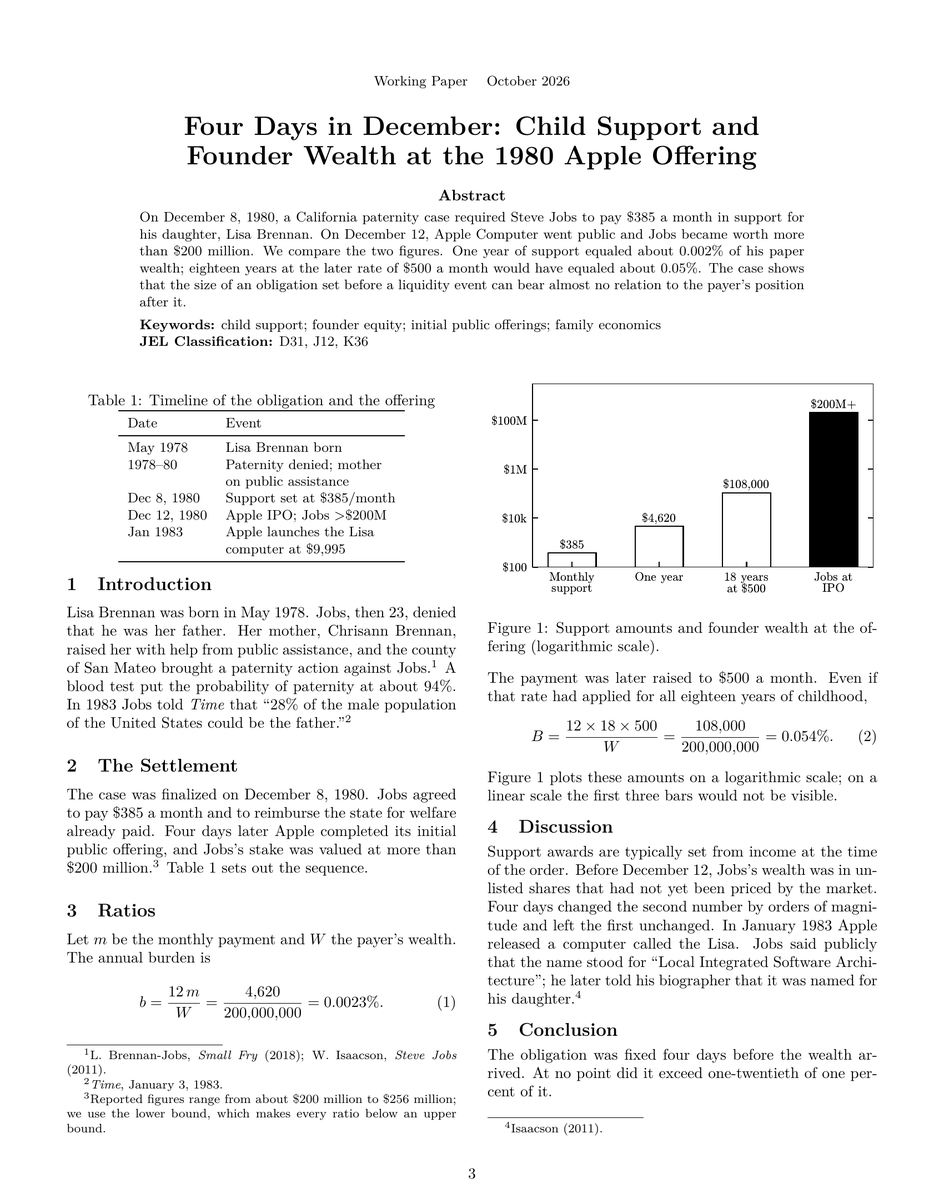
On December 8, 1980, Steve Jobs was ordered to pay $385 a month for his daughter Lisa. Four days later, Apple went public and Jobs was worth more than $200 million.
Lisa was born in May 1978. Jobs, then 23, denied he was her father. Her mother raised her with help from welfare, and the county of San Mateo took Jobs to court.
A blood test put the chance he was the father at about 94%. Years later, he told Time that “28% of the male population of the United States could be the father.”
Table 1 shows the timeline. The settlement was signed on December 8. The IPO came on December 12.
Then the math. $385 a month is $4,620 a year. Against $200 million, that’s 0.0023%.
The payment was later raised to $500. Even at $500 for all 18 years of her childhood, the total is $108,000. About 0.05% of what he was worth at the IPO.
Watch Fig. 1. It’s on a log scale. On a normal scale, the first three bars wouldn’t be visible.
In 1983, Apple released a computer called the Lisa. Jobs said the name stood for “Local Integrated Software Architecture.” Much later, he admitted it was named after her.
The case for Jobs: the amount was set by a court, not by him, and he later raised it. Before December 12, his money was only shares on paper.
Here’s the lesson: a deal signed right before a big payday is priced on the old numbers.
Was Jobs just following the court, or did he know exactly what four days were worth?
Four Days in December
Child Support and Founder Wealth at the 1980 Apple Offering
HOLY F*CK, ELON MUSK'S SPACEXAI BUILT GROK BOT TO FINISH 90% OF THE JOB ON ITS OWN AND STOP RIGHT BEFORE ANYTHING IRREVERSIBLE
grok 4.6 is the brain. the bot is a persistent computer, routines, a team of bots and an approval line around it
The idea: draw the approval line by reversibility, not task size
→ research, draft, organize, stage: done without asking
→ send, publish, buy, delete: parked for your OK
→ loops capped at 3 tries, then it escalates to you
→ one chief bot routes work to specialists
→ bots earn autonomy after 5 clean runs
↳full breakdown in the article below
holy f*ck, SpaceXAI's Grok Bot library is a full org chart of AI teammates.
I counted 98 of them, and the video above is the list.
one places outbound AI phone calls and reports back. one scores your sales calls. one drafts replies for your product support inbox. one writes your pre-call brief. one controls your home robots and vacuum from chat.
each one is built around a single job, so you pick by the job you want done.
how to try one:
1open the marketplace or the use cases page
2pick a bot by the job
3add it to your Grok Bot team
4send it the first task in chat
before you add any bot, read everything it does. SpaceXAI itself says to review a bot before putting it on your team.
heads up: Grok Bot is in beta and runs on SuperGrok Heavy, Cursor Ultra or Cursor Teams Premium plans.
marketplace: https://t.co/1WKDN3YbXE
use cases: https://t.co/NqSywXROIZ
save this ↓
408 FRAMES, 72,000 PARTICLES, 300 SESSIONS AND ZERO STOCK FOOTAGE. THE RAINBOW COMES OUT OF THE F*CKING CODE
what you see is 300 sessions running in parallel with a cheaper model checking every claim. 6 passes, 293 verified, 7 dropped before anything gets saved. the rainbow is 72,000 particles and about 6,500 bits of code flying out of the listing
my take is that the checking part matters more than the model. writing stuff is easy for models now. i'd rather have a cheap checker on every single claim than trust one smart model and hope
no video editor, the sound is code too. btw every number on the dashboard is made up, only the animation is real
what would you check first if you had 300 agents running at once?
XIV, a $1.9B note that bet against volatility, lost 96% of its value on February 5, 2018. That day the VIX rose 115.6%, its largest one day increase on record.
To deliver -1x the daily move, the product had to buy back VIX futures after every up day: about 2 times the move times its size. A 10% rise in a $2B fund means $400M of buying at the close. That buying pushes futures higher and forces more buying. Most of the loss came in roughly 15 minutes after the stock market closed.
10-minute visual breakdown. bookmark & watch.
Frontier AI is expensive, luckily I built an 128gb ram with 36gb vram AI server last year.
Now, I’m having Grok add all the tools and subagents to my opencode project using qwen3-coder:30b
It’s actually on par with the paid models with all tooling, just have to pay the electrical bill.