And the other thing is, Saez is already on the record saying the NPV depends on whether the wealth tax "is an experiment or becomes permanent".
https://t.co/GdWROqDkMP
This is funny, Zucman is either:
1. Credibly committing to forever stop advocating for CA wealth taxes; indeed to vigorously oppose wealth taxes after passage of Prop 40, or
2. He is lying, plus his inability to constrain his future self proves Rauh's expectations channel
Works in Progress is hiring for a US-based Head of Events (NYC or SF).
Build our events program and team, think up interesting events and unexpected speakers, and find partners and sponsors to collaborate with. Join us!
https://t.co/fx2E6lXdfF
interpretability might be the most important scientific problem in the world right now, as I don't think we can solve alignment if we don't know what we're building. I think I have good news about it. I co-authored early work in mechanistic interpretability at OpenAI and came away pessimistic, because neural networks appeared to fold into arbitrary tangled knots. years later, I started openai's first large-scale automated interpretability project, finding about 2% of neurons legible with the primitive tools we had
with modern agentic tools and a much closer look, the picture looks totally different. the vast majority in models up to trillions of parameters are legible, and their circuits beautiful. many famous examples of tangled neurons turned out to be misunderstood. The roadblocks I expected mostly aren't there. I now think ambitious interpretability will be solved by the time we need it most, and possibly quite soon, as automated scientists keep improving. it may be a bitter lesson for interpretability: the simple thing, at absurd scale, works
https://t.co/zHij5zwKGT
More convinced than ever at @rootsofprogress: the key cultural change we need is that the goal for young people is to know how to and to value contributing to the human standard of living, rather than "standing up for justice", self-actualization/self-development, etc. 1/2
Too many in Silicon Valley believe that "success" for humanity means controlling the largest possible share of matter and energy in the universe, which is a task that seems well beyond human limits, and because of this they gradually collapse into being successionists. If instead they understood success in human existence as coming from our inner lives, relationships, creativity, cooperation, and the greatness we can exhibit in the struggle to overcome our limitations, maybe they would not be so pessimistic.
it feels like it should shock us more than it does how much the bible seem to contemplate and anticipate the challenges that would arrive as a result of continued technological progress thousands of years before it would happen
Great point. I think AI x jobs is not about job loss, instead about counterfactual jobs-not-created — but those jobs didn't actually exist yet anyway! And small business growth is good, period. New jobs open up elsewhere instead of that specific counterfactual.
In the real world, all the positive AI sentiment I hear is from small business owners.
They love the posters, the cool custom websites, accounting, legal help, support agents.
How do you align humans? Not pre-training!
It's intensive parenting, religion, and social punishment.
Multiplied by rational self-interest encouraged by institutions.
Should it be any different for agents? You can express all this in language...
Exciting!
The East India Company was so vertically integrated it had a college. I've been wondering who would build something like this today. A coalition approach makes more sense today than a single company.
It's good for higher ed to have more competition.
Today, we’re launching an ambitious new school called The Horowitz Andreessen Academy.
Based in San Francisco, The Academy serves the most promising young high school graduates.
We think this can be an elite institution that attracts top tier talent. One that prepares students for the future rather than remaining stuck in the past.
The #1 goal is to help students learn to build, which is the most important skill in the AI era. They'll learn primarily by pursuing their own projects, either individually or in groups. There are classes and guest lectures, too, from some truly amazing people who have built modern-day Silicon Valley.
The Academy is designed as a network, since that’s the reason students go to school in the first place. Core to that network are our 10 Founding Partners: Anduril, Anthropic, Coinbase, Google, Meta, NVIDIA, OpenAI, Palantir, Replit, and Stripe. The network includes over 50 hiring partners and over 200 speakers and mentors. To join as a hiring partner or faculty member, you can apply on our website.
We raised $42M in funding led by @a16z. I'll be CEO and @pmarca and @eriktorenberg will join me on the board.
Applications are open for our Founding Class Fellowship, which will be one year and tuition-free. Eventually, pending regulatory approval, we plan to offer a two-year program that charges tuition, similar in cost to an elite private university.
We're looking for the most unusually ambitious young builders on the planet. Come join us in San Francisco:
https://t.co/NfavmBy2ex
After co-inventing ChatGPT, I kept asking myself: why have superhuman chat models not led to AGI?
I’ve spent the last 2 years in stealth building a new way to train models (RLCD), and a new type of frontier AI model that we are releasing today: Jev
• 20-200x faster
• 40-400x cheaper (w/ output tokens free)
• Frontier composable intelligence optimized for decisions
AFAICT the shortest path to AI-based economic revolution
Great piece. I don't think it will be that different. Barely a plurality of people are formally employed anyway in the US. how different would 25-75 be from 60-40?
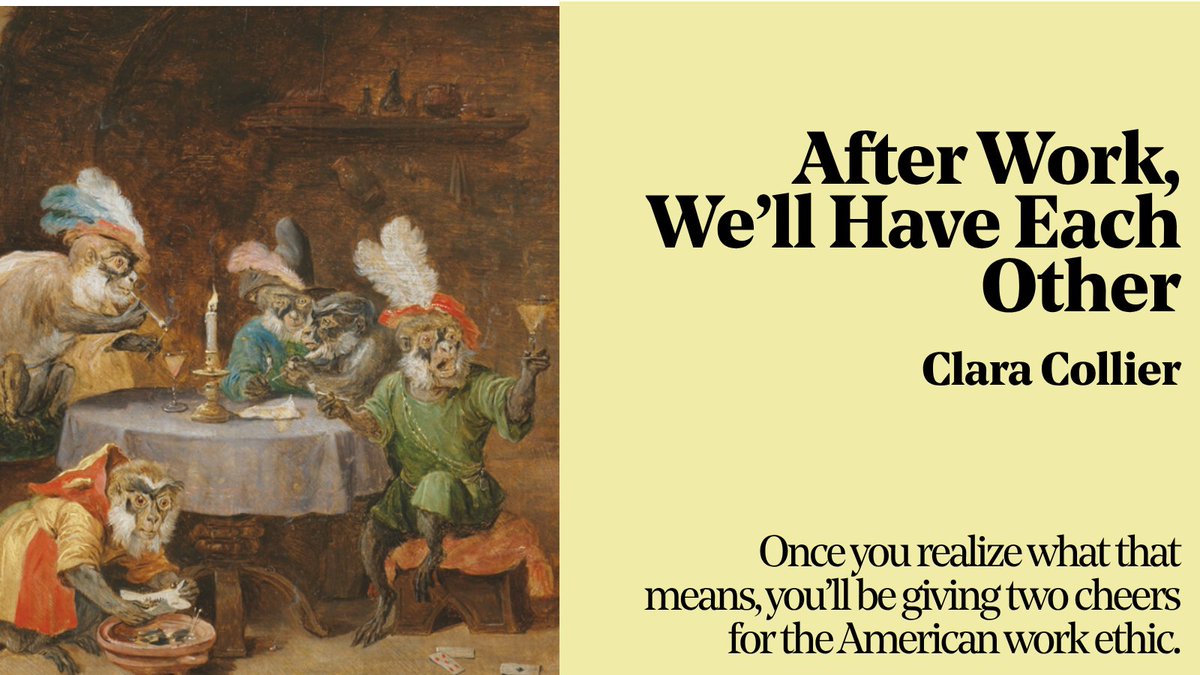
We already know what a world without work looks like. It's the life of 18th century aristocrats, who concerned themselves with political gossip and petty dramas; of society ladies in the 1980s, who spent their time hosting and volunteering; and Italian-Americans in 1950s Boston, whose status was centered around their peer groups, rather than their jobs.
Relational living comes to us naturally, but – argues @clarabcollier – work offers us dignity, structure, and meaning, as evinced by surveys that consistently find that about 85% of Americans are "somewhat" or "completely" satisfied by their jobs. Work gives us an escape from the cliquishness of relational societies: without it, our personal relationships might become even more stifling and transactional.
@arpitrage Great place to bike or run! I think Hanes Pt was built from dredging the tidal basin. It floods frequently. Tough to imagine building there without very major land reclamation first.
Wow!
Also great future of work examples: (a) human creativity & intuition + AI formalization, and (b) check the checkers.
Wiles proved the theorem 30 years ago. But it's hard to be sure in math. So much to check, and so few people who can check it. Now we can be pretty sure. Someone might still need to check Claude's work though...
Checking that a major mathematical proof is correct can take years. Formalization—converting the mathematical reasoning into a form computer proof assistants like Lean can verify—can help.
Last month, Claude completed the first formalized proof of Fermat’s Last Theorem, one of the most famous theorems of all time. This was a project experts thought would take many years. It is the largest Lean proof ever written.
Fermat’s Last Theorem was first proven in 1995 by Sir Andrew Wiles, more than 350 years after it was conjectured. Our proof, which totals over 13 million lines of code, provides machine verification. More importantly, it proves over 29,000 other theorems that the proof requires, across many areas of math which had never before been formalized.
We see this as a major step in the long process of firming up the core of mathematical knowledge, building on work from three centuries of mathematicians and hundreds of contributors to Lean and Mathlib. We are optimistic that AI-assisted verification of mathematical proofs will help reduce the burden of refereeing mathematics in an era where more proofs are being produced than ever before.
You can read about the process on our Science Blog: https://t.co/ryYnDEAU6J
And see the complete proof on GitHub: https://t.co/wlYMXYnofz