@Krakennn17 Most of the human data are associations, so it's partly a marker. But cold exposure that boosts brown fat activity has improved insulin sensitivity in people with type 2 diabetes, which suggests it does more than mark good health.
Adults still have brown fat, and the people who have more of it tend to be metabolically healthier. In a large scan study, people with detectable brown fat had lower odds of type 2 diabetes, coronary artery disease and heart failure, and their glucose, triglycerides and HDL looked better too. The link was strongest in people with overweight or obesity.
Brown fat burns energy to make heat, and regular cold exposure can increase its activity. I'd consider a cooler bedroom or brief cold exposure a reasonable habit, but it adds to good food and movement and won't replace them.
@TommyLindsey16 Not at all, I think these drugs can help a lot of people. Weight comes back after any diet when old habits return, which is why I'd use the time on the drug to build habits that last.
Stopping tirzepatide usually brings much of the weight back. In the trial that tested this, people who had lost about 21% of their body weight and then switched to placebo gained 14% back over the next year, while those who stayed on the drug kept losing.
The drug works well while a person takes it, but the appetite it controls returns when it stops. I think the time to build the habits that hold the weight, like eating fewer carbs and lifting to protect muscle, is while the drug is still working.
Anyone starting a GLP-1 should have a long-term plan with their doctor from the beginning.
A single big dose of sugar can impair how well a healthy person's arteries relax within just a couple of hours. In adults without diabetes, a standard glucose drink cut the arteries' ability to widen by more than 40% at the two-hour mark, and it took about four hours to recover.
One spike is temporary, but many people repeat it several times a day, every day. I think that pattern matters for heart health far more than most people realize, and keeping meals low in refined carbs is the simplest way to avoid it.
@Alexleaf Some protein is lost in the first days of a fast, and I've never said otherwise. My point is that the body works to limit it, and protein loss falls steadily as ketones rise.
@Alexleaf Growth hormone does both, and when it's blocked during a fast, muscle protein breakdown goes up. In the classic fasting work, protein loss is highest in the first few days and then falls as ketones take over as fuel for the brain.
@raecarson It was 14% of their body weight at the point they switched to placebo, so they regained a large share of what they had lost, though not all of it.
@kebie19 Honey is about 40% fructose, so I treat it like any other sugar. The main difference is that people tend to use far less of it than they drink in juice.
I agree, and how fast the fructose arrives matters as much as how much. In healthy, normal-weight adults, just three days of a fructose-rich diet, at the same calories as a glucose-rich one, raised bacterial endotoxin in the blood and nudged up a liver enzyme. Whole fruit with its fiber is a different situation, but juice is a fructose drink and I treat it that way.
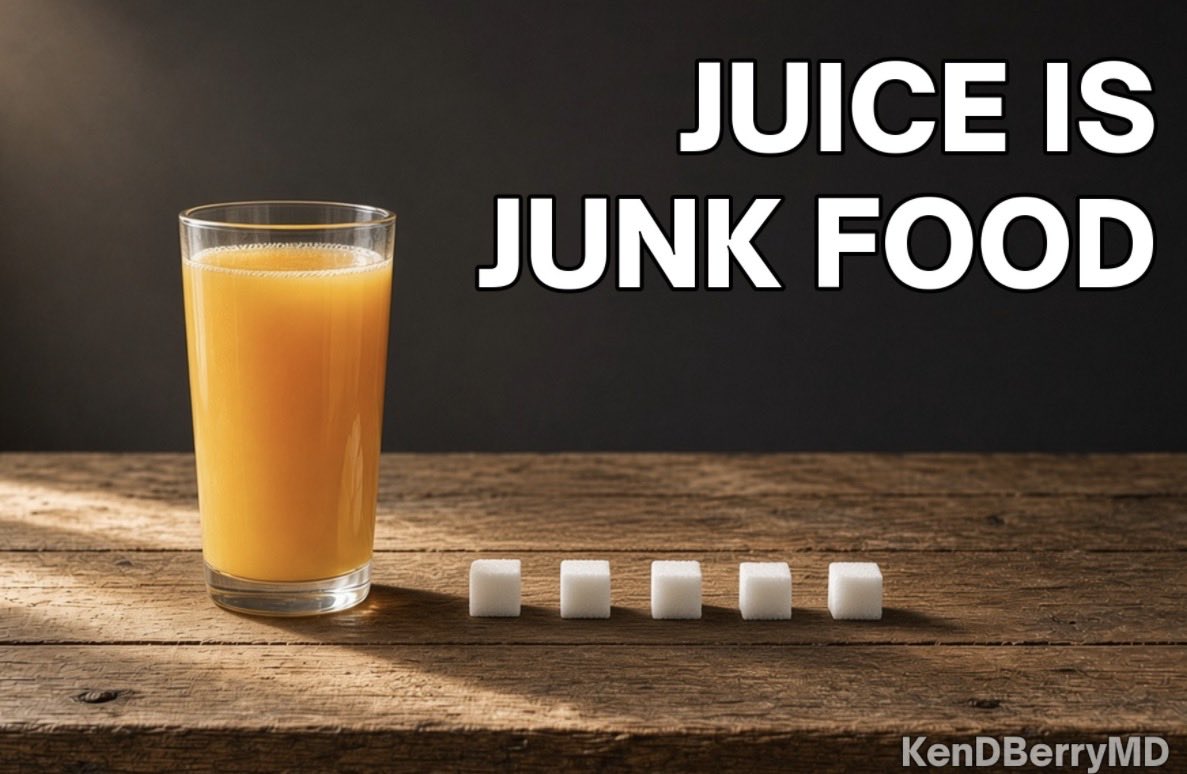
Orange juice is not a health food. It's sugar water with a good publicist.
One 8 oz glass = about 20 grams of sugar. That's 5 sugar cubes.
And about half of that is fructose, the same sugar we're blaming for the fatty liver epidemic in kids.
No fiber. No protein. No fat. Just sugar water with a pinch of vitamin C...
Eat an orange if you must. Better yet, eat some eggs.
Carbs are optional & not needed.
This is one of the more ironic facts in physiology. The heart gets most of its energy from burning fatty acids, and it readily uses ketones as well, so it's built to run well when insulin is low. In obesity and type 2 diabetes the heart gets flooded with more fuel than it can handle and loses its flexibility to switch between fat, glucose and ketones, and that loss of flexibility is a hallmark of insulin resistance, not of eating fat.
The heart runs on fat, and the organ they put on a low-fat diet is the one organ in the body that eats almost nothing else.
Every heartbeat is paid for, and the currency is fatty acids. They supply the bulk of the heart's energy, around the clock, from the day you are born.
Heart muscle is a third mitochondria by volume, more than any other muscle in the body, and mitochondria are where fat is burned.
A heart cell burns fat at rest, burns fat under load, and burns fat while you sleep.
Given a choice between glucose and fat, the heart takes the fat. Given ketones, it takes those more readily still, and gets more work out of every unit of oxygen.
A failing heart, when it starts to run out of road, switches more of its fuel to ketones. The sick heart reaches for the thing the diet sheet forbade.
The cardiologist's own ward uses that. Fasting patients, patients in ketosis, patients on fat, and the heart keeps time.
Then the same ward hands the patient a diet sheet with the fat cut off and the bread left on, in the name of the heart.
The organ they are protecting from fat is the one organ that was built to live on it.
Heart-healthy is a word for food the heart would not choose.
Retatrutide adds glucagon receptor agonism to GIP and GLP-1 agonism, and the main target is the liver. Glucagon increases energy expenditure and pushes the liver to burn fat and make ketones, and this lowers liver fat. In a phase 2 trial, people on the 12 mg dose lost 24.2% of body weight at 48 weeks, and liver fat fell by up to 86%.
I think this steady, low-level glucagon signal is very different from the larger rise in glucagon that happens with fasting, and in people with type 2 diabetes it didn't raise blood glucose, since HbA1c fell by up to 2%. I think this pairing is a promising way to treat fatty liver directly.
One short night of sleep is enough to make a healthy person insulin resistant the next day. After a single night of about four hours of sleep, healthy adults' insulin worked roughly 25% less effectively, and both the liver and muscle were affected.
This matters because many people sleep poorly and then lean on a carb-heavy breakfast to get through the morning. I'd make sleep a priority, and after a bad night I'd keep carbs especially low the next day.
High insulin is linked to Alzheimer's disease even in people who don't carry the main genetic risk gene. In older adults without diabetes and without APOE4, those with high fasting insulin had Alzheimer's at about five times the rate of those with normal insulin.
This study looked at one point in time, so it can't prove cause, but it fits a large body of work tying insulin resistance to the brain. I'd want anyone worried about dementia to ask for a fasting insulin test along with their glucose.
Two breakfasts with the same calories don't keep a person full for the same amount of time. In a randomized crossover study, overweight women ate either an egg breakfast or a bagel breakfast with identical calories and weight, and after the eggs they felt fuller and ate about 160 fewer calories at lunch without being told to eat less. Their intake stayed lower for the next 36 hours. A bagel is mostly fast carbohydrate, so insulin spikes and hunger returns sooner, but eggs bring protein and fat that keep a person satisfied, and that matters more than the calorie count.
@ken_trails No, the modest rise in stress hormones during a fast happens while insulin is low, which is very different from the chronically high epinephrine seen in these patients.
Stress hormones disrupt glucose metabolism and insulin function, and a new study shows it clearly. In 40 patients with adrenal tumors that pump out epinephrine and norepinephrine, fasting glucose and glucose throughout an oral glucose test were elevated, and the body's insulin response relative to its needs was impaired. Once the tumor was removed, glucose came down, HbA1c fell from 6.18% to 5.51% by six months, and insulin function improved.
This is an extreme example, but it's the same mechanism I describe when I say chronic stress is one of the drivers of insulin resistance, since everyday stress raises these same hormones.
@jeffreytee That points to oxidative stress as the cause. High-dose C and E right after training can blunt some of the insulin-sensitizing benefits of exercise, so taking them away from workouts makes more sense.
@purecity_life The metabolic cost shows up at very low intakes, not moderate ones. High insulin makes the kidneys hold on to sodium, so lowering insulin often helps blood pressure more than cutting salt to the bone.
Cutting salt as low as possible isn't free of metabolic cost. In a study of 152 healthy adults, each person spent a week on a very low-salt diet and a week on a high-salt diet in random order, and insulin resistance was higher after the low-salt week. Very low sodium switches on aldosterone and the sympathetic nervous system, and both make cells less responsive to insulin. Lowering salt does help some people's blood pressure, but a person eating mostly whole, unprocessed food doesn't need to fear the salt shaker.