1/ Excited to share my new blog post on Deep Reinforcement Learning and the Entity Neural Network (ENN) project! It's all about making RL easier to apply in complex simulated environments. Check it out: https://t.co/CpWIzNYZYM
We are excited to announce the start of ChemNLP, an open and collaborative community project aiming to explore the applications of large language models for chemistry! 🧪🚀
1/4
Last chance to register for the GRS on Biomass to Biobased Chemicals and Materials on May 27-28 in Newry, Main!
Are you are Ph.D. student: Come and discuss your ideas with your peers and seasoned veterans in the field.
Register a talk till 19.02!
https://t.co/maVQtGsYje
@JakeKramp So bio-based succinic acid has huge advantages compared to fossil-based adipic acid and some advantages compared to bio-based adipic acid.
However, this is all prospective, so the difference between bio-based succinic acid and bio-based adipic acid might be within uncertainty.
Do you also think the Life Cycle Assessment of #biobased processes can be a bit of a mess?
Maybe we can help with our new paper in @ACSSustainable:
"Sugar-to-What? An Environmental Merit Order Curve for Biobased Chemicals and Plastics"
https://t.co/kJVWB6FLIr
Reallocating feedstock currently used for bio-based ethanol production to other bio-based chemicals could reduce CO2 emissions by an additional 130 Mt/year, even if bio-based ethanol is replaced by fossil gasoline.
The results show there is a large difference in the reduction efficiency between processes and products. Some processes even have negative efficiency, i.e., increased carbon emissions!
Ethanol, the most produced bio-based chemical, is barely positive!
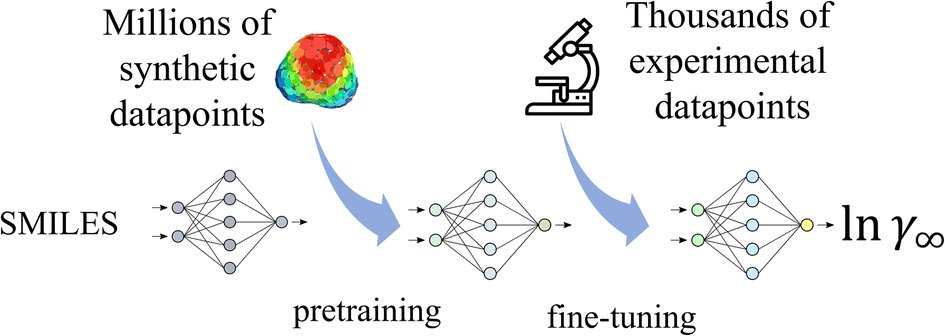
Did you know a SMILES is all you need to predict molecular properties? Check out how first-principle models combine with ML to achieve accurate predictions, in today's featured article from @benedikt_winter et al.:
https://t.co/bKwRYXYccp
@A_Aspuru_Guzik Thank you for sharing! Especially in generation task I agree with the advantages of SELFIES. I will also have a look into the effect of length towards prediction quality.
Excited about our new model SPT-NRTL to predict thermodynamically consistent molecular properties using physics-guided machine learning.
Do you ever struggle to get high-accuracy predictions for activity coefficients?
Check out our new pre-print: https://t.co/SrOjXLRVU5
1/8
And best of all, we calculated NRTL parameters for 100 000 000 mixtures for anyone to use! No code to download, no environments to set up!
https://t.co/N1WFATvIA2
Stay tuned for the full release of the code later.
8/8
SPT-NRTL is able to predict VLEs with high accuracy, even when the components are not part of the training set!
Here demonstrated for a water/ethanol mixture, where all ethanol mixtures were removed from the training data.
7/8