Really excited to be part of this amazing work! Huge congrats @danielgb_87 and company. Check out our new paper on cross species functional brain dynamics :)
Ever wondered if the *dynamic* organization of brain networks is conserved across mammals? We too!
Our latest work @NatureComm details what we found by comparing fMRI patterns in humans👨macaques 🐒 and mice🐁
https://t.co/c2vqkig6mH
Mini 🧵 @IITalk
1/🧵 Research on ADHD neurobiology has made leaps, yet remains elusive. Dive into our latest paper in @NatRevNeurosci as we examine progress, tackle past hurdles & explore emerging frameworks to unlock ADHD’s complex neurobiological underpinnings. https://t.co/rUj9serKKV
We often hear humans and macaques share 93% of the genome, and mice and humans 85%, and that we are more similar to flies than we think! But what about the brain? What are the dynamic rules that govern large-scale brain network dynamics?. 1/n
5⃣ In summary, our results show that the dynamic organization of fMRI networks in the mammalian brain is evolutionarily conserved!
Kudos & congrats to mighty @danielgb_87, super⭐️ coauthors @TingsterX, @benediktramirez#stefano_panzeri & many thanks to @ERC_Research for funding!
4⃣ Finally, we found that C-Mode occurrence rates "explain" many features of the steady-state organization of the fMRI connectome, including the organization and ranking of fMRI connectivity gradients
2⃣ Using this approach, we found that fMRI network dynamics in humans, awake macaques and mice is characterized by a transition between 4 dominant, neuroanatomically-homologous C-modes
1⃣ Here, we propose a (very) simple formalism where spatially-opposing coactivation patterns (CAPs) are coalesced into spatiotemporal coactivation Modes (C-Modes).
The resulting dimensionality reduction was key to our ability to compare the fMRI dynamics across species!
We previously shared a detailed "tweetorial" on our work (are they still called that🤔on X?) ⤵️
https://t.co/lNxz53ZqXF
Below is a quick refresher in case you're in a rush!
⬇️⬇️⬇️⬇️
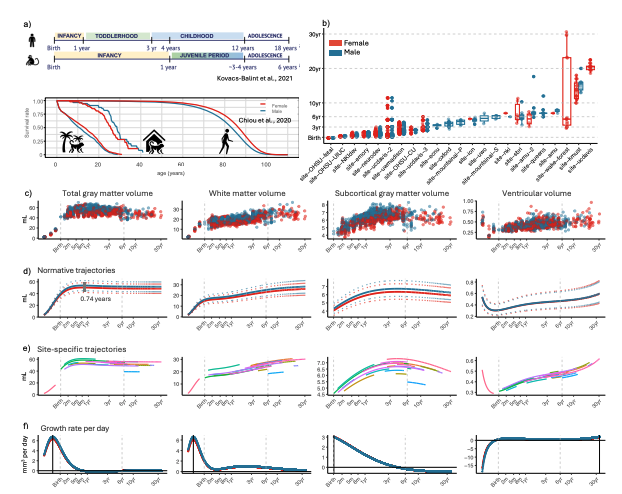
Curious about human brain development through an animal model? 🧠🐒Check out our new preprint on Brain Charts of the Rhesus Macaque Lifespan! We've mapped normative trajectories for macaque brains using 1.5k MRI scans from PRIME-DE and collaborators! https://t.co/qAREofrEpz
Can lifespan brain charts from rhesus macaques inform our understanding of neurodevelopment across species? A new preprint by @TingsterX et al. presents detailed MRI-based normative trajectories for brain structure, based on 1,522 scans. Check it out here: https://t.co/bOJqbG5SYb
Now available open-access online @npp_journal !
Our review "Psychiatric neuroimaging designs for individualised, cohort, and population studies"
https://t.co/kPbE7iTKJQ
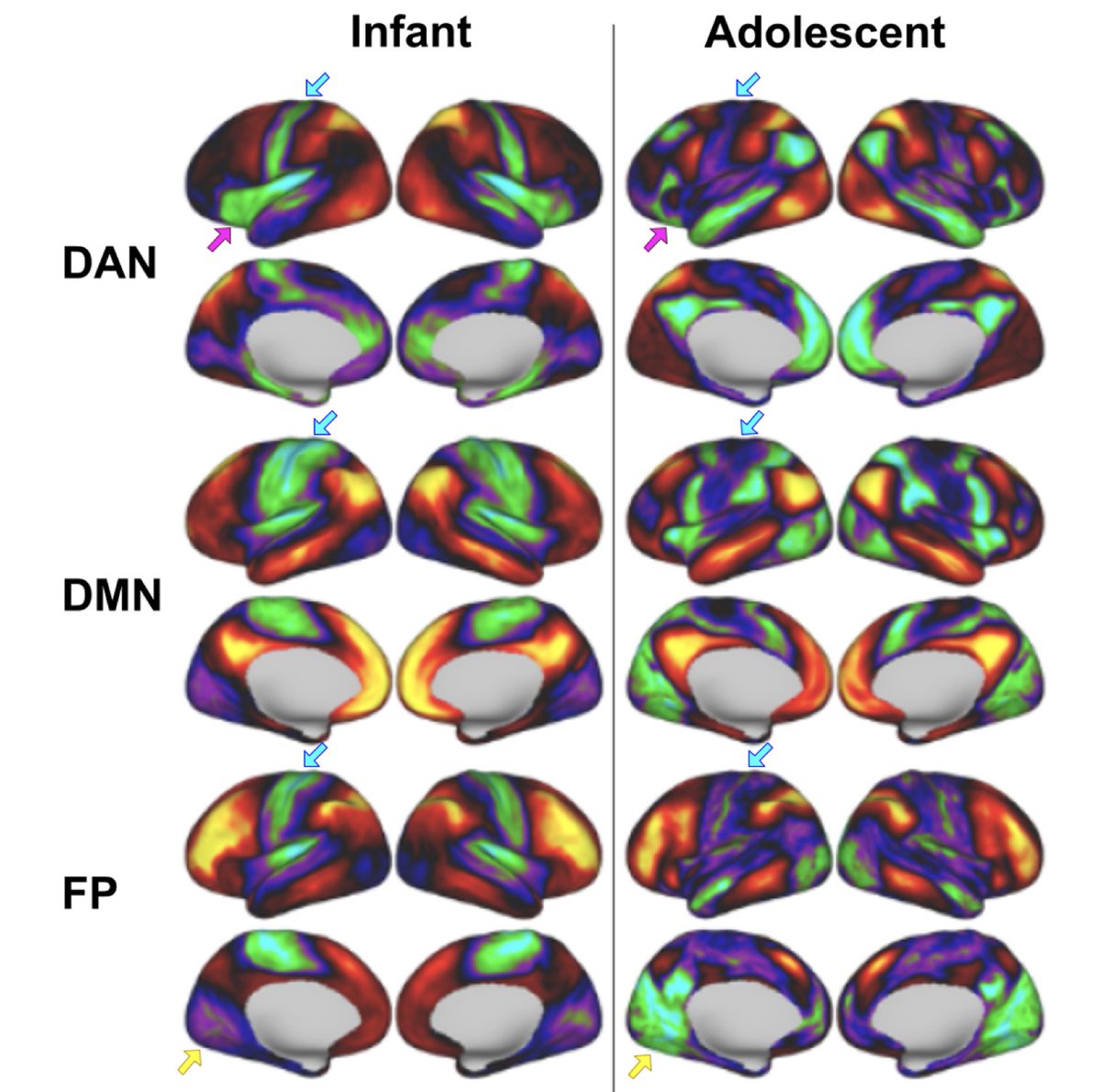
New paper in Imaging Neuroscience by Lucille A. Moore, Alice M. Graham, et al:
Towards personalized precision functional mapping in infancy
https://t.co/AFDG5W5eUG
📢New preprint! 📢
w/ @martin_gell , @sNeuroble, Tim Laumann, @stevenmnelson
Check out our overview and perspective:
“Psychiatric Neuroimaging Designs for Individualised, Cohort, and Population Studies”
https://t.co/5JPRkPO0pr
🧵