@timrpeterson I’m most excited about the antidote & drug delivery applications, but de novo prot-lig interactions are understudied relative to other binder design apps. and we’re just scratching the surface of what’s possible. Hoping this work enables more interest and ideas in the field!
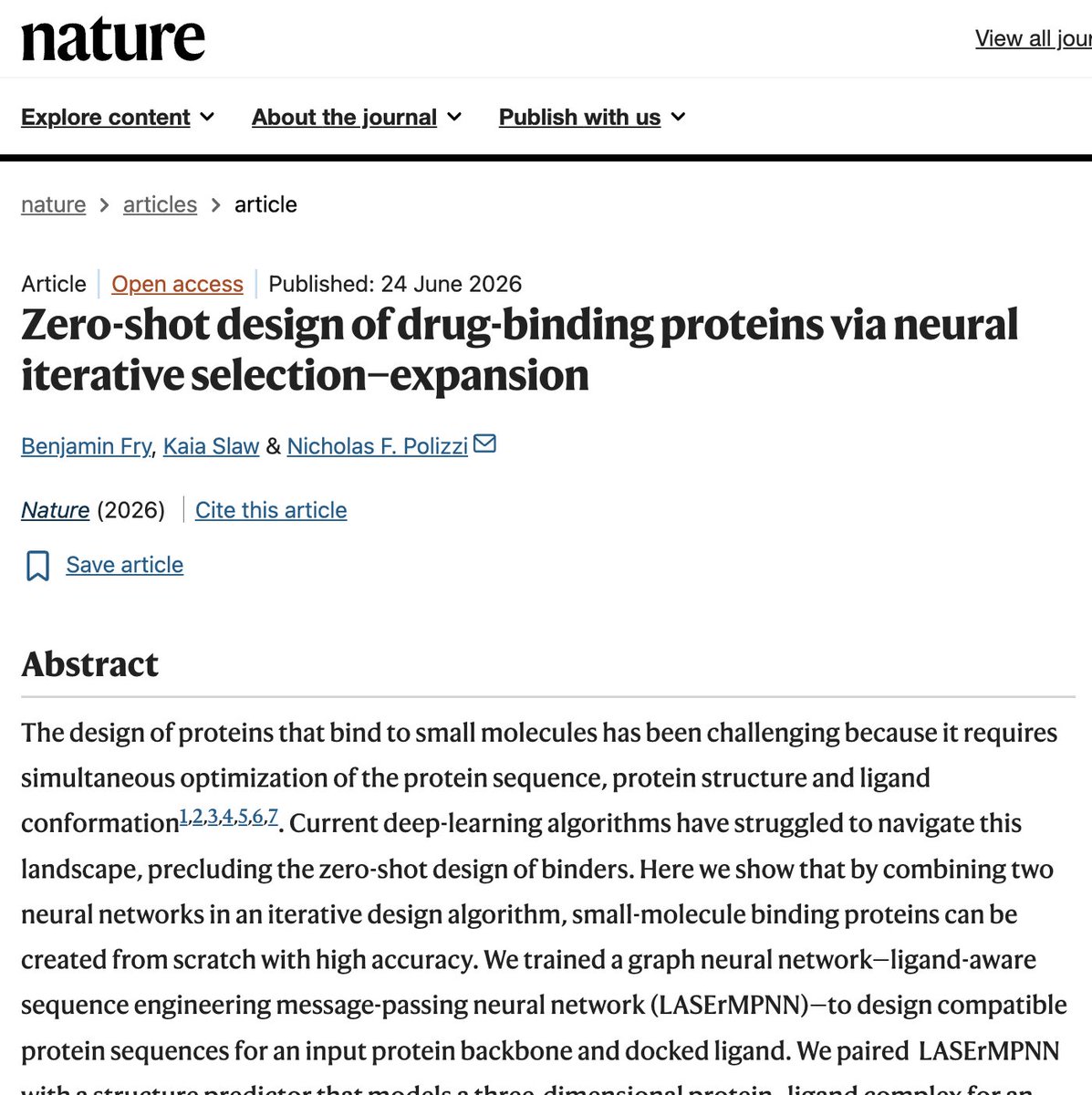
My first-author paper describing our protocol for the zero-shot de novo design of drug-binding proteins is now available as an article in Nature! Here’s what we did and what's new from the preprint posted last year 🧵 (1/10):
Zero-shot design of drug-binding proteins via neural iterative selection−expansion
1. The work introduces NISE (neural iterative selection–expansion), a closed-loop algorithm that jointly optimizes protein sequence, protein structure, and ligand conformation—enabling true zero-shot design of small-molecule binders where prior deep-learning approaches struggled.
2. NISE alternates between two reciprocal neural conditionals: LASErMPNN samples sequences conditioned on a protein–ligand co-structure, and a co-structure predictor (RoseTTAFold-All Atom or Boltz-2) predicts the 3D protein–ligand complex from sequence + ligand identity; designs are selected by tripartite self-consistency (backbone and ligand r.m.s.d.) plus ligand confidence.
3. A key conceptual shift is treating “self-consistency” as protein–ligand self-consistency (not just foldability): many sequences can be backbone self-consistent, but far fewer place the ligand in the intended orientation; ligand self-consistency becomes a stringent computational screen for productive binding.
4. LASErMPNN is a ligand-aware heterograph message-passing model trained on PDB co-crystal structures to decode both amino-acid identity and side-chain dihedrals; it includes a pretrained ligand encoder trained on quantum-derived atom properties (for example partial charges), improving generalization to new ligands and reducing design pathologies like overpacking.
5. On exatecan (a camptothecin payload with a hydrolysis-prone lactone), NISE redesigned a four-helix bundle binder from scratch starting only from backbone + docked ligand coordinates; all 4 experimentally tested NISE designs bound exatecan (100% hit rate), with the best binder EPIC at Kd = 120 nM.
6. Against a traditional COMBS + Rosetta pipeline (16 tested designs), only 3 bound exatecan and the best was ~70-fold weaker than EPIC; analysis suggests NISE’s advantage comes from iterative “resculpting” of backbone/packing and ligand placement, not just filtering with a structure predictor.
7. The authors then perform purely in silico affinity maturation (“neural proofreading”): LASErMPNN proposes single-site substitutions that reduce sequence NLL in the bound context; two substitutions (Q51N and M97L) each improve affinity >10×, and the double mutant improves EPIC ~100× to Kd = 1.2 nM without experimental feedback.
8. X-ray structures of EPIC (2.0 Å) and EPIC(Q51N) (2.2 Å) validate the designed binding mode and explain the affinity gain: Asn51 enables deeper burial and bidentate H-bonding to the hydroxyl and lactone carbonyl, with only ~sub-Å deviations from intended placement in the pocket core.
9. Functionally, EPIC variants protect exatecan’s lactone from hydrolysis: EPIC(Q51N/M97L) keeps >99% of exatecan in the ring-closed (bioactive) form for at least 50 hours in PBS pH 7.4, and protection persists even with high human serum albumin present—supporting drug-stabilizing delivery/sponge applications.
10. Generality is shown on apixaban using NTF2 scaffolds and Boltz-2 within NISE: 5 of 6 tested designs bound tightly (83% success), with the best (APEX) reaching Kd = 80 pM—nearly 10,000-fold tighter than prior LigandMPNN/Rosetta apixaban binder design reports on the same backbone family, and approaching the native target factor Xa affinity.
💻Code: https://t.co/zqGJmTiIS9 ; https://t.co/pcPGDfP3Bg ; https://t.co/1zAPZkTNfd
📜Paper: https://t.co/q5T9uFleCa
#ProteinDesign #ComputationalBiology #DeepLearning #StructuralBiology #DrugDiscovery #GenerativeModels #ProteinLigand #DeNovoDesign #GNN #Boltz2 #RoseTTAFoldAllAtom
@ozalabCP …for your lig you can encode that in the filters/score term to optimize for that. Check out the paper SI to see the full pipeline for the apx binder design. I can also suggest things to add to the score term that can resolve certain issues I’ve seen (underpacking/no HBs) (2/2)
@ozalabCP The initial pose does constrain the solutions for each type of ligand. Some ligands also just won’t fit well in 4hb / ntf2 scaffolds in which case you might want to use RFD3 to generate starting scaffolds to optimize with NISE. If you have a sense of what is sensical… (1/2)
Closing the design loop: two coupled neural networks for zero-shot small-molecule binder design
Protein structure prediction has gotten very good, but design is a different problem. Predicting how a known sequence folds is one thing, inventing a brand-new protein that grips a specific small molecule tightly is much harder, because you have to optimize three coupled things at once: the amino-acid sequence, the backbone it folds into, and the conformation of the ligand in the pocket. Change one and the other two shift. Deep-learning methods that crushed folding have mostly stumbled here, which is why most successful drug-binding proteins still come from slow experimental screening.
Benjamin Fry and coauthors close this loop with NISE (neural iterative selection-expansion). The idea is to pair two neural networks that solve reciprocal halves of the problem and let them refine each other. One, a graph neural network they call LASErMPNN, proposes many candidate sequences for a given backbone and docked ligand. The other, a structure predictor like RFAA or Boltz-2, folds each candidate and predicts where the ligand actually ends up. Designs that agree with themselves across both networks (low r.m.s.d. on backbone and ligand) get selected and expanded in the next round. No physics-based energy function is involved. The system climbs toward a high-probability mode of the joint sequence-structure-ligand distribution learned from the Protein Data Bank. When they swapped the neural predictor for a Rosetta energy function, the loop simply failed to optimize.
The results are hard to argue with. On the anticancer drug exatecan, all four tested designs bound it, the tightest about 70-fold better than the leading prior method. For the anticoagulant apixaban, NISE hit an 83% success rate using the same starting scaffolds a previous method had used, and its best binder reached 80 pM affinity, roughly 10,000-fold tighter and rivaling its natural target at a third the size. The same network then "proofread" its own design, suggesting two mutations that improved affinity 100-fold with no experimental input.
The practical signal is that bespoke small-molecule binders are becoming a design problem rather than a screening problem, and a fast one: a typical run takes about five hours on four GPUs. In drug delivery, biosensing, antidote development, and diagnostics, that means custom proteins to sequester, stabilize, or detect a specific compound can be generated on demand and matured in silico, compressing timelines that once needed large wet-lab campaigns.
Paper: Fry et al., Nature (2026), CC BY 4.0 | https://t.co/6RStmDauFr
A nice (or should I say NISE?) article written about our work by Derek Lowe!
Looking forward to sharing results on the diverse compounds we've applied our method to bind that didn't make it into this paper, but will be published in the coming months.
https://t.co/QXNHFJjfMB
@GregPreibisch Thanks! I think handling the two separately keeps us on the manifold of natural-like sequence and structure. Trying to do both simultaneously / backprop methods go into unrealistic sequence or fold space at the moment. Picking known ligand-binding scaffolds helps us atm as well.
@GregPreibisch@sokrypton The full protocol is in the SI for the apx binders and I didn’t mention it in the thread but after the ranking by hbonding I refolded the top 250 designs with AF2 and RF3 and filtered again for self consistency to make sure we weren’t overfitting to Boltz!
(10/10) Links Below:
Link to Paper📜 (Open Access): https://t.co/hBH7K8XOsf
Link to Code 🤖 (MIT License): https://t.co/TMQ05CPwyX
Personal Website 🧔♂️ (Interactive Visualization): https://t.co/JlO9OpMaz4
(9/10) All of the LASErMPNN & NISE code is open-source under an MIT license. Shoutout to Kaia Slaw my co-author and the awesome RA who did all of the experimental validation for this work. Check out my personal website for an interactive visualization of the binders we designed.