The French hate air conditioning.
So Paris built a 120-kilometre machine under its streets for producing cold.
It’s called Fraîcheur de Paris, and it does for summer heat what district heating did for winter: centralise the problem.
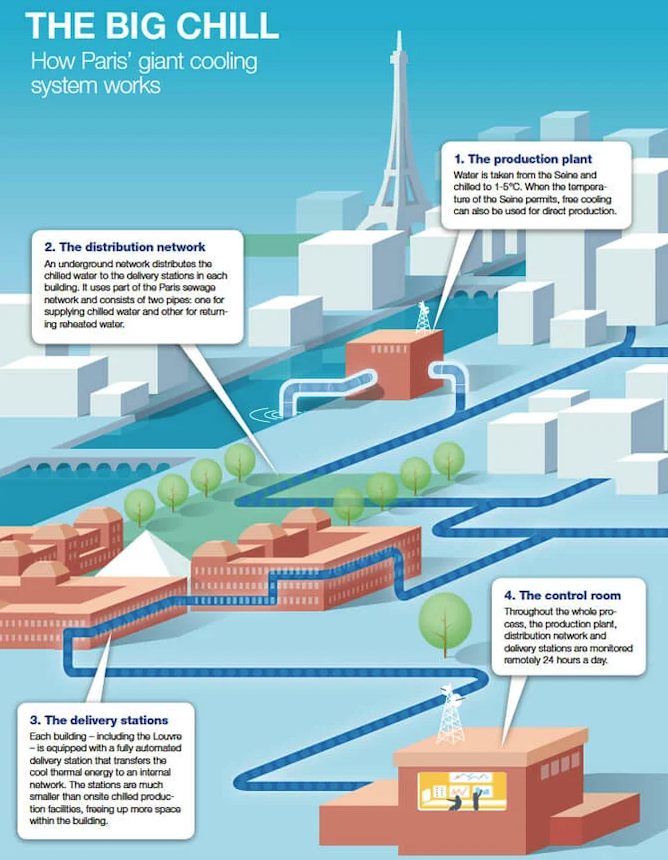
Instead of every museum, office, hotel, hospital and shop bolting its own cooling plant onto the building, Paris moves cold through pipes.
The network sends water chilled to 2 to 4°C through buried supply lines. The water enters a connected building, absorbs heat through an exchange station, then returns at 12 to 14°C to be cooled again.
It essentially functions with two pipes. One carries the cold out, the other carries heat back.
The production plants cool the circuit from 12°C to 4°C. Some sites use the Seine as a heat sink. In colder periods, the system can use the river’s own temperature for free cooling, which means the machines work less and the electricity demand drops. The Seine water doesn’t become the building water. It stays separate, passing temperature across heat exchangers.
The scale is pretty strange when you see it written down though.
It's got 15 production sites, 4 storage sites, 120 km of underground network with 924 subscribers. This has resulted in 7 million square metres cooled, and 493 GWh of cooling sold.
A cold utility running beneath one of the densest cities in Europe.
The Forum des Halles has been cooled this way since 1979. The Louvre since 1986. Galeries Lafayette, Opéra Garnier, Hôtel de Ville, Station F, La Samaritaine and the National Assembly all sit on the same idea. Tourists stand in the Louvre looking at paintings while a municipal cold loop does part of the dull work below ground.
The boring part is the breakthrough.
Cold can be stored at night in chilled water or ice, then used during daytime peaks. The network is monitored from a control room with more than 125,000 control points. A delivery station inside a building takes 5 to 7 times less space than a standalone cooling installation and avoids the roof and façade clutter that turns cities into compressor farms.
That matters because conventional air conditioning solves heat by moving it somewhere nearby. In a dense city, thousands of private machines mean thousands of outdoor units rejecting heat into streets, courtyards and roofs, plus refrigerants, noise, vibration and maintenance spread across every building.
Paris’s public cooling network has a stated coefficient of performance of 4, against 3 for a wet standalone system and 2 for a dry standalone system. Against an equivalent set of autonomous installations, Fraîcheur de Paris says the network gives 100% higher energy efficiency, 35% less electricity use, 90% fewer refrigerant-fluid emissions and 50% lower CO2 emissions.
The climate backdrop is the real reason this exists.
Paris ran a full crisis exercise called “Paris at 50°C” in 2023. Météo-France’s 2050 reference trajectory for France points to heatwave days becoming five times more frequent, hot nights rising sharply in urban centres, and some local extremes around 48°C becoming possible.
The city signed a 20-year concession in 2022 with Fraîcheur de Paris, owned 85% by ENGIE and 15% by RATP. The contract is worth a projected €2.4 billion. The plan is to extend the network by 158 km by 2042, add 20 production plants and 10 storage sites, and reach more than 3,000 subscribers, including hospitals, nurseries, schools and care homes.
This is basically the infrastructure version of admitting that summer is becoming a public systems problem...
@jasonc_nc Americans "move" to Europe because they get the massive benefits of the 50% tax state: cheap food, walkable urbanism, low crime, while paying no tax and competing for space with euros making 20-40k
@Andercot@johnkonrad we were never good at shipbuilding: the leader went from the UK to Japan to China. Brian Potter has a great article on it here https://t.co/epcY1KBOX3
@benghunt@JoeSagues I primarily worked on collection and logistics. Once you had the farmers on board, it was pretty basic; bale, store, deliver. We spent a lot of time learning how to reduce in field dry matter loss as much as possible. But going in to the plant is where it got hard.
@RizomaSchool coming up with fun new techniques that future people could use is cool and politically very safe, but won't change the temperature or keep it from going up.
@tszzl current scale: reduce child mortality, increase vaccination rate. future scale: control global thermostat, satellite camera justice system, AGI Leviathan
@danmiller999@25_cycle this references the archer (2009) paper where they admit that most of the carbon equilibrates into the much larger ocean (~centuries) but suggest that some fraction only equilibrates through rock weathering (10^5 yrs).
@Jordan_W_Taylor gas is a capex commodity: if you plug into the permian with a LNG setup they will pay you to take the gas so they can pull up the oil. the world can have as much gas as it wants, and most of it continues to be burned at the source for no value whatsoever