Bittersweet life update: First the sweet, I'm excited to announce I'll be joining @Square as a UX researcher. I'll be part of a small team doing research to help discover new features and services we can provide to small businesses.
it's up! A VBW exclusive report - @yorl joins @peez and @tamler to talk about his experience applying to UCLA only to have his candidacy pulled at the last minute because of remarks made on his podcast(!) about diversity statements. Plus more fraud https://t.co/CV2fZpEooN
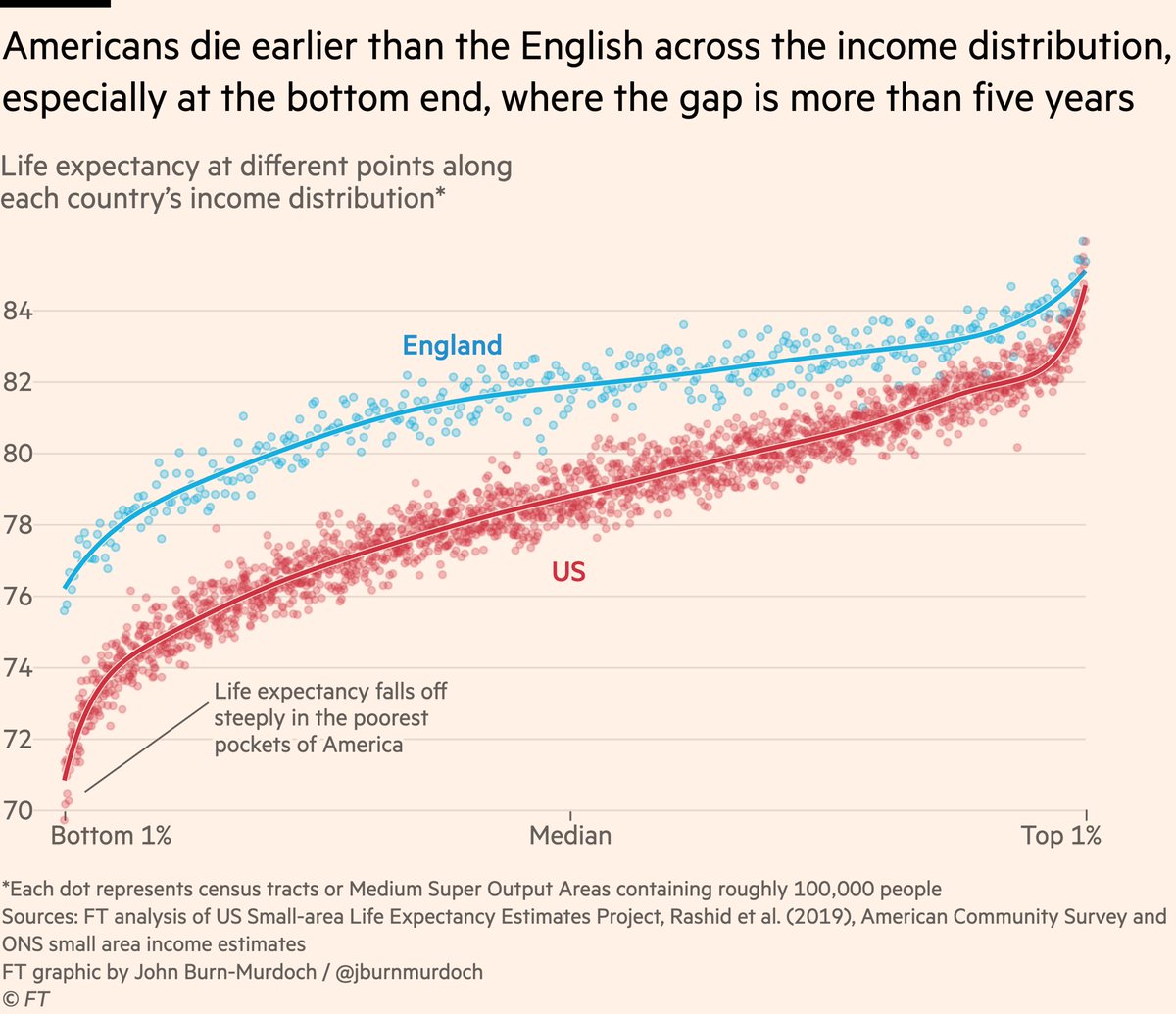
NEW: I’m not sure people fully appreciate how dire the US life expectancy / mortality situation has got.
My column: https://t.co/dBIhT9eZLv
And some utterly damning charts.
1) at *every* point on the income distribution, Americans live shorter lives than the English.
Dopamine might play a more complex role than was previously assumed when it comes to learning and reward association.
Find out how @benjamin_seitz@MelissaJSharpe and colleagues from @UCLA figured this out 👇
https://t.co/CHUDwTpBHO
Very excited to have one of our dopamine projects out in @CurrentBiology this week! Led by @benjamin_seitz, with @ivybhoang, Lauren DiFazio, and @AaronBlaisdell. We show dopamine neurons are necessary for the excitatory and inhibitory components of backward conditioning!
Check out our dispatch written with @mike_kendig on @MelissaJSharpe’s excellent Current Biology paper showing that dopamine encodes specific inhibitory backwards associations: https://t.co/xsXFsxEq5p
Thrilled to share data from this project with @ivybhoang, @AaronBlaisdell, @MelissaJSharpe. "Learning in reverse: Dopamine errors drive excitatory and inhibitory components of backward conditioning in an outcome-specific manner". https://t.co/jYAJ4DxydA
but that doesn't mean there's a real effect here. And that's the point. We need to seriously consider how much emphasis to place on individual effects, especially those with few stimuli, and ask whether the effect would generalize more broadly using other stimuli.
Excited to share this work: "The perils of small stimulus sets: How stimulus selection affects generalizability" now on @PsyArXiv with @AaronBlaisdell @JosieEquita @DiSH_Lab. https://t.co/QU5brbNPbH. Here we provide a powerful case study on how stimuli can influence outcomes
This is not specific to memory studies either, lots of studies in psychology use a small handful of stimuli and worse, when we think about replication we place strong emphasis on using the same stimuli. So if someone replicates our v6 they'll probably get the same result as us...
As always, i am so grateful to mentors and friends who have gotten me this far and the droves of people who gave me their time over the past 6 months to help me make this decision.
Bittersweet life update: First the sweet, I'm excited to announce I'll be joining @Square as a UX researcher. I'll be part of a small team doing research to help discover new features and services we can provide to small businesses.
I love bouncing around different topics and projects and think a career in tech is much better suited for that. I could be wrong, and i might find myself back on a campus someday, but for now i'm incredibly excited to start this next chapter in my career.