🚨 3 days ago I told you to save yourself the July 1 unlock panic. Said screenshot it we'd check on the 1st.
The unlock hit: 13.7M $SUI, 0.14% of supply. Non-event, exactly as called.
The tell: this week the alt market's down ~2%, peer L1s down ~5% and SUI is flat-to-green. The one day everyone braced for a dump, it outperformed a red tape.
A scary headline "TOKENS UNLOCKING" and a number that actually moves price are two different things. Sizing is the whole skill. 0.14% was never going to be the story.
Data precision over ego. Onto the next.
Everyone's about to blame July 1 for $SUI's next red candle. Save yourself the panic.
The unlock: 13.7M SUI. $9.4M, 0.14% of total supply.
For scale: SUI trades $400M a day. This unlock is ~2% of a single day's volume. The market clears that before lunch.
I flagged supply as a real bear case two days ago and it is, structurally, over years. But a 0.14% drip is not a cliff. Conflating the two is how people fade decent setups for the wrong reason.
Where it lands:
Community Reserve - 4M
Early Contributors - 7.65M
Mysten Treasury - 2.07M
The only bucket to watch is Early Contributors. Insiders, not ecosystem funds. 7.65M, $5.25M, still noise at this volume.
So if SUI dumps July 1, it won't be the unlock. It'll be the same thing dragging the whole alt market.
Screenshot this. We'll check on the 1st.
Hashi goes live on $SUI this week.
Your timeline: "$500M for Bitcoin DeFi!"
Read the word they keep skipping. $500M committed is not $500M deposited. It's a coalition of 20+ firms BitGo, Anchorage, FalconX pledging to supply capital as their integrations go live.
So here's the only number that matters, and I'll be tracking it:
how much of the $500M actually shows up as live hBTC collateral in the first 30 days. And how much stays after the launch posts stop.
A commitment is a press release. A deposit is a vote. Watch the deposits.
Even Sui's own partners' coverage says it plainly: no on-chain record shows $500M locked. It's an IOU, not a TVL number.
I'm not saying it won't come. Some of it probably will. But "pledged" and "deposited" are the same gap I've been pointing at all along.
A tiny reserve throwing off a tiny yield buying a tiny slice. For this to matter, USDsui has to become enormous.
So the bull case finally has a mechanism. But "there's a flywheel" and "the flywheel is big enough to matter" are different sentences and only the first one is true.
For two months I asked one question about $SUI:
Who actually pays the chain?
This week they answered it. Nobody.
The foundation is now buying back SUI with yield from its own stablecoin, USDsui. Everyone's posting it as the bullish flywheel.
Here's the scale they left out:
Buybacks so far: $646,000.
Market cap: $4.16 billion.
That's the monetization engine. Also 0.015% of the thing is supposed to support.
And it's capped by design. The buybacks come from yield on USDsui which is $77M in supply.
$SUI's Mysten Labs just swapped CEOs and everyone scrolled past it.
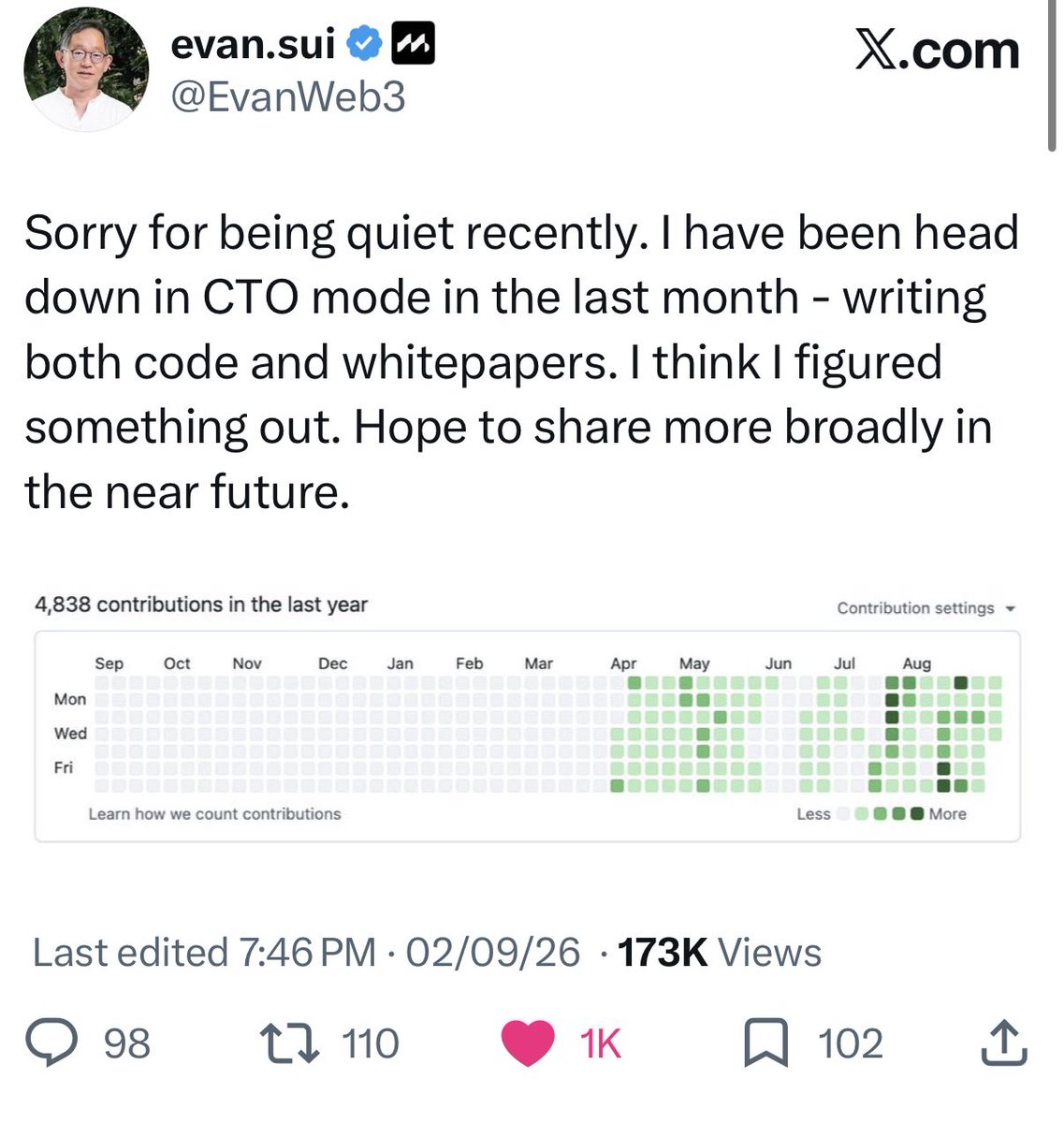
@EvanWeb3, the founder, stepped down as CEO to run a new AI unit building agent infrastructure for Sui.
Read that again. The guy who built the chain is handing off the chain to go chase the agentic-AI bet.
I lean toward it being honest signaling. They’ve basically admitted where the next chapter has to come from and it isn’t fees on stablecoin transfers. It’s whatever that AI unit ships.
So the whole thesis now rests on one bet by one person, what the AI unit actually produces.
Two ways to read it.
Conviction: the founder sees agents as so big he wants to build it with his own hands.
Or a tell: the core product is mature enough to delegate, and the real growth story now lives in a side unit, not the L1 itself.
$Sui's biggest DEX by TVL is Cetus: $30M locked, $470M monthly volume. Its 30-day fees are keeping LPs in.
But look at DeepBook. $12M TVL. And it's doing $290M a month in volume on it. DeepBook is turning over its liquidity 2x harder than Cetus and nobody's watching.
because the order book doesn't show up in the "TVL leaderboard" everyone ranks by.
TVL tells you who parked money. Volume-to-TVL tells you whose money actually works.
On Sui, that's quietly flipping toward the order book.
ETF flows aren't the whole demand side, sure. But when your loudest bull stat can't outrun your own dilution, is the thing keeping the floor from falling out.
Watch the ratio, not the streak.
Everyone is posting the same $SUI stat today: five straight weeks of ETF inflows while $BTC and $ETH funds bleed. Institutions stacking SUI, bullish.
Nobody put a number next to it, so I will.
Five weeks of inflows is 14M SUI bought.
SUI unlocked over those same five weeks.
The institutional bid everyone is celebrating is getting outprinted almost 2 to 1 by the token's own unlock schedule.
That's real demand showing up and still losing to the faucet which is exactly why the inflows headline and a sub-$1 print landed on the same day.
$SUI did a 70% run and I want to point at the one number that didn't move with it.
New all-time hype: TPS records, Samsung, Hashi, a conference in Singapore. Price went from 72 cents to $1.20.
Chain fees over that same stretch?
Think about how strange that is. The network had the best month of its life and earned almost nothing extra for it.
Every catalyst was an announcement.
That's not a dip to buy or a top to short. It's a tell. This run was paid for by belief.
Now it's back to $1.05 and cooling.