Will stablecoins disrupt traditional banking or create new opportunities for financial institutions?
Instant cross-border payments, tokenized deposits, programmable money and autonomous AI agents are opening a new chapter in the history of finance.
Banks have a choice: risk being disintermediated or become key players in the emerging tokenized economy.
But this transformation requires specialized technological expertise.
At @GoodHive_io, we help banks and financial institutions find the Web3 and blockchain talent they need to navigate this transition and build the next generation of financial infrastructure.
Technology is only part of the equation. Finding the right talent is essential to turning ambition into reality.
On December 3, I will co-moderate an ESSEC Alumni conference with Muriel Faure, bringing together speakers from Banque de France, Circle, Incomlend and De Gaulle Fleurance to discuss the future of money.
Will banks be the winners or the losers of this monetary revolution?
📅 December 3, 2026 | 6:30 PM (Paris time)
📍 Epitech, Paris & online
🎙️ Conference held in French
Register here:
https://t.co/C0vRHnBsLz
#Banking #Stablecoins #Tokenization #Web3 #GoodHive #FutureOfFinance
Et si les Européens finissaient par payer en dollars sans même quitter l'Europe ?
Près de 99 % de la capitalisation mondiale des stablecoins est aujourd'hui libellée en dollars.
Alors que l'Europe multiplie les discours sur sa souveraineté, une nouvelle infrastructure financière mondiale se construit essentiellement autour de la monnaie américaine.
Et ce n'est probablement que le début.
Paiements internationaux, commerce transfrontalier, tokenisation des actifs financiers et, demain, transactions autonomes entre agents d'intelligence artificielle : les stablecoins pourraient devenir une infrastructure essentielle de l'économie mondiale.
Dans quelle monnaie ces transactions seront-elles réalisées ?
Assistons-nous à une dollarisation silencieuse de l'économie numérique européenne ?
L'Europe est-elle en train de perdre une bataille monétaire avant même d'avoir commencé à la livrer ?
Nous en débattrons le 3 décembre lors de notre conférence ESSEC Alumni :
Stablecoins : vers un nouveau système monétaire mondial ? Qui contrôlera la monnaie de demain ?
Avec quatre intervenants aux perspectives complémentaires :
• Audrey Metzger, Banque de France
• Coralie Billmann, Circle
• Morgan Terigi, Incomlend
• Anne Maréchal, De Gaulle Fleurance
J'aurai le plaisir de coanimer ce débat avec Muriel Faure.
📅 Jeudi 3 décembre à 18h30
📍 Epitech, Paris 15e, et en ligne
🥂 Cocktail dînatoire à l'issue de la conférence
Inscription obligatoire :
https://t.co/C0vRHnBsLz
#Stablecoins #Web3 #Finance #AI #Souveraineté
Et si la prochaine bataille pour la domination monétaire se jouait sur la blockchain ?
Les stablecoins ne sont plus seulement des instruments de l'écosystème crypto. Ils deviennent progressivement des infrastructures de paiement, de financement du commerce international et de circulation des actifs tokenisés.
Mais derrière cette évolution technologique se joue une question bien plus fondamentale : qui contrôlera la monnaie de demain ?
Les banques centrales ? Les banques commerciales ? Les émetteurs privés ? Les protocoles décentralisés ?
Et surtout, les stablecoins vont-ils renforcer la domination du dollar ou offrir une nouvelle chance à l'euro ?
C'est le débat que nous organiserons le 3 décembre à Paris, avec les clubs Digital & Technology et Finance Banque Assurance d'ESSEC Alumni.
Quatre regards complémentaires :
• Audrey Metzger (@banquedefrance) : souveraineté et infrastructures monétaires.
• Coralie Billmann (@circle) : émission et développement des stablecoins.
• @MorganTerigi (@incomlend ) : paiements internationaux et financement du commerce.
• Anne Maréchal (@dgfla_group De Gaulle Fleurance) : réglementation et enjeux juridiques.
Une discussion que j'aurai le plaisir de coanimer avec Muriel Faure (AFG).
📅 3 décembre 2026, 18h30
📍 Epitech, Paris 15e
🥂 Cocktail dînatoire après la conférence
Inscription obligatoire : https://t.co/C0vRHnC0B7
#Stablecoins #Blockchain #Finance #ESSECAlumni
The battle for the future of financial infrastructure is taking shape.
On November 3, SEC staff issued a no-action letter concerning Canton Coin, the native token of @CantonNetwork.
Beyond the regulatory development, the announcement highlights a broader shift: several competing infrastructures are positioning themselves to become the backbone of tokenized finance.
Canton is focusing on institutional capital markets, with privacy and interoperability at its core.
Circle's Arc, Stripe-backed Tempo, Ripple's XRP Ledger and Stellar are targeting different parts of the payments and digital asset markets.
Meanwhile, Ethereum and Solana continue to attract financial institutions, while banks such as JPMorgan are developing their own infrastructure through initiatives like Kinexys.
These players don't all compete on the same ground. But their ambitions increasingly overlap.
The stakes go well beyond transaction costs or processing speed.
They involve liquidity, access to financial institutions, regulatory compliance and, ultimately, control over the infrastructure on which financial assets will circulate.
One thing remains uncertain: will a few dominant networks emerge, or will financial markets operate across multiple interconnected systems?
The answer may depend less on which blockchain is technically superior than on who manages to establish the standards everyone else adopts.
#Blockchain #Tokenization #DigitalAssets
Why build a talent community instead of just another recruitment agency?
When I started @GoodHive_io, I had a simple conviction.
The people who create value should have the opportunity to share in it.
Traditional recruitment often treats talent as a resource to be sourced, matched, and placed.
But exceptional people are much more than profiles in a database.
They have skills, ambitions, relationships, and, perhaps most importantly, the trust of people they've worked with.
That's why I wanted to build a community rather than just another recruitment platform.
And recently, I've seen some encouraging signs.
Several members of our community have recommended talented people from their own networks, including profiles we would probably never have discovered through traditional sourcing.
Some of these introductions have been particularly promising.
It's still early, and recommendations don't automatically translate into successful placements.
But they reveal something important.
Exceptional talent knows exceptional talent.
And when people trust each other, they can open doors to a hidden talent market that no database can fully capture.
That's the kind of collaborative recruitment model we're building at GoodHive.
One relationship, one recommendation, one opportunity at a time.
#Web3 #TechTalent #Recruitment
Hong Kong is preparing for a world where banks can settle tokenized money 24/7, without waiting for traditional banking hours.
On November 2, Hong Kong announced a major step toward programmable money.
Through Project Ensemble, 12 banks and 20 industry partners can now support 24/7 interbank settlement of tokenized deposits using tokenized central bank money.
Hong Kong is not alone. Singapore, Switzerland and major US banks are also developing tokenized financial infrastructure.
But Hong Kong's position is particularly strategic: a global financial center, a gateway to China and a potential testing ground for future monetary innovation.
As dollar stablecoins expand globally, banks and central banks are building competing forms of programmable money.
The question is no longer just how money will move, but who will control the infrastructure on which it moves.
On December 3 in Paris, we'll explore these questions with representatives from @banquedefrance, @circle, @dgfla_group and @incomlend.
I'll have the pleasure of co-moderating the debate with Muriel Faure (AFG), on behalf of the ESSEC Alumni Digital & Technology Club, with @GoodHiveLabs supporting the event as a partner.
Join us in Paris or online.
Register here: https://t.co/C0vRHnBsLz
#Stablecoins #Tokenization #Blockchain #DigitalCurrency
What if AI becomes a bigger threat to blockchain security than quantum computing?
On October 7, @VitalikButerin warned about a possibility we rarely discuss: AI accelerating mathematical discoveries that could undermine today's cryptography.
Less than three weeks later, on October 26, OpenAI announced that its models had disproved the Exponential Time Hypothesis, a major conjecture in computational complexity.
Greg Brockman, @gdb, was quick to clarify: “P still probably doesn't equal NP.”
And no, this discovery does not break Bitcoin, Ethereum or zero-knowledge proofs. The result is still undergoing independent scientific review.
But imagine a world where the mathematical problems protecting our digital lives suddenly become much easier to solve.
Digital signatures could be forged. Crypto wallets could be compromised. Banking systems, private communications, medical records and confidential business data could be exposed.
Even our conversations with AI assistants, and the deeply personal context they accumulate about our lives, could become vulnerable if the encryption protecting them were broken.
The consequences would extend far beyond blockchain.
This is not an inevitable future. But cryptography relies on mathematical problems being computationally difficult, not impossible.
And AI is increasingly capable of discovering new mathematics.
The question is no longer just how powerful AI will become, but whether the security of our digital world can keep pace with its discoveries.
That makes cryptographic research, adaptable infrastructure and highly skilled technical talent more important than ever.
#Cryptography #AI #Blockchain #Web3
Yann LeCun was right & nobody in this industry wants to say it out loud.
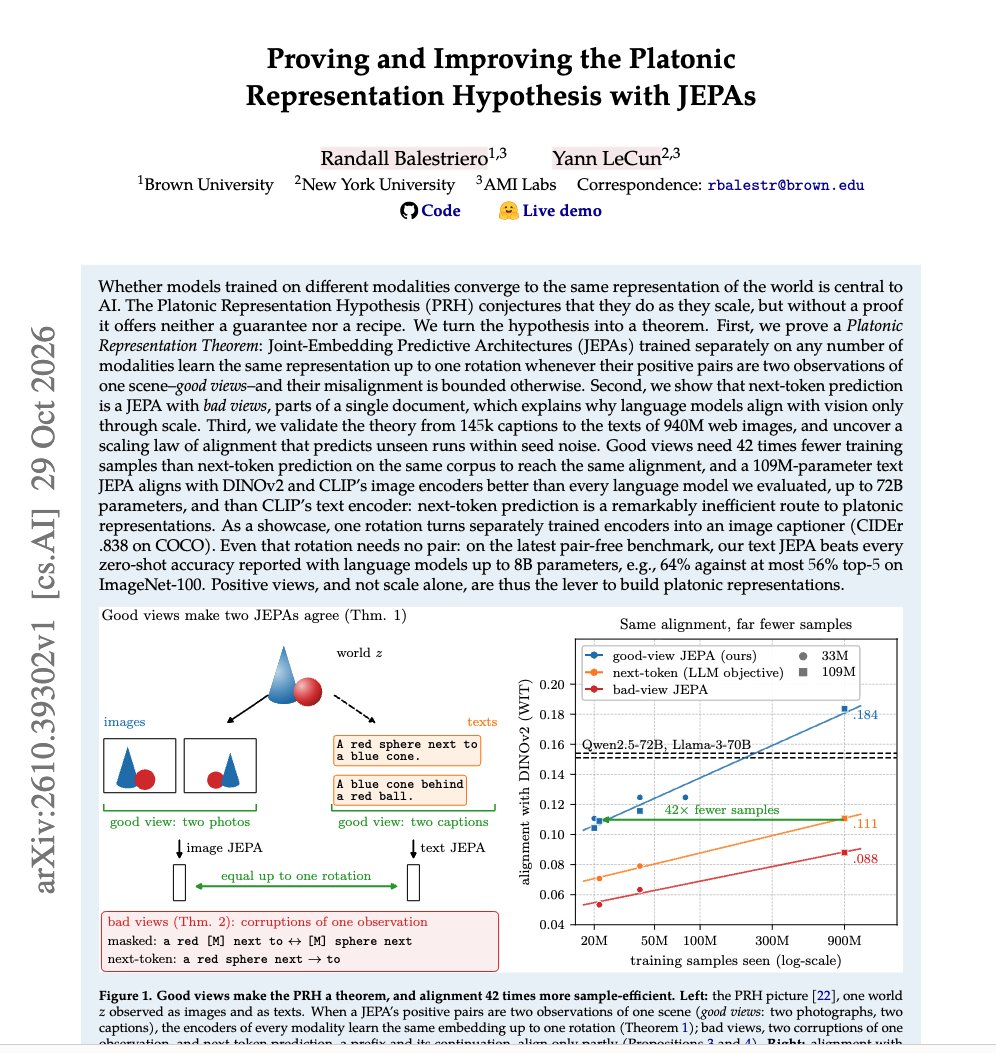
109 million parameters beat 72 billion.
He has spent years saying scale is not the thing that makes a model understand the world. Meta bet the other way. He left in November and started his own lab in Paris.
Last Thursday he published the proof.
The theory everyone has been running on since 2024 is that if you train models big enough, on text, on images, on sound, they all end up with the same picture of reality inside them. Size does it. Nobody ever proved that part.
Randall Balestriero and LeCun proved it. And the proof says size was never doing the work.
What does the work is which two things you show a model together.
A photo and the caption of that photo are two views of one thing. Models trained on pairs like that get there fast.
Two paragraphs pulled from the same document are not two views of one thing. Models trained on those get there slowly and expensively.
Next word prediction is the second kind. That is what every chatbot in the world runs on.
In their tests the first method reached the same understanding after 21.6 million examples. Next word prediction needed 900 million.
And a 109 million parameter text model ended up closer to an image model's view of the world than a 72 billion parameter language model was.
660 times smaller.
On nous promet de devenir les managers des IA. Mais pourquoi les IA auraient-elles durablement besoin de nous comme managers ?
Cette question m’est restée après le débat entre @dr_l_alexandre et @FournesMaxime, que j'ai coanimé avec François MARE à Échos de 2050.
Laurent Alexandre présente l’orchestration d’agents IA comme une évolution du travail.
Maxime Fournes en interroge la pérennité : si ces systèmes progressent, pourquoi leur coordination resterait-elle humaine ?
La promesse est séduisante. Nous déléguerions l’exécution pour nous concentrer sur la supervision. Mais superviser suppose aussi de répartir des tâches, comparer des résultats et corriger des erreurs. Des fonctions que l’on cherche précisément à automatiser.
Cela ne signifie pas que tous les managers vont disparaître. Cela signifie que « savoir piloter des agents » ne suffit pas à garantir une place durable.
Pour recruter et former, la question devient plus exigeante : quelle expertise permet de repérer une réponse convaincante mais fausse ? Qui choisit les objectifs et assume les conséquences ?
L’orchestration est-elle un métier d’avenir ou une étape de transition ?
Le débat complet est en commentaire.
#IntelligenceArtificielle #FuturDuTravail #Recrutement
Pour écouter l'échange en intégralité 👉https://t.co/mhH5AGNNY6
Wall Street is moving blockchain into the heart of financial markets.
On October 28, DTCC announced the launch of its tokenization service, with 20 major financial institutions signed up for access, including JPMorgan, Citi and Morgan Stanley.
This is a significant step. We're moving beyond isolated blockchain experiments toward integrating tokenized securities into existing financial infrastructure.
And Europe isn't standing still.
In France, @Spiko_finance just announced that its SAFO fund reached $2.39 billion in assets, overtaking @BlackRock's BUIDL and @circle's USYC.
But another number caught my attention: 44% of its instant withdrawals happened outside traditional banking hours.
That's a concrete example of what tokenization can bring. Not just digital ownership, but financial services that operate 24/7.
Meanwhile, @collaterizehq is taking a more Web3-native approach, connecting real-world assets with DeFi infrastructure.
Different players, different approaches, but the same underlying shift: tokenization is moving from experimentation to real financial applications.
And there's a talent dimension worth watching.
As traditional finance and Web3 converge, demand for people who understand both worlds is likely to grow.
Follow the infrastructure. Follow the adoption. Follow the talent.
#Tokenization #RWA #Web3 #DigitalAssets
@cryptorecruit@googlecloud Exactly. And now companies like Google are looking for these same profiles. That's going to make hiring even harder for smaller Web3 companies. For people with these skills, growing demand and limited supply should also mean higher market value.
Want to know where technology is heading? Follow the recruitment.
A few weeks ago, I spotted a @googlecloud job opening for a senior Web3 architect in Hong Kong.
The required expertise? Multi-Party Computation (MPC), institutional custody, stablecoins, tokenization and digital asset infrastructure.
Now @Google is unveiling its own MPC security solution for financial institutions, with commercial availability expected in early 2027.
I can't say the job opening was directly connected to this product. But the overlap is striking.
This is why I pay close attention to hiring signals.
Companies announce products when they're ready to show them. But they often start recruiting the expertise they need much earlier.
Recruitment can be an early indicator of where an industry is heading.
And as institutional finance increasingly embraces blockchain, the skills companies are looking for can tell us a lot about what comes next.
At @GoodHiveLabs, this is part of how we think about the Web3 talent market.
Don't just follow the announcements. Follow the recruitment.
#Web3 #GoogleCloud #DigitalAssets #GoodHive
Want to know where technology might be going? Follow the hiring.
Apple is looking for expertise in stablecoins, tokenized deposits and blockchain for Apple Pay.
Google Cloud is looking for RWA tokenization, stablecoin rails, custody and institutional Web3 infrastructure.
Two jobs don't make a trend. And neither company is new to crypto.
But what's interesting is how specific the skills are becoming.
Apple is looking at the payment layer. Google at the infrastructure layer.
Stablecoins. Tokenized deposits. RWA. Custody.
Technologies pioneered inside Web3 are gradually finding their way into mainstream financial infrastructure.
Product announcements tell us what companies are ready to show.
Hiring can sometimes give us an earlier glimpse of what they are preparing to build.
Two jobs don't make a trend. But they may tell us where to keep looking.
@0xnathan_ai Agreed on the advantage of open rails. But agents can also operate through delegated payment credentials. Crypto's real edge may be permissionless, programmable settlement at machine scale, without requiring every agent to depend on a banking intermediary.
AI agents don't need Mastercard to pay. They don't even need x402. So why is Mastercard adopting it?
In March 2026, Binance founder CZ predicted that AI agents would make a million times more payments than humans using crypto.
He may even be underestimating the scale.
Imagine millions of autonomous agents buying data, computing power and API services, generating thousands of micropayments every day.
Technically, we already know how to do this. Give an agent a crypto wallet, let it pay a smart contract, verify the transaction and deliver the service.
No bank. No credit card. No x402 required.
The real challenge isn't payment. It's interoperability.
How does an agent transact with 10,000 independent providers, each potentially using different payment interfaces, authorization systems and delivery mechanisms?
Coinbase introduced x402 in 2025 to standardize machine-to-machine payments through HTTP.
On October 20, Mastercard announced Agent Pay for Machines, building on x402.
A traditional payments giant adopting a Web3-native protocol. That's significant.
But x402 isn't alone.
Stripe and Tempo have MPP. Google has AP2 for authorization. China's Ant ecosystem is developing its own agent-commerce protocols.
Some are complementary. Others compete.
Here's the paradox: crypto removed the need for financial intermediaries, but incompatible payment standards could create a new generation of intermediaries.
Universal gateways, intelligent routing, agent identity, verification, security and automated accounting.
A whole new industry could emerge around making these systems work together.
The next big opportunity may not be inventing another payment protocol, but connecting the entire machine economy.
Will AI agents transact in one open global marketplace, or in fragmented ecosystems?
#Web3 #AIAgents #x402 #Stablecoins #Mastercard
@open_is_free That's a great distinction. Mastercard may be positioning itself at the orchestration and trust layer rather than reinventing settlement rails. Settlement could happen through stablecoins or traditional networks. The strategic question is who controls interoperability.
@Picklerfun Exactly. Payment rails solve execution, not trust. Agent identity, reputation, authorization and counterparty verification could become an entirely new infrastructure layer. That's where I see some of the biggest opportunities.