The MLB Draft has major flaws.
It’s unsettling yet exciting all at the same time.
Here is what we at Moment are doing for our newly drafted players four days post draft.
This week alone I have worked with our draft class on:
- Locating housing for residency purposes
- Identifying vehicles as their reward purchase
- Shopping proper insurance policies on both of the above
- Making sure team payroll has the correct direct deposit instructions
- Coordinating with agents on contract language and bonus split payouts so that we are all aligned
People reach out to me all the time and say they want to work with athletes.
I would urge them not to unless they know what the job entails.
The job?
Doing anything and everything to make our clients feel comfortable with becoming a pro. And nothing to do with anything on the field.
It’s everything money touches.
Everything that an 18-21 year old has no idea about.
I just created a folder with 100 VIRAL YouTube formats you can copy and use for your own channel
Retweet & comment '1of10' below and I'll send it to your DM
(must follow to receive DM)
A $5,000,000 signing bonus isn’t $5,000,000.
For many MLB draft picks, it might be the only guaranteed check they ever receive.
Here’s what it actually looks like:
Signing Bonus: $5,000,000
∙Federal Taxes (37%): −$1,850,000
∙Agent Fees (5%): −$250,000
∙State Taxes (5%): −$250,000
Take-home: $2,650,000
Not $5M. $2.65M.
Now the fun starts. What am I going to buy?
∙$1M home
∙$100K vehicle
∙$100K to family
Nothing reckless. Just normal decisions for a 18 or 21-year-old who just got a life-changing check.
But here’s the problem.
Minor league salaries are minimal. Call it $30k-$40k.
Arbitration isn’t guaranteed.
Free agency isn’t guaranteed.
And for most draft picks? They never reach either.
We don’t know what comes next. To be clear, that’s not me being negative. It’s just the truth.
Working with professional baseball players, we don’t build plans around projection or best case scenarios.
We build around the guarantee. Around what we know to be true.
That means:
∙Taxes reserved before lifestyle expands
∙Spending defined, not assumed
∙Capital set aside to cover minor league years
∙Liquidity preserved in case Career #2 becomes the conversation
∙Illiquid investments capped early
If arbitration comes, great.
If free agency comes, awesome.
But the plan works even if neither happens.
If you were advising a top draft pick today, would you plan for the $100M deal or plan like the signing bonus might be all there is?
We are 40 days away from the 2026 MLB Draft.
This is what we’re talking about with our clients waiting to hear their names called.
Before your signing bonus hits your account, there are three things you need to understand about what the IRS is about to take.
1. Most teams withhold around 22% for federal taxes.
Your actual federal liability is likely higher. The gap is often six figures and it comes due at filing. By then, most rookies are already spending money they don’t have.
2. The MiLB 401k lets you defer up to $24,500 of taxable income before the IRS touches it.
3. If you’re earning from cards, memorabilia, or appearances, a Solo 401k can shelter a significant portion of that income too.
The athletes who get this right just had someone in their corner who knew the specifics before the check cleared.
Make sure your team does too.
Announcement:
I’m looking for 100 new YouTube channels to implement our latest growth strategies with. 🎉
After 9 sold-out cohorts, we're opening applications to cohort 10 of my YouTube Accelerator.
We find talented creators and implement my full growth playbook with them.
We've taken channels from 1k views a video to 500k+
From $100/month to $10,000/month (within months)
We have even had multiple creators make 5m+ view videos DURING the cohorts.
This is going to be our best cohort yet… we’ve spent years fine tuning what we deliver:
- 8 week intense group coaching program focused on results
- 30+ hours of fully refreshed live training from me
- Our complete AI operating system for YouTube
- Personalized strategy help and feedback
- 24/7 live community to support
One of the biggest pieces of feedback we get from students is we undersell how much work we put in lol.
If you want to see if you're a fit... apply below (we will literally review within days!)
If you have applied before and not been accepted, don’t be discouraged.
We've even had someone who applied 5+ times and then finally got in.
And also f**k it... we're making this a reoccurring thing:
One person who likes and RT this tweet will get a 100% paid for scholarship (worth thousands).
Fully taken care for by me. ❤️
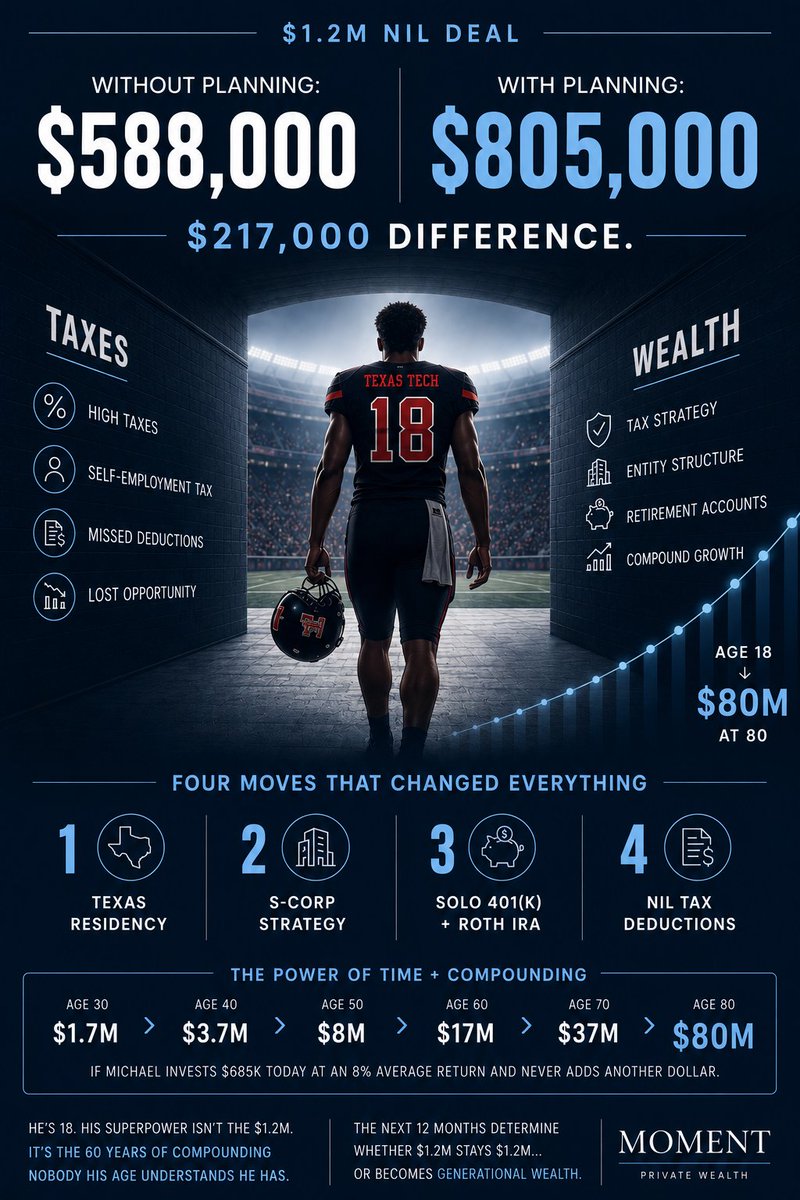
$1.2M NIL deal at 18.
Most keep $588K. Michael kept $805K.
The $217,000 gap was four decisions wide.
Meet Michael. 18 years old. From California. Never filed a tax return in his life. Just walked into more money than most adults will see in a decade.
Here’s how we drew it up.
𝗠𝗼𝘃𝗲 𝟭: 𝗦𝘁𝗮𝘁𝗲 𝗿𝗲𝘀𝗶𝗱𝗲𝗻𝗰𝘆.
California has a 13.3% top tax rate. Texas has none. NIL income is taxed based on your state of domicile, not your school’s state. We established Michael as a Texas domiciliary.
Saved: $127,000.
𝗠𝗼𝘃𝗲 𝟮: 𝗘𝗻𝘁𝗶𝘁𝘆 𝘀𝗲𝗹𝗲𝗰𝘁𝗶𝗼𝗻.
NIL income is self-employment income. As a sole proprietor, Michael would pay self-employment tax on every dollar. We set up an LLC taxed as an S-corp, paid him $190K in salary, and took the rest as distributions.
Lower SE tax. And it unlocked the next move.
𝗠𝗼𝘃𝗲 𝟯: 𝗥𝗲𝘁𝗶𝗿𝗲𝗺𝗲𝗻𝘁 𝗮𝗰𝗰𝗼𝘂𝗻𝘁𝘀.
Remember that $190K salary? It wasn’t random.
It maxed out his solo 401(k): $24,500 employee + 25% employer match = $72,000.
Add a backdoor Roth IRA at $7,500.
Tax savings today: ~$26,000. Plus 50 years of compounding.
𝗠𝗼𝘃𝗲 𝟰: 𝗗𝗲𝗱𝘂𝗰𝘁𝗶𝗼𝗻𝘀.
Here’s the one most athletes never hear:
Off-field NIL income lets you deduct agent fees. On-field salary doesn’t.
Agent fees ($60K+) + business expenses ($20K) = $80K off the top.
Four moves. $217K back in his pocket. Now we invest.
If Michael puts $685K to work at age 18 and never adds another dollar, an 8% return gets him here:
Age 30: $1.7M
Age 40: $3.7M
Age 50: $8M
Age 60: $17M
Age 70: $37M
Age 80: $80M
He’s 18. His superpower isn’t the $1.2M.
It’s the 60 years of compounding nobody his age understands he has.
What he does in the next 12 months decides whether $1.2M stays $1.2M or becomes $80M.
If you’re on a big NIL deal, let’s talk.
Today I turn 30.
I’ve dedicated over 50% of my life to mastering YouTube strategy.
50+ billion views, millions in revenue, across 100s of channels later…
Here are 30 lessons for creators:
I wrote a blog last week about why athletes need to build their financial locker room before the money shows up.
Truth is, I only wrote it because I had just lived the reason why two weeks earlier.
Onboarded a new client. By the time they sat down, the damage was already done. Big, unexpected, income hit the books last year. Their CPA never ran a projection. Never called during the year. Never flagged the liability before the extension deadline.
Just sat back, waited to collect tax documents, and delivered the verdict:
"It is what it is at this point."
Verbatim.
That's not tax advice. That's a status update.
Now there's a six figure tax bill, penalties, and interest stacking on top of it.
All preventable with proactive planning and ongoing communication amongst everyone on the team.
Here's the pattern I see over and over.
Athletes build their team backwards. A CPA a buddy recommended. An advisor a year or two in. An attorney only when something goes sideways.
Nobody is talking to each other. Everybody is filing paperwork in their own lane. The athlete is the only one who sees the full picture, except they don't actually see it either.
The cost of that disorganization isn't small. Across a career, it's hundreds of thousands of dollars in missed planning, bad entity structure, blown quarterly estimates, and strategies that never got run because nobody was looking forward.
You wouldn't take the field without a catcher, a center, a left tackle, or a coach. Why would you build a career without an advisor, a CPA, and an attorney already in the huddle?
Advisor, CPA, attorney. Same room. Same plan. Talking to each other all year, not just in April.
Athletes who win long term don't have better luck. They have a better bench.
$1,200,000. College Athlete. 1099 Income.
Here’s what nobody tells NIL athletes pulling real money:
The moment your first revenue share or NIL check cleared, you became a small business owner.
The IRS doesn’t care that you’re a student-athlete in college.
They don’t care that your earning window might be just a few years.
They want their cut. Today.
Here’s what we did to keep serious money in his pocket instead of sending a check to Uncle Sam:
1️⃣ LLC taxed as an S-Corp
Put him on his own payroll and paid him a reasonable salary. The rest? Taken available as distributions.
Stops 15.3% self-employment tax from gutting every endorsement check.
→ Saves tens of thousands of dollars.
2️⃣ Maximize business deductions
Training. Recovery. Content production. Travel. Equipment. Agent and legal fees. Home office.
The real cost of running a 7-figure brand, finally run through the entity.
→ Saves tens of thousands of dollars.
3️⃣ Solo 401(k)
$24,500 employee + $47,500 employer = $72,000 deferred for retirement.
At age 20 with 45 years of compounding ahead, that single contribution can grow to millions of tax free money.
And we plan to do this every year that we’re earning 1099 income.
→ Saves roughly $26,000 per year.
4️⃣ Pass-Through Entity Elective Tax
State tax paid at the entity level. Sidesteps the federal SALT cap.
→ Saves about $30,000
5️⃣ Backdoor Roth IRA
$7,500 in. Tax-free growth for life.
At 20 years old, this is the highest-leverage account he’ll ever own.
6️⃣ Donor Advised Fund / his own Private Non-Profit
Builds a giving legacy. Aligns with his personal brand. Generates real federal deductions.
→ Saves $15,000–$40,000+, depending on giving level
Total tax savings for 2026: $150,000+
This is what we do.
Same story every time with NIL athletes earning 6 and 7 figures:
→ Treating the income like an allowance
→ Spending before structuring
→ Trusting the same tax preparer their family used for W-2 income their whole life
You’re not a college kid with a side hustle.
You’re the CEO of a 7-figure personal brand.
Your team should look like one.
📍 If you want to see where you stand with your money, take our Moment Money Quiz and find out in two minutes 👇
He sold his company for $62 million.
And didn’t feel what he expected.
No fireworks.
No overwhelming relief.
Just… quiet.
He was 63.
Built the business over 28 years.
Family-owned. Capital-efficient. Highly profitable.
A strategic buyer offered $62M.
He signed.
Wire hit.
I have heard this thought before:
“Now what?”
Everyone talks about the valuation.
No one talks about the vacuum.
Because once you sell at that level, three things hit at once:
https://t.co/nQ6Yy6ql5m’re wealthy.
https://t.co/5L9SNjNomQ’re liquid.
https://t.co/C5nyEZej4E’re no longer the founder.
That last one is the hardest.
The Reality of a $62M Exit
After taxes, fees, and adjustments,
his net liquidity was closer to $40M–$45M.
Still life-changing.
But not infinite.
And here’s the part most founders underestimate:
Wealth concentration risk doesn’t disappear.
It transforms.
Instead of one business risk,
you now face:
- Investment risk
- Tax drag
- Estate tax exposure
- Family governance risk
- Behavioral investment risk
At this level, mistakes compound differently.
What We Would Help Do
Before closing:
- Structured gifting to trusts to cap future estate exposure
- Modeled capital gains, NIIT, and state residency impact
- Designed a post-sale investment policy statement
- Segmented capital into lifestyle, growth, and legacy buckets
After closing:
- Built a guardrails-based income system
- Stress-tested spending from $1M–$2M per year
- Mapped estate tax exposure under multiple growth scenarios
- Created a family governance structure for next-gen involvement
What $40M+ Really Supports
If invested prudently:
- $1M/year = conservative
- $1.5M/year = sustainable
- $2M/year = confident with oversight
- Above that? Requires intentional structure
At this level, you don’t need a withdrawal rate.
You need:
A capital allocation strategy.
A tax minimization roadmap.
An estate compression plan.
A purpose.
The Unexpected Part
He didn’t struggle with money.
He struggled with identity.
For 30 years, he was:
The operator.
The problem-solver.
The decision-maker.
Now he had capital.
And time.
That shift is harder than the deal.
A $62M exit isn’t about retiring rich.
It’s about managing complexity.
You don’t “set it and forget it” at this level.
You design:
- Income
- Risk
- Legacy
- Family structure
- Philanthropy
- Governance
The business was simple compared to that.
Does this sound a lot like you or someone you know?
Schedule a time with @LukeTurner_CFP
$6.2M signing bonus. $3.3M after taxes. $1.6M spoken for before we touched a single investment.
A few years ago I sat across from a 21-year-old former first-round pick.
$6.2M signing bonus. Endorsement money already coming in.
On paper, he was set. In reality, he was one bad decision away from financial pressure before he ever stepped into a big-league clubhouse.
What most people get wrong about the early years of a pro career: burn rate wins. Every time.
Federal taxes at 37%. State at 5%. Agent fees at 5%.
$6.2M became $3.3M net.
Then real life started:
$1.1M home
$120K vehicle
$150K to pay off mom and dad’s mortgage
$250K in furnishings, travel, offseason training, and living expenses while grinding in the minors
$1.6M gone before we ever talked about where to invest a dollar.
So we had a choice. Chase returns or build durability.
We built durability.
We set aside two full years of projected living expenses in high-yield cash and short-term treasuries. Not exciting.
But it bought him time if his development stalled.
We built the boring infrastructure. Quarterly tax projections, multi-state filing, an entity structure for his endorsements, disability coverage, umbrella policy.
The stuff nobody talks about that prevents catastrophic mistakes.
The remaining capital went into a globally diversified portfolio. No concentrated bets. No locker-room private equity deals. No speculative real estate.
Here’s what the minor leagues actually look like:
Income is uncertain. Promotions are uncertain. Careers are uncertain.
Liquidity isn’t.
If he flames out in three years, the goal isn’t to have maximized returns. It’s to still have options.
Athletes don’t fail financially because they didn’t earn enough. They fail because lifestyle creep outpaces flexibility.
In the early years, cash flow control is everything.
And this is why education is stuck in such a rut, and constantly regresses back whenever we make an inch of improvement: because the progressive tropes are so intuitively attractive, easy, and simple, and the reality of learning is much more complex and difficult.
You don't learn very well by watching an amusing or entertaining video; you retain the information in it like a river running through you. You're aware of it temporarily until it is replaced by the next packet of facts, but you don't retain it well or in a way you can retrieve easily later. You might remember novel, surprising, amusing, or shocking parts well enough, but miss the details that weren't obvious, or the links between them.
Knowledge and skills are acquired through scaffolded explanations/ demonstrations followed by the student processing it, using it, thinking about it. The teacher then checks their understanding and offers high quality feedback, reinforces, corrects, redirects or reconstructs. Then the next lesson connects meaningfully with the last one in a similar way, infused with retrieval and revision of prior concepts to ensure deep learning.
Videos can be part of that, but they are not that. We actually do know a lot now about how we learn, and how we teach, and collectively they tend to be called the Learning Sciences, or Evidence-Informed Education. It's urgently required across the world as an antidote to both the winner-takes-all grindhouse of poorly led-lecturing, or more commonly, the inane performative pantomime of progressive flim-flam.
Mr B's references here demonstrate the old Keynesian adage of how so-called practical men who believe themselves free from bias, are usually in the grip of some long dead economist or philosopher. He trots out the most pedestrian and reactionary dogma about learning while believing himself to be a common-sense revolutionary. It's not his fault. I don't know anything about being a social media megastar.
But tech, no matter how shiny, cannot replace the architecture of the human brain. There is a 1300g bag of neural porridge inside every one of us that isn't going anywhere fast, so we better get busy using it to understand how to replicate and build on how we already actually learn, rather than what we wish it was like- or what sells content.
The average pro athlete's career lasts less than 5 years.
5 things I did to transition from athlete to entrepreneur:
I will never forget flying home from South Korea in 2019 and thinking, "This is it".
My season with the Kia Tigers hadn't gone as hoped, and my drive was waning.
I knew it, and my wife knew it ~ it was time for something new.
So, here is what I did.
-
1) Took Stock
I didn't start with passions.
I started with the reality of where my life was.
What opportunity set did I have, what financial situation was I in, and what was the balance between "have to" and "want to"?
Start with the reality of your current situation.
-
2. Made My List
I have always enjoyed sports, people, and finance.
I made a list of a handful of roles that tied those concepts together.
Agents
Advisors
Real Estate
Investment Banking
I created these by first understanding reality and then examining passions.
-
3. Your Network
My phone wasn't ringing with the next opportunity, I had to go create it.
I put together a list of "successful" people (however you define that) to reach out to.
My Pitch:
Buy You Lunch
Learn About Your Journey
Understand If You Would Do It Again
-
4. Craft Your Offer
At this point, I knew the industry but wasn't sure of the role.
Instead of waiting for an opportunity ~ I asked for one.
My offer ~ One that would be nearly impossible to refuse.
Any Role
Any Salary
Your Terms
*My reality allowed this as an option.
-
5. Go All In
I found something I loved ~ advising families.
I needed to combine that with who I can help the best ~ athletes and entrepreneurs.
I multiplied that by doing something that would keep my drive over decades ~ building a business.
6 Years later, here we are.
-
Your situation is different than mine.
Your reality, skillset, and passions are different than mine.
Yet, you can follow the same framework I did to transition.
Whether you are a pro athlete, a valued team member, or still searching for the right role, I hope this helps.
-
📌 If you find this helpful, please share it with your network ♻️ and follow me, Jacob Turner for more at the intersection of sports and money 💵.
He had three offers for his company.
All within $2 million of each other.
One from Private Equity.
One from a strategic competitor.
One from his own management team.
Everyone around him kept asking:
“Which one pays the most?”
Wrong question.
The real question was:
“What life do you want after this closes?”
Because who you sell to doesn’t just determine price.
It determines control.
Risk.
Culture.
Time horizon.
And whether you ever see a second dollar.
The Three Paths
1️⃣ Sell to Private Equity
You usually:
- Sell 60–80%
- Roll 20–40% equity
- Stay on 3–5 years
- Grow aggressively
- Aim for a second exit
Upside:
- Second bite of the apple
- Institutional capital
- Faster scaling
Tradeoff:
- Board oversight
- Aggressive growth targets
- Less autonomy
- You’re not the only decision maker anymore
You de-risk personally.
But you’re still in the arena.
2️⃣ Sell to a Strategic Buyer
You usually:
- Sell 100%
- Cash out fully
- Possibly sign a 1–3 year transition agreement
Upside:
- Clean exit
- Highest upfront price (sometimes)
- No rollover risk
Tradeoff:
- Your company likely gets absorbed
- Culture changes
- Your name eventually disappears
You maximize certainty.
But you give up upside.
3️⃣ Sell to Employees (ESOP or Internal Buyout)
You usually:
- Transition gradually
- Structure seller financing
- Maintain legacy
- Preserve culture
Upside:
- Protect your people
- Keep mission intact
- Tax advantages (if structured correctly)
Tradeoff:
- Lower immediate liquidity
- Longer payout timeline
- Higher execution risk
You prioritize legacy over speed.
What He Chose
He didn’t pick the highest bid.
He picked the offer that matched:
- His burnout level
- His desire for a second run
- His family’s risk tolerance
- His need for liquidity
He sold majority to PE.
Rolled equity.
Took enough off the table to retire if he wanted to.
And stayed because he wanted to not because he had to.
That’s the difference.
⸻
The Decision Framework
Before you compare offers, answer this:
- Do you want to work 5 more years?
- Do you want upside or certainty?
- Is legacy more important than price?
- How much is “enough” for your family?
- Can you emotionally handle losing control?
Because at this level, the delta in price matters less than the structure.
Most founders think selling is a financial decision.
It’s not.
It’s a life decision with a financial wrapper.
Choose the buyer that fits the life you want not just the headline number.
If you got value from this post ♻️repost it and share it with a friend.
He was about to sell for $25 million.
And walk into retirement with no plan.
He was 58.
Tech-enabled service business.
Scaling for a decade.
Buyer lined up. $25M valuation. All cash.
I have heard something similar 60 days before closing
“We’re selling. I’ll probably just live off 3%. That should be safe, right?”
He’d done everything right in the business but had no plan for what came after.
No entity structure.
No gifting plan.
No tax modeling.
No idea how much he could spend or give without blowing up the next 30 years.
He was about to make the single biggest deposit of his life
…into an account with no instructions.
How we would think about helping (Before and After the Exit)
Segmented the proceeds:
- $10M for long-term growth
- $8M for flexible, tax-efficient income
- $5M transferred into a family trust with future gifting strategy
- $2M in liquidity and opportunity capital
- Established a charitable gifting plan (DAF + CRT) to offset part of the gain
Created a spending policy using guardrails so he could live well and adjust over time
- Integrated estate tax planning to cap future exposure
- Built out a full cash flow map across brokerage, 401(k), Roth, real estate, and trusts
- Modeled the plan through age 100 under stress-tested market assumptions
He didn’t need a “safe withdrawal rate.”
He needed a wealth operating system.
We built one.
And now?
- He travels more than he works
- Pays less tax than expected
- Has total visibility into spending, giving, and legacy
- And knows exactly when to dial income up or down
💸 What You Can Spend After a $25M Exit
(If planned correctly)
- $500K/year = ultra-conservative
- $750K/year = flexible with margin
- $1M–$1.2M/year = confident, sustainable, guardrails-based
- $1.5M+/year = aggressive, but possible with controls
A $25M exit isn’t freedom by default.
It’s just potential.
The difference between the owner who stays wealthy…
and the one who slowly bleeds it away?
Planning.
Tax. Income. Risk. Legacy.
All tied together in one system.
The sale isn’t the finish line.
It’s the fork in the road.
Make it count.
A $20M mistake averted.
Ben was a 61 year old business owner.
Owned a business worth $20 million.
Cash flow strong. Kids involved.
And he was ready to step back.
“I think I’m just going to gift the business to the kids. I don’t need the money, and I’d rather avoid taxes.”
If I heard this here is how I would think about it.
He had no plan.
No valuation strategy.
No tax modeling.
No liquidity set aside for his own retirement.
If he followed through, he would’ve triggered a massive gift tax bill, lost control of the business immediately, and left his kids exposed with no guardrails.
We took a different approach.
We asked one question:
“Do you want out… or do you want options?”
Here’s what we did instead:
The Planning Path That Let Him Retire On His Terms
- We had the business formally valued to establish a defensible baseline.
- Transferred minority non-voting interests to a trust for the kids using a valuation discount (25–30%).
- Set up a grantor trust so future appreciation passed estate-tax free.
- Established a salary continuation plan so he had steady, tax-efficient retirement income.
- Structured the transition to keep him as board chair, so control passed gradually not overnight.
- Funded an ILIT (irrevocable life insurance trust) to backfill estate liquidity needs.
- Created a buy-sell agreement that protected the family if anything happened to one of the kids.
10 months later, he stepped away.
1) No giant tax bill.
2) No loss of control.
3) The business stayed in the family, fully protected.
4) And his personal financial plan gave him $600K+ per year in retirement income, without touching a dollar of the business again.
**He thought he needed to walk away.
What he really needed was a strategy.**
Too many business owners confuse retiring with giving it away.
And too many advisors treat exit planning as “sell it or gift it.”
But there’s a middle path.
You can retire.
Keep optionality.
Protect your kids.
Avoid unnecessary taxes.
And build a legacy you control.
If your business is worth more than $10 million, your exit is not a transaction.
It’s a tax event, a legal event, a financial event, and a family event.
Don’t wing it.
Plan it.
Follow @LukeTurner_CFP if you own a business and like learning about money.