We are pleased to announce a call for abstracts and sessions for the Second International Conference of Critical Legal Geography (Concepción, Chile, 17-20 March 2026).
Applications due November 10. No conference fee & some grants available. Further info: https://t.co/zmHmIMA5Cb
Yes.
Writing is not a second thing that happens after thinking. The act of writing is an act of thinking. Writing *is* thinking.
Students, academics, and anyone else who outsources their writing to LLMs will find their screens full of words and their minds emptied of thought.
The University of Saskatchewan College of Law invites outstanding candidates to apply for the Ariel F. Sallows Chair of Human Rights
https://t.co/8uBDplcY6k
NEW 🧵: Is human intelligence starting to decline?
Recent results from major international tests show that the average person’s capacity to process information, use reasoning and solve novel problems has been falling since around the mid 2010s.
What should we make of this?
Going forward, subject to an appeal, the Commission will have to redetermine the adequacy of consultation in line with the "new added layer" that UNDRIP imposes on the duty to consult in this context. Here are some key paragraphs for those curious.
Justice Blackhawk of the Federal Court has issued a very detailed & thoughtful decision on the relevance of UNDRIP to decision making by the federal Canadian Nuclear Safety Commission in Kebaowek First Nation v Canadian Nuclear Laboratories, 2025 FC 319 https://t.co/u4SsO0cnRE
There's a somewhat provocative discussion of whether the Crown ought to have done more to ensure clarity as to who properly represents Algonquin section 35 rights holders as well. But this doesn't seem to have been determinative.
Quebec Court of Appeal recently granted leave in case about whether Quebec Superior Court has jurisdiction to judicially review a decision made under a Kahnawà:ke Mohawk law: https://t.co/I1BncTSERk
Are pre-1970 @SCC_eng@CSC_fra precedents still legally relevant?
After analyzing around 1.5 million citations found in 5000 appeal factums and 468,500 judicial and administrative decisions, I think so.
Draft paper here:
https://t.co/9ylo0qM94o
There is a concerning influence of sovereign citizen rhetoric (or pseudolaw) on Indigenous sovereignty. Explore this intersection with us at a workshop next November at the University of Otago. Our CFP is attached. Please share it widely and with anyone who may be interested.
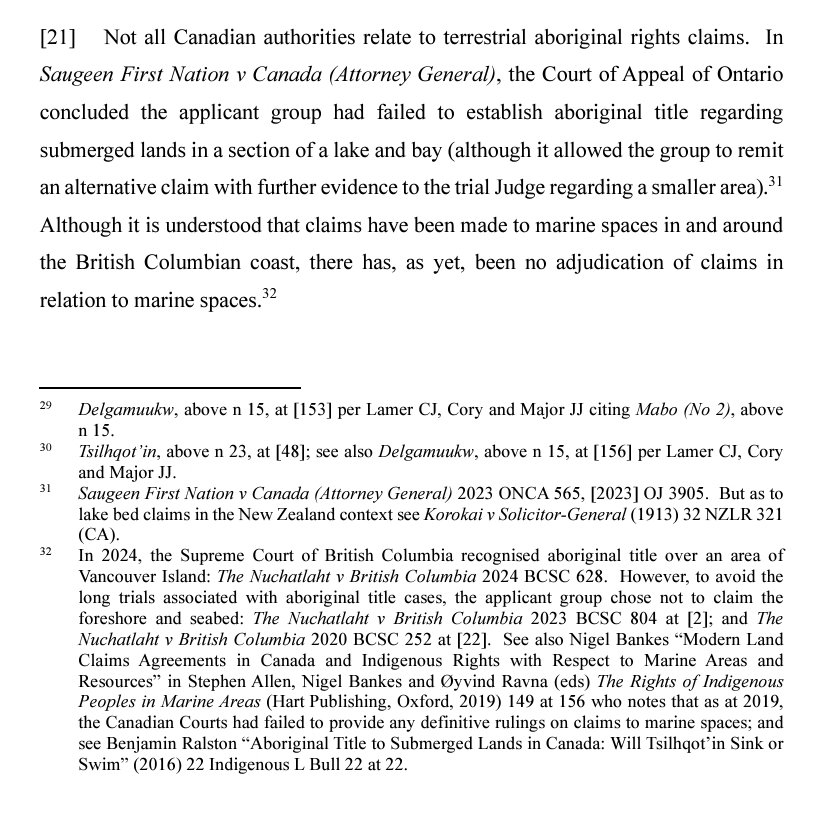
Here's an interesting decision from the New Zealand Supreme Court on rights to marine areas with some discussion of the Canadian and Australian case law that influenced the statutory regime in New Zealand. It was a happy surprise to be cited as well.
NZSC to release interpretation judgment in the combined Marine and Coastal Area (Takutai Moana) Act 2011 proceedings at 3pm today
https://t.co/W7lDSPi5G6
A fascinating new judgment on the Honour of the Crown. Building on its recent decision on "legislative reconciliation" in the child and family services context, the Court has articulated a complementary framework for contractual reconciliation here.
The Court dismissed the appeal in Quebec (Attorney General) v. Pekuakamiulnuatsh Takuhikan. It confirmed the obligations the province of Québec was bound by in the execution of agreements on police services in an Indigenous community: https://t.co/Ez8faIH6Z3. #CdnLaw
Among other things, the majority judgment has an interesting synthesis of principles elaborated in relation to the Crown's duty to consult and treaty infringement in past cases, including with respect to identifying credible but unproven rights claims and damages. Lots to unpack.
The Supreme Court will deliver its judgment on the following appeal on November 27, 2024, at 9:45 a.m. ET: Quebec (Attorney General) v. Pekuakamiulnuatsh Takuhikan. A plain language summary of the judgment will accompany the decision. https://t.co/NbL3HMqMAz