My latest Substack. A question for our next dean - and for every Canadian and American law dean out there: in an age of artificial intelligence, how will you justify law schools' existence? Comments welcome. Link below.
@LawScribes@UKSupremeCourt Permission to appeal can also come from the Court of Appeal. And my impression is that the Court of Appeal grants permission to appeal to the UKSC with some regularlity, unlike Canadian courts of appeal (who also have the power but haven't used it in 20 years).
Breaking: major decision from the New Brunswick Court of Appeal today upholding certainty for private property rights in context of Aboriginal title claims: https://t.co/DXp15KbnYu
Property rights are on everyone's minds as of late, and for good reason. Whether it is the security of financial assets, the capacity to undertake major resource projects, or the security of fee simple land title, property rights seem not as strong as many have assumed. In fact, Canada is fairly unique among peer countries in our explicit lack of constitutional protections for property rights.
There's a better way forward for Canada that preserves the ability of the government to act in the public interest for natural resource extraction, major projects, national security, and to govern for the common good, while strengthening protections for private property.
@PAWarchuk argues that “Weak property rights discourage investment, erode public trust, and concentrate power in the state. A society that treats ownership as conditional undermines citizens’ freedom to plan, build, and innovate.”
To effectively address the problem, he urges Canada to adopt comprehensive safeguards built on four core ideals:
-Fair compensation for all takings
-Legitimate public purpose
-Due process before deprivation
-Proportionality
“The question is not whether Canada should protect property rights more robustly, but when and how.”
@MLInstitute
https://t.co/FK4Wl0ETL8
It's not going to be easy to explain much about the lengthy Cowichan Tribes Aboriginal title decision post-by-post - I've written some initial thoughts on one big point in my new substack - TLDR is: yes a lot of private land faces new uncertainty - see https://t.co/XE1vMfpVQR
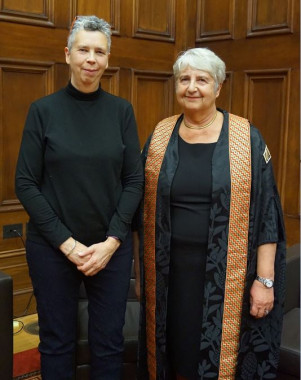
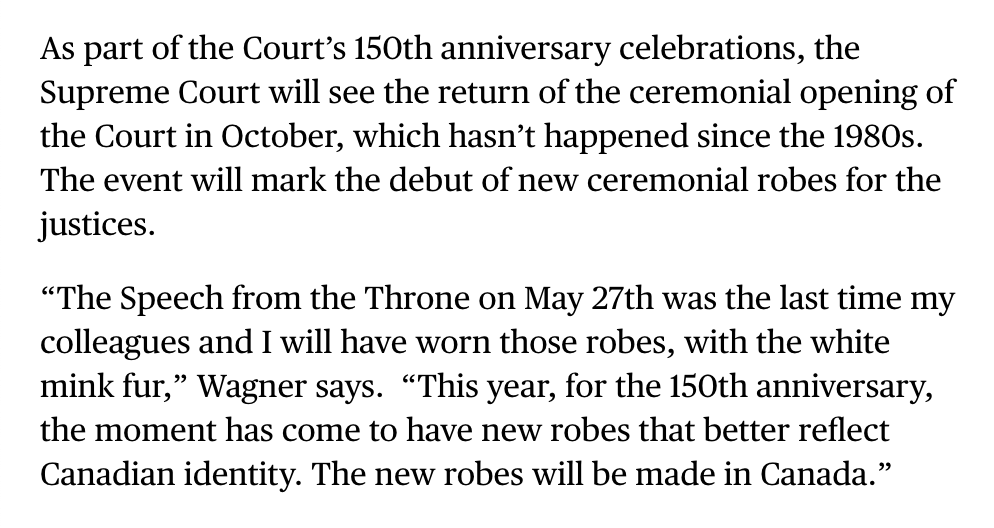
Ian Holloway (@LawProfHolloway): The Supreme Court is ditching its iconic red robes. Yes, it matters
FREE 3-month Hub subscription: https://t.co/B8hoCnqVCh
Full article here: https://t.co/8OT8iDgipJ
I certainly hope they don't take the approach that the English judiciary took with their new gowns: https://t.co/BhPH01ogxB
I suspect they'll go for something similar to New Zealand: https://t.co/5xlalceAuC
I wonder if they will also ditch court dress, like the UK and NZ?
Disappointed to learn that the SCC will ditch their traditional robes, which date back 500+ years. It certainly won't be cheap either. 12 new robes for the UKSC cost over $250,000 more than a decade ago: https://t.co/rxe9YWo0L1
Amid the controversy over Wagner CJ's putative ignorance of who donated the bust of him in the Supreme Court of Canada building, it's worth noting another one of his aesthetic announcements:
In a Year Zero move, the SCC will soon be replacing its "Santa Claus" ceremonial robes.
Prorogation litigation update 🚨
A rare Saturday decision from the Federal Court granting the applicants’ motion to expedite.
February 13-14 hearing for the challenge to the lawfulness of the Trudeau prorogation.
Impressive speed from Crampton CJ!
https://t.co/qJyPfYsD4l
Are pre-1970 @SCC_eng@CSC_fra precedents still legally relevant?
After analyzing around 1.5 million citations found in 5000 appeal factums and 468,500 judicial and administrative decisions, I think so.
Draft paper here:
https://t.co/9ylo0qM94o
Good article by @GillisMatilda in the recent Issue of @PL_PublicLaw defending the HRA & arguing that following an adverse ECtHR decision, a new policy can be found which respects rights, but still preserves much of the original policy aims. A moderated and collaborative approach!
@alyssa_tomkins “[61] Under the Doré approach, a reviewing court must begin by determining whether the administrative decision at issue “engages the Charter’”
To me, these paras from Commission scolaire suggest it’s for the Court to perform the first step for itself.
@alyssa_tomkins I think they are consistent. See para. 61 and “[67] Once the reviewing court has determined that the impugned administrative decision infringes Charter rights…the court must…determine whether the decision is reasonable through an analysis of its proportionality”.
@PJSobkowski @espinsegall She might want to take a look at her reasons in Reference re art. 35, where she relied heavily on original intent, embodied in "one of the important compromises of the Fathers of Confederation, on which the special and inalienable status conferred on the s. 96 courts is grounded"
@GeoffSigalet @espinsegall Despite the Court's insistence otherwise, there is a strong argument that the SCC has used originalist reasoning in a few areas of constitutional interpretation. This article makes that point: https://t.co/5OGURJqUzR
I asked Claude 3 Opus whether the @SCC_eng majority reasons in the recent Privacy Commissioner case (2024 SCC 4) are consistent with Vavilov. Maybe it's drawing on Côté J's concurrence, but I'm impressed. AI is rapidly improving. What do others think? @pauldalyesq@MarkPMancini
Court declares that the GG must appoint superior court judges “within a reasonable time of the vacancy”, “the Court expects the untenable and appalling crisis, and critical judicial vacancy situation found by this Court as identified by the Chief Justice and CJC will be resolved”