Musk heeft niet gelogen: Tesla-miljardenbonus is officieel binnen | De Tijd
De grootste holdup in plain daylight uit de geschiedenis van het bedrijfsleven: een CEO die van een omgekochte RvB diep in de kassa mag graaien. Repulsive! https://t.co/P0w5pqPpDO
In the 1920s, a Stanford psychologist tracked genius children for 50 years.
Malcolm Gladwell breaks down what he discovered:
Rich families → successful. Poor families → failures.
Not average. Failures. Genius-level IQs that produced nothing.
He spent 60 minutes at Microsoft explaining why we're wrong about success:
The psychologist was named Terman. He gave IQ tests to 250,000 California schoolchildren.
He identified the top 0.1%. Kids with IQs of 140 and above.
His hypothesis: these children would become the leaders of academia, industry, and politics.
He tracked them. And tracked them. For decades.
The results split into three groups:
The top 15% achieved real prominence. The middle group had average, moderately successful professional lives.
And the bottom group? By any measure, failures.
The difference wasn't personality. Wasn't habits. Wasn't work ethic.
It was simple: the successful geniuses came from wealthy households. The failures came from poor families.
Poverty is such a powerful constraint that it can reduce a one-in-a-billion brain to a lifetime of worse than mediocrity.
There's a concept called "capitalization rate."
It asks a simple question: what percentage of people who are capable of doing something actually end up doing that thing?
In inner city Memphis, only 1 in 6 kids with athletic scholarships actually go to college.
If our capitalization rate for sports in the inner city is 16%, imagine how low it must be for everything else.
Here's something stranger.
Gladwell read the birth dates of the 2007 Czech Junior Hockey Team:
January 3rd. January 3rd. January 12th. February 8th. February 10th. February 17th. February 20th. February 24th. March 5th. March 10th. March 26th...
11 of the 20 players were born in January, February, or March.
This isn't unique to the Czechs. Every elite hockey team in the world shows the same pattern. Every elite soccer team too.
Why?
The eligibility cutoff for youth leagues is January 1st.
When you're 10 years old, a kid born in January has 10 months of maturity on a kid born in October. That's 3 or 4 inches of height. The difference between clumsy and coordinated.
So we look at a group of 10 year olds, pick the "best" ones, give them special coaching, extra practice, more games.
We think we're identifying talent. We're just identifying the oldest.
Then we give the oldest more opportunities, and 10 years later they really are the best.
Self-fulfilling prophecy.
The capitalization rate for hockey talent born in the second half of the year? Close to zero.
We're leaving half of all potential hockey players on the table because of an arbitrary date on a calendar.
Kids born in the youngest cohort of their school class are 11% less likely to go to college.
11% of human potential squandered because we organize elementary school without reference to biological maturity.
Now here's the part about math.
Asian kids dramatically outperform Western kids in mathematics. The gap is enormous and consistent across decades of testing.
Some people say it's genetic. It's not.
It's attitudinal.
When Asian kids face a math problem, they believe effort will solve it.
When Western kids face a math problem, they believe the answer depends on innate ability they either have or don't.
Here's the proof.
The international math tests include a 120-question survey. It asks about study habits, parental support, attitudes.
It's so long most kids don't finish it.
A researcher named Erling Boe decided to rank countries by what percentage of survey questions their kids completed.
Then he compared it to the ranking of countries by math performance.
The correlation was 0.98.
In the history of social science, there has never been a correlation that high.
If you want to know how good a country is at math, you don't need to ask any math questions. Just make kids sit down and focus on a task for an extended period of time.
If they can do it, they're good at math.
Why do Asian cultures have this attitude?
Gladwell's theory: rice farming.
His European ancestors in medieval England worked about 1,000 hours a year. Dawn to noon, five days a week. Winters off. Lots of holidays.
A peasant in South China or Japan in the same period worked 3,000 hours a year.
Rice farming isn't just harder than wheat farming. It's a completely different relationship with work.
There's a Chinese proverb: "A man who works dawn to dusk 360 days a year will not go hungry."
His English ancestors would have said: "A man who works 175 days a year, dawn to 11, may or may not be hungry."
If your culture does that for a thousand years, it becomes part of your makeup.
When your kids sit down to face a calculus problem, that legacy of persistence translates perfectly.
Now consider distance running.
In Kenya, there are roughly a million schoolboys between 10 and 17 running 10 to 12 miles a day.
In the United States, that number is probably 5,000.
Our capitalization rate for distance running is less than 1%.
Kenya's is probably 95%.
The difference isn't genetic. The difference is what the culture values and where it spends its attention.
Here's the most fascinating finding.
30% of American entrepreneurs have been diagnosed with a profound learning disability.
Richard Branson is dyslexic. Charles Schwab is dyslexic. John Chambers can barely read his own email.
This isn't coincidence. Their entrepreneurialism is a direct function of their disability.
How do you succeed if you can't read or write from early childhood?
You learn to delegate. You become a great oral communicator. You become a problem solver because your entire life is one big problem. You learn to lead.
80% of dyslexic entrepreneurs were captain of a high school sports team. Versus 30% of non-dyslexic entrepreneurs.
By the time they enter the real world, they've spent their whole life practicing the four skills at the core of entrepreneurial success: delegation, oral communication, problem solving, and leadership.
Ask them what role dyslexia played in their success and they don't say it was an obstacle.
They say it's the reason they succeeded.
A disadvantage that became an advantage.
Here's what Gladwell wants you to understand:
When we see differences in success, our default explanation is differences in ability.
We forget how much poverty, stupidity, and attitude constrain what people can become.
We refuse to admit that our own arbitrary rules are leaving talent on the table.
We cling to naive beliefs that our meritocracies are fair.
The capitalization argument is liberating.
It says you don't look at a struggling group and conclude they're incapable. It says problems that look genetic or innate are often just failures of exploitation.
It says we can make a profound difference in how well people turn out.
If we choose to pay attention.
@RpsAgainstTrump He bought stocks in Dell & asked folks to buy them, leading to a rally. Even handed them a Pentagon contract.
He did the same here, and has been doing it multiple times. This is gross manipulation of financial markets.
How is this not a felony?
HOLY CRAP Trump actually accomplished a miracle. Here is what he got out of Iran:
- Reduce its stockpile of enriched uranium by about 98%
- Limit uranium enrichment to 3.67% purity (far below weapons-grade)
- Cut the number of installed centrifuges by roughly two-thirds
- Only enrich uranium at one declared site (Natanz)
- Stop enrichment activities at Fordow and convert it into a research facility
- Redesign the Arak heavy-water reactor so it could not easily produce weapons-grade plutonium
- Ship out or dilute excess enriched uranium
Allow extensive inspections by the International Atomic Energy Agency (IAEA)
Permit continuous monitoring of nuclear facilities and supply chains
- Accept “snap” inspections under expanded monitoring rules
- Avoid building new heavy-water reactors for years
- Stay within strict limits on uranium stockpile size and centrifuge development for set periods ranging from 10–25 years
Ooops, sorry!
That was the JCPOA that Obama signed with Iran, only to have him tear it up, kill 140 kids, get hundreds of Americans injured, 13 killed, and gas prices to surge 50%.
The Trump phenomenon:
why did half of America believe a liar?
Many people keep asking the same question: how did Donald Trump come to power?
Why did such massive support go to a man widely seen as uneducated, irresponsible, and narcissistically self-obsessed?
Why did intelligence, competence, and experience suddenly carry so little political weight — and what does that say about democracy itself?
• Populism always sells simple answers.
Where experts talk about complexity, risks, and nuance, populists shout slogans. “Build the wall.” “Bring back greatness.” A slogan is always shorter than analysis — and therefore more effective for masses tired of thinking, or who never wanted to think deeply in the first place.
• Emotion defeats argument.
Trump, like every demagogue, spoke not to reason but to emotion. His rhetoric was built on anger, resentment, and fear. He created enemies, promised revenge, and avoided complicated explanations. Like many populists before him, he relied less on programs and more on outrage and emotionally charged narratives.
• Simplicity becomes the language of the “common people.”
Intellectuals almost always lose in mass politics. Complex language irritates people. Many feel uncomfortable when they do not understand something, but instead of admitting it, they blame the speaker. The person who speaks more simply is seen as “one of us.”
• Confidence is mistaken for competence.
Human nature has not changed. People still confuse decisiveness with wisdom and confidence with knowledge. Trump became a perfect example of the Dunning–Kruger effect: a man with limited understanding who presents himself as a genius. Yet this blind self-confidence is exactly what many voters perceive as strength.
• Populists surround themselves with weaker people.
Demagogues and authoritarian-minded leaders fear intelligent independent thinkers. That is why they often surround themselves with loyal but less competent figures. Trump’s first administration was partially restrained by institutional inertia and traditional Republicans. Later, many critics argued he increasingly preferred loyalists, conspiracy theorists, and ideological fanatics over experienced professionals.
• History keeps repeating itself.
A society searching for easy answers repeatedly opens the door to demagogues. Instead of embracing the difficult reality of democracy — compromise, institutions, responsibility — people choose the illusion of simplicity. They want a “strong leader” who supposedly “knows how” and will finally “tell the truth,” even if that truth is largely fiction.
• Knowledge itself becomes a disadvantage.
One of the paradoxes of modern politics is that intellect often appears weak. Thoughtfulness creates doubt, and doubt annoys people. The one who analyzes seems uncertain. The one who promises certainty sounds convincing. For many voters, appearance matters more than reality.
The lesson is simple and brutal: democracy without thoughtful voters is only a shell.
As long as large parts of society continue believing in easy answers to complex problems, the Trump phenomenon — or something very similar to it — will keep returning in different countries and under different faces.
And every time, it comes with the same promise:
“I alone can fix it.”
That is why democracy requires more than voting.
It requires thinking.
Without that, anyone with a slogan can become your master.
@_InfoGram_ Who is this ‘we’? The US don’t have the authority to ‘kick out’ another nation from NATO, it doesn’t happen like that. And, the US have constantly said they want to withdraw themselves. This is just Trump and his manbaby issues
@wettmaker69@IRanMediaco Incredible how might/ violence colonialism/ imperialism deranges people’s mindsets. There was an agreement on the table in 2015 that fulfilled today’s US claims, but Trump tore it apart in 2016 out of infantile grudge. Today the world is paying whilst his friends get richer…
@HungaryBased This is so absurd and delusional, it’s getting funny. The anti-EU tsar going for EU-presidency. Good luck with that!
PS: I’m pro democratic reforms in the EU, with direct elections of a president. Orban wouldn’t stand a single chance.
@Amockx2022 Trump and Netanyahu are far gone. They don’t even grasp what’s happening. They believe they are winning and those opposing them are panicking. They don’t see they are destroying their very foundations and will simply continue.
This is how you make the United States a global laughingstock in real time. China just humiliated us on the world stage while Trump was busy tweeting threats.
The damage to America’s credibility is staggering. Will it take a full decade of competent leadership to repair once he’s finally impeached and removed? What an absolute disgrace.
Trump threatened to cut off all trade with Spain for not supporting the Iran war.
Spain’s response?
Sánchez flew to Beijing.
Signed deals with China.
Xi Jinping told him they are both on the right side of history.
This is the part nobody warned Trump about.
When you threaten your allies, you do not just lose allies.
You hand them to your rivals.
With a bow on top.
Follow @Eyuskant if you want someone to say what everyone else is thinking
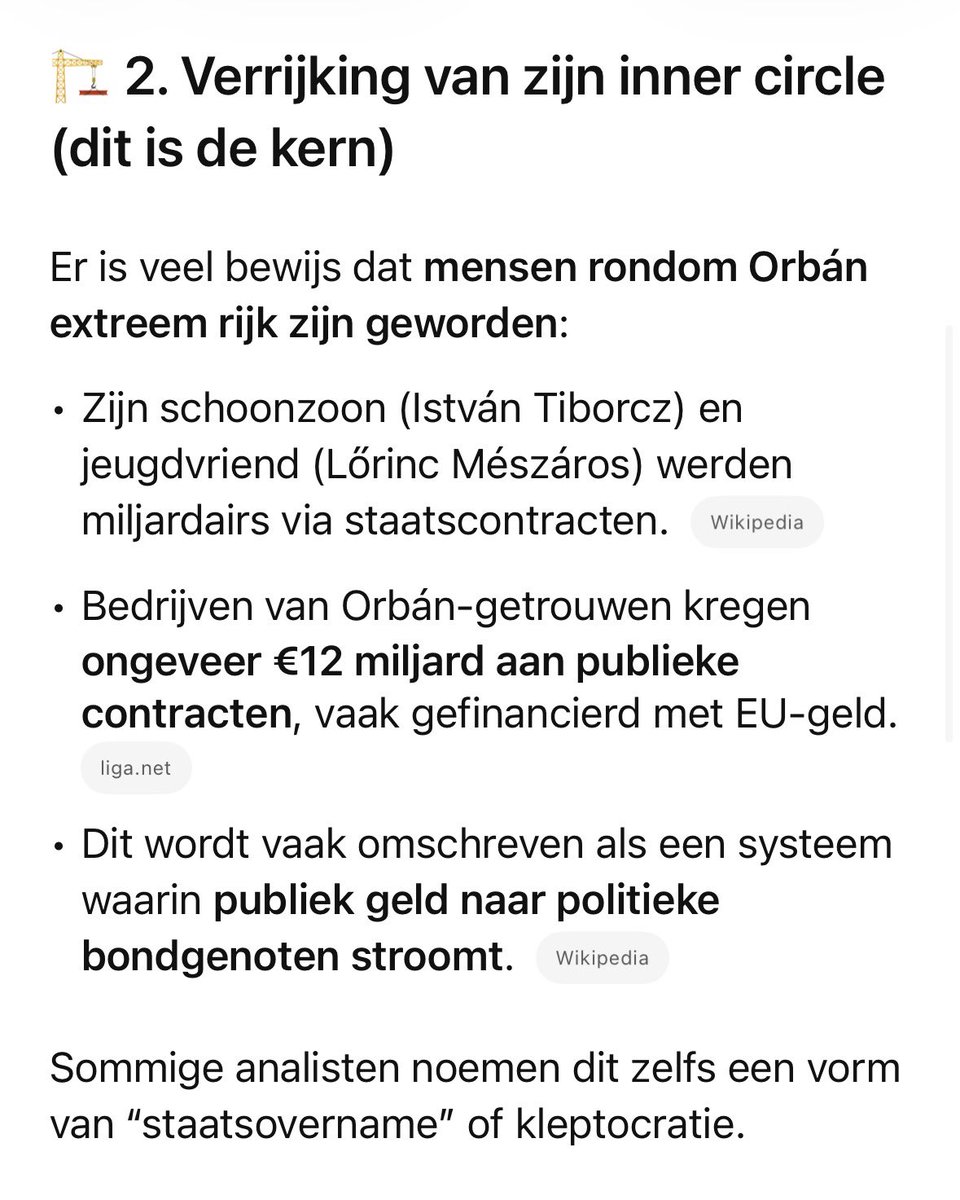
@EvaVlaar@PM_ViktorOrban Orban mainly built his own little condo no other EU PM could dream of, enriching himself and his close family, friends and supporters. African dictator style, bling, bling Trump style, a crocodile we’re all glad to be rid of.
@tomvangrieken Hij heeft altijd Viktor Orban en z’n vriendjes op 1 gezet… daarna Hongarije. Ik ben helemaal voor het verdedigen van eigen belangen.. maar dit is de zoveelste leider die zichzelf slinks verrijkt heeft. Ongelooflijk dat mensen zo’n man enige waardigheid toedichten! #toondoof
@tomvangrieken Dat softe fascistengeleuter: het gaat niet om of je hem mag of niet. Het gaat erom dat hij een racist, antidemocraat, Kremlinpapegaai en door en door corrupte landverrader was zoals heel extreemrechts in Europa. Een vijand van onze rechtsstaat en in eeuwen opgebouwde beschaving.
@tomvangrieken Hoezo onterecht? 3.5 MM kiezers voor Magyar, 2.5 MM voor Orban, ondanks steun van Trump, Putin, Vance, Le Pen, Farage, Wilders etc. Duidelijke overwinning toch? Laat die zichzelf verrijkende kikker maar eens voelen wat samenwerking, democratie en rechtsstaat betekenen.
Sour loser, Steve? List of Orban supporters: Trump, Putin, Vance, Le Pen, Wilders, Van Grieken, Weidel, Farage …says it all, doesn’t it?
Far more relevant are the 3.5 million HU voters that preferred Magyar over Orban.
🇭🇺 Orbán verliest van Péter Magyar, een omstreden mild rechtse politicus, met verslaving- en partnergeweld verleden.
Zijn enorm verheugd met dit nieuws :
Macron
Von der Leyen
Alexander Soros
Zelensky
Merz
Starmer
Nicușor Dan
Barack Obama
Hillary Clinton
Dat zegt genoeg, toch?