O BRICS somará em breve 3,727,938,000 de habitantes.
Isso é 46% da população mundial.
O que é ignorado ou negligenciado pelo G7 -- mas será estudado pelos historiadores?
Aqui está a lista completa de 13 exemplos:🧵
Somani era um cardiologista em 1985 que sabia que, após um infarto, existe uma chance de morrer por arritmias malignas. A sorte é que ele tem um potente remédio chamado Flecainida à sua disposição.
Um dia, um pesquisador perguntou a Somani se poderia pesquisar seus pacientes. 🧵
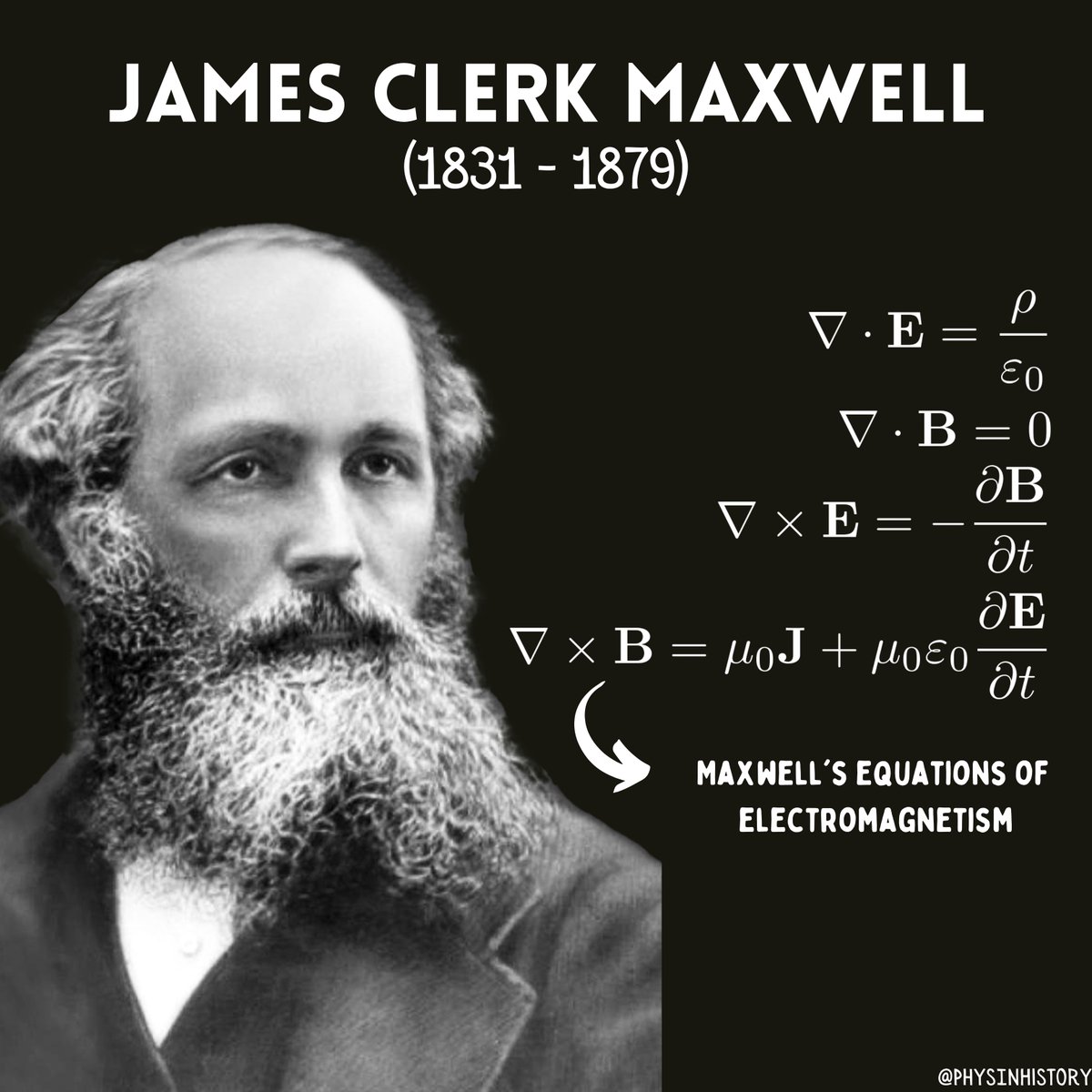
Happy 192nd Birthday to James C. Maxwell, one of the most brilliant minds in the history of science.
James Clerk Maxwell was a Scottish physicist, renowned for his pioneering work in the field of electromagnetism. His most significant contribution was the formulation of the classical theory of electromagnetic radiation, which combined electricity, magnetism, and light into a unified theory.
This was done through the development of Maxwell's equations, a set of partial differential equations that describe how electric and magnetic fields interact. The equations predict the existence of electromagnetic waves, which travel at the speed of light, and were fundamental in confirming that light is a form of electromagnetic radiation.
Beyond electromagnetism, Maxwell made significant contributions to the kinetic theory of gases, with Maxwell-Boltzmann distribution providing insight into the statistical nature of molecular behavior. His work in these areas laid the groundwork for much of modern physics, influencing the development of special relativity and quantum mechanics.
Newton vs Leibniz, the great Calculus Controversy:
The development of calculus is one of the most important advancements in the history of mathematics and has played a critical role in the physical sciences. The dispute over its invention, often referred to as the "calculus priority dispute," was between two of the greatest mathematicians of the 17th century, Sir Isaac Newton and Gottfried Wilhelm Leibniz.
Isaac Newton began developing his methods of "fluxions," (later to become known as calculus) in the mid-1660s. However, he was initially reluctant to publish his work due to his aversion to potential criticism and controversy. The ideas were used in his monumental work, "Philosophiæ Naturalis Principia Mathematica," but the mathematical methods he used in the "Principia" were mostly geometric, following the mathematical style of the time.
Gottfried Wilhelm Leibniz, a German mathematician and philosopher, started working on his version of calculus around 1674, and he first published in 1684, almost 20 years after Newton made his original discoveries. Leibniz developed much of the notation used in calculus today, including the integral sign ∫ and the d used in derivatives and integrals.
The controversy began in the early 1690s when Newton claimed that Leibniz had plagiarized his work. This was after the Royal Society received a letter from Fatio de Duillier, a Swiss mathematician and Newton's friend, claiming that Leibniz had learned of Newton's unpublished work on calculus during his visit to London in 1673.
Leibniz denied the allegations and insisted on his independent discovery. The Royal Society, which Newton presided over, set up an "impartial" committee to decide on the matter, but it was far from unbiased. In 1713, the committee published a report, written by Newton himself, which unsurprisingly concluded that Newton was the true inventor of calculus and that Leibniz was a fraud. The dispute was bitter and divisive, straining relations between English mathematicians and their continental European counterparts. In the years following, the English largely stuck to Newton's notation of fluxions while the Europeans used Leibniz's notation.
Today, historians generally agree that both Newton and Leibniz independently developed the fundamental principles of calculus, albeit with different notations and approaches. Both made substantial contributions, and the notation of calculus used today is primarily that of Leibniz. But the controversy itself is a historical testament to the high stakes and intense rivalries that can exist in the world of science and mathematics.
Para ser professor titular de universidade federal, você primeiro precisa ter doutorado para disputar uma vaga. Depois, passa por oito avaliações, uma a cada dois anos. No fim, ganha menos que a pensão da "viúva" de quem foi expulso do Exército por cometer vários crimes.
Passa o Bizu aí
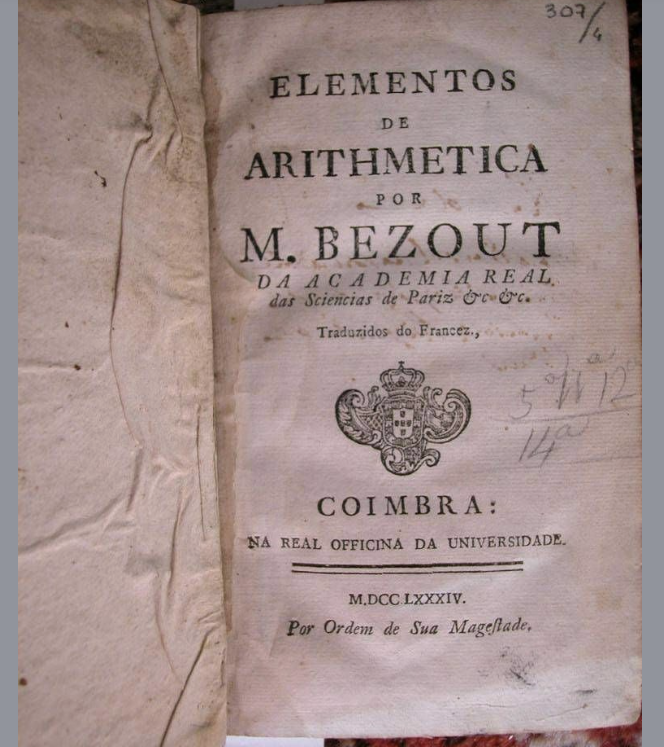
Quando a Família Real veio para o Brasil, trouxe em sua comitiva diversos professores de Coimbra. Esses docentes foram colocados na Real Academia Militar. As aulas de Matemática eram o terror dos alunos. +
It’s been a mystery why Roman concrete often lasted thousands of years, but ours decays in mere decades.
Turns out they incorporated chemicals in a process that induces self-healing; scientists at MIT just figured this all out - in 2022.
Extraordinary.
https://t.co/cOPyln0ifd