.@PershingSquare CEO @BillAckman recently gave @YahooFinance's @BrianSozzi his one rule for sorting the AI trade after the sell-off.
Bill favors business models that don't depend on raising huge amounts of capital. Labs like @AnthropicAI are exposed if markets won't fund them on their terms.
With AI names already cut hard, that splits the sector into cash generators and capital consumers, and makes funding risk the thing to price ahead of hype.
"I like businesses that generate cash as opposed to ones that need massive amounts of it to implement their business plan."
The man who ran America's 2008 bank bailout just warned that markets are underestimating the risk of the AI boom unwinding.
Hank Paulson was Treasury Secretary when Lehman collapsed. Before that he ran Goldman Sachs.
And he just said: "I've never seen so much money chasing one opportunity with not a lot of earnings and ROI backing it up."
He wasn't alone that day.
Baidu CEO Robin Li told the APEC CEO Summit in Shenzhen that AI could turn into a bubble if companies can't turn adoption into real profits. He said the spread of AI applications has fallen short of expectations despite all the infrastructure spending.
So the former head of the US Treasury and the boss of one of China's biggest AI companies said basically the same thing on the same day.
But the thing that worries me most:
The money funding AI is changing shape.
Global AI funding fell from $239.1 billion in the first quarter of 2026 to $153.1 billion in the second quarter, then to $103.3 billion in the third, according to figures cited in a Fortune op-ed.
That's a drop of about 57% in 6 months.
And the gap is being filled with DEBT. Morgan Stanley projects nearly $570 billion of global AI-related debt issuance this year, more than double last year.
Equity funding is shrinking, and lenders are stepping in to fill the hole.
That matters because debt is how losses spread. A missed payment hits banks, insurers and pension funds that never chose to bet on AI.
The cracks are already visible: In October, the yield on CoreWeave's 2031 bonds blew past 16%, a level that usually signals distress.
And the price of borrowing is going UP.
Fed Governor Christopher Waller said this week the Fed may need to shock people with a half-point hike in December. Markets are pricing a 100% chance of a hike next month. The 10-year Treasury yield is still above 5%.
So the AI boom is switching from equity money to borrowed money at the exact moment borrowing gets more expensive.
And this rhymes with 2008. Back then, the problem was loans made against the assumption that house prices would keep rising. In 2026, it's loans made against the assumption that AI demand keeps rising fast enough to pay for the data centers.
And the stock market is starting to feel it.
It's true that the biggest spenders, Microsoft, Alphabet, Amazon and Meta, mostly pay for this out of enormous cash flows. Nvidia just reported $65.3 billion of profit in a single quarter. Most of this debt sits with strong companies, and a correction in AI stocks wouldn't automatically become a banking crisis.
But that's only true for the giants.
CoreWeave's bond yields blowing past 16% tell you the risk sits at the bottom of the chain with the weakest borrowers, and in 2008 that's where the trouble started.
Paulson also said governments need to work much more closely with business to cut the odds of a catastrophe or a financial crisis. When a former Treasury Secretary says that out loud in Silicon Valley, I think people should listen.
STANLEY DRUCKENMILLER: "I SHORTED $200 MILLION OF INTERNET STOCKS IN MARCH 1999. IN THREE WEEKS I COVERED THEM AT A $600 MILLION LOSS."
"I was short 12 stocks. They all went bankrupt. Every one of them."
He was right on every single pick. Still lost $600M.
"If you're dead wrong on a long, you can lose 100%. If you're dead wrong on a short, you can lose 10 times your money."
"Frankly, I'm not sure I've ever made money in shorts. I've never had a down year, but I'm not sure I've made money in shorts. I like it. It's fun. But you can get your head handed to you."
"Don't try that at home."
Since 1950, the s&p500 drops on average every 2 years by 10%.
If you buy the low of this dip, you have about 80% odds of making 10% (or more) the same year.
You have 20% odds that the 10% dip will become a full blown bear market.
There is nothing more pointless than worrying about outcomes.
Your job is to prepare dice that favor you, then keep rolling them.
Even if one result is a loss, nothing is wrong.
Even if losses continue, nothing is wrong.
The problem is when you switch to different dice.
The problem is when you keep tinkering with the dice.
I turned 40 this year. These are the things I wish I had known at 20.
Starting with...
1. Develop the ability to add and delete habits. I’ve observed that recovering addicts can have an edge on normal people--they have come to the stark realization that change is existential. Change is the price of survival for all of us. (For me, deleting is easier than adding. You might be different.)
@Mericamemed Honestly, why make fun of them?? You sounded serious and these days I wouldn’t be surprised if there is a left handed hammer in the market. Shaming them for this is not cool bro
Marc Andreessen about Elon Musk $TSLA
“Elon identifies the biggest problem that the company is having that week, and he fixes it, and then he does that every week for 52 weeks in a row
And then each of his companies has solved the 52 biggest problems that year, and you know, most other large companies are still having the planning meeting for the pre-planning meeting for the board meeting, for the presentation”
35 years ago tonight, a food chemist from Illinois named Clark Wilhelm Griswold put down a $7,500 deposit for installation of an in-ground swimming pool while assuming his upcoming Christmas bonus would cover the rest.
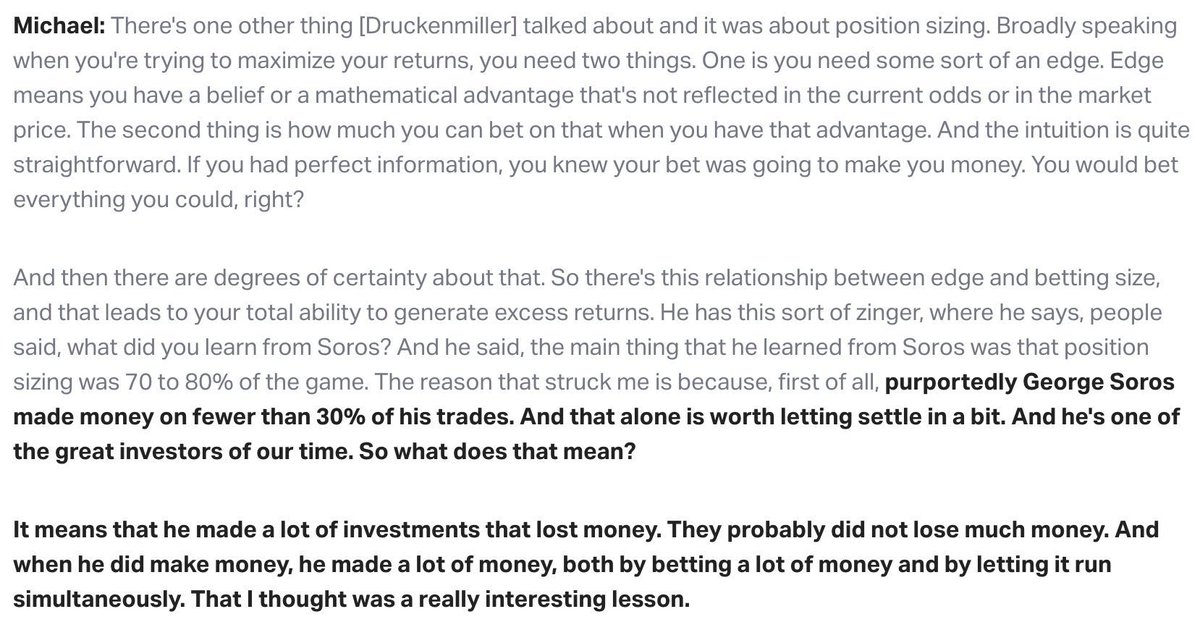
Stanley Druckenmiller obsesses over position sizing.
And it's one of the (many) reasons why he generated 30% CAGRs without a single down year.
"Position sizing is 70 to 80% of the game."