Whoever is responsible needs to be absolutely fined to the max. Giving all farmers a bad name. Prosecution possible after 20,000 fish die in Louth river https://t.co/6nQyBri4bE via @rte
It’s all talk. Just withhold foreign aid to Israel for a month and they’ll stop bombing their neighbors - instant peace, the Strait of Hormuz can be opened, and gas drops $2 a gallon. Israel has been, and continues to be, the biggest welfare recipient from American tax payers.
@maryodonnell03@PaulGoldsmith73 He’s a former Professional footballer who was given his opinion. The vast majority of us are sickened by what has happened in Gaza just as we were by what happened on October 7. Israel should be banned just like Russia were banned for invading Ukraine
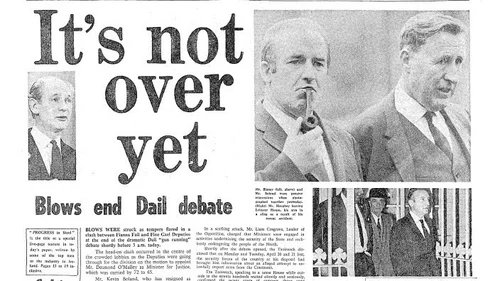
Today in 1970, two Fianna Fáil TDs, Charles Haughey and Neil Blaney, were arrested and charged with conspiring to import weapons and ammunition in what became known as the Arms Crisis. Both had held senior positions in government until a few weeks earlier. Haughey was Minister for Finance. Blaney was Minister for Agriculture and Fisheries.
Taoiseach Jack Lynch had dismissed them both, saying he was "satisfied that they do not subscribe fully to Government policy in relation to the present situation in the Six Counties."
That situation had been building for some time. In August 1969, the sectarian violence in Derry and Belfast had sent thousands of nationalist families fleeing south. Lynch had publicly ruled out sending the Irish Army across the border.
But privately a four-man cabinet subcommittee had been established to deal with "certain aspects" of Northern Ireland affairs. Haughey and Blaney were both on it. So was a £100,000 relief fund, which Haughey oversaw, ostensibly to help displaced northern Catholics.
The allegation was that the two ministers had used the apparatus of the state to facilitate an attempt to smuggle arms to nationalists in the North. Arms dealer Otto Schleuter in Hamburg was contacted. Captain James Kelly of Irish Army intelligence was the go-between. Albert Luykx, a Belgian-born businessman who ran a restaurant in Sutton, was the fixer with continental connections. John Kelly, a Belfast republican, was the man on the northern end. No weapons ever actually made it across the border.
Haughey flatly denied everything. "I now categorically state that at no time have I taken part in any illegal importation or attempted importation of arms into this country." Blaney was far more scathing. "Ireland has always had its British lackeys; you can pick them out in every generation, those hypocrites, those who for their own ends are always ready to play Britain's game in this country." A third minister, Kevin Boland, resigned in protest, accusing Lynch of "the greatest treachery of which an Irishman could be guilty."
The charges against Blaney were dropped in July. But Haughey, Captain Kelly, John Kelly, and Albert Luykx went forward to trial on 22 September. The first trial collapsed when the presiding judge, Aindrias Ó Caoimh, withdrew after allegations of bias. A second trial opened in October, and it was there that the real confrontation happened. Haughey denied any knowledge of what the cargo contained. Minister for Defence Jim Gibbons contradicted him directly. As Justice Séamus Henchy observed from the bench, one of the two men was lying under oath.
The jury decided it didn't matter. On 23 October 1970, all four defendants were acquitted in under two hours. Their finding, that the accused had "operated under properly delegated authority," was a pointed verdict. Haughey immediately called on "those responsible for the debacle" to consider their positions. He clearly meant Lynch, though his career survived.
The state papers, released decades later, showed that Colonel Michael Hefferon had given statements substantially altered before they went into the book of evidence, bolstering the case that the cabinet knew far more than it let on.
Bertie Ahern would eventually issue a statement saying Captain Kelly had done nothing wrong and had been acting under orders. Haughey never spoke publicly about the Arms Trial again and in 1979, he became Taoiseach.
Buy the Dublin Time Machine a pint and support the DTM Book
https://t.co/U7jtCrOTtb